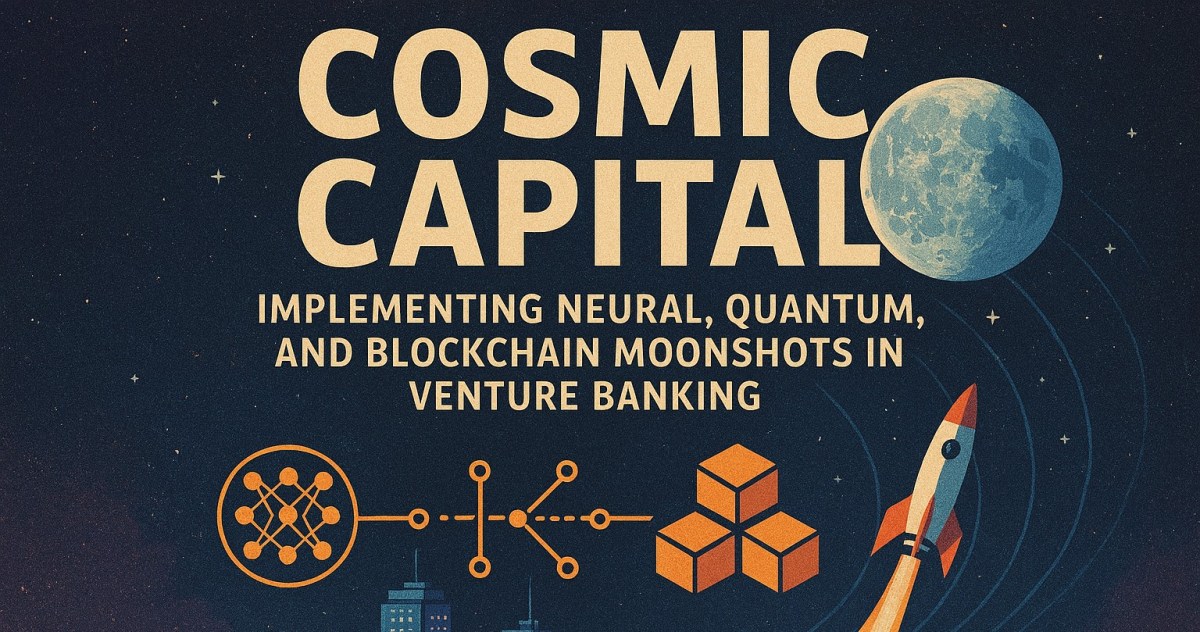
Executive Summary
The transition of the human economy from an Earth-centric, scarcity-based model to an expansive, multi-planetary model fundamentally necessitates an exponential leap in financial technology. Traditional venture capital processes, constrained by human cognitive bias and limited computational capacity, are insufficient for the high-stakes, high-dimensionality environment of interstellar resource markets and colony investments. This report proposes the “Cosmic Capital” platform, a synergistic framework built upon three foundational moonshot technologies: Neural-Linked Interfaces (for cognitive augmentation), Quantum Allocation Engines (QAE) (for superior predictive optimization), and a Blockchain-Based Interstellar Syndicate (BIS) (for resilient, trustless governance). The core premise is that the synthesis of these technologies creates a system that is not merely faster, but fundamentally smarter (Neural), more optimal (Quantum), and more resilient (Blockchain) than any existing financial platform. The implementation framework outlines a phased, eight-plus-year roadmap covering exploration, prototyping, and eventual large-scale interstellar operation, complete with rigorous risk and ethical mitigation strategies.
I. Introduction: The Tripartite Future of Venture Finance
A. Context: The Need for Exponential Capital (From Earth-Centric to Interstellar Markets)
Current venture capital allocation relies heavily on linear scaling methods and human intuition. While effective within Earth’s established legal and economic frameworks, this model is severely constrained by cognitive limitations, resulting in decisions often hampered by inherent biases and restricted information flows. Scaling capital allocation to support ambitious off-world endeavors—such as supporting Mars colonization, orbital manufacturing, or galactic resource extraction markets—requires a shift from linear to exponential capability.
The challenge of futuristic venture banking is multifaceted: it requires maintaining extremely high decision velocity and optimal resource allocation across systems subject to high dimensionality (incorporating complex, interconnected factors like traditional Earth economics, Martian resource extraction rates, and orbital mechanics) and extreme temporal latency inherent in vast astronomical distances. Traditional finance is not equipped to efficiently model, fund, or govern investments separated by astronomical distances and multi-minute communication delays. The deployment of advanced technologies is therefore not merely an enhancement but an operational necessity for survival in the multi-planetary economy.
B. Thesis Statement: Unifying Neural, Quantum, and Distributed Ledger Technologies
The Cosmic Capital thesis posits that superior financial outcomes in the emergent multi-planetary economy are achievable only through the synergistic deployment of a Neural-Linked interface for high-resolution human/machine interaction, a Quantum Allocation Engine (QAE) for hyper-complex optimization, and a Blockchain-Based Interstellar Syndicate (BIS) for guaranteed, auditable governance and settlement. This tripartite framework addresses the limitations of human perception, classical computation, and terrestrial governance simultaneously, creating a robust financial backbone for interstellar expansion.
C. Structure and Scope of the Paper
This comprehensive analysis commits equal depth to the scientific foundations, integration pathways, technical roadmaps, risks, and ethical considerations pertaining to each of the three foundational pillars. The subsequent sections detail the actionable, three-stage technical roadmaps required for a fictitious venture banking firm to explore, prototype, and scale these innovations into a unified cosmic venture finance ecosystem, concluding with a synthesis of their interconnected function.
II. Neural-Linked Fund Management: The Cognitive Interface
A. Scientific Foundation: From Medical Implants to Financial Augmentation
The application of Brain-Computer Interface (BCI) technology is undergoing a rapid transition from primary medical and military applications toward commercial, high-stakes environments. Companies like Neuralink have demonstrated significant maturation in developing implantable BCIs, utilizing very thin (4 to 6 m in width) threads capable of high data throughput.1 This maturity, evidenced by substantial funding ($158 million by 2019, with $100 million from the founder) and a large workforce (c. 300 employees), signals that the technology is approaching readiness for deployment in high-stakes non-critical commercial fields like advanced financial decision-making.1
The core value proposition of BCI in finance lies in enhancing decision velocity and accuracy through the integration of real-time neural and behavioral data. Research confirms that combining traditional behavioral responses (such as execution confirmation) with instantaneous neural features (such as Event-Related Potentials, which are correlated with decision uncertainty) can significantly improve accuracy in complex, rapid decision tasks.2 This neuro-behavioral feature acts as an objective, implicit measure of the decision-maker’s confidence or cognitive load, proving especially valuable when dealing with complex scenes or high perceptual loads.2
The primary financial value of BCI resides in its function as a cognitive safety brake, rather than merely an input mechanism for thought-based execution. Since established research demonstrates that neural features can reliably predict when a decision is likely to be incorrect 2, the BCI system provides fund managers with an objective, real-time measure of their own subjective state—fatigue, stress, or cognitive overload—that they may not consciously perceive. This capability transforms the BCI from a simple input device into an essential cognitive risk mitigation tool, critically important in the high-volume, high-value decision environments characteristic of sophisticated venture banking.
A staged approach to implementation is essential to manage ethical and regulatory hurdles. While high-fidelity, invasive methods (such as those pioneered by Neuralink) offer the greatest long-term precision 1, initial BCI pilots must leverage non-invasive techniques (e.g., EEG/fNIRS) to establish baseline cognitive risk models, monitoring simple metrics like focus and fatigue. The eventual transition to invasive, high-resolution BCIs (in later phases) must be rigorously justified by the demonstrable exponential accuracy gains achieved by integrated neuro-behavioral feature scoring.2 This methodology allows the system to transition smoothly from simple cognitive monitoring to integrated decision augmentation, mitigating immediate regulatory scrutiny while retaining the ultimate goal of exponential cognitive enhancement.
B. The 3D Mental Holographic Dashboard (MH-D): Concept and Design
The Neural-Linked interface necessitates the development of a 3D Mental Holographic Dashboard (MH-D). This interface is designed to move beyond traditional two-dimensional displays, providing an immersive, intuitive environment where fund managers can interact with the hyper-complex, multidimensional output of the Quantum Allocation Engine (QAE).
The MH-D must satisfy several key functional requirements. It must display core decision metrics, portfolio risk exposures, and—most critically—the fund manager’s real-time cognitive confidence score, derived directly from the integrated BCI data. To prevent potentially catastrophic cognitive dissonance or delayed feedback loops, the entire system must operate under near-zero latency, ensuring that the neural feedback loop is synchronized precisely with the investment data presentation. A latency mismatch between decision intent and data state could lead to erroneous, high-stakes execution.
C. Integration Pathway: Merging BCI with Traditional Investment Platforms
The integration of BCI technology into a venture banking platform requires a staged, cautious approach to manage risk and demonstrate incremental value.
| Metric | Phase 1: Exploration (0–3 Yrs) | Phase 3: Scaling (8+ Yrs) | Primary Risk | Mitigation Strategy |
| Technology | Non-invasive EEG/fNIRS | Implantable BCI (Neuralink-class) 1 | Neural Hacking/Data Breach | Biometric neural authentication and PQC-secured data links. |
| Function | Fatigue/Focus Monitoring | Real-time Confidence Scoring 2 | Cognitive Overload | Mandatory Rest Cycles based on high neural-risk scores. |
| Interface | 2D Screen Overlay | 3D Mental Holographic Dashboard | Erosion of Autonomy | Neural Autonomy Councils and clear use-consent revocation procedures. |
Table 1: BCI Implementation and Risk Matrix
Phase 1 (Explore): The initial focus centers on pilot testing non-invasive BCI technology within a controlled environment, monitoring metrics like analyst fatigue levels during high-intensity due diligence cycles. The primary objective is to develop and refine baseline cognitive risk models based on validated neural research.2
Phase 2 (Prototype): This stage involves the development of high-resolution BCI prototypes, initially restricted to senior management operating under strict informed consent. The central technological task is the integration of the neuro-behavioral feature scoring system 2 into a simulated investment dashboard, validating the system’s ability to flag projected errors.
Phase 3 (Scale): Upon successful validation, the system achieves full deployment. This involves securing the scalable Neural-Linked interface with robust biometric neural authentication protocols, providing real-time cognitive optimization signals that integrate directly into the QAE’s risk weighting parameters for large-scale fund management.
D. Risk and Ethics Framework: The Threat of Cognitive Manipulation
The introduction of BCI into finance carries unique ethical and security challenges, primarily relating to the prevention of cognitive overload and external neural hacking. Hardware and software safeguards are paramount, including multi-factor, biometric neural authentication protocols and easily accessible hardware/software kill-switches (accessible both mentally and physically). Furthermore, the system must enforce ‘Cognitive Rest Cycles’ automatically, based on BCI detection of high fatigue or low objective confidence scores, thereby preventing erroneous decisions caused by burnout.
The erosion of human autonomy is the central ethical challenge. Deployment requires clear legal frameworks that delineate the boundary between BCI-augmented decision support (suggesting optimization paths) and human autonomy (finalizing execution). The establishment of ‘Neural Autonomy Councils’ will be necessary to audit the deployment and usage of BCI technology, specifically monitoring the use of neural features that predict error 2, ensuring informed consent is maintained, and guaranteeing that fund managers retain the right to override algorithmic suggestions regardless of cognitive scoring.

III. Quantum-Powered Predictive Capital Allocation: The Optimization Engine
A. Theoretical Foundation: Quantum Advantage in Multidimensional Optimization
The challenges facing interstellar venture finance—specifically the vast computational complexity required to model multidimensional success factors—mandate the use of computational systems beyond the capacity of classical computers. Quantum Computing (QC) is highly complementary to classical Artificial Intelligence (AI).3 While classical AI excels at pattern recognition (e.g., predicting startup success based on features like funding, location, and team size 4), QC harnesses the principles of quantum mechanics to process and analyze massive, complex datasets exponentially faster.3 This ability addresses the current limitations of classical computers in scaling large language and machine learning models, offering a vital advantage for venture finance where sparse success data must be modeled against numerous, highly correlated factors.3
Venture capital allocation is intrinsically a combinatorial optimization problem: selecting the mathematically optimal set of investments from a vast possibility space to maximize potential return while minimizing multidimensional risk. QC is perfectly suited for such complex optimization problems. The Quantum Allocation Engine (QAE) is designed to incorporate far higher dimensionality than classical systems, modeling factors such as planetary environmental dynamics and long-term galactic resource valuations alongside traditional economic and psychometric data.
B. Designing the Quantum Allocation Engine (QAE)
The QAE requires leveraging Variational Quantum Algorithms (VQAs) that are effective on current Noisy Intermediate-Scale Quantum (NISQ) devices. Specifically, the Variational Quantum Eigensolver (VQE) and the Quantum Approximate Optimization Algorithm (QAOA) have already demonstrated applicability to portfolio optimization and complex combinatorial problems in financial research.5
A systematic analysis comparing these two algorithms reveals a critical preference for stability in a high-risk environment. The QAOA frequently outperforms VQE by utilizing less complex quantum circuit architectures, demonstrating greater stability and less variation across experiments, even when high-risk tolerances are modeled.7 Given the extremely high inherent risk of early-stage venture finance and interstellar investments, QAOA is positioned as the preferred primary optimization engine due to its robustness and consistent performance.7
The QAE must ingest a sophisticated, multidimensional data input schema far exceeding classical limitations. This schema encompasses three major vector sets: (1) Macroeconomics (Earth/Interplanetary): Traditional market indicators and evolving regulatory risks; (2) Startup Psychometrics: Behavioral data derived from BCI-validated interviews and analysis of team dynamics, representing a critical causal link from the Neural interface (Section II); and (3) Galactic Resource Markets: Detailed modeling of the fluctuating supply, demand, and extraction rates of off-world commodities (e.g., lunar helium-3, Martian water ice). The inclusion of these highly complex, non-linear resource vectors provides the requisite high-dimensionality input that demands quantum acceleration.
Quantum models, particularly those derived from deep QML architectures, pose a profound challenge to interpretability, often referred to as the “explainability crisis.” Allowing institutional overreliance on the QAE as an opaque black box inherently creates systemic risk, particularly the danger of amplifying hidden biases introduced during training.3 To mitigate this risk, the framework mandates the implementation of “Hybrid Classical Verification Layers” (HCVS). The HCVS must independently audit the QAE’s input weights and outputs using verified classical methods. The output of the QAE must be verified not only for computational accuracy but also for logical consistency, ensuring the results are coherent and justifiable to a human fund manager. This verified result is then presented via the BCI interface for cognitive verification, linking the computational layer back to the cognitive layer.
The QAE’s ability to rapidly model the intersection of disparate, high-dimensional markets—such as correlating Earth-based Intellectual Property (IP) valuation with volatile Martian industrial capacity and off-world energy prices—allows the engine to identify investment inefficiencies that are computationally invisible to classical systems. This capability—finding optimal capital allocation paths between non-linear, geographically separated economies—is the source of “Cosmic Capital’s” ultimate competitive advantage and its ability to engage in interstellar market arbitrage.
C. Implementation Roadmap: From Simulation to Specialized QAE Deployment
The QAE deployment strategy requires a pragmatic, three-stage phase-in, validating performance before transitioning to costly quantum hardware.
Phase 1 (Explore): Development and thorough validation of a QML simulator are required. This phase focuses on benchmarking the performance of QAOA and VQE algorithms against large, existing historical Earth-based venture datasets. The goal is to conclusively demonstrate quantum advantage over high-performance classical machine learning models before requiring dedicated quantum resources.7
Phase 2 (Prototype): This stage involves securing necessary access to a Noisy Intermediate-Scale Quantum (NISQ) device, typically through cloud services or strategic partnerships. Limited QAE pilots are launched, focusing specifically on specialized, high-dimensionality sectors (e.g., advanced fusion energy startups, complex logistics optimization) as initial test cases, prior to expanding to fully integrated multi-market models.
Phase 3 (Scale): Full integration of the QAE into the decision stack is achieved. The engine becomes capable of synthesizing real-time galactic resource market data, psychometric vectors, and traditional financial metrics, providing optimized capital allocation strategies across Earth and nascent colony economies with high speed and verifiable consistency.
D. Risk and Mitigation: Bias Amplification and Systemic QAE Reliance
The potential for algorithmic bias amplification is significant. Since classical AI models already risk propagating and amplifying bias 3, QML, with its exponentially increased complexity, presents a magnified risk. Mitigation strategies involve implementing rigorous pre- and post-processing bias testing frameworks. The Hybrid Classical Verification Layer (HCVS) must be specifically tasked with checking for geographical, demographic, or sectoral bias introduced through the high-dimensional training data vectors.4
To maintain operational resilience, robust failover protocols are required. Given the current inherent limitations and potential unavailability of NISQ devices, the QAE system must operate within a Hybrid Classical/Quantum framework. If the quantum hardware is unavailable or returns an inexplicable result, the system must immediately revert to a verified, high-performance classical optimization algorithm without interrupting the decision velocity of the fund manager.
IV. Blockchain-Based Interstellar Venture Syndicate: The Trust Layer
A. Foundational Architecture: Extending DeFi Principles to Interplanetary Scale
The establishment of a Blockchain-Based Interstellar Venture Syndicate (BIS) is necessary to provide the requisite trust, transparency, and efficiency for financial interactions across planetary jurisdictions. The principles of Decentralized Finance (DeFi)—disintermediation, transparency, high efficiency, and increased inclusion—provide the essential blueprint for trustless, high-value financial interactions when traditional centralized intermediaries (like banks or brokerages) are rendered impractical by latency and legal separation.9
For the BIS to possess long-term viability and security, especially considering the rapid advances in QC, the immediate integration of Post-Quantum Cryptography (PQC) standards is essential. Future quantum computers pose a critical threat to existing cryptographic signatures, such as the Elliptic Curve Digital Signature Algorithm (ECDSA) commonly used in Bitcoin and other major blockchain ecosystems. Therefore, the implementation must immediately incorporate NIST-recommended PQC standards to ensure the dependability of the ledger for centuries of multi-planetary operation.10
Direct consensus synchronization across astronomical distances (e.g., Earth-Mars latency varies from 3 to 22 minutes) is computationally infeasible for real-time financial settlement. The necessary architectural solution lies in adopting hierarchical scaling frameworks, specifically the Interplanetary Consensus (IPC) architecture. IPC leverages the concept of Parent Chains and Child Subnets to balance global security with high local performance.11
A core advantage of the IPC framework is its utilization of InterPlanetary Linked Data (IPLD) resolved via the InterPlanetary File System (IPFS).11 When settling transactions, the IPC system does not transmit the actual, large data payload across the vast, high-latency space link; instead, it transmits only the small cryptographic link (IPLD) referencing where the data is stored. This dramatically minimizes the size of consensus messages, allowing the confirmation of state change (settlement confirmation) to happen as fast as the speed of light allows, while the underlying data retrieval is managed asynchronously. This distinction makes “real-time settlement” effectively possible for the venture syndicate, circumventing the primary barrier of interstellar latency.
B. Interplanetary Consensus (IPC) and Latency Management
The BIS infrastructure requires a dedicated network of satellite-based relays (spanning Earth, Lunar orbits, and Mars) to establish minimum-latency communication paths. The IPC framework is critical, utilizing permission-less spawning of new, EVM-compatible sub-systems composed of subnets to achieve scalable performance.11
The IPC architecture, with a single Parent Chain running core smart contracts (called “actors”) and managing an infinite number of Child Subnets 11, naturally mirrors the necessary legal and logistical structure for an Earth-Mars syndicate. The Earth Parent Chain establishes global PQC standards and governance, managing the overall validator and staking mechanisms. A Martian colony, meanwhile, operates a localized, high-speed Child Subnet (potentially using CometBFT consensus for local speed) for local execution of deals and resource management.11 This Child Subnet communicates periodic, verified checkpoints back to the Parent Chain via minimal IPLD messages. This hierarchy effectively balances the conflicting goals of achieving high local performance and maintaining global security/decentralization across planets.11
Smart contracts governing Earth-Mars syndicate deals must be designed specifically to account for variable, multi-minute latency. This requires sophisticated time-lock mechanisms and contingency protocols. For time-sensitive transactions, protocols must be established (e.g., pre-signed or conditionally executable transactions) that can execute independently on a local subnet if the Parent Chain confirmation cannot be reached within a set threshold due to maximal planetary distance separation.
C. The Universal Digital Asset (UDA): Concept for an Interplanetary Reserve Currency
A standardized medium of exchange is required for seamless settlement across disparate, non-sovereign jurisdictions. The Universal Digital Asset (UDA) is proposed to function as this standardized, non-sovereign reserve currency for all syndicate capital deployment and settlement. Its value stability would not be tied to a single fiat currency but rather pegged to a basket of key interstellar commodities (e.g., standardized metrics of energy output, calculated mass-per-delivery metrics, or Earth/Mars resource indices).
The UDA ledger must be protected by PQC from its inception.10 It is centrally managed by the main Parent Chain, allowing for seamless, auditable cross-chain transfers between the syndicate’s operational Earth and Martian subnets, ensuring capital liquidity is always guaranteed against an immutable standard.
D. Regulatory and Governance Frameworks: Establishing Interstellar Securities Law
The deployment of an interstellar financial platform presents a formidable non-technical challenge: defining legal and jurisdictional boundaries for Earth-Mars syndicate deals. The blockchain itself, through the codification of smart contracts, must act as the primary legal layer. This necessitates the development of a new field of Interstellar Securities Law that preemptively defines rules for asset ownership, collateralization, and transfer based on the physical location of the asset and the executing subnet (Parent or Child).
Dispute resolution protocols must be established to handle transactions that are confirmed on a fast, local subnet but subsequently contested on the global Parent Chain. This complex governance requires the implementation of a Decentralized Autonomous Organization (DAO) model for the syndicate. This DAO would feature voting mechanisms that are resilient to the long latency periods, potentially using long consensus windows or delegation pools weighted by validated capital commitment.
V. Architecting Cosmic Capital: Integration and Roadmapping
A. The Unified Cosmic Capital Platform Architecture
The Cosmic Capital platform functions as a seamless three-layer stack, ensuring optimal decision-making, hyper-efficient computation, and resilient execution.
- Cognitive Layer (BCI): This layer provides real-time, high-fidelity human insight (Cognitive Confidence Scores, Intent, and high-level Approval) directly to the computational layer. It filters out human error before it can influence the optimization process.2
- Modeling Layer (QAE): This layer processes hyper-dimensional data vectors (including the psychometrics validated by the BCI and galactic resource market data) to calculate the globally optimal capital allocation strategy, leveraging the speed and complexity of quantum algorithms.3
- Execution Layer (BIS): This layer receives the finalized, BCI-approved allocation instruction from the QAE and executes atomic settlement via PQC-secured smart contracts deployed on the Interplanetary Consensus (IPC) infrastructure, utilizing the UDA as the settlement currency.10
The end-to-end venture cycle involves the BCI generating neural input, which feeds into the QAE alongside market data. The QAE then outputs optimized portfolio weights, which automatically trigger the creation of smart contracts on the IPC Parent Chain. The Parent Chain relays these atomic transactions to the appropriate Earth and Mars Subnets for final, low-latency settlement using the UDA.
B. The Fictitious Company Roadmap: Stages of Exploration, Prototype, and Scaling
The roadmap details the step-by-step commitment required for Cosmic Capital to secure a first-mover advantage, strategically balancing highly speculative moonshots with near-term feasibility requirements.
Table 2: Phased Implementation Roadmap for Cosmic Capital
| Phase | Timeframe | BCI Focus (Neural) | Quantum Focus (QAE) | Blockchain Focus (Interstellar) |
| Phase 1: Exploration & Earth Proof | 0–3 Years | Non-invasive BCI pilot for focus/fatigue monitoring in fund managers. Develop cognitive risk metrics using existing neural research.2 | Develop QML simulator; test VQE/QAOA algorithms against historical Earth venture data sets.7 Prove quantum advantage on classical hardware. | Implement mandatory Post-Quantum Cryptography (PQC) standards organization-wide.10 Develop Earth-only DeFi syndicate models using EVM compatibility.9 |
| Phase 2: Prototype & Infrastructure Build | 4–7 Years | Invasive/high-resolution BCI prototype trials with informed senior management.1 Develop 3D mental dashboard (MH-D) MVP linked to cognitive risk scores. | Build partnership for NISQ device access. Launch limited QAE pilots for specialized, high-dimensionality sector modeling (e.g., nuclear fusion, deep-sea mining). | Deploy core IPC Parent Chain architecture. Establish initial Earth-Moon subnet communication and settlement protocols.11 Create first UDA reserve mechanism. |
| Phase 3: Scaling & Interstellar Operation | 8+ Years | Deploy scalable, secure Neural-Linked interface for active, mass-market fund management. Integrate neural feedback loops directly into QAE parameters. | Full integration of QAE for multi-market allocation; scale modeling to include complex galactic resource factors and psychometric data vectors. | Launch Interplanetary Venture Syndicate (Earth-Mars) via IPC subnets. Establish UDA as the primary cross-planet settlement layer. Codify Interstellar Securities Law via DAO governance. |
C. Systemic Risk Aggregation and Mitigation Strategy
A comprehensive assessment requires recognizing that the failure of any single component introduces systemic risk to the entire platform. Integrated mitigation strategies must address these layered vulnerabilities.
Table 3: Systemic Risk Aggregation and Mitigation Strategy
| Component | Primary Risk | Second-Order Systemic Risk | Mitigation Strategy |
| Neural Interface (BCI) | Neural Hacking & Cognitive Overload | Malicious manipulation of investment decisions, leading to systemic market instability. | Biometric neural authentication; Hardware kill-switches; Mandatory cognitive rest cycles enforced by the platform. |
| Quantum Engine (QAE) | Algorithmic Bias & Explainability Crisis | Institutional overreliance on opaque models, leading to biased capital flow and systemic failure in un-modeled markets. | Hybrid Classical Verification Layers (HCVS); Quantum-aware regulatory audits; Bias testing frameworks that validate results across varied input vectors.3 |
| Interstellar Blockchain | Cross-Planet Latency & Consensus Failure | Inability to finalize high-stakes, time-sensitive deals between jurisdictions; asset forfeiture disputes. | IPC Subnet hierarchy for local consensus 11; Guaranteed, PQC-secured message relays; Latency-aware smart contract time-locks. |
VI. Conclusion: Seizing the Cosmic Capital Advantage
A. Summary of Findings
The integration of the cognitive, computational, and trust layers outlined in the Cosmic Capital framework provides a platform capable of exponentially scaling venture capital beyond current physical and cognitive limitations. The Neural-Linked Interface delivers a competitive edge by minimizing inherent human error and cognitive risk.2 The Quantum Allocation Engine provides the necessary mathematical capability to solve the unique, high-dimensionality optimization problems of the multi-planetary economy, leveraging the synergy between AI and QC.3 Finally, the Interstellar Blockchain (BIS), utilizing PQC and the IPC framework, provides the secure, resilient, and low-latency execution framework necessary for governance and settlement across vast astronomical distances.10
B. Strategic Outlook and Recommendations
The transition to a Cosmic Capital model must be meticulously phased. The most immediate strategic recommendation is the prerequisite investment in Post-Quantum Cryptography standards 10 and classical QML simulation (Phase 1). Establishing PQC now ensures the long-term defensibility of the ledger, while QML simulation establishes the required quantum advantage before committing to expensive hardware.
For Phase 2, critical resource acquisition must focus on securing access to NISQ device infrastructure, either through purchase or strategic partnership, and dedicating R&D resources to developing BCI protocols specifically tailored for financial risk flagging. These early infrastructure commitments are critical for ensuring operational readiness as the Earth-Moon-Mars network expands (Phase 3).
C. Call to Action: Securing First-Mover Advantage in the Post-Earth Economy
The firm must immediately allocate dedicated R&D capital to establish a “Cosmic Capital Lab,” focusing specifically on the fusion of these three disciplines—BCI, QAE, and IPC. Failure to pursue this unified strategy will inevitably lead to technological and systemic obsolescence as the financial gravity well of Earth’s localized economy begins to weaken. The economic opportunity presented by interstellar expansion is unprecedented, but it requires a financial platform capable of non-linear optimization and autonomous, resilient governance. The time for technological exploration is now; the strategic market advantage is interplanetary.
Works cited
- Neuralink – Wikipedia, accessed October 12, 2025, https://en.wikipedia.org/wiki/Neuralink
- Collaborative Brain-Computer Interface for Aiding Decision-Making …, accessed October 12, 2025, https://pmc.ncbi.nlm.nih.gov/articles/PMC4114490/
- Harnessing the complementary power of AI and Quantum Computing | Inside Global Tech, accessed October 12, 2025, https://www.insideglobaltech.com/2025/10/10/harnessing-the-complementary-power-of-ai-and-quantum-computing/
- sumitjhaleriya/Startup-Success-Prediction-using-Machine-Learning – GitHub, accessed October 12, 2025, https://github.com/sumitjhaleriya/Startup-Success-Prediction-using-Machine-Learning
- Challenges of variational quantum optimization with measurement shot noise | Phys. Rev. A, accessed October 12, 2025, https://link.aps.org/doi/10.1103/PhysRevA.109.032408
- Evolving objective function for improved variational quantum optimization | Phys. Rev. Research – Physical Review Link Manager, accessed October 12, 2025, https://link.aps.org/doi/10.1103/PhysRevResearch.4.023225
- PO-QA: A Framework for Portfolio Optimization using Quantum Algorithms – arXiv, accessed October 12, 2025, https://arxiv.org/html/2407.19857v1
- Challenges of variational quantum optimization with measurement shot noise – arXiv, accessed October 12, 2025, https://arxiv.org/html/2308.00044v2
- Decentralized Finance (DeFi): The Future of Finance Specialization – Coursera, accessed October 12, 2025, https://www.coursera.org/specializations/decentralized-finance-duke
- (PDF) A Quantum-Resistant Blockchain System: A Comparative Analysis – ResearchGate, accessed October 12, 2025, https://www.researchgate.net/publication/391327097_A_Quantum-Resistant_Blockchain_System_A_Comparative_Analysis
- Interplanetary Consensus: Introduction, accessed October 12, 2025, https://docs.ipc.space/
 Jarad Ponce