🎄
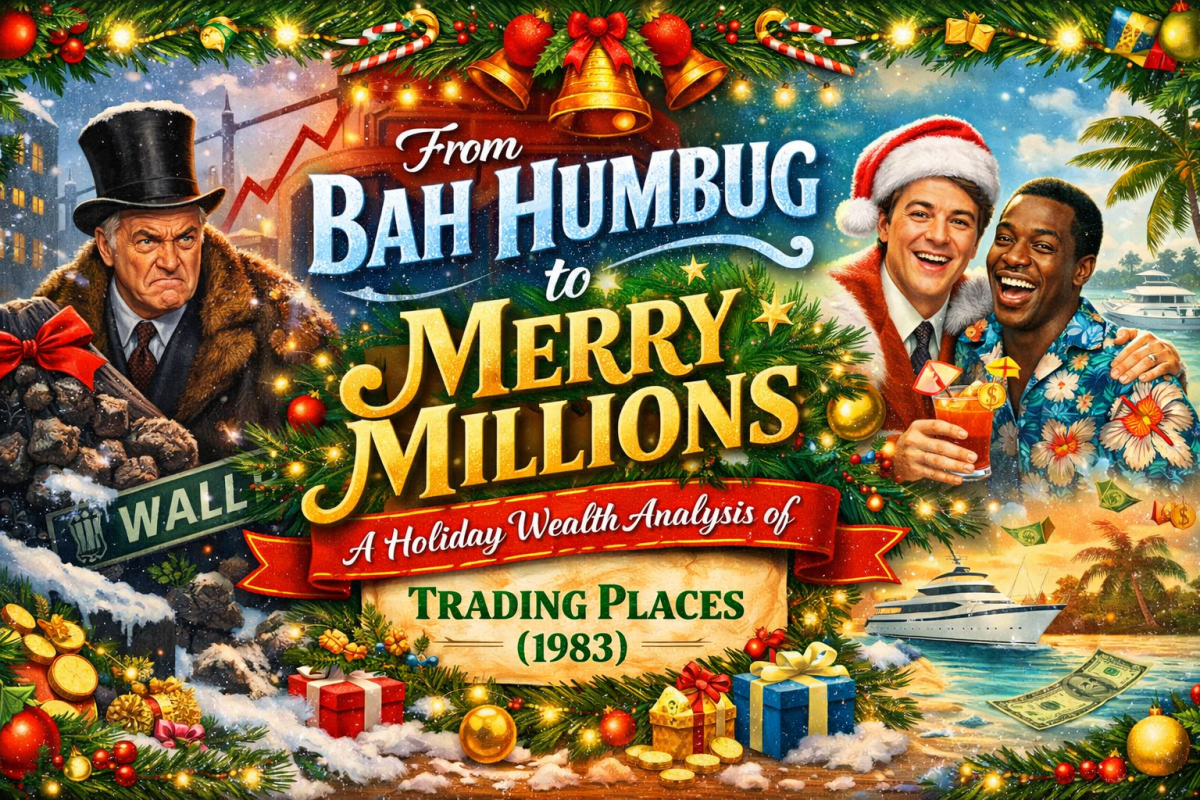
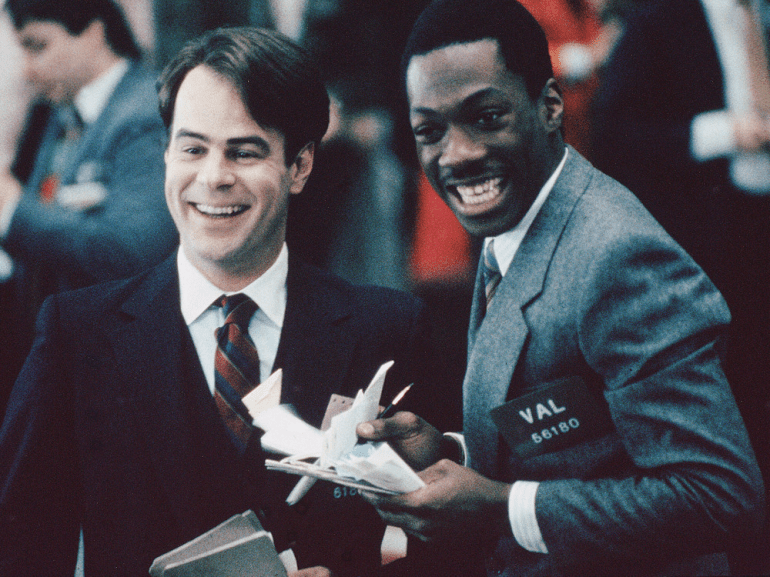
When the holiday season rolls around, Trading Places (1983) often reappears as an unconventional Christmas classic en.wikipedia.org. This comedy—set against a backdrop of Christmas and New Year’s festivities—tells the story of a snobbish investor and a street hustler who swap lives as part of a twisted nature vs. nurture wager orchestrated by two rich, scheming brothers en.wikipedia.org. In true holiday fable fashion, the “naughty” characters get their comeuppance (and a big lump of coal in their metaphorical stocking), while the “nice” underdogs receive the ultimate gift of fortune.
But just how fortunate (or unfortunate) do these characters become? Let’s unwrap the finances of the main characters in Trading Places, looking at their starting wealth versus their ending wealth after the film’s events. We’ll use clues from the film’s plot to estimate net worths – keeping it analytical but with a dash of Christmas cheer. (Since 1983 was a long time ago, all dollar figures are given in 1983 terms with 2025 equivalents in parentheses, adjusted roughly 3.3× for inflation.) 🎁
Starting Wealth (Before the Events) 🎅
At the beginning of the story—before the Duke brothers’ devious Christmas experiment upends everyone’s lives—we have a clear “naughty or nice” wealth hierarchy. Here’s where each major character stands financially before the life swap:
- Duke Brothers (Randolph & Mortimer, combined) – Approximately $300–$500 million (in 1983 dollars; about $990 million–$1.65 billion in 2025 terms). These two are the epitome of old-money wealth, living in lavish luxury and running their own brokerage firm, Duke & Duke, in Philadelphia en.wikipedia.org. They dine at exclusive clubs, make absurd wagers for sport (their infamous bet is just $1 – the price of a wager literally too small to care about en.wikipedia.org), and have the means to manipulate markets and people at will (from planting insider reports to hiring operatives). Such extravagance suggests a net worth in the high hundreds of millions – enormous for the early 1980s, though not quite billionaire level (billionaires were rare back then). In fact, when their commodities scheme later goes awry, we learn they can’t cover a $394 million margin call, which essentially bankrupts them en.wikipedia.org. The sheer size of that loss implies the Dukes’ total fortune was in this multi-$100 million range – a Grinch-sized hoard of cash that would make even Scrooge McDuck envious.
- Louis Winthorpe III – Approximately $3–$8 million (1983; roughly $10–$26 million in 2025). Louis is the Dukes’ managing director (a well-paid executive job) and part of Philadelphia’s social elite. He was born with a silver spoon – Ivy League educated, residing in a lavish townhouse (owned by the firm) with a personal butler (Coleman), and even engaged to the Dukes’ own grandniece, Penelope en.wikipedia.org. His life is filled with the privileges money can buy: gourmet dining, elite club memberships, and a hefty investment portfolio… at least, until it’s all yanked away. While wealthy by normal standards, Winthorpe’s assets are modest compared to the Dukes’. We imagine he has a few million in savings/investments (perhaps partly an inheritance or trust fund), but much of his luxury lifestyle is provided by Duke & Duke as an employment perk. Tellingly, once the Dukes frame him and freeze his accounts, Louis is almost immediately broke – reduced to crashing Christmas parties in a dirty Santa suit and eating fish out of the rug (a far cry from foie gras!). This fall from grace shows that outside his job and social connections, Winthorpe didn’t have massive independent wealth or liquid assets to sustain him.
- Billy Ray Valentine – Approximately $0 – $10,000 (1983; $0 – $33,000 in 2025). Before the Dukes’ “Christmas charity” project plucks him off the streets, Billy Ray has next to nothing. He’s a street-smart hustler scraping by on con jobs and panhandling. When we first meet him, he’s literally pretending to be a legless veteran to solicit pocket change. He has no home (living in a flophouse or on the street), no savings, no stocks – not even a bank account. In other words, Billy Ray starts at zero on the wealth scale, which is exactly why the Dukes choose him as the subject of their cruel bet. If Louis represents “nurtured” privilege, then Billy Ray represents the “nature” side – raw talent with no resources. His net worth at the start is effectively $0 (give or take the few dollars in his pocket earned from the day’s hustling). He’s the personification of holiday poverty, making his later rise all the more dramatic – the kind of rags-to-riches turnabout that warms the heart (and wallet).
Ranking by Wealth (Start): Based on the above, the pecking order at the movie’s outset is clear. 1. The Duke Brothers sit comfortably at the top (rich enough to buy everyone in Philadelphia a Christmas turkey). 2. Next is Louis Winthorpe III, enjoying a high-society life but still an employee, not a mogul. 3. And at the bottom is Billy Ray Valentine, who couldn’t even afford a cup of eggnog on his own.
Ending Wealth (After the Events) 🎉
By the film’s triumphant climax (set around the New Year), Santa must have worked overtime – because the fortunes of our characters have completely flipped! In a festive twist of fate, those who started with nothing end up with plenty, and those who were hoarding wealth lose it all. Here’s how the balance sheet looks after Winthorpe and Valentine’s sweet revenge:
- Billy Ray Valentine – Approximately $75–$150 million (1983; about $248–$495 million in 2025). Talk about a Christmas miracle! By the end of Trading Places, Billy Ray has gone from rags to riches in spectacular fashion. Using his street smarts and newfound trading savvy, he teams up with Louis to pull off a brilliant commodities trading coup. In the famous climactic scene, they execute a short-sale on frozen concentrated orange juice (FCOJ) futures at $1.42 per pound and later buy those contracts back at around $0.29 per pound advisor.caadvisor.ca – profiting immensely on the price difference. It’s essentially a $394 million transfer of wealth: what the Duke brothers lose on their failed gamble, Valentine and Winthorpe gain en.wikipedia.org. After settling up on the trading floor, the two friends literally pay each other $1 (symbolizing they’ve beaten the Dukes at their own bet en.wikipedia.org) and walk away ridiculously wealthy. How wealthy? The movie implies roughly $390+ million in profit to be split among the heroic team (Billy Ray, Louis, and their compatriots, Ophelia and Coleman). Dividing that haul four ways, Billy Ray’s personal share might be on the order of $90–$100 million – easily putting him into the ultra-rich club. We see the evidence in the final scene: Valentine is lounging on a tropical beach without a care in the world, sipping cocktails instead of hustling on cold city streets en.wikipedia.org. In just a week’s time, he’s received the ultimate holiday gift: financial freedom for life, and then some.
- Louis Winthorpe III – Approximately $75–$150 million (1983; about $248–$495 million in 2025). Louis ends up in the same boat as Billy Ray – literally, as we last see them both relaxing on a luxury yacht in the Caribbean. After hitting rock bottom (unemployed, broke, and even briefly Santa-suited and suicidal on Christmas Eve), Winthorpe bounces back with determination and a little help from his friends. He partners with Valentine to turn the tables on the Dukes, and together they pull off the ultimate insider trading trick (albeit using fake insider info!). By shorting high and buying low in the FCOJ market frenzy, Louis nets a profit comparable to Billy Ray’s advisor.ca. In fact, the two operate as full partners, so we can assume their end-of-day payouts are equivalent. With Ophelia (the kind-hearted prostitute who helped nurse him through his darkest hour) and Coleman (his ever-loyal butler) each getting a cut for their assistance, Louis likely walks away with around a quarter of that ~$394 million windfall – putting his newfound net worth near $100 million as well. This represents an astronomical upgrade from his pre-bet status. Not only has he reclaimed his former lifestyle, he has far surpassed it – and, most satisfyingly, he did so independently of the Dukes. Free of his old employers’ leash, Louis can truly enjoy his wealth. The film’s joyful ending montage – sunny beach, new love (Ophelia by his side), and best friends toasting their success – says it all. It’s a happily-ever-after as warm as a Christmas morning by the fire (and for Louis, it sure beats that cold sidewalk he was sleeping on a few days prior!).
- Randolph & Mortimer Duke – $0 (Bankrupt in 1983; still $0 in 2025 – with a good dose of humiliation). Every holiday fable needs its Scrooges, and the Duke brothers end up getting exactly what they deserve. After decades of calling the shots and sitting atop a financial empire, the greedy old pair lose everything in one disastrous day. When the genuine crop report is released and orange juice prices collapse, the Dukes find themselves on the wrong side of the market with massive long positions. In a blind panic, they try to unload their contracts – but it’s far too late. The price plummets from that $1.42 peak to as low as 29 cents advisor.ca, and the Dukes incur losses so great that they face a margin call of $394 million that they cannot possibly pay en.wikipedia.org. In a single stroke, their fortune is wiped out: the commodities exchange literally sells off their trading seats and confiscates every asset they have. The mighty Duke & Duke is ruined, and Randolph and Mortimer are last seen in tatters: one brother collapsing from a heart attack, the other furiously shouting for someone to help as trading halts – to no avail en.wikipedia.org. It’s a total reversal of fortune. From penthouses and private clubs, the Dukes are presumably headed to the poorhouse. In the final scene (while our heroes bask in tropical sunshine), we see the once-powerful siblings huddled together on the street, arguing over a financial emergency with no one left to bail them out. They’ve effectively received coal in their stockings for Christmas – poetic justice for the pair who thought money was a game and other people’s lives mere pawns.
Ranking by Wealth (End): The wealth ranking after this whirlwind holiday adventure is completely flipped. 1. (tie) Billy Ray Valentine & Louis Winthorpe III – now both multi-millionaires enjoying the “good life” (yachts, champagne, and no winter in sight). 3. The Duke Brothers – from first to worst, they end up penniless (and in need of some charity themselves). In short, the once-“naughty” Dukes are knocked off their perch, and our “nice” heroes ride off into the sunset – Merry Millionaires at last!
Conclusion 🎁
In the spirit of the season, Trading Places delivers a heartwarming (and cathartic) lesson: greed and cruelty put you on the naughty list, while friendship, ingenuity, and a bit of holiday magic can turn everything around. The exact dollar figures might be make-believe, but the message rings true like a silver bell. Louis and Billy Ray’s wild ride from Christmas Eve to New Year’s Day leaves them richer not just in money, but in allies and life lessons – truly the best gifts one could ask for. And as for the scheming Dukes? Let’s just say they learned that misfortune can be the great equalizer. In this classic holiday tale, wealth is fleeting but good hearts prevail, making Trading Places a story as warming as hot cocoa on a cold December night. Happy holidays, and as Valentine and Winthorpe would say with a grin, “Merry New Year!” 🥂
Sources:
- Harris, Timothy, et al. Trading Places (Film), 1983 – Plot details and dialogue en.wikipedia.org en.wikipedia.org.
- Wikipedia: “Trading Places” – Confirmation of key plot points (the $1 bet, margin call amount, final outcomes) en.wikipedia.org en.wikipedia.org.
- Advisor.ca: Trading Places more fun than fact-based – Explanation of the climactic commodity trade (price soaring to $1.42 then crashing to $0.29 per pound of FCOJ, Dukes’ losses and Valentine/Winthorpe’s gains) advisor.caadvisor.ca.
- Goodmoneyguide.com: The End of Trading Places Explained – Analysis of the margin call and contracts (101,000+ contracts, $394M loss, ~15,000 lbs per contract, inflation adjustment of 1983 dollars) goodmoneyguide.com goodmoneyguide.com.
- US Inflation Data – CPI-based inflation estimate (1983 to 2025 ~3.2× increase; e.g. $1 in 1983 ≈ $3.20 in 2025) calculateme.com calculateme.com.
 Jarad Ponce