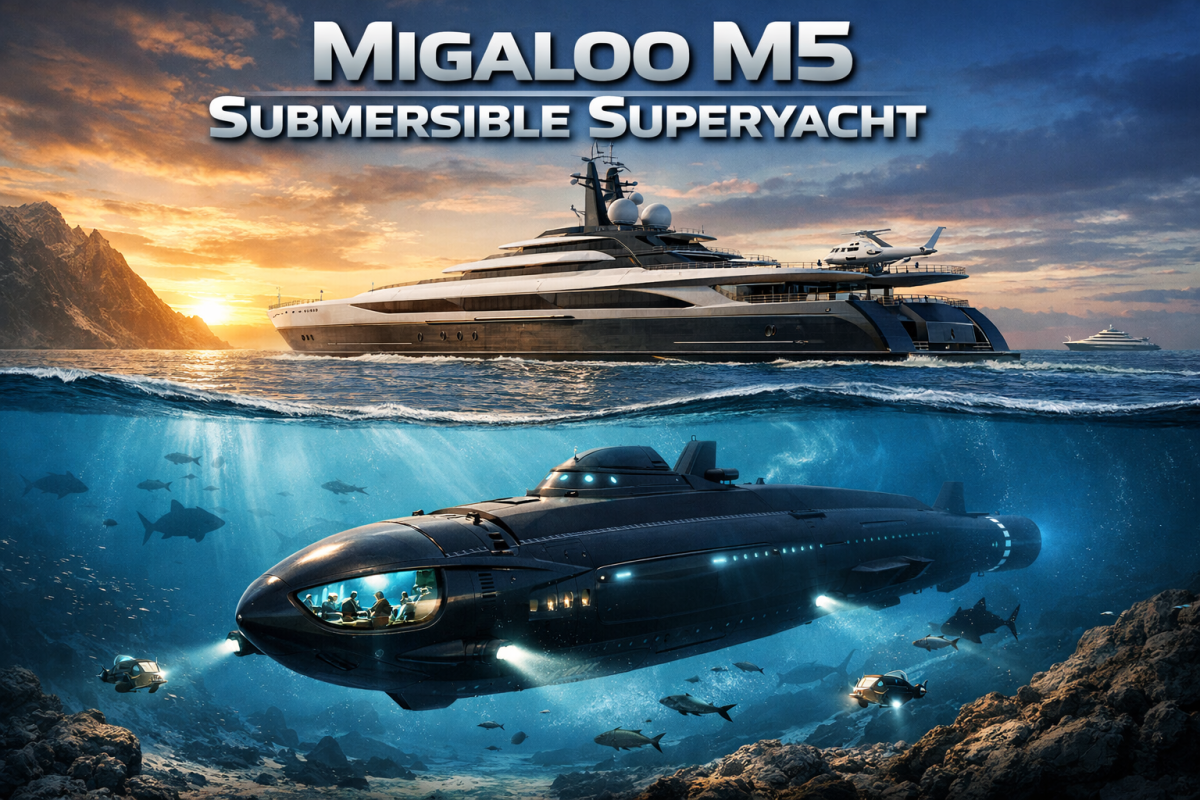
Feasibility Report
Executive Summary
- Migaloo M5 Concept Overview: The Migaloo M5 is a proposed 165.8-meter (≈540 ft) “submersible superyacht” concept – essentially a luxury submarine yacht. It promises capabilities far beyond any private vessel ever built: cruising on the surface at 20 knots, fully submerging to ~250 m depth, and remaining underwater for up to 4 weeks. The design includes lavish amenities (1000 m^2 of interior space with spas, cinemas, etc.) and a suite of auxiliary vehicles (helipad and hangar, mini-submarines, tenders, even a hot-air balloon). However, it remains purely a marketing concept/design study with no vessel constructed or ordered[1]. Public unveilings in 2023–2024 rebranded it as the ultimate private “submersible fortress” for ultra-wealthy owners seeking privacy and security. No verified buyers or shipyard contracts exist as of 2025, and industry experts emphasize that such a project, while imaginative, is unproven in practice[2][3].
- Feasibility Summary: Building the M5 to its advertised specs faces enormous technical and regulatory hurdles. It would essentially require creating one of the largest submarines ever, with safety and comfort standards akin to a cruise ship. Engineering feasibility is borderline – the basic physics of a 166 m pressure hull are understood from naval submarines, but integrating luxury accommodations and large viewing galleries is unprecedented. Classification and certification present a major unknown: no clear regulatory framework exists for a private submersible carrying ~40–60 persons in luxury, so multiple stringent codes (submersible standards, Passenger Yacht Code, SOLAS, etc.) would need to be satisfied (or new rules written)[4]. Cost is prohibitive, likely on the order of $1–2+ billion USD to build (similar to a military nuclear submarine)[3], plus perhaps $50–100+ million in annual operating costs – effectively limiting the buyer pool to perhaps a handful of billionaires or state actors. Operationally, it could physically travel global oceans (surface range ~8,000 nmi), but using it as a yacht is constrained by port access, legal restrictions on diving in territorial waters, and the sheer complexity of safe submarine operations. Docking and support infrastructure for a 15,000 GT submersible yacht barely exists outside naval bases. Insurability is questionable in the wake of recent private-sub accidents, and buyer demand is speculative at best (even among the ultra-rich, enthusiasm is uncertain due to risk and optics[3]).
- Top 5 Bottlenecks if Someone Tried to Build M5 Now: (1) Engineering & Design: The concept lacks detailed engineering – designing a huge pressure-hulled vessel with yacht-level interiors would be a massively expensive, unproven engineering exercise[2]. (2) Classification & Safety Approval: No precedent for certifying such a vessel – negotiating requirements with class societies and flag states (pressure vessel standards, escape systems, etc.) could stall or dead-end without major R&D[4]. (3) Shipyard & Supply Chain: Only a few shipyards (military submarine builders) have the capability to fabricate such a hull, and they are booked with navy contracts; sourcing specialized components (e.g. high-yield steel hull sections, large acrylic viewports, massive Li-ion battery banks, AIP systems) would be extremely difficult and time-consuming. (4) Cost & Financing: The likely ~$2B cost plus ongoing support would require an unprecedented financial commitment from a private individual – even interested buyers might balk once full lifecycle costs and risks are clear. (5) Insurance, Liability & Perception: Post-Titan submersible disaster, insurers and regulators would demand rigorous proof of safety. Any accident could be fatal and high-profile, raising ethical and PR concerns; this could deter both insurers and the ultra-rich clientele from proceeding.
- Most Defensible Price Range: $1 to $2 billion (USD) is the best current estimate for M5’s construction cost. This range is informed by analogous projects: nuclear submarines like a U.S. Navy Los Angeles-class (~110 m) cost ~$2 billion each[3]; the M5, at ~165 m and bespoke luxury fit-out, would be in the same order. The $2B figure has been cited in media as M5’s notional price tag[5][6]. A detailed cost breakdown (see Cost & Capital section) suggests that even in a optimistic case ($1B), adding contingencies and first-of-kind engineering easily pushes total CAPEX toward $1.5–2B. There is simply no way to achieve a vessel of this scale and complexity for less – for comparison, a conventional 150 m surface megayacht already costs $400–600M, and a smaller 65 m luxury submarine concept (Phoenix 1000) was once priced around $90M two decades ago. M5’s pressure-proof hulls, life-support, and custom systems would multiply costs beyond a normal yacht. Thus, “billions” is justified, and ~$1.5B (base case) to ~$2.5B (with ample margin) is a defensible range.
- Docking & Infrastructure Needs: “Docking” a 166 m submersible yacht is not as simple as pulling into a marina slip. In practice, M5 would require a deepwater berth or dedicated facility akin to a naval submarine base. Likely options include large commercial ports or shipyards (for example, a high-security pier at a naval yard or an industrial port) – standard superyacht marinas rarely have >8–10 m depth or clearance for a ~23 m beam submarine. It might need a custom-built submarine pen or floating drydock to safely service and berth it. Many ports also have restrictions on fueling and handling vessels with large quantities of Li-ion batteries or pressurized gases (for life support), implying special hazmat accommodations. In short, the owner might need to construct a private base or heavily modify an existing facility (costing tens of millions) to dock and maintain M5. While a brief visit to a deep harbor (e.g. a naval dock in a superyacht hub like San Diego, Toulon, or Abu Dhabi) is conceivable, routine mooring in a civilian marina is unrealistic. A feasible approach might be mothership support: keeping M5 offshore or submerged and using tenders/helis to transfer people, but that entails its own complexity. Bottom line: “docking” M5 means naval-grade infrastructure, not just a yacht club slip – essentially treating it more like a small private ship/submarine rather than a yacht.
- Minimum Viable Submersible Yacht: Given the challenges, a more realistic “starter” luxury submarine would be much smaller – on the order of 30–60 m – carrying perhaps a dozen people for shorter dives. For example, a 20 m civilian sub (Neyk L3) for 20 passengers was under construction for ~€20M[7], and tourist submersibles (~18 m, 40-passenger) are in service at shallow depths. A 50 m private submersible yacht could maybe include a couple of small staterooms and a lounge with viewports, and crucially, it would stay within known engineering limits (pressure hull size similar to existing deep-diving submersibles or military diesel subs). This “minimum viable” sub-yacht might dive to 100–200 m for a day or two at a time (not a month), use off-the-shelf submarine technology (steel hull, commercial-off-the-shelf life support and battery systems), and have just enough luxury finish to be comfortable. It could perhaps pass certification by piggybacking on established submersible rules and limiting passenger count to ≤12 (avoiding the strictest passenger ship codes). Such a vessel would still cost in the hundreds of millions, but at least it lies within current technical capability and regulatory frameworks. In contrast, the 165 m M5 pushes every parameter (size, endurance, capacity) into uncharted territory.
- Market Trend – Small vs. Mega Submersibles: Over the next decade, the consensus is that smaller, class-certified submersibles will dominate the private and commercial market, rather than mega-sub yachts. Already, wealthy yacht owners and tourism operators are investing in mini-subs (2–3 person deep-diving pods by Triton, U-Boat Worx, etc.) and mid-size tourist subs (20–50 pax) – these are manageable in cost and have established safety records. Large submersible yachts like M5 remain hypothetical. Several barriers would need to fall to change this trend: breakthrough advances in safety (such as fail-safe pressure hull materials or standardized rescue systems), dramatic cost reductions (perhaps via modular construction or dual-use military-civilian projects), and a shift in ultra-rich consumer appetite toward underwater living. It’s possible that one or two trailblazers may attempt a moderately large private sub (say 70–100 m) if technology and regulators allow, but unless that succeeds and proves safe, the niche will stay small. In the pessimistic scenario, heightened regulation and insurer wariness after incidents like Titan could further constrain even existing tourist subs, keeping anything larger than hobbyist subs off-limits to civilians. In summary: at least in the near term, the private submersible market trend skews toward smaller, certified submersibles (personal or tourist use) rather than towards behemoth underwater yachts – and it would take significant changes in safety tech, regulatory support, and ultra-high-net-worth (UHNW) demand to alter that trajectory.
Feasibility Scorecard
To quantify the viability of the Migaloo M5 concept, we assess key dimensions on a 0–10 scale (0 = impossible showstopper, 10 = easily feasible with current means). These scores reflect current reality:
| Aspect | Feasibility Score (0–10) | Notes (Rationale) |
| Engineering | 4/10 | Pressure hull design for a 165 m sub is extremely challenging but theoretically possible (military subs approach this size). However, integrating large view windows, yacht-level amenities, and reliability pushes well beyond proven engineering. Redundancy and safety system design adds complexity. Score: 4 (possible in theory, but high risk and untested).[2] |
| Certification | 3/10 | No clear regulatory pathway exists for a hybrid “yacht-submarine” of this scale. Would need to satisfy submarine class rules (DNV, ABS, etc.) and yacht safety codes (LY3/PYC) in novel combination[4]. Regulators have zero prior examples to follow – a huge uncertainty. Score: 3 (achievable only with extensive, first-of-kind certification efforts). |
| Cost | 2/10 | The capital required (likely $1–2B+) is enormous[3][6], and cost-per-volume is very inefficient compared to surface yachts[2]. Financially, it’s a black hole unless an owner is undeterred by spending an order of magnitude more than a conventional megayacht. Score: 2 (only a virtually unlimited budget makes it viable). |
| Operations | 5/10 | Basic operation as a submarine is feasible (ex-Navy crew, existing sub tech for navigation, etc.). But yacht-style operations (frequent stops, luxury hospitality, guest turnover) conflict with submarine constraints (need for controlled dives, restricted areas). Score: 5 – could operate in a narrow, carefully planned scope, but not freely like a normal yacht (see Operational Envelope). |
| Docking/Support | 3/10 | Infrastructure is a major bottleneck. Only a handful of ports worldwide might accommodate M5’s size and draft, and security/hazmat needs demand special facilities. Likely reliance on a custom base or naval port. Score: 3 (logistically very hard, limits homeport options severely). |
| Insurability | 2/10 | Marine insurers would view a private sub of this size as extremely high risk, especially post-incident analysis of sub disasters. Premiums could be astronomical or coverage simply refused. Owner might have to self-insure. Score: 2 (serious doubts about obtaining comprehensive coverage, and without insurance port access and financing also suffer). |
| Buyer Demand | 1/10 | The pool of individuals both rich enough and willing to take on such an experimental asset is minuscule[3][8]. Sovereign wealth or governments have more motive for large subs (military or research) than private persons do for a $2B toy. Score: 1 – at most one or two eccentric billionaires worldwide might be candidates, and none have publicly committed. |
Overall Feasibility: Low. Every category above faces significant challenges, with cost, regulation, and demand being especially prohibitive. While not a total zero (the concept isn’t physically impossible), the coordination of all factors would require extraordinary will, resources, and risk tolerance. In its current form, M5 is best viewed as an inspirational concept or conversation piece, rather than a project likely to materialize soon[1][3].
1. Verification & Context of the Migaloo M5 Concept
Publicly Claimed Design & Capabilities: The Migaloo M5 is presented by its creators (Migaloo Private Submersible Yachts, an Austrian design firm) as the apex of private submersible design. Key specifications and claims include:
- Dimensions: Length overall 165.8 m, Beam 23.0 m, Draft ~8.6 m. This makes it longer than the world’s largest surface superyachts and comparable in size to military submarines like the Russian Typhoon class. The concept’s gross tonnage is around 15,000 GT, indicating enormous internal volume.
- Submergence Performance: Maximum diving depth ~250 meters (820 feet). Underwater endurance up to 4 weeks continuous operation, enabled by diesel-electric propulsion with Air-Independent Propulsion (AIP) systems (e.g. presumably hydrogen fuel cells or Stirling engines). Range on the surface is quoted ~15,000 km (~8,000 nautical miles) – enough for transoceanic travel.
- Speed: 20 knots surfaced, 12 knots submerged. (These are in line with conventional submarines – fast for a yacht, modest for a warship.)
- Capacity: Designed to accommodate 14–20 guests in luxury, with 32–40 crew and staff. The crew includes submarine officers, engineers, and hospitality staff.
- Luxury Amenities: About 1,000 m² of customizable interior living space (e.g. an owner’s duplex apartment ~220 m², a 200 m² spa, VIP suites, lounges). Features touted: multiple underwater viewing lounges with large acrylic windows, an open-air sundeck with a pool and hot tub that retract before diving, a helipad and helicopter hangar (in a dedicated pressure-proof bay), a cinema, library, gym, and even fantastical options like an “underwater shark feeding station” and LED lightshows for entertainment. Essentially, it promises all the trappings of a megayacht plus the ability to explore undersea environments in privacy.
- Auxiliary Vehicles: The concept includes an extensive “garage” of toys and support craft: two 17 m mini-submarines (called “Limo Sub Tender” for carrying guests on excursions) accessible via onboard airlock, additional smaller submersibles/ROVs, a fleet of surface tenders (luxury tenders, RHIB work boats, etc.), personal watercraft (jet skis, Seabobs, dive gear), two off-road vehicles, aerial drones, and even a hot-air balloon for excursions. This inventory underlines the yacht’s intended self-sufficiency and expedition capability, both on and off the water.
- Safety and Security Features: Migaloo heavily markets the M5 as a “submersible fortress,” emphasizing protection. The design is double-hulled with multiple pressure-resistant inner hull sections – akin to military subs that have an outer hydrodynamic hull and inner pressure hull(s). It has fore and aft escape locks/escape hatches and deployable emergency buoy beacons to signal distress. All critical systems are redundant (backup life support, propulsion, power). The crew and guests would have Submarine Escape Immersion Equipment (SEIE) suits – essentially individual escape suits for emergency ascent (though their effectiveness at 250 m depth is limited by decompression issues). The company also references compliance with U.S. Navy SUBSAFE standards in design/operation, implying a very rigorous safety approach (SUBSAFE is a quality control program to prevent submarine flooding/casualty, used for U.S. military subs). In marketing language, Migaloo suggests the M5 could act as a secure refuge during geopolitical or environmental catastrophes, keeping owners safe “below the waterline”.
Concept vs. Reality – Marketing Hype vs. Naval Architecture Feasibility: It’s important to distinguish the renderings and promises of the M5 from what is actually achievable with current technology and engineering:
- Many features are clearly in the concept/marketing realm: for example, the idea of an opulent two-story ballroom or a massive windowed lounge under water (as shown in glossy renderings) is aspirational. In practice, large viewports on a submersible capable of 250 m depth are a huge engineering challenge – thick acrylic or glass composites would be required, and class societies strictly limit viewport size for safety. The M5 might need to significantly downscale the “wall of windows” concept to a few smaller portholes to meet structural rules (the concept art likely glosses over this). Similarly, fun extras like a hot-air balloon or “hovercraft garage” are more about illustrating extravagance; they don’t impact core feasibility, but suggest the concept is a wish-list rather than a weight-balanced, engineered design.
- On the other hand, core naval architecture aspects lean on known principles: A 165 m sub would almost certainly adopt a cylindrical pressure hull (or multiple hulls) of high-strength steel, akin to military subs. Migaloo’s mention of multiple pressure hulls hints they might use a sectioned approach – possibly one main pressure hull for living areas and separate pressure capsules for things like the helicopter hangar, thruster rooms, etc.. This is plausible (the Soviet Typhoon-class sub had multiple parallel pressure hulls). The double-hull with ballast tanks and an outer hydrodynamic shape is also standard in large subs. So the general naval architecture could follow military submarine practice – but scaled for luxury. The difficulty is that yacht owners expect high ceilings, spacious rooms, and big open-plan areas, whereas submarines normally have tight compartments and lots of reinforcing bulkheads. Squaring those conflicting design priorities would be extremely hard – you might end up splitting large interior spaces with structural frames or risk a flimsy hull if you don’t.
- Mission and Use-Case: Migaloo’s marketing swings between framing the M5 as a leisure cruiser (“explore reefs by day, watch movies by night”) and as a survival bunker (“escape global uncertainties in a submersible fortress”). This dual positioning itself reveals the concept’s unresolved identity: Is it a science/research vessel, a pleasure yacht, or a private defense asset? Each use-case would drive different design priorities. For example, a science mission might require labs and external manipulation arms; a pleasure yacht wants open deck spaces and jacuzzis; a fortress emphasizes stealth and maybe even countermeasures. Trying to be all of the above makes for great PR text but would complicate the actual design focus.
Timeline of Development & Public References:
- 2013: The Migaloo concept first appeared around 2013. An Austrian design studio “Motion Code: Blue” (led by Christian Gumpold and others) unveiled a 115 m “Migaloo” supersub concept. Early articles described it as a “superyacht of the future” that takes a standard submarine form and converts it into a private luxury vessel. That 115 m concept already featured the retractable pool, aft heli-deck, and an owner’s suite with private balconies. It was named after Migaloo, an albino humpback whale (apt for a white-painted luxury sub).
- 2015–2016: Migaloo (the company) expanded the concept range. By April 2016, five submersible yacht designs were advertised, from ~72 m (236 ft) up to an incredible ~283 m (928 ft) “M7” concept. The M5 at that time was a 135 m design – notably smaller than the current 165 m version. An industry news piece in 2016 gave technical details of the 135 m M5: crew 16 + 2 officers + 1 captain, 12 guests + 2 owners (total 32 on board), a submerged endurance of “several weeks”, beam ~16 m and draft ~7 m. It mentioned 2× MTU diesel gensets, rim-drive electric propulsors, and 2× 1200 kW Li-ion battery banks as the powertrain. That spec suggests an early vision of a diesel-electric sub with significant battery capacity (~2.4 MW in batteries). It also credited Starkad Technologies OÜ (an engineering firm) with technical development – indicating Migaloo had at least some engineering partners exploring feasibility. Notably, the 2016 article coyly stated “The price for all this luxury? Well, that would be telling…” – confirming no price was officially given (but clearly expected to be extremely high).
- 2017: The concept caught mainstream media attention. Bloomberg published an article in September 2017 titled “Before You Spend $2 Billion on Your Own Submarine, Read This.” It discussed Migaloo and similar projects, with industry experts expressing skepticism. Stewart Campbell, editor of Boat International, was quoted: “It seems like a massively expensive engineering exercise—and an unproven one—in the recreational sector…You’re not getting much volume for the money, and the equivalent yacht will give you more of everything.”[2]. This highlighted that, by yacht standards, a submersible’s thick hull and ballast eat up a lot of space that would otherwise be lavish interior on a surface yacht – a fundamental trade-off. The Bloomberg piece also noted that no one was actually building these mega-subs yet: U.S. Submarines (another private sub venture) admitted “we’re not building anything right now” and was focusing on small tourist subs instead[9]. It did mention one civilian sub under construction: a 64 ft Neyk sub by Ocean Submarine, for a “very rich client,” delivery 2018[10] – which shows that at least smaller luxury subs had some traction.
- 2023: After some quiet years (no Migaloo model was built or announced in the late 2010s), interest in private subs resurged. Tragically, June 2023 saw the implosion of the Titan submersible on a dive to the Titanic, which put a spotlight on deep-sea sub safety. The Migaloo team, likely aware of both the cautionary tale and the publicity, doubled down on promoting a safety-first, class-certified image for M5. By late 2023, they updated the M5 design to ~166 m length with more features (the “Fortress” concept) and began a PR push.
- Early 2024: Migaloo formally “revealed” the updated M5 design. A press release and new renderings were covered by yachting media in January 2024. SuperYacht Times and Boat International ran pieces noting the 165.8 m length and 250 m dive depth. The CEO, Christian Gumpold, pitched submersible superyachts as a “new category of private vessel” alongside motor and sail yachts. Migaloo partnered with a company called “SAFE” for the fortress/security angle, clearly aiming at UHNW individuals with doomsday concerns.
- Mid 2024: A high-profile interview appeared in Business Insider (May 2024) highlighting the M5. It emphasized the vessel as an ultra-rich toy that’s “no rickety Titan”, stressing that Migaloo would adhere to navy-level safety. The CEO claimed some clients were in discussions (no names or contracts, just hints). The article relayed some almost whimsical custom options being offered – e.g. LED lighting with laser shows, an onboard hot-air balloon, and an underwater shark-feeding station to entertain guests. This shows how far the marketing goes to capture imaginations.
- 2025: By this time, the concept remains unbuilt. Migaloo’s website and materials still position it as a design ready for a client to customize and begin construction, but no shipyard announcement or keel-laying has occurred. The industry remains skeptical: as one 2025 commentary noted, “with exceptions, nobody can pull it off…larger submarines are still almost exclusively military… for a long list of reasons. Budget is the first…and the main reason submarines aren’t catching on as commercial vessels is safety”[11][12]. The Migaloo M5 thus stands as a conversation piece at yacht shows and in media – a “what if?” scenario that fascinates, but with no concrete build timeline.
Credible Industry Commentary: Across the timeline, maritime and defense experts consistently raise feasibility concerns about a civilian mega-sub like M5:
- Cost vs. Value: As Stewart Campbell noted, you pay a fortune but lose volume to the pressure hull – so a conventional megayacht of the same price would have far more spacious suites, open decks, pools, etc.[2]. In other words, an underwater yacht inherently forces compromises that the ultra-rich might not accept when they could just get a bigger surface yacht. This calls into question the real demand.
- Safety and Regulations: Many have pointed out that while small tourist subs have a good safety record (classed by ABS, DNV, etc., with millions of dives and no fatal accidents until Titan)[4], scaling up to a huge private sub is a leap. There’s also wariness after Titan – that submersible was unclassified and experimental, and its failure underscored why strict standards are needed. A Migaloo M5 would have to overcome a trust deficit by being completely transparent and certified, which is a slow and costly process.
- Operational Practicality: Seasoned yachtsmen note that part of the appeal of superyachts is the expansive outdoor experience – sun, sea breeze, hopping between glamorous ports. A submarine, conversely, is sealed off and (when submerged) has no views except via artificial lighting. The M5 tries to mitigate this with viewing galleries and by also functioning as a surface yacht when desired. But some skepticism remains: will an owner actually spend much time fully submerged for weeks, or will it mostly be used as a normal yacht with occasional “dive show” for guests? If the latter, one might argue it’s over-engineered for its real use.
- Technical Unknowns: Naval architects have quietly pointed out a host of technical unknowns: for instance, how will the M5 manage stability both surfaced and submerged with that large flat superstructure? How will the transitional dynamics be when diving or surfacing such a large vessel (controlling buoyancy and trim smoothly to avoid uncontrolled angles)? These are engineering questions that haven’t been answered publicly. The concept mentions “rim-driven propulsors” in older specs – these are electric drive propellers integrated into the hull that can be very quiet. That suggests a reliance on modern tech, but details (like battery endurance, charging methods, life-support specifics) are not fully disclosed. Industry experts suspect a lot of these issues are left for future resolution pending a committed project and funding for R&D.
In summary, the Migaloo M5 is a visionary design study that has evolved over the past decade in concept art and specification sheets, but it remains far from real-world implementation. Public information confirms the extravagant features and basic dimensions, while expert commentary consistently urges caution – highlighting that, so far, M5 is more sci-fi than shipyard. It stands at the intersection of luxury yachting fantasy and hardcore submarine engineering, with the gap between the two yet to be bridged in practice[1][2].
Concept rendering of the Migaloo M5 surfaced. The design resembles a sleek modern submarine with a helipad on the aft deck and a retractable pool; auxiliary craft (helicopter, mini-sub) give a sense of scale. If built, its 165.8 m length would make it one of the largest submarines ever, civilian or military.

2. Cost & Capital Stack Analysis
Building a vessel like the Migaloo M5 would require a tremendous capital investment. Here we estimate the cost breakdown (CAPEX) and also consider ongoing operating costs (OPEX), benchmarking against analogous projects. All estimates are in USD and assume modern (mid-2020s) costs. Given the uncertainty, these should be treated as order-of-magnitude ranges with significant contingency.
Major CAPEX Components:
- Concept Design, Engineering & Classification Approval: Up-front design & engineering for M5 is a multi-year effort involving submarine architects, structural/failure analysis, tank testing, and class society reviews. This includes developing the General Arrangement (GA), performing finite element analysis on the pressure hull, designing life-support and emergency systems from scratch, etc. Also, because no exact regulatory code exists, Migaloo (as project manager) would likely need to fund cooperative development of standards or novel solutions with class (DNV/Lloyd’s/ABS) and flag state. Estimated cost: on the order of $50–100 million. This covers design offices, model testing, consulting fees, and class oversight through the design approval stage. (By comparison, large passenger ships or navy subs easily spend tens of millions in design and simulation; M5’s unique nature likely doubles that.) This phase also carries high risk: it could stretch longer or require redesign if regulators demand changes.
- Hull Construction (Pressure Hulls & Outer Hull): The pressure hull is the core of the submarine – high-grade steel or possibly titanium for smaller sections. For M5, we anticipate multiple pressure hull sections (cylinders of perhaps ~8–10 m diameter each) built to sustain ~25 bar pressure (250 m depth plus safety margin). This involves specialized forging or rolling of thick steel plates (likely HY-80 or HY-100 steel, as used in naval subs), precision welding, and extensive non-destructive testing. Additionally, an outer hull (light steel or composite) forms the hydrodynamic shape and houses ballast tanks. Given M5’s size, hull fabrication might be done in modules at a military-grade yard (e.g. Naval Group, TKMS or similar) and then assembled. Estimated cost: roughly $300–400 million. This is extrapolating from military sub costs – for instance, a US Virginia-class attack sub (~115 m) pressure hull reportedly costs a few hundred million in materials and labor. M5’s hull volume is larger, though simpler (no weapons, but more accommodation openings). Titanium is likely too expensive except for small parts; steel is assumed. Note this includes basic structural shells, internal stiffeners, and welding, but not the fit-out.
- Propulsion & Power Systems: M5 is diesel-electric with AIP. This means: multiple diesel generator sets (likely marine diesels similar to those on large yachts or small ships, but modified for submarine use with snorkel exhaust), large electric motors or rim-drive propulsors for silent propulsion, an enormous battery bank, plus possibly fuel cells or Stirling engines for AIP. Let’s break that down:
- Diesel generators: Perhaps 2–4 high-power units (maybe MTU or Caterpillar engines in the 2–3 MW range each, like on a small ship). These need shock-mounting and acoustic isolation.
- Electric drive: A main propulsion motor (or two) delivering maybe 5–10 MW total for 20 knots surfaced (submerged speed will be limited by that and battery output). Possibly podded or rim-drive props for low noise.
- Battery system: Li-ion batteries on the order of several MWh. The 2016 spec said 2×1200 kW batteries (which might mean 2.4 MW total capacity), but to stay submerged weeks, likely much more is needed – perhaps tens of MWh of energy storage. This could be, say, 200–300 tons of batteries, costing many tens of millions by itself (industrial Li-ion around $500 per kWh in integrated systems; 50,000 kWh would be $25M, as a ballpark).
- AIP system: if using hydrogen fuel cells or closed-cycle diesel or Stirling engines, these are relatively custom. Swedish Gotland-class subs use Stirling AIP – costs were significant but on a smaller scale. For M5, one might allocate $50M+ for a bespoke AIP setup including liquid oxygen tanks, etc., to achieve the 4-week submerged goal.
- Other electrical: switchboards, power management, converters, backup emergency power, etc.
Estimated cost for propulsion & power: approximately $150–200 million. This is a rough sum of the above components (diesels & motors ~$50M, batteries ~$50–80M, AIP ~$50M, plus integration and testing). This figure aligns with known data: a modern naval sub’s propulsion-electrical systems are a large fraction of its cost. Notably, Migaloo’s approach must prioritize reliability and low noise (to avoid sonar detection if “security” is a selling point).
- Life Support & Atmosphere Control: Unlike any surface yacht, M5 needs a complete life support system akin to a spacecraft or naval sub. This includes:
- CO₂ Scrubbers: chemical scrubbers (e.g. soda lime cartridges or more advanced lithium hydroxide systems) to remove carbon dioxide exhaled by perhaps ~50 people continuously. Also CO₂ monitoring sensors throughout.
- Oxygen supply: either large O₂ storage banks and an automated release system to maintain ~21% atmosphere, and/or an Electrolysis system (like military subs use) to generate O₂ from water when power is available. Redundancy is key (likely both stored O₂ and generation).
- Pressure control: internal atmospheric pressure normally at 1 atm, with humidity control (dehumidifiers to avoid condensation).
- Air conditioning: Thermal management for a closed environment – with many people and equipment, heat accumulates. Chillers and air circulation are needed, plus removal of other trace gases (carbon monoxide, hydrogen from battery charging, etc.).
- Backup systems: perhaps a small stock of emergency “oxygen candles” (chemicals that release O₂ when burned, used on subs as backup) and portable scrubbers in liferafts or escape suits.
- If the vessel is to be capable of extended dives (weeks), the life support must be extremely robust and sized for duration. (For perspective, the ISS life support and a submarine’s are similar in complexity, though a sub can also refresh air by snorkeling periodically – M5 could do that if it surfaces or snorkels every few days, reducing the burden on full AIP.)
Estimated cost: likely $20–40 million. This draws from analogs: a single deep-diving DSV (like Alvin or James Cameron’s sub) has a life support system costing in the millions, but that’s for 2–3 people for days. A military submarine’s life support gear (scrubbers, oxygen generators) can be tens of millions. M5’s system might be commercial-off-the-shelf adapted from naval designs, plus a luxury twist (maybe higher redundancy for civilian safety). For budgeting, one might allocate ~$30M for design+install of atmosphere control and safety systems (fire suppression overlaps here too).
- Habitability & Interior Outfit: This encompasses everything from the pressure-proof internal structures to the high-end yacht decor. We can break it into:
- Internal hull/decks: The pressure hulls will be subdivided into decks and compartments. These need fabrication of deck plates, hatches, watertight doors between sections (like between main hull and escape trunks, etc.). There’s also likely a central tower (sail/conning tower) structure with a hatch, periscope, antennas – part of hull construction but with outfitting like a navigation bridge inside.
- Hotel systems: plumbing (freshwater and waste systems capable of operating at depth – e.g. special marine toilets with compressed air flush for depth), HVAC for all rooms, a galley/kitchen that can run electrically (no open flames on subs), cold storage, lighting, etc.
- Interior luxury finish: All furniture, wall paneling, flooring – likely to superyacht standard when possible. However, note materials must comply with submarine safety (low flammability, low off-gassing under pressure). This could require custom fabrication of, say, lightweight marble-like surfaces or special fabrics. The owner’s areas, guest suites, spa, etc. would be furnished akin to a $300M megayacht’s interior. For reference, a premium superyacht interior fit-out can easily cost $10,000+ per square meter. With ~1,000 m² of guest/owner space, that suggests ~$10 million just in top-tier furnishings. Add crew areas (900 m² crew space per Migaloo spec, though those might be more utilitarian).
- Special features: e.g. the viewing lounges with thick acrylic windows – those windows are extremely expensive (a large acrylic dome or cylinder can cost hundreds of thousands). Also things like an indoor submarine hangar or moon pool (if included for deploying subs) would require complex mechanisms and waterproof doors (think of something like a mini U-boat hangar with sealable door – a feature some concepts imply). Each of those moving hatches or deployment systems could cost millions.
Estimated cost: approximately $150–250 million. A breakdown could be: maybe $50M for basic internal structures and systems (decks, piping, cabling, AC, galley, etc.), and $100–200M for the luxury fit-out and specialized installations. This is in line with large cruise yachts – for instance, a 150 m yacht might spend $100M+ on interior and hotel systems. M5 might be higher due to the complexity of fitting things inside a curved pressure hull (lots of customization, fewer standard modules).
- Navigation, Control, and Electronics: M5 would need both submarine-grade and yacht-grade electronics:
- Sonar and sensors: A forward-looking sonar for obstacle avoidance (essential for diving near reefs or seabed), side-scan or multibeam for exploration, maybe a naval-quality navigation sonar. Also underwater communication systems (acoustic modems) since radio/GPS don’t work underwater.
- Navigation suite: When surfaced – standard marine radar, ECDIS (electronic charts), GPS, etc. When submerged – inertial navigation systems, possibly ground-mapping sonar or periodic GPS fixes via periscope mast.
- Communication: A radio suite for surface comms (satellite communications, VHF, etc.), and emergency comms like the floating buoy that can transmit position if the sub is in trouble.
- Control systems: A modern integrated bridge/command center with autopilot, depth control computers, ballast monitoring, flood sensors, etc. Likely many automated systems (for a yacht, one would want push-button surface-to-dive transitions). Also, dynamic positioning or hovering capability via thrusters, which requires control software.
- Luxury electronics: extensive AV/IT for guests – vessel-wide Wi-Fi (usable only surfaced or via satellite when shallow), entertainment systems, etc.. Security CCTV, perhaps even countermeasures or anti-intruder systems if “fortress” is literal.
Estimated cost: $50–80 million. Rationalization: A top-end 150 m yacht’s bridge and electronics might be $10–20M. A military sub’s combat system (sonars, etc.) can be $100M+, but M5 might not need combat-grade, just navigation grade. We budget perhaps $30M for navigation+sonar, $20M for communications (satcom antennas, etc.), and another $20M for luxury IT/AV and security systems. High redundancy will be needed in controls (e.g. multiple depth gauges, backup steering controls), contributing to cost.
- Testing, Sea Trials, and Certification Processes: After construction, the vessel must undergo rigorous trials:
- Harbor tests: powering up all systems dockside, pressure testing compartments, etc.
- Surface sea trials: making sure it handles properly on surface, reaching top speed, etc.
- Diving trials: A crucial and delicate phase. Likely incremental: first dive to periscope depth in a controlled area, then progressively deeper dives. Emergency drills (simulate power loss and use backup blow ballast, etc.), and testing of safety features (e.g. does the emergency buoy deploy correctly, do escape suits work in trial).
- Class society inspectors would witness many of these tests to sign off on certification. They may require a formal deep dive test to 1.1× or 1.25× the design depth (military practice is to test slightly beyond operational depth). That could be ~300 m test dive – a risky but required venture.
- Crew training is intertwined – the initial crew (probably ex-submariners) would be learning the handling characteristics during trials.
- Given the prototype nature, expect a long trial period and debugging stage.
Estimated cost: $20–30 million (this includes the operational cost of test runs, class fees, and likely some redesign or fixes that come up). Also consider opportunity cost – a year or more of testing where the shipyard and engineers are still involved.
- Project Management, Overhead & Contingency: A project of this unprecedented complexity would require strong management and also a large contingency reserve. Unexpected technical hurdles are almost guaranteed (e.g. if during pressure hull construction a weld fails tests, rework is costly; or if during dives, unforeseen vibrations occur requiring added stabilizers). Also inflation and supply chain issues over a multi-year build (likely 5+ years) need buffers.
- Typically, one might add ~15–30% contingency on top of base estimates for first-of-class vessels.
- There’s also the cost of keeping an expert team on retainer throughout (Migaloo as the “owner’s representative” would charge fees, and the shipyard overhead).
Estimated: If we sum rough base costs from above (let’s do that in the table below), then add ~20% contingency, it could be on the order of $200–300 million extra for project overhead and contingency.
Bringing it together, here is a summary cost model table:
| Cost Element | Estimated Cost (USD) | Notes/Assumptions |
| Design & Engineering (incl. certification development) | $75 million (range $50–100M) | Concept design refinement, class rule negotiations, safety case studies, modeling tests[2][4]. Very high due to first-of-kind nature. |
| Pressure Hulls Fabrication | $350 million (range $300–400M) | Multiple high-strength steel pressure hull sections + outer hull. Heavy naval-grade work. |
| Propulsion & Power Systems | $180 million (range $150–200M) | Diesel-electric plant, huge battery bank, AIP fuel cells/Stirling, propulsors. Includes integration and noise mitigation. |
| Life Support & Safety Systems | $30 million (range $20–40M) | CO₂ scrubbers, O₂ supply, climate control, fire suppression, escape equipment. Scaled from naval sub systems. |
| Interiors & Outfit (Structure + Luxury) | $200 million (range $150–250M) | All interior build-out: decks, furnishings, amenities (spa, theater), special features (viewing windows, sub hangars). Superyacht-level finish within sub constraints. |
| Electronics & Control | $65 million (range $50–80M) | Navigation sonar, sensors, comms, control systems, guest IT/AV. Modern tech, heavily redundant. |
| Testing & Trials | $25 million (range $20–30M) | Extensive sea trials, depth testing, class certification proving, crew training period. |
| Project Mgmt & Contingency (~20%) | $185 million (approx 20% above) | Buffer for unforeseen issues, management, financing costs, etc. Given unprecedented scope, a large contingency is prudent. |
| Total CAPEX (Rounded) | $1.1 – 1.3 billion (base); possibly up to $1.5 – 1.8 billion with more contingency | Base-case around $1.2B. With conservative contingency or scope increases, could approach $2B. Some media have cited ~$2B as likely cost[6][3]. |
Table: Preliminary cost breakdown for Migaloo M5 build. All figures are rough estimates. The total aligns with the notion that M5 would cost on the order of a modern naval submarine (which is ~$2B for a large nuclear sub)[3], plus the yacht luxury premium. Notably, if the owner insisted on top-of-line everything (e.g. titanium hull sections, lavish interiors, unlimited R&D), costs could escalate well beyond $2B. Conversely, a very strict, conservative build (treat it more like a research sub) might shave some luxury cost, but the savings would likely be marginal relative to the huge fixed costs of hull, power, and safety.
Comparison Benchmarks: It’s useful to compare these numbers to analogous projects:
- A 150 m surface megayacht (e.g. Dilbar 156m, Azzam 180m) reportedly cost in the range of $600 million[3]. These vessels have similar hotel amenities and size, but none of the submarine-specific structure. Our estimate for M5 is roughly 2–3 times that, reflecting the added complexity of making it submersible.
- A U.S. Los Angeles-class submarine (Los Angeles-class, ~110 m nuclear attack sub) cost about $1.5–$2.0 billion (in today’s dollars) each to build[3]. It carries a crew of 130, a nuclear reactor, and weapons – M5 doesn’t need a reactor or combat systems, but instead has luxury outfitting. The cost ballpark is similar; indeed SupercarBlondie notes each Los Angeles-class is around $2B and implies M5 would be comparable[13].
- The Phoenix 1000 concept (65 m private sub, late 1990s design) was quoted at ~$90 million. Adjusting for inflation (~25 years) and its much smaller size, that actually aligns with our scaling – roughly $1.5M per meter of sub in that smaller range, and for M5 we get on the order $7–9M per meter (owing to diseconomies of scale and uniqueness). It shows how non-linear costs become as size increases.
- A small tourist sub (e.g. 40-seater, 18 m, dives 100 m) might cost $3–5M new. The 64-ft (20 m) Neyk Submarine mentioned in 2017 was priced about €20M (~$24M)[14]. Extrapolating to 165 m is not direct, but roughly, length ×8, volume ×~50, cost might ×100 or more, which indeed pushes into billions. That indicates our numbers are not outlandish.
- Operating Cost Benchmarks: As a rule, superyachts incur annual operating costs around 5–10% of their build price[15]. For a $1.5B asset, that naïvely suggests $75–150M per year. However, for subs the percentage could be even higher (subs require more specialized upkeep). Nuclear subs, for example, have whole life-cycle costs several times build cost due to maintenance and crew training. M5 won’t have a reactor but will have expensive battery renewals and drydockings.
Annual OPEX Considerations: Even if an owner can afford to build M5, they must sustain it. We outline key operating expenditures:
- Crew Salaries and Training: Operating a submersible yacht demands a large, highly skilled crew. Migaloo suggests 32–40 crew including hospitality. Within that, you’d need at least: a captain with submarine command experience, several licensed submarine pilots/officers, engineers specialized in sub systems (life support, electrical, hydraulic), plus deck crew, stewards, chefs, etc. Submarine specialists (likely ex-naval) command high salaries – perhaps $150k–$300k+ each annually for senior roles. Let’s say an average fully burdened cost of $100k per crew (some lower for stewards, higher for specialists). For 40 crew that’s ~$4M/year. Training is crucial: drills for emergency ascents, dives, etc. We might allocate another $1M/yr for ongoing training and certifications (simulator time, etc.)[16] – operating a sub safely requires continuous practice, unlike a normal yacht where navigation is more routine.
- Fuel and Energy: On the surface, M5 would consume marine diesel like a large yacht or small ship. If we assume it has, say, four diesel generators each burning ~200 liters/hour at cruising load, that’s 800 L/h. At 12 knots surfaced (hull speed for 165m might be higher, but let’s assume economical cruise), 800 L/h might equate to ~20 tons of fuel per day. If doing long transits, costs add up (marine diesel ~$700/ton as an estimate, so $14k per day underway). Annually, maybe the yacht travels 10,000 nm – roughly $1–2M in fuel. Underwater, it uses battery/AIP. The AIP might consume specialized fuel (e.g. stored oxygen and diesel or hydrogen). Those consumables (liquid oxygen, etc.) will also cost money and need replenishment after dives.
- Maintenance & Refit: A vessel like this would likely require annual maintenance periods and a major drydock every 5 years (if following ship practice, or even more often due to class – note that to inspect a pressure hull, you must drydock and maybe even do ultrasound tests each time). Regular maintenance includes: checking and recalibrating life support systems, replacing CO₂ scrubber chemicals, overhauling valves, painting the hull with anti-fouling (biocide paint) to prevent marine growth (which is trickier if you submerge often).
- The battery will need replacement perhaps every 5–7 years as its capacity fades – that could easily be a $20–50M item each cycle.
- Spare parts for custom systems (e.g. a spare pump for ballast system, or spare circuit boards for control systems) must be stocked. If something like the AIP fuel cell needs manufacturer support, that’s costly specialist work.
- Given no expense spared, an owner might budget ~$20–30M per year for maintenance/refit on average (some years less, a big refit year could spike higher). For comparison, a $600M yacht might spend $5–10M on upkeep yearly[15]; a submersible’s systems are more complex and critical, hence the higher absolute number.
- Insurance: Insuring a one-of-a-kind private submarine will be challenging. Hull insurance (coverage for physical damage) and P&I insurance (protection & indemnity, for liabilities) are standard in yachting. But underwriters will charge a premium given the experimental nature. They may even exclude underwater operation from coverage initially or set very strict conditions (e.g. require class certification and certain rescue agreements).
- If an insurer does take it on, we could foresee annual premiums on the order of 5% or more of hull value for such a risky venture. If valued at $1B, 5% is $50M/year – likely unacceptable. The owner might opt to self-insure (i.e. effectively go without full insurance, except maybe third-party liability). Even then, they’d at least get liability insurance for environmental damage or collisions – perhaps a few million per year.
- We’ll estimate $10–20M/year for insurance if insured at all. (This is speculative, but even the largest yachts rarely cross $10M premiums; M5 is riskier.)
- Port fees and Logistics: M5 cannot just park anywhere, but when it does dock, port fees will be sizable. Commercial ports charge by tonnage; 15,000 GT could incur thousands of dollars per port call. More importantly, one might have to rent a secure berth or facility long-term. For instance, leasing a naval dock or a private quay in a deep harbor – could be on the order of $1M+ per year for the privilege, depending on location.
- Harbor pilots and tugs would be required each time M5 enters/leaves port (due to size and perhaps authorities mandating it for a sub). That’s minor in the big picture (maybe $10k per movement).
- Resupply: Because it’s essentially a self-contained unit, reloading oxygen, fuel, provisions is a specialized task. The owner might keep a dedicated support tender or barge that can replenish M5 at anchor (if avoiding crowded ports). That support infrastructure (crew, fuel depot, etc.) could add cost.
- Miscellaneous: Classification society annual surveys (paying class inspectors yearly and per drydock to maintain the certificate). Submarine rescue drills or agreements – some private sub owners arrange contracts with professional rescue teams (for example, an agreement with a navy or commercial rescue service to be on call). This could cost some retainer fees.
- Training of new crew over time, certifications, etc., ongoing.
- High-end hospitality for guests (just like any yacht: fine dining, etc., but that’s negligible compared to technical costs).
Expected Annual OPEX: Summing up, a reasonable estimate: – Crew: ~$5M – Fuel/Energy: ~$2M – Maintenance/Refit: ~$25M (averaged) – Insurance: ~$15M (if insured) – Berthing/Logistics: ~$3M – Other (class, admin, etc.): ~$2M Total: on the order of $50–60 million per year (if heavily used). It could be higher if something major happens (like a battery replacement year might shoot up to $80–100M). If the owner is cost-conscious (somewhat paradoxical after spending 1–2B), they might limit usage (e.g. dive rarely to reduce wear) which could lower some costs.
Over a 10-year period, assuming no catastrophic incidents, the 10-year total cost of ownership (TCO) would include the initial build ~$1.2–1.5B plus roughly $500M in operations, summing to ~$1.7–2.0 billion. At the end of 10 years, one also has to consider resale value – likely very low or zero, as such a bespoke sub finds no second-hand market (unlike superyachts which at least can be sold at a fraction of build cost). So it’s almost pure expenditure.
To emphasize: these costs make M5 one of the most expensive civilian projects one could undertake – essentially equivalent to running a small navy or space program privately. This is why the buyer universe is extremely limited (discussed in a later section) and why, to date, no one has publicly stepped up to finance it. The CEO of Migaloo acknowledged that even the wealthiest clients have “complex needs” and that privacy and security are motivators – essentially trying to justify the cost as fulfilling needs beyond a normal yacht. But even if a billionaire is keen, they would have to accept a huge, ongoing financial commitment with uncertain returns (except bragging rights and personal enjoyment).
Verified vs. Inferred vs. Speculative: Most cost figures here are reasoned inferences, since no exact analog exists. We cited known costs (e.g., naval subs at ~$2B[3], Phoenix 1000 at $90M) to ground the estimates. The division of costs is speculative but based on typical cost drivers in shipbuilding and submarine engineering literature. For example, pressure hull and machinery often dominate a sub’s cost, which is reflected in our model (hull + power ~40–50% of total). We have flagged speculative elements (like insurance rates) with appropriate caution.
In conclusion, the cost to build Migaloo M5 likely lies in the $1–2 billion range, with ~$1.2B being an optimistic scenario with few overruns, and ~$2B a safer number to include contingencies and gold-plating. Operating costs around ~$50M/year further underscore that the only feasible buyers are those for whom this expenditure is a rounding error – essentially, individuals or entities worth tens of billions. The “capital stack” in practice would be simple (one ultra-rich equity backer; no bank would finance this without collateral), and perhaps supplemented by national support if any government took interest in using the platform for research or dual purposes. But absent that, it’s a pure cash purchase and cash upkeep situation for a private owner.
3. Classification, Flagging & Regulatory Feasibility
One of the most complex challenges for the Migaloo M5 is navigating the regulatory and legal frameworks that ensure vessel safety. Because M5 straddles two domains – it’s both a large passenger yacht and a manned submersible – it does not cleanly fit into existing categories. Here we identify the likely classification society rules, flag state issues, and specific certification hurdles the project would face.
Classification Societies & Applicable Rulesets: Migaloo has signaled intent to work with top-tier classification societies like DNV (Det Norske Veritas) or Lloyd’s Register, etc., referencing “DNV/GL Passenger Yacht Code or equivalent” for M5. This implies two sets of rules:
- Passenger Yacht Code (PYC): This code, originally developed by the Red Ensign Group (UK and its territories), applies to yachts carrying more than 12 passengers up to typically 36 passengers. It’s essentially a tailored version of SOLAS (international Safety of Life at Sea convention) for large yachts – covering things like stability, fire safety, lifesaving appliances, etc., but with some relaxations for yacht usage. M5, with potentially 20 guests, falls into this category of needing PYC or even full SOLAS passenger ship compliance. For surface operation, it would need to meet these standards (e.g. damage stability with certain compartments flooding, fire-resistant construction, lifeboats or life rafts for all onboard, etc.).
- Manned Submersible Rules: Classification societies also have rules for submersibles, usually under “Special Service Craft” or dedicated guidelines. For instance, DNV has “DNVGL-ST-0276 Manned Submersibles” which covers the design, construction, and testing of submarines and submersible vehicles (commonly applied to tourist subs or research subs). These rules ensure the pressure vessel integrity, life support, emergency ascent, etc. Similarly, ABS (American Bureau of Shipping) and Lloyd’s have rules for underwater vehicles[4]. M5 would have to comply with these as a baseline for the submarine aspect.
In practice, no single code covers a 165 m submersible carrying many people in luxury. So what would likely happen is a bespoke classification approach: – The class society (say DNV) would convene a special project team. They’d apply Submersible Rules for all aspects related to diving (hull strength, dive systems, life support) and apply Yacht/Passenger Ship Rules for aspects like surface stability, accommodations, and safety when operating on surface or in port. – Where rules conflict or leave gaps (and there will be gaps, e.g., yacht codes don’t imagine a submerging vessel; sub rules assume small craft, not 15,000 GT ships), class would issue Alternative Design assessments. They might require risk analyses from the designers to show an equivalent level of safety. – US Navy SUBSAFE: Migaloo mentions designing to SUBSAFE standards. SUBSAFE is not a class rule but an internal Navy program ensuring submarine critical systems are built and maintained with the utmost quality (born from lessons of USS Thresher sinking). Applying SUBSAFE basically means extra-thorough QA on all hull penetrations, valves, etc. If done, it would further assure class and flag that quality is high. However, adopting SUBSAFE-like practice is a voluntary layer; class will still require their own surveys and tests.
Key Certification Bottlenecks & Requirements:
- Pressure Hull Certification: The primary safety element is the pressure hull design and proving it safe to 250 m. Class would demand a design margin (often 1.5 to 2.0 times operating depth as collapse depth). So the hull must theoretically survive ~500 m without collapse. This might involve building a scale model for destructive testing, or finite element analysis plus conservative design. Each hull penetration (hatches, windows, thruster openings) is a potential weak point – class will scrutinize these intensely. Welding procedures must be pre-qualified and every weld x-rayed. This is a huge undertaking similar to military sub construction. (Often naval subs aren’t built under class; here it must be, since it’s civilian.)
- Stability and Buoyancy: As a surface vessel, M5 must meet stability criteria (e.g. IMO weather criteria, able to withstand certain wind and wave without capsizing). As a sub, it needs proper buoyancy and ballast control. One tricky aspect: yacht code might require sufficient freeboard (height of decks above water) and stability in hull-up condition, which submarine shapes struggle with. M5’s wide beam helps, but a submarine is generally less initially stable on surface (they rely on ballast tanks to ride low). The designers might have to demonstrate via simulation and model tests that M5 has positive stability in all surface conditions and can recover from rolls. Also, damage stability: PYC would require that if certain compartments flood, the vessel still floats (like a ship with watertight compartments). For M5, the worst case is flooding a ballast tank or part of the outer hull – which presumably is fine (since the pressure hulls are inside and should remain intact).
- Lifesaving Appliances: Normally, a passenger yacht would need life rafts or lifeboats for everyone. But on a submarine, if something’s wrong the last thing you want is to abandon ship on the surface (unless you can surface safely). Instead, the focus is on underwater escape or rescue. M5’s plan: emergency escape locks and SEIE suits. Class/flag will question: is that sufficient for all persons? SEIE suits allow individual ascent from a sunken sub, but they have depth limits (modern submarine escape suits can theoretically work up to maybe ~180 m with saturation decompression, but 250 m pushes it). Even if possible, expecting untrained guests to do a free ascent is not ideal. Therefore:
- Rescue hatch compatibility: It would be prudent to have a standard NATO-size rescue seat (a reinforced hatch where a Deep Submergence Rescue Vehicle (DSRV) can dock). Many military subs have one, typically ~26-inch diameter flange. Class might strongly suggest or require this on M5. That way, if it bottoms out or can’t surface, a rescue sub could bring people out. M5’s design mentions bow and stern locks – possibly these could be designed as rescue hatches.
- Lifeboats on surface: When surfaced, perhaps they still need life rafts for abandon ship in case of a fire or other surface emergency. They could store inflatable life rafts on deck or in a locker that auto-deploys. Not a major issue to include, but something code will checklist.
- Fire Safety: A huge issue on any sub – fire and smoke in an enclosed space is extremely dangerous. PYC/SOLAS will require fire detectors in all spaces, fixed fire suppression (e.g. gas flooding systems like FM-200 or CO₂ in machinery spaces), proper flame-retardant materials, and emergency breathing apparatus for crew. M5’s design would have to treat fire risk as critical (submarine history shows fire is a leading cause of accidents). Lithium-ion batteries also introduce fire risk (thermal runaway), so likely they must be in compartments with automatic fire extinguishing and isolation.
- Emergency Surfacing: Does M5 have the means to surface quickly from depth in an emergency? Traditional subs have ballast blow systems – high-pressure air to rapidly empty ballast tanks, or drop weights. M5 should too. Class will want to verify that even with a single failure (say one ballast tank stuck flooded), the sub can still surface (perhaps slowly). Redundancy in buoyancy (multiple ballast sections, releasable drop ballast weights) may be mandated. Testing an emergency ascent might be part of trials – which is dramatic (the sub rockets up). Ensuring that doesn’t harm occupants is also a concern (too fast an ascent can cause decompression sickness if they’ve been at pressure – though at 250 m, internal pressure remains 1 atm, so they don’t saturate, so DCS isn’t an issue for people inside, but is an issue if they leave in an escape suit).
- Battery and Electrical Safety: Class will apply rules for unattended machinery spaces (since presumably the engine room might not be manned 24/7, more like automated). Also, the large Li-ion battery installation would fall under new regulations like IEC standards for marine battery systems. Thermal runaway protection (heat sensors, cooling, fire suppression in battery compartments, robust ventilation to avoid hydrogen accumulation during charging) all must be proven. The maritime industry is cautious with Li-ion after some ship fires, so a massive battery on a sub gets double scrutiny.
- Flag State and Jurisdiction: The flag state is the country under whose laws the yacht is registered. Common flags for superyachts are Cayman Islands, Marshall Islands, Malta, etc. Will any of these be willing to flag a 165 m private submarine? They have experience with large yachts, but not with submersibles. Likely, they’d rely heavily on the class society’s technical judgment. Some flags might require additional oversight or even refuse if they feel they lack expertise. Perhaps more pragmatic flags (Marshall Islands, which often registers unusual vessels) could be open to it, especially if classed by e.g. DNV.
- The flag authority will need to issue a registration and relevant safety certificates. Possibly a one-off Exemption or Alternate Compliance Certificate would be needed because the vessel can’t literally meet some clauses of SOLAS (e.g., SOLAS might require lifeboats, but an alternative (escape pods) would be accepted by exemption).
- Naval vs. Civilian classification: One interesting path – sometimes large projects partner with navies or defense contractors. If, say, a government got involved, they might classify M5 as a naval auxiliary instead of a yacht, skirting some commercial rules. But that’s speculation and would complicate private use. It’s more likely to stay civilian with class oversight.
Flagging Challenges: On top of technical rules, some legal issues: – Many countries have laws about submerged navigation in territorial waters. For instance, a submarine is typically required to navigate on the surface and show its flag when in another nation’s territorial sea (to avoid being seen as a covert military vessel). A private sub would presumably do that – you wouldn’t dive in coastal waters without permission. But flag state might need to issue guidelines to the owner about complying with UNCLOS (United Nations Convention on Law of the Sea) rules, which say submersibles must navigate on surface/with flag in territorial seas. – Some flag states might worry about liability: If an accident occurs (e.g. the sub sinks with casualties), will they have the investigation expertise? Will they face political flak? It’s not an idle concern; after Titan, for example, flags like Bahamas (where Titan’s support ship was flagged) had to participate in investigations. A flag might demand the owner to have a very detailed emergency response plan, and perhaps even sign special agreements (like waivers or additional insurance). – Rescue Coordination: A flag state (and indeed any coastal state where the sub operates) will insist the sub has an emergency locator and a plan for rescue. The M5’s emergency buoys would assist in location. The International Submarine Escape and Rescue Liaison Office (ISMERLO) is a real body coordinating sub rescue worldwide for military subs – a private owner might have to tap into that network via agreements, or have their own standby DSRV. It’s a legal/ethical area: if M5 is in distress, presumably navies would attempt rescue, but having pre-planned procedures is key. The flag state would likely mandate that an arrangement is in place (to not leave dozens of civilians stranded underwater with no rescue lined up). – Environmental and Hazard Regulations: Because M5 carries potentially hazardous materials (large battery, fuels, oxygen, etc.), the flag and ports will want to ensure compliance with environmental regulations (e.g. if it sinks, how to mitigate pollution, though nuclear isn’t an issue here, diesel is). Also ballast water management (subs take in/expel ballast seawater – need to ensure not transporting invasive species between regions, per IMO rules – likely fine if deep water exchange).
To sum up the regulatory status: No explicit prohibition exists on a private individual building a big submarine, but meeting the letter and spirit of safety regulations is a formidable task. All sub makers claim adherence to class and standards[4] – Migaloo is no different. The difference is scale: certifying a 2-person submersible or a 40-person tourist sub has been done; certifying a 40-person 165 m sub never has.
Class societies would likely treat Migaloo M5 as a special project where every novel aspect requires either compliance with an existing rule or explicit approval of an alternative design. For example, DNV’s Manned Submersibles rules have specifics for hull plate thickness calculations, viewports up to certain sizes, etc., and likely assume a max of maybe 50 persons because no sub holds more in civil use. M5 might exceed some limits (like total internal volume), but class can still handle it by analogy to pressure vessels.
One particular note: The company might pursue a “dual-class” or “multiple certificates” approach – e.g., get a Certificate of Classification as a Diving Submersible Yacht from DNV, and separately a Passenger Yacht Code compliance certificate from a flag or class. Essentially, stitch together all needed approvals so that when M5 is on surface it’s treated legally as a yacht, and when it’s submerged it’s recognized as a certified submersible. The intersection of those domains is new territory.
Regulatory Bottlenecks (5 critical ones): 1. Unified Safety Case: Convincing regulators that an large group of civilians can be as safe on M5 as on a surface ship. Without decades of operational data, initial skepticism must be overcome by engineering rigor. One failure (like a minor flooding incident) could cause regulators to revoke permissions. So the margin for error is slim. 2. Crew Certification: What licenses do crew need? Likely a mix: a surface captain with a Master Mariner license for when it’s a yacht, plus one or more licensed submersible pilots for when it’s submerged. Currently, there’s no “private submarine captain” license. Possibly, the flag state would require the person in charge to have a submarine pilot certificate from a recognized institution (e.g. the pilots who drive tourist subs often have to be certified by the sub manufacturer and sometimes by the flag maritime authority). This could be a bottleneck if not enough crew have the right credentials. 3. Insurance/Financial Security: Some flag states require proof of insurance or financial security for large yachts in case of wreck removal, pollution, etc. As mentioned, getting insurance for M5 is tough. The owner might have to post a bond or demonstrate they can cover worst-case costs (like salvage if it sinks). 4. International Acceptance: Each country’s port state controls (PSC) might have their own view. For example, if M5 goes to Monaco or St. Maarten, the local authorities will inspect certificates. Since it’s unusual, they might scrutinize it. If any paperwork seems not in order (like “what do you mean this is a ‘Private Submersible Yacht – Prototype Class’ certificate?”), they could detain the vessel or refuse entry. This could be solved via diplomacy (the flag state reaching out to common port states in advance explaining the vessel’s certification). But it’s a potential friction point until the vessel’s reputation is established. 5. Legal Liability & Public Policy: Underlying all this, regulators will consider the optics: approving essentially a billionaire’s submersible toy to roam the oceans. Post-Titan, there’s an argument that stricter controls on deep-sea tourism and private subs are needed. Some jurisdictions might in the future implement specific laws (e.g. requiring permits for any dives beyond certain depths in their EEZ). If the regulatory climate hardens, it could make operations a headache (though on the high seas, freedom of navigation generally allows a sub to dive as it pleases; restrictions come in territorial waters).
In conclusion, while nothing in maritime law outright forbids a “superyacht + submarine” hybrid, the regulatory path is convoluted and would likely become the pacing factor of the project. Engineering could theoretically be done in, say, 5 years, but obtaining all approvals might extend that. The CEO of Migaloo has emphasized safety standards and classification precisely because they know that without them, no serious buyer or port would go near this project. Expect any actual build to have a close partnership with a classification society from day one, essentially co-developing the rules as they design. It’s a challenge, but not impossible: class societies like interesting projects (they can claim a first-of-kind). If funded, class would be on board to figure it out.
However, if any one of these regulatory pieces fails – say no flag will register it, or class can’t agree on viewport safety – it could stop the project cold. Thus, regulatory feasibility is arguably the Achilles’ heel: it demands perfection and convincing multiple conservative bodies to bless a very novel idea.
4. Docking, Port Access & Infrastructure Reality
Operating the Migaloo M5 in the real world raises a fundamental question: Where do you park your private submarine the size of a cruise ship? “Docking” a 165.8 m submersible yacht is nothing like mooring a typical yacht. This section explores the physical requirements for berthing, the available (or not) infrastructure globally, and what modifications or new facilities might be needed.
Berth Requirements: By the numbers: – Length: 166 m LOA means any berth must accommodate roughly that length plus clearance. Many superyacht marinas top out at berths for ~100 m vessels, with a few exceptions (Port Vauban in Antibes, France, or Porto Montenegro have one or two 150m berths, etc.). 166 m is at the extreme upper end even among the largest yachts. – Beam: 23 m. This beam is wider than many naval ships (for instance, a US Navy Arleigh Burke destroyer is ~20 m beam). It’s roughly equivalent to a Panamax ship beam. The berth needs enough width in the slip or fairway to account for this beam and possibly additional spacing if moored alongside other ships. – Draft: 8.6 m (almost 28 feet). This is deep. Most leisure marinas are far shallower (3-5 m typically). Even commercial ports, 8.6 m draft excludes many smaller harbors. Deep-water ports or dedicated naval bases are often dredged to 10–12 m or more, which could accommodate M5. So candidate berths likely reside in commercial or military harbors, not typical yacht marinas. M5’s draft is similar to a small cruise ship or a warship. Any home port must be dredged accordingly and kept clear of silting.
Additionally: – Displacement: We estimate M5 might displace on the order of 15,000–20,000 tonnes (since Typhoon-class subs 175 m long displace ~26,000 tonnes submerged). While gross tonnage (15,000 GT) is a volumetric measure, the actual weight matters for pier strength and docking. Many yacht facilities are not built for such heavy ships berthing – the fenders, bollards, and pier structure need to handle it. Essentially, wherever M5 docks needs to be equivalent to a small ship pier in strength. – Height: When surfaced, how tall is M5’s “freeboard” (hull above water)? Likely not huge – perhaps 5–8 m. But including the sail (conning tower), the highest point might be ~15 m above water. Ports with low bridges or height restrictions would be an issue (though that’s seldom a factor except in places like London or Paris where you go under bridges – not relevant to superyachts usually). – Shore Power & Utilities: A vessel like M5 would ideally plug into shore power in port to avoid running its diesels (especially given it might have massive battery banks to charge). The power requirement could be enormous: If they wanted to recharge a, say, 20 MWh battery in 24 hours, that’s ~0.83 MW power draw continuously, not counting hotel load. Realistically, they might need multi-megawatt high-voltage shore connection if they want to recharge quickly (many ports don’t even have that for ships; cruise terminals are starting to get 6–10 MW connections for big ships). Alternatively, M5 could run a diesel generator for days to charge – but that’s noisy and defeats zero-emission port stays. So any proper home port should be outfitted with a high-capacity electrical feed, perhaps a custom medium-voltage plug system. Also needed: water refilling (potable water for showers, etc.), which could be tens of thousands of liters, and waste pump-out facilities (sewage, waste oil) – likely similar to a small cruise ship’s needs. – Security & Privacy: A normal yacht marina is often public or semi-public; a unique asset like M5 would attract gawkers and also pose security concerns (especially if marketed as a doomsday fortress, one assumes the owner cares about security). So docking likely requires a private or restricted-access berth, possibly with a perimeter or stationed security. If in a commercial port, one might need to arrange a secluded corner or use of a naval base where access is controlled. – Hazardous Materials & Special Handling: M5 will carry large amounts of diesel fuel, possibly compressed oxygen or other gases for life support, and a large Li-ion battery (fire risk). Ports have regulations for vessels carrying hazmats – for instance, some marinas might not accept a vessel if its fuel load or materials exceed certain limits. However, since M5 is not a tanker or carrying cargo, it may be treated just like any fueled vessel. The main difference is if the battery is considered a hazard – some ports might insist on safety protocols or not allow charging at an unsafe rate. If oxygen is stored on board, refilling those tanks in port might require special permits (oxygen is an accelerant). – Maintenance Facilities: Beyond just docking, M5 will need periodic drydocking and servicing. There are only a few shipyards in the world capable of handling submarines of that size, and they are usually naval yards or big commercial yards. For routine berthage, the owner might want a nearby yard or a floating drydock available. If not a naval yard, a heavy shipyard like in Germany (Lürssen, which built 150m+ yachts), Netherlands, or a US yard could theoretically do it. But transferring a private sub to a naval drydock (e.g. one used for nuclear subs) might involve bureaucratic barriers. So planning for maintenance is key to where it can be based.
Likely Homeport Candidates: We should identify a few global locations that could reasonably host M5, considering depth, security, and legal environment:
- Middle East (Arabian Gulf): The Gulf states have built infrastructure for mega-yachts and have deep ports. For example, Abu Dhabi’s Mina Zayed or Dubai’s Port Rashid have superyacht facilities and deep water (they’ve docked 160m+ yachts). These states also have relatively lax regulations under private ownership and high security – if a royal were the owner, they could designate a naval berth for it. Also, the wealth and interest in showy projects is there. Downside: the Gulf’s waters are shallow in parts and there’s heavy maritime surveillance (Iran, etc., might not love a private sub roaming around).
- Mediterranean – Naval/Commercial Ports: The Med is the playground of superyachts, so an owner will want to cruise there. But marinas like Monaco or Antibes might be too shallow or crowded. Instead, think La Ciotat or Marseille (France) – Marseille’s commercial port has deep berths and has serviced large vessels; they could allocate a private quay with security. La Spezia, Italy – a naval port with deep water and some superyacht yards (Fincantieri) – could host such a thing, especially if Italy’s navy is friendly. Malta – has deep harbors (Grand Harbour) and is a popular flag state and service hub, plus a mix of commercial/naval facilities. Malta might actually welcome being the base for something like this (they have a history of accommodating unique vessels).
- UK or Northern Europe: Perhaps less likely for homebase due to weather, but Portsmouth or Plymouth, UK (major naval bases, deep water) could theoretically berth it if an owner negotiated usage. Northern European countries (Germany, Netherlands) have the technical yards, but not really luxury yacht homeports – though the owner could keep it at a shipyard pier off-season (e.g. in Germany where it might be built).
- United States: If a US-based billionaire owned it, they’d need a US port. Candidates: San Diego, CA (huge naval base, deep water, and the owner could perhaps get a private area – one precedent, the 150m yacht Rising Sun was allowed to dock at North Island Naval Station occasionally). Also Kings Bay, Georgia or Groton, Connecticut – but those are nuclear sub bases, unlikely to host a private sub unless on a PR goodwill event. Perhaps Miami or Fort Lauderdale could accommodate the length at a mega-ship berth, but security is an issue in public ports. Also, US flagging is unlikely (most yachts are foreign-flagged for regulatory reasons).
- Asia-Pacific: Singapore stands out – it’s a major port with a penchant for high-end assets, and has the technical support. They could offer a secure berth at perhaps Sembawang or a cruise terminal. Singapore’s laws would scrutinize it but are adaptable and they have sub rescue capacity via their navy. Australia (e.g. Sydney has Garden Island naval base and superyacht facilities, but security might be tricky for a private sub). China is a dark horse – a Chinese billionaire might theoretically base it in Hainan or Shanghai, but Chinese waters are tightly controlled and a private sub might not be allowed to roam freely.
- Caribbean & Americas: Perhaps Bahamas – it’s close to US, many big yachts registry, and has deep anchorages. They might let it anchor off and use tenders to ferry to shore (the approach if no dock fits). But onshore facilities in Bahamas are limited for something that size. Panama could be interesting – it has a submarine history (decommissioned sub pens from US times) and is very maritime-focused.
Given the above, a likely scenario: M5 rarely enters marinas, instead staying offshore or at anchor when visiting typical yacht locales, and only mooring in a handful of big-port locations for maintenance or crew change. For example, it might anchor outside Cannes during film festival (with just its conning tower above water, perhaps a spectacular sight or perhaps submerged for privacy), then surface and go to a commercial port for reprovisioning later.
Security Perimeter & Requirements: If treated as a “high-value asset”, one might enforce a no-fly zone for drones around it, or a water exclusion zone to keep other vessels at distance (for safety – e.g., if someone accidentally hit the sub’s hull it could be bad, also to prevent curious divers or saboteurs). Such security zones would need cooperation from local authorities. Naval bases automatically have this; civilian ports might require special arrangements (e.g. contracting security boats to patrol around the sub).
Bespoke Docking Facilities – Feasibility & Cost: The ultimate solution for total privacy and convenience might be to build a dedicated facility: – One concept: a submarine berth or pen carved into a private island or coastal estate. For example, the owner could dredge a basin on their property, with a camouflaged cover or boathouse, essentially a private submarine cave (James Bond villain-style). This is extremely expensive civil engineering – digging a 200 m long, 30 m wide, 10 m deep basin and fortifying it, possibly with a roof, might cost on the order of $100–200M. But for an owner spending $2B on the sub, maybe that’s acceptable. – Another concept: a floating drydock customized to carry M5. The sub could float in, then the drydock lifts it partially for maintenance or just keeping it secure out of water. There are heavy-lift ships that transport submarines (the US Navy uses chartered heavy-lift vessels to move small subs around). A dedicated semi-submersible barge for M5 would allow it to be hauled out anywhere. Cost for such a barge/drydock could be tens of millions. – A simpler bespoke idea: an underwater mooring – e.g., in a remote location, lay a submerged dock or large cradle on the seabed at ~20 m depth. M5 could submerge and latch onto it, effectively hiding underwater except maybe a buoy on surface. This is far-fetched and would complicate crew logistics, but is an idea if stealth is desired. Maintenances would still require a real dock though.
Given likely owner preferences, the path of least resistance is to leverage an existing well-secured port. E.g., if a Middle East royal buys it, they’d likely berth it at a naval facility in their country (Abu Dhabi’s naval base or a purpose-built quay at their private island). If a Western owner buys it, they might deal with a friendly naval base or keep it mostly at a shipyard when not cruising.
Port Access When Traveling: Each time M5 arrives somewhere, clearances are needed: – If arriving submerged (which it probably wouldn’t do to a harbor due to laws – it would surface at sea and request pilot like any ship), the vessel would need to follow standard port protocols. Harbourmasters might be uneasy with a submarine coming in – likely they’d insist on it navigating like a normal surface ship. A port might also assign an unusual berth – e.g., a commercial dock away from the main yacht marina, as it “remains to be seen which port in the world will accommodate” such dimensions easily. – Some smaller tourist ports might outright deny entry, forcing the sub to anchor outside and use tenders. For example, say St. Barths in Caribbean – no way to dock a 165m ship, normal megayachts anchor out anyway. M5 could anchor, but given its draft, it must ensure the anchorage is deep enough (some anchorages might be borderline for 8.6m). – Canal transits: The Panama Canal nowadays can take quite large ships (New Panamax ~366m). A 166m sub could physically transit, but would the Canal Authority allow a submerged-capable vessel? Likely yes, but on the surface like any other. It might require special advisory pilots (who have experience with subs, if any). Suez Canal similarly – it’s about depth and politics. Suez has about 24m depth, fine for 8.6m draft. Politically, Suez might treat it as a naval vessel or require escort if suspicious. But presumably if properly flagged and identified, it’s just an odd-looking yacht to them. – If wanting to visit places like the Mediterranean, note that Greece and France have shown concern about private subs (thinking about artifact looting on sea floor)[17]. They might impose conditions such as requiring an observer onboard during dives in their waters or restricting diving entirely. The owner would have to navigate those legalities, possibly by planning dive activities only in friendly jurisdictions (or international waters).
Global Shortlist of Possible Homebases: Based purely on infrastructure and logic (not “vibes”): – Abu Dhabi, UAE: Deep port, high security, pro-mega-project environment. The owner could even build a structure (the UAE has built “floating villas” and artificial islands; a submarine pen is not unthinkable there). – Malta (Grand Harbour Marina / Valletta): Deep natural harbor, used to unusual vessels, strong maritime services. Could allocate an area, and Malta’s flag might even be the registry. – Gibraltar: A UK naval port but also a civilian marina hub for megayachts. It has deep berths and the navy dockyard. Being small, security is easier and they like unique visitors. – Singapore: Keppel Harbour or Sembawang – can dock huge vessels, secure, and an East-West crossroads. Singapore might also derive prestige from hosting the “world’s first submarine yacht”. – San Diego, USA: If US-friendly – could sit at a superyacht facility or naval base. The challenge is US legal framework (Jones Act, etc., but since it’s foreign-built and private, not a commercial vessel, it might just be treated as a pleasure craft). – Marseille or Toulon, France: Toulon is a major naval base (French Med fleet HQ). If a French billionaire or just for convenience, perhaps arrangements can be made (though the French Navy might be very reluctant). Marseille’s commercial port Fos has lots of space and some privacy, albeit industrial. – Naval Shipyard in Germany (Kiel or Hamburg): Perhaps not an exciting yachting destination, but as a home for maintenance and occasional use, a German owner might keep it near where it’s built, then do cruises from there to Norway etc.
Realistically, an owner might not keep M5 in one place year-round anyway. They might seasonally move it (like many yachts: Med in summer, Caribbean in winter). But that requires multiple friendly ports or reliance on anchorages. M5’s independence (it can hover offshore unseen) is a plus but when at surface it still needs support.
Cost of Bespoke Facilities: If an owner decides to invest in a dedicated berth: – A private island base with a hidden sub pen: Could run a couple hundred million as earlier reasoned. It’s like building a personal mini-naval base. This might include a covered boathouse that hides the sub from satellites (if privacy from prying eyes is wanted). – A simpler approach: negotiate with a country to lease an unused naval dock or section of port and beef up security. For instance, paying an annual fee to a naval base for a “guest submarine berth” plus adding custom fenders, utility hookups, etc. The cost might be a one-time $5–10M for upgrades and then, say, $1M/year lease and security services. This is probably the most feasible if the political connections are there (e.g. an ally state or one where the owner has influence).
Marina vs. Naval Dock vs. Anchor – What “Docking” Means for M5: – In practice, when someone says “docking M5”, they likely mean alongside a solid pier or quay for embarking/disembarking and provisioning. That’s where all above conditions apply. – It’s unlikely M5 would ever “dock” inside a floating marina with finger piers and yachts around – it’s too disruptive. Most often it might anchor offshore and use its tenders or mini-sub to ferry people to a destination (imagine diving the sub off a coral reef and sending guests in the midget sub to see underwater sights, then surfacing at a remote island). – We should also consider tender support: the M5 carries a 12.5 m limousine tender for a reason – that’s to get people ashore elegantly when M5 can’t come close. It also has a RHIB work tender for shuttling crew or supplies. So, “docking” might often mean anchoring outside a port and handling everything via tenders and helicopter. This is similar to how some very large yachts operate when ports can’t handle them, but M5 will face that even more.
Example scenario: If M5 wanted to visit Monaco during Grand Prix – Monaco’s harbor cannot berth it (largest berth ~135m, and depth might be an issue). M5 could stay outside territorial waters (or just outside the harbor) and sit submerged at periscope depth for stealth, or surfaced anchored among other superyachts (but the physical presence would be enormous). Perhaps more discreet: it could remain a few miles out to sea, and guests are helicoptered in to Monaco. But helicopter ops from a moving/surfaced sub might be tricky if waves, though it has a helipad. If anchored, it’s fine. For guest experience, they might just use the sub as a moving base and use ancillary craft for the last leg.
In summary, infrastructure constraints are a reality that significantly shape how and where M5 could be used. The owner must essentially create a personal support network akin to what a small navy does for its submarines. Only a handful of places in the world can host it conveniently, so itineraries must revolve around those. If one asked “what does docking mean – marina, naval port, or custom facility?”, the answer is: almost certainly a naval/commercial port or a bespoke facility. A normal yacht marina is off the table for routine use (except perhaps just a stern-to berth in an empty commercial quay near a marina, if arrangement is made).
Given the cost and complexity, some owners might even opt to minimize port calls entirely – treating M5 as an independent mobile island, resupplying at sea via yacht support vessels or rendezvous with a supply ship, to avoid port hassles. But that’s another layer of complexity (like needing a shadow vessel with extra supplies, etc.).
Thus, before building M5, a prospective buyer would need to plan: Where will I keep it? How will I maintain it? If those answers aren’t satisfactory, it could indeed be a deal-breaker. It’s telling that media remarks ask “which port in the world will be able to accommodate” it – implying that this is an open question. The solution might be that M5 is accommodated outside the usual yachting marinas, forging a new paradigm of private vessel infrastructure – basically, a private submarine base approach.
Concept image of an underwater lounge in the Migaloo M5. Large acrylic viewing windows would allow guests to experience the ocean environment from inside the yacht. While stunning, features like these pose engineering and classification challenges (pressure resistance, escape routes, etc.)[2]. The practicality of such expansive underwater vistas would be scrutinized by class societies.

5. Operational Envelope: Where and How It Could Actually Go
Assuming Migaloo M5 is built and in the water, what would its operations look like? This section describes plausible operating profiles (surface cruising vs. submerged use), performance constraints (range, speed, endurance), and geographic and environmental considerations. We also outline places it can and cannot go, both from practical and regulatory perspectives.
Operating Profiles:
- Surface Cruising (“Mega-yacht Mode”): In many situations, M5 would operate like a conventional superyacht on the surface. With a 20 knot surface speed, it can relocate relatively quickly between destinations (for reference, 20 kn is about 37 km/h; a transatlantic crossing ~3000 nm would take ~6.5 days). On surface, it can use GPS navigation, have open-air decks in use (its design shows a convertible deck/pool area), and host helicopter operations. Surface cruising is efficient for covering distance, given the diesel generators can directly power motors or charge batteries simultaneously. However, on the surface M5 likely rides low (submarines have limited freeboard), making for a wet deck in waves and less stability in rough seas. So it might avoid long surface voyages in bad weather, preferring to submerge to calmer water layers if needed (one advantage subs have: they can slip under stormy surface conditions).
- Shallow “Show Dives”: One expected use is demonstration dives – e.g. taking VIP guests under water near a scenic reef or island, but perhaps just to periscope depth or 20–30 m, in daylight, for a couple of hours. This would let guests enjoy the underwater lounge view without significant risk or complication. These leisure dives could be a selling point (the wow factor of watching marine life through the big windows). They’d likely be done in relatively controlled conditions: calm seas, known safe area (no submerged hazards like seamounts, adequate depth but not too deep). The sub could submerge in the morning, cruise submerged sightseeing for a while (maybe even travel unseen into a bay), then surface in the evening at a new locale.
- Extended Submerged Cruising: The concept touts up to 4 weeks submerged endurance. Realistically, this would be used rarely, but might be exercised for either stealthy travel or in an emergency (e.g., if owner truly wanted to hide). Extended dives would require running AIP and drawing down batteries, moving slowly to conserve energy. We might imagine an “extended cruise” scenario: say M5 wants to transit a piracy-prone region or just remain out of public view – it could dive to ~50–100 m and proceed at maybe 6–8 knots silently. At that speed, range is limited by fuel for the AIP and battery capacity. Four weeks at e.g. 5 knots would cover ~2000 nm. More likely it could do something like 1–2 weeks at a time without snorkeling, covering perhaps 1000 nm submerged. The 4-week figure might assume it essentially drifts or sits on the seabed for part of that time (the ultimate in “loitering” hidden).
- Snorkel-mode Operations: Diesel-electric subs normally snorkel periodically – i.e., run at periscope depth with a snorkel mast sucking in air for the diesels to recharge batteries. M5 could do this if needed, rather than surface fully. Snorkeling is noisy and not stealthy, but perhaps safer in rough seas (you stay mostly submerged but still get air for engines). It’s plausible M5 would snorkel at night to recharge while keeping a low profile (only a small mast visible). This operational trick extends underwater endurance greatly: rather than using up onboard oxygen, you refresh air via snorkel and charge batteries frequently.
- At-anchor and Hotel Mode: When moored or stationary (surface or submerged near-surface), power would primarily come from either battery or an onboard generator. If near a shore power station, it could plug in. But imagine M5 at anchor in a beautiful cove: it could shut down engines and run hotel load (lights, AC, etc.) on batteries for many hours silently. If battery runs low, quickly start a generator to top up. This gives it an advantage of quietness at anchor (no engine noise for guests).
- Crew Rotation and Maintenance Cycles: Operating a sub continuously for long periods has crew fatigue implications. Likely there’d be two crews or at least extra crew to stand watches (military subs have 3 rotating watch sections). In practice, a private owner might not run 24/7 for weeks; they might do daily dives and surface nights, etc. But if they did, crew would shift every 6 hours like a naval sub to monitor systems. M5’s design even includes a “Command Center” and separate captain’s and officer’s areas, indicating it envisions continuous operations with proper command structure. Crew would also need periodic shore leave if truly out for weeks or months – which goes back to docking or meeting a support vessel for crew swap every so often.
- Passenger Comfort and Hotel Load Impacts: Underwater, the hotel operations (HVAC, cooking, showers) all draw from battery or AIP power. This could limit what’s feasible on long dives – e.g., laundry dryers or sauna heaters might be curtailed to save power. Also, underwater there’s no fresh air intake, so all humidity from hot showers stays in the air until scrubbers remove it. The crew might impose some routines like shorter showers or certain hours for heavy appliance use when they can run a generator. On surface, these restrictions vanish as you have unlimited air and can run diesel gensets to power everything.
Performance Constraints:
- Submerged Speed vs. Endurance: The top submerged speed 12 knots would drain batteries extremely fast. Likely that’s only sustainable for a short tactical burst (maybe an hour or two if needed to evade something). Normal submerged cruising might be ~8 knots or less to stretch endurance. At 4–6 knots, a modern sub with AIP can be almost silent and last longer. The trade-off: higher speed underwater exponentially increases drag and energy use. M5’s hull is probably shaped for efficient submerged travel (long and streamlined), but pushing a 15k-ton vessel at high speed underwater is energy-intensive. So practically, submerged repositioning from point A to B would be slow.
- Range: On surface, range ~15,000 km (8,000 nmi) likely assumes full diesel fuel load and economical cruise – plenty to go from Europe to the Americas or circle half the globe. Submerged, if not snorkeling, range is limited by AIP fuel. Without knowing exact AIP tech, we guess maybe a few hundred nautical miles at slow speed per AIP fuel load (modern AIP subs can go ~1,000 nmi on AIP at very slow speed; M5 might carry more fuel for AIP to reach the “weeks” endurance).
- Depth Capability: 250 m is the design depth. It likely would have a crush depth somewhat below that, but as a private yacht it wouldn’t operate near crush depth routinely for safety. 250 m is deep enough to go under most surface detection (radar/horizon issues aside) and to explore continental shelf areas (most reefs and wrecks of interest are <200 m). It cannot reach abyssal depths like Titanic (~3800 m) – not even close. So it’s not a deep-diving submersible like Alvin; it’s more of a mid-depth cruiser. This means where it cannot go includes the deep ocean floor in most places. It’s limited to relatively shallow waters (which is fine for most tourism and hiding from surface threats).
- Sea State Limitations: Launching and recovering helicopters or tenders demands fairly calm sea (Sea State 3 or lower ideally). Diving or surfacing a sub also has limits – at high sea states, the transition can be dangerous as waves slam the hull or fill the superstructure unpredictably. Military subs generally try to avoid surfacing in very rough weather for that reason. M5 might plan to submerge to ride out storms, but if it must surface (for e.g. helicopter operations or because AIP fuel is low), it would choose calmer weather. In extreme weather (hurricanes, etc.), it could theoretically dive under the storm, which is an advantage, but it can’t stay indefinitely if needing to recharge air or batteries eventually. The safest bet: avoid scheduling M5 in known cyclone seasons in dangerous areas, same as yachts do.
- Crew Workload: Operating in submarine mode is system-intensive (monitoring life support, sonar, etc.). The crew to guest ratio is actually quite high (40 crew for 20 guests max), reflecting that complexity. Underwater, guests might be restricted from doing certain things (like no open flames – probably the galley is electric only, which is fine; no smoking obviously; maybe even limiting how many people can be in certain viewing rooms at once to manage CO₂ pockets? That might be overthinking, but possibly certain high-occupancy events underwater could stress the CO₂ scrubbers). So the crew might enforce schedules, like periodic “airing out” periods (snorkel or surface every few days to refresh atmosphere and give scrubbers a break).
- Noise and Stealth: If privacy/security is a goal, M5 would operate quietly when needed. At low speed on electric motors, it could be very quiet – maybe not nuclear-sub quiet, but likely hard to detect at a distance. It could also turn off active sonars and run in “silent mode” to avoid detection. Realistically, navies would know if a 165m sub was around (satellites or intelligence from port departures), but in localized terms it could hide from paparazzi or pirates by submerging. The operational trick of arriving unseen is appealing (e.g., anchor underwater just offshore of a private island, then surface when owner wants to disembark on a beach).
- Environmental Conditions: In tropical waters, underwater life is interesting but water clarity matters for those big windows. In plankton-rich areas, below 30–40m might be dark and not much to see. So “scenic diving” is best in clear water locales like the Bahamas, certain parts of the Med (clear but not so much marine life at depth), or Red Sea, etc. In cold Arctic water, clarity can be good but there’s little light if ice-covered or winter. M5 is touted for tropical and arctic – in Arctic use, it could submerge to go under ice floes, but caution: it is not an icebreaker and likely not hardened to surface through ice. It would have to find or make a polynya (gap) to re-surface. That’s a dangerous game if not in communication with icebreakers or satellites. Most likely Arctic “capability” just means strong enough systems to handle cold water and maybe some light ice in surface mode, not actual under-ice long missions.
Geographic Feasibility:
- Mediterranean: Feasible area for operations with many interesting coastal waters. Challenges: heavy maritime traffic and many nations’ waters in close proximity – would need clearance if diving in each EEZ. Some nations (e.g. Greece, as mentioned) might be restrictive. Also, the Med is mostly <300m deep in large areas, so M5 could dive anywhere there easily without pressure issues. It could travel from one end of Med to other submerged if desired (though probably no need).
- Caribbean: Another likely cruising ground. Many island nations might not have specific sub laws, but as noted, territorial water dives could raise eyebrows. The region’s waters are generally shallow around islands but deep trenches in between. M5 could sit submerged off say the Cayman wall to let guests see that famous deep drop-off (within 250m maybe near the top of it). Port-wise, likely keep it in say the Bahamas or a private island anchor.
- Red Sea: Clear water, rich reefs – attractive to use the sub’s capabilities. Politically, Red Sea has some tensions (near Yemen, etc.). But places like NEOM (Saudi’s new megaproject) or Sharm El Sheikh might love to host an exotic vessel like this. Suez transit to get there is possible as described.
- Indian Ocean: Perhaps around Maldives or Seychelles – very appealing to watch marine life from an underwater lounge. However, those island nations might not have infrastructure for the sub, so it’d likely anchor offshore. They might allow it if assurances are given (and maybe if the owner basically owns an island or resort there, making it easier).
- South Pacific: Huge distances (makes use of its range). Could explore places like the Great Barrier Reef (though Australia would heavily regulate interaction with reef), or French Polynesia etc. French Polynesia does allow small tourist subs in Bora Bora; a private giant sub would be unprecedented, but maybe an arrangement can be found. The remoteness means always being self-sufficient or coordinating with a support ship for supplies.
- Atlantic / Open Ocean: Crossing oceans submerged is not practical – M5 would do it surfaced or snorkeling. So the sub mode is likely reserved for tactical or touristic uses, not for routine transit.
- High North (Arctic): If an owner wanted to reach say Svalbard or go under the ice, they must be extremely careful. A scenario could be: M5 surfaces along the ice edge, then carefully submerges and follows leads in the ice. But if it got trapped under ice without capability to break through – major risk. Possibly could be done in summer when ice is minimal. There might be curiosity to be the first private sub to reach the North Pole undersea (like nuclear subs have). But that’s beyond M5’s depth likely (the North Pole depth ~4 km, it can’t go near seabed, it’d just be under ice at 250m deep water above).
- Areas to Avoid:
- Shallow coastal waters with lots of obstacles (like Indonesian or Philippine archipelagos) – risk of underwater pinnacles or fishing nets. Also those navies might get nervous if something underwater.
- Busy straits: e.g., Strait of Malacca, or Dover, etc. A submersible yacht would likely transit on surface with AIS on, because a submerged vessel in such traffic lanes would be a hazard (could collide with ships that don’t know it’s there). Legally, in straits used for international navigation, a submarine is obliged to navigate on surface with flag (per UNCLOS) when in territorial waters of strait states. So Malacca, Gibraltar, Hormuz, etc., it cannot just sneak through underwater without causing an incident.
- Exclusive zones: Some countries have zones like military exercise areas or undersea cable fields – likely no-go for diving. Also marine protected areas might restrict even surface vessels, let alone a sub (e.g., some fragile reefs or archeological sites might ban submersibles to prevent treasure hunting or damage).
- Depth limitations: any area deeper than 250m can’t be fully explored by M5’s underwater mode – it can still transit through deep water column, but it can’t go to the bottom. So tasks like visiting Titanic wreck (3800m) or deep ocean trenches (Mariana) are impossible for it, ironically those are tasks small deep-diving submersibles can do, but they carry 3 people, not 40. So M5 is for shallow-to-mid depth cruising, not extreme deep-sea exploration. That’s a limitation in scope: it’s more about living underwater than reaching the deepest point.
- Regulatory Friction by Region: We touched on Europe (antiquities concern), US waters – note the US has had concerns about foreign subs in its waters historically (for obvious reasons). A private sub wanting to dive near, say, Florida might face coast guard scrutiny. They may require it to remain surfaced in US territorial sea, or at least inform authorities before any dives. Similarly, near any naval base worldwide: approach submerged and you might be treated as a threat. The prudent mode is to always surface and identify before coming near coasts. So covert approach to places is legally problematic.
“Where it cannot go” Summary: – It cannot berth in standard marinas or shallow harbors. – It cannot legally roam submerged in others’ territorial waters without consent (so no sneaking into a country’s harbor underwater – that could be seen as espionage or invasion!). – It cannot safely operate in heavy ice or extremely rough sea on surface. – It cannot dive beyond 250 m or into deep-sea trenches (so not a vehicle for deep ocean floor research at extreme depths). – It cannot easily use narrow, shallow channels (some small islands or the Intracoastal Waterway, etc., are off-limits simply by size and draft). – It cannot respond quickly in an emergency like a surface ship can – e.g. if another boat is in distress, M5 is not going to maneuver fast or take people aboard easily. This is a minor point, but in some jurisdictions, vessels have a duty to assist – a submarine yacht would likely avoid entanglement in such and may not be allowed in congested areas where quick maneuvering is needed (like near ferries, etc.).
Safety and Environmental Operations: – If an incident occurs while submerged (like mechanical failure), standard procedure would be to surface immediately if possible. Operating profiles would always plan a “margin” – e.g., ensure enough battery to reach surface at any point. – The crew would also be monitoring weather via forecasts and likely via a floating buoy or periscope antenna if submerged – you don’t want to surface into a storm blind. Operating in hurricane zones would require careful watch or avoidance. – For underwater cruising with guests, the captain might set depth such that in an emergency they could do an emergency blow and surface in e.g. under 2 minutes. If you’re at 200 m, that might take more time or cause potential pressure issues if an escape was needed. Thus, for non-critical enjoyment, maybe they’d limit themselves to say 100 m with guests, leaving the deeper capability as a reserve for security. – Piracy or Threat Evasion: If traveling in say Gulf of Aden (pirate prone), M5’s procedure could be: run on surface with escort at high speed, but if an attack threat emerges, dive and vanish. That’s a unique defensive option no other yacht has. However, being on surface at all invites initial detection. Possibly, to be safest, they’d avoid such areas or ship M5 on a transport carrier through unsafe zones. But the possibility of using submersion to avoid piracy is part of the selling “security” point Migaloo makes.
To illustrate a possible itinerary in a realistic way: – Caribbean example: M5 starts in St. Thomas (USVI) on surface to clear customs (since US might require it). Then it heads to a quieter area, submerges around British Virgin Islands for a private dive among coral caves, surfaces at Anegada to let guests snorkel naturally, then travels overnight submerged to avoid detection, popping up off St. Kitts next day. But it cannot dock at St. Kitts marina, so it anchors offshore; guests tender in for a beach. Meanwhile, local coast guard watches curiously but allows it because they were informed. Then M5 perhaps heads to an isolated atoll, staying underwater midday to keep cool and unseen, and surfaces at sunset for a party on deck. This kind of pattern – alternating surface and submerged as needed – seems plausible. All the while, its operations center is contacting any needed authorities and navigating carefully to avoid collisions (a surfaced sub is not super visible on radar to others due to low profile – they’d have to perhaps use AIS and even an escort boat to avoid accidental run-ins).
Endurance Constraints – People, not just tech: On a psychological note, keeping guests underwater for extended periods might have limitations. Non-mariners might feel claustrophobic or anxious after some days without seeing open sky. Even though the interior is spacious, the knowledge of being underwater can be stressful long-term (this is known from submarine crew experiences – although professionals adapt). So I suspect in practice, a private owner would use the submersion in bursts – a few days max at a time – unless truly in a doomsday scenario. The optimistic four-week figure is probably rarely exercised; it’s more a capability bragging right (or for emergency). The Business Insider piece implied the selling point of staying a month underwater for privacy, but insurers or risk assessors might question the health/mental effects of that on civilian guests not trained for it.
Crew Duty Cycles: The crew likely splits into at least two shifts if 24h operations. While surfaced and at anchor, things relax (like a normal yacht, with overnight anchor watch by a few crew). While submerged, definitely a rotating watch in the control room, engineers monitoring life support, etc., at all times. This means running submerged is more labor-intensive (crew can’t all sleep at night; they need constant operations). So the owner’s use of submerged mode might depend on how hard they want to work the crew; they might prefer to be surfaced at night to allow a more normal crew routine.
Hotel Loads Underwater vs Surface: – Underwater, one might reduce exterior lighting to maintain stealth or preserve battery. So those fancy “RGB exterior lasers and lights” would probably be used only on special occasions and likely on surface at night for a show. – If the owner wants to throw a party with loud music and disco lights, they might do that on surface (no air issues, can use open decks). Underwater parties – possible, but you accumulate CO₂ faster with dancing people! The life support can handle it, but it’s an interesting consideration.
Areas It Cannot Practically Go: – Shallow reefs/lagoon interiors: With nearly 9 m draft, forget anchoring inside an atoll lagoon or over a shallow reef. It must stay outside those areas (which is ironic if you want to dive near reefs – it can observe from some distance but can’t get into all the nooks small subs can). – Rivers or inland waterways: Too large and draft too deep for almost any river (e.g. it can’t do the Nile or the Amazon like some adventurous yachts try, definitely not). – Polar deep ice: As mentioned, under solid ice for extended time is not advisable without an icebreaking capability. – War zones or adversarial waters: A private sub in contested waters (say near disputed maritime zones in South China Sea, or spying around naval exercises) is a bad idea. It could be mistaken for a military asset. So owners will likely steer clear of any politically sensitive region, sticking to more open international waters or friendly territory. – Not underwater: As a humorous but real point – it cannot go on land. Some billionaires have yachts that beach or have wheels (a joke, but e.g. landing craft). M5 is purely maritime; except for its carried SUVs which can disembark at a port, it itself can’t “go on land” obviously. So any travel beyond coasts requires separate arrangements (air or land travel – but they have a helicopter for that).
Conclusion of Operational Feasibility: Migaloo M5 could operate globally but with careful planning and constraints. Its best utility comes in regions with interesting underwater seascapes, politically stable and accepting of such a vessel, and where deepwater port access for resupply is within reach. It can provide unmatched privacy by using the open ocean (truly “international waters” freedom – on the high seas it can dive at will, no authority to answer to except safety obligations). But near coasts, it has to behave more like a normal ship, mostly surfaced. The ability to disappear beneath the waves is a unique tactical and experiential advantage, yet the owner must use it judiciously to avoid legal trouble or personal discomfort.
We can envision its operational profile in peacetime leisure as largely surface cruising from one remote area to another, then short-term submersion for effect or safety. In an extreme scenario (bad weather, threat, etc.), it can fully utilize its submarine nature to shelter or escape for longer periods. This dual-mode flexibility is its hallmark – but also what makes it so complex to implement.
6. Buyer Universe: Who Could Afford and Use It
The Migaloo M5, with an estimated price tag around $2 billion and hefty running costs, squarely targets the ultra-ultra-high-net-worth. We’re talking the top fraction of billionaires or sovereign entities. Let’s break down potential buyer segments and assess their ability and willingness to purchase such a vessel, as well as the optics and practicalities for each.
1. Ultra High Net Worth (UHNW) Individuals – “The Mega-Billionaires”: These are people with personal fortunes well above $5–10 billion, for whom a $2B outlay, while huge, is not incapacitating. Historically, even the richest yacht owners rarely spend more than ~5–10% of their net worth on a yacht. For M5, 10% of net worth being $2B implies the buyer should have ~$20B+ net worth. As of mid-2020s, there are a few hundred individuals in that range globally. But wealth isn’t enough – they need the inclination to do something this extreme.
- Tech Billionaires: Could a tech mogul (e.g., a Google co-founder, or someone like Elon Musk or Jeff Bezos) buy this? Tech billionaires have shown interest in exploration (space rockets, etc.) and often have a futurist mindset. Someone like Musk, while he has the means, tends to focus on his own companies. Bezos, worth over $100B, did build a $500M yacht (and a support yacht with a submarine hangar for smaller subs). Bezos’ sphere includes ocean exploration through expeditions to recover Apollo rockets, etc. It’s not inconceivable one of these might consider a submarine-yacht as the next leap. They could integrate it with philanthropic aims (e.g., ocean research) to justify it. On the flip side, these individuals are public figures and might worry about the optics of such extravagance – it could be branded as a “Bond villain” move. Also, many already have large yachts; would they switch to an unproven concept?
- Industrial/Energy Tycoons: Folks in oil/gas, mining, etc. – some have massive yachts (e.g., Russian oligarchs, Middle Eastern oil families). For them, security and privacy are often top priorities (some Russian oligarchs built heavily secure yachts with anti-paparazzi tech, etc.). A submarine yacht could appeal as the ultimate secure getaway (especially in unstable times). However, Western sanctions and scrutiny on oligarchs post-2022 make it difficult for them to undertake conspicuous projects now. Still, a Middle Eastern oil billionaire not under such restrictions could be plausible.
- Family Offices & Second-Generation Billionaires: Sometimes the next generation of a wealthy family is more daring in purchases. A family office with substantial funds might treat it as a legacy project – “the first family to own a private submarine liner.” But typically they are more conservative with money management.
- Affordability: Let’s say an individual has $30B net. $2B capital and $50M annual is under 10% of net worth and a tiny fraction of annual income from investments (assuming a modest return, $30B could yield >$1B/year in returns, so $50M is 5%). That’s not outlandish financially. The bigger hurdle is committing to the complexity and risk. Such a person likely already has everything; whether they want an underwater yacht is a matter of personal dream or vision. It’s a very niche dream – most who want subs just get a $3M mini-sub on their yacht, not a dedicated 166m boat. So it takes a particular personality – likely someone with a taste for extreme tech and uniqueness.
2. Sovereign-Aligned Private Owners / Royal Families: In certain countries, the line between personal and state wealth blurs for leaders or royal families. For example: – Gulf Royalty: The kings/princes of Saudi Arabia, UAE, Qatar, etc., often commission the largest, most extravagant yachts (many 100m+ yachts belong to Middle East royals). For them, a submersible yacht could serve dual roles: a private escape and a status symbol that underscores their power and futuristic vision. They could also justify it as a security platform – e.g., if instability arises, have a secure underwater refuge. Since these countries have vast wealth (so $2B is conceivable) and a penchant for one-upping each other in luxury, a Gulf prince is a top candidate profile. They also have domestic waters to operate it (Persian Gulf) and could keep it within their controlled environment. However, optics could be tricky if the population or international community sees it as wasteful – but that hasn’t stopped lavish purchases before. One mitigating factor: these royals often buy with absolute privacy (we only find out years later or by leaks). A submarine yacht might be easier to keep secret (literally hidden underwater or in a naval base). – Heads of State (authoritarian leaning): Possibly a president or dictator with access to state funds might want a “doomsday escape sub.” For instance, hypothetically, a very wealthy autocrat might channel money to build this as the ultimate secure bunker, doubling as a prestige project. However, building it might require foreign expertise, which is a security risk. Also, a state leader might prefer state-owned secure subs or underground bunkers rather than a hybrid civilian craft. – For royals, the “legal optics” are less of a worry because they are sovereign. They can also assign state resources (naval officers, etc.) to help operate it, quietly integrating it into their fleet. – Note: Historically, Roman Abramovich (not royal, but an oligarch close to state) equipped his yacht Eclipse with a mini-sub and heavy security. If he or similar individuals were unsanctioned and still around in this capacity, they’d be the type – concerned about assassination or surveillance, thus valuing a sub’s privacy. But again, current geopolitical climate has sidelined many of those figures.
3. Family Offices Seeking Trophy Assets: There’s a class of multi-billionaire families who collect unique assets (private islands, personal jets with custom interiors, rare art). A submersible yacht could be seen as the “ultimate trophy asset” – the only one in the world. – This segment overlaps with UHNW individuals, but think of it as a collective decision by a family or conglomerate. Maybe a billionaire’s family trust decides to invest in it as a legacy (like how the Guinness family built unusual vessels historically, etc.). – However, a trophy is only worth it if it can be displayed or utilized. A submarine yacht, by nature, is not very public (can’t show it off easily since it’s secretive), except as news headlines. So the ego satisfaction might come more from media buzz (“the mysterious owner of the $2B submarine”) or personal enjoyment, not from docking in Monaco to show off – because it likely won’t dock in the usual spots often.
4. Experiential Luxury Brands / Hospitality Groups: Could a company or consortium buy it to use for high-end tourism or charters? – Possibly a luxury resort chain or expedition cruise company might toy with the idea of a submarine cruise experience – offering guests a chance to sail underwater in luxury for a hefty price. For instance, a visionary hotel entrepreneur might pitch “the world’s first underwater cruise liner.” – The economics would be very tough: If it costs $2B, no realistic ticket price would recoup that, given capacity ~20 guests. Even at $250k per guest per week (which is extreme high-end), 20 guests for 52 weeks = $260M gross, which is actually quite high; but operation costs maybe $50M, depreciation of $2B is huge – it doesn’t pencil out profitably. Also, commercial use would attract even stricter regulation (SOLAS fully, and classification as a passenger vessel which is even harder). – More plausible is a hybrid model: A private owner occasionally charters it out to offset cost (some yacht owners do this). But charters for something so complex could be risky; also one would need to find charter clients comfortable with the perceived risk. Perhaps a scientific expedition charter (like a wealthy philanthropist renting it to host scientists for ocean research trips). – A luxury travel company could partner with the owner to do exclusive trips (like “3 weeks under the Pacific with National Geographic photographers onboard” type of thing). But the liability and insurance would be mind-boggling. So while an experiential brand might market involvement, they likely wouldn’t foot the bill to own it.
5. Research/Philanthropy Hybrids: A billionaire with a passion for ocean science might justify M5 as both a personal yacht and a research vessel. – For example, someone could position it as “I will allow marine biologists to use my sub for studies part of the year, and in return I get a cool toy.” There are precedents: Ray Dalio (hedge fund manager) invested in research vessels and subs (his Alucia yacht carried a Triton sub and did scientific missions). He later launched OceanX initiative with a high-tech research yacht. – M5 could be pitched similarly: maybe outfitted with lab space or ROVs, could explore reefs and wrecks with scientists aboard, then double as luxury quarters for the owner. If structured as a philanthropic project (with a foundation owning it), there may even be tax or public relations benefits. – Still, $2B is a lot for philanthropy – donors often prefer to fund many smaller projects than one giant personal asset. Unless the owner is extremely committed to ocean exploration and feels this is the way (which in truth, a fleet of smaller subs and one retrofitted research vessel could achieve more science for far less cost). – Public perception of philanthropy could sour if it looks like a vanity project in disguise. They’d have to be transparent and get scientific results out of it to justify that angle.
Buyer Profiles (Archetypes):
Let’s create some hypothetical archetypes that fit the above:
- “The Reclusive Tech Visionary” – e.g., a tech billionaire in his 50s, not driven by public approval (perhaps already semi-retired from day-to-day business), with a known interest in futurism and exploration. He sees M5 as the ultimate gadget and a way to push boundaries, analogous to owning a private spaceship. He’s comfortable working with engineers to solve problems and might pour extra money to ensure it’s done right. He frames it as both personal leisure and a contribution to technology advancement. Doesn’t care if people call him a Bond villain – in fact, might enjoy that mystique. This person has the mindset to greenlight a crazy project because they love the idea, not because it’s rational.
- “The Royal Defender” – a Gulf state crown prince who prioritizes his family’s security. He lives in a volatile region; having a submersible fortress appeals as an insurance policy. Money is no object (state coffers essentially open). He will use it mostly in private, perhaps keeping it near his private island. The vessel might double as a safe house for VIPs or a mobile command center if needed. He likely keeps the project secret or low-profile, built under the guise of a “naval auxiliary” perhaps. This buyer cares less about scientific use and more about the vessel’s safety and reliability for his needs. Also, this profile wouldn’t charter it out – it’s exclusively for the inner circle.
- “The Trophy Hunter Family” – an old-money family with a history of collecting rare vehicles (maybe they own vintage warbirds, unique cars, etc.). The patriarch (or matriarch) decides they want to leave a legacy: owning the first private submarine yacht. They might coordinate with a museum or science organization to after-use (e.g., “when we’re done in 20 years, it’ll become an oceanographic museum piece”). For them it’s about prestige and legacy. They might invite select guests (other aristocrats, celebrities) for curated underwater trips, almost like a private club experience. They worry about reputation, so they’ll want it to have some noble purpose (education, conservation) publicly, while enjoying it privately.
- “The Experiential Entrepreneur” – a luxury resort owner or cruise magnate who personally has billions and wants to revolutionize tourism. They might attempt to use M5 as the basis of an ultra-exclusive underwater resort experience – selling ‘tickets’ to offset cost. This profile would likely not do it alone, they’d try to form a consortium or get sponsors. They’d talk up the novelty in media to attract ultra-rich clients. The risk here is high financially, so this is less likely unless costs drop or they secure government backing as a tech demo.
- “The Shadow Military Benefactor” – not exactly “private” but consider if a government or defense-adjacent figure funnels resources to have a “private” yet strategically useful sub. For example, a nation’s wealthy proxy could own it, but it might be quietly available for that nation’s use if needed (like an emergency evac or covert transport). This is highly speculative, but in the buyer universe one can imagine scenarios. However, the constraints of classification (if it’s private it can’t be armed without breaking laws) and cost (militaries could build their own subs for less if just for function) make it less practical. More likely if a state wanted it, they’d just nationalize the project.
Affordability & Economics from a buyer’s perspective:
- Purchase + Annual Burn: If net worth is N, spending 2B is 0.1N for N=20B (10%). Annual burn of 50M is 0.25% of N per year – negligible in proportion if investments yield >2-3% annually. So financially, for the mega-rich, it’s viable. The larger issue is tying up capital in an illiquid asset. For most billionaires, $2B could be invested in ventures that yield more wealth or influence. So you need a buyer who prioritizes personal fulfillment or security over just growing their fortune.
- Comparable Superyacht Ownership Economics: Large yacht owners accept that their asset depreciates and costs a lot to run. For instance, a $500M yacht might resell for $300M later (if at all) and costs $20-30M/yr to run. Many justify it as the cost of enjoying life or networking (yachts are used to host business partners, etc.). For M5, depreciation might be near total (who else will buy a used one?). And usage could be limited by logistics. So the rational economic argument is worse than a normal yacht. It’s pure expenditure, minimal residual value.
- Insurance & Reputational Risk:
- Insurance we covered – might have to self-insure, meaning in a loss you swallow billions. Only someone who can stomach that would proceed.
- Reputational risk is not trivial: After Titan implosion, there was public criticism of “extreme tourism for the rich” and a lot of safety concerns voiced. If a billionaire commissions M5, they might face scrutiny: “Instead of solving world hunger, so-and-so built a private submarine palace”. Some segments of public/media will always spin it negatively, which could affect their business or social standing. Many ultra-rich prefer to keep low profiles these days to avoid being targets of public anger. M5 is the opposite of low-profile. So a buyer must either not care about public sentiment (maybe because they operate in a sphere beyond reproach, like a monarch or autocrat), or they must spin it positively (hence philanthropic angles or science contributions).
- Also, if any accident happened with M5, the owner would face immense backlash (like “billionaire’s folly kills people undersea”). It’s a risk to their legacy and conscience. That might dissuade the more risk-averse rich folks.
Shortlist of Buyer Archetypes in summary (without doxxing actual names):
- The Futurist Tech Mogul: A Silicon Valley billionaire known for investing in bold, unconventional projects (think someone who funds space travel, AI, etc.). For him, M5 is a natural extension of pushing boundaries – and a personal escape where he can retreat offline under the sea. He has the engineering acumen to appreciate it and the PR savvy to maybe incorporate research to blunt criticism.
- The Sovereign Prince with a Secret: A Gulf royal with effectively unlimited budget and a desire to have an ace card for personal security. He might not announce the sub at all; it could be built quietly under a code name. To the world, it might be rumored but not confirmed, unless seen. This individual uses it sparingly, keeping it on standby as a secure yacht or as a unique entertainment for the inner circle. Money is no obstacle, and domestic criticism is non-existent due to absolute rule.
- The Legacy Builder: An heir of an industrial dynasty who wants to leave a mark in maritime history. Perhaps inspired by the likes of Howard Hughes (who funded the Glomar Explorer, a special vessel), this person wants a technical marvel attached to their name. They have the patience and capital to see it through, and will likely ensure it finds a place in history books (maybe even donating it to a national navy or museum eventually). They’ll likely emphasize the scientific and innovative aspects to justify it.
- The Ultra-Exclusive Resort Owner: He runs the world’s most luxurious private island resort, and his clients are the 0.001%. He decides to create the ultimate experience: an underwater cruise. He’ll sell week-long trips in M5 to say 10 couples for $5M each. It’s a gamble, but he believes the novelty will draw enough interest over a decade to cover costs (this might be optimistic). He might not outright buy it alone; instead, he finds a few investors who each get some usage rights (like a time-share for billionaires in a submarine!).
- The Filmmaker-Explorer Collaboration: Imagine a scenario where a visionary filmmaker (like a James Cameron type who loves deep sea) partners with a billionaire patron to create a unique platform for ocean filmmaking and luxury. The billionaire gets to join expeditions and enjoy luxury living, the filmmaker gets a capable mothership for projects. Together they pitch it as advancing understanding of the ocean. This is niche, but not impossible – Cameron actually commissioned deep submersibles for his own dives. If someone with wealth admired that, they could go bigger with M5.
Each profile would approach usage differently – some for personal retreat, others for social statement or business (charter, science). Importantly, any prospective buyer will do intense due diligence: they’ll consult with navies, engineers, insurers, etc., to gauge risk. It’s likely that if someone bites, they will be extremely committed and likely an outlier personality. Perhaps a bit of a maverick – someone who doesn’t shy from doing what nobody has done, with a mix of ego and genuine passion.
One might conclude the “who” question by saying: If any, it will be a one-off visionary or a security-conscious magnate. There is not a market of multiple buyers for submersible yachts currently – it’s essentially waiting for one pioneering buyer to prove it. If that happens and is a success, maybe a second or third might follow decades later, but it’s not like there’s a lineup of clients.
In the world of superyachts, we saw one 162m sailing yacht (Sailing Yacht A) built as a unique project by an oligarch – no one else has built something similar since. Submarine yachts would be even more singular.
Thus, the buyer universe is extremely small, and much of M5’s concept existence may be a “if you dream it and can pay, we’ll build it” pitch, waiting for that one dreamer with a checkbook.
7. Safety, Ethics, and Public Perception
The advent of a civilian submarine superyacht raises not just technical questions, but also significant safety, ethical, and perception issues. In light of incidents over the past decade with private submersibles (most notably the 2023 Titan tragedy), any project like M5 will be scrutinized by insurers, regulators, and the public through a lens of risk and responsibility. Here we examine these concerns and how they might manifest for M5:
Safety and Risk Management Post-Incidents: The OceanGate Titan implosion in 2023 was a watershed moment. It demonstrated the lethal consequences of design shortcuts and lack of classification in a private submersible venture. Though Titan was much smaller (5-person, experimental carbon-fiber hull), its failure made everyone—from the public to the maritime industry—acutely aware of deep-sea sub risks. Key lessons and how they relate to M5: – Classification and Oversight: Titan was not class-certified and operated in international waters without oversight, which drew heavy criticism. In response, industry voices have essentially doubled-down that any private sub carrying people must adhere to class rules and proven engineering[4]. For M5, this means insurers and ports will demand to see valid class certificates. If M5 for some reason tried to skip or skimp on certification (which Migaloo indicates they wouldn’t), insurers/ports would likely refuse involvement. Even with certs, some insurers might still be wary given no operational history for such a large sub – they might impose additional requirements, such as third-party expert audits or trials in presence of insurer reps. – Design Conservatism: The Titan incident will push M5’s designers to be very conservative (likely they already intend to be). For example, using tried-and-true hull materials (steel, not new composites), building in ample safety margins, etc. It might also encourage features like real-time health monitoring of the hull (strain gauges, acoustic sensors) to detect any issues early – something Titan had but arguably ignored. Migaloo would need to show they have multiple layers of safety monitoring. – Escape and Rescue: Titan’s occupants had no escape; when it imploded, it was instant. But had it been stranded intact on the seafloor, there was no easy rescue either (no detachable sphere, etc.). M5, being bigger, can incorporate more robust escape and rescue measures. Insurers and others will likely ask: “How will people get out if something goes wrong underwater?” Migaloo’s answer is SEIE suits and emergency locks. However, as mentioned, the practicality of 50 people ascending from 200 m is questionable. So they might be pressed to integrate, for instance, a rescue docking collar or even a single-atmosphere escape pod (some military subs have a free-floating rescue sphere for the crew). If none of those are included, insurers might demand at least a contract with a professional rescue service (e.g., have a standing arrangement that a DSRV can be mobilized within X hours to known cruising areas). For context, there are only a few DSRVs in the world (US, NATO, Russian), so private access would rely on governments. After Titan, likely an international arrangement is being set up for any sub incidents, which M5 could tap into if pre-agreed. – Operational Protocols: Insurers would also want to ensure that the vessel’s operation is taken as seriously as a naval sub. That means rigorous crew training, maintenance schedules, periodic drydock inspections, etc. Possibly requiring involvement of experienced submarine officers in the crew, not just yacht crew. They might also require an independent safety management audit (like ISM code for ships, adapted for submersible operation).
How Insurers, Class, and Ports Might React: – Insurers: Initially very cautious. They could either refuse to cover hull losses (meaning the owner self-insures that portion) and only cover third-party liability, or if they do cover, charge a huge premium. They will likely ask for evidence that the design underwent all necessary testing and perhaps even request to attend sea trials to satisfy themselves. Insurers might impose warranties – conditions in the policy – such as limiting dives to certain depths until a certain number of safe cycles are done, or requiring certain equipment always be functional. If Titan caused any legal changes (e.g., calls for regulating deep-sea tourism), insurers will align with those standards. – Classification Societies: They would relish the opportunity but also be very strict. If anything, Titan’s fiasco (where the company bypassed class) vindicated the societies’ importance. So class surveyors will be hawk-eyed on M5’s construction. They might bring in their submarine experts (DNV, for instance, works with navies too for sub certification). Class could also demand more trials and tests than normal, given novel size. Possibly a shallow unmanned test dive or other precautions before human occupancy at depth. They have reputational risk too – if they class M5 and something happens, it’s on them. So they will ensure every rule is met or create new notations to cover things not in current rules (ensuring no gap like Titan exploited). – Port Authorities: Ports differ, but any that consider allowing M5 to dock will consider public safety and their own liability. If an unthinkable event happened at port (like a battery fire or it sinking in the harbor), it’d be a big deal. So ports might set conditions: e.g., require it to have two tugs escort at all times, require a pilot on board who perhaps has had a briefing on submarine handling, possibly restrict it to entering/exiting in daylight or slack tide for caution. Some ports might bar it from submerging or “playing submarine” within port limits – likely moot, as they wouldn’t anyway. Also, port state authorities could do inspections under SOLAS or national laws; they may want to verify safety equipment, like doing a drill of emergency evacuation for their comfort. – Resentment or Curiosity: Ports in popular yachting areas might be curious and welcoming (imagine the tourism draw of “the world’s biggest sub yacht anchored off our coast”). Others might resent the complication – e.g., a small island port might say “No, we can’t handle that, just anchor outside and we won’t take responsibility.” Major ports that handle cruise ships probably will be fine, treating it as another weird large vessel but one that likely poses no harm if properly managed.
Transparency vs. Secrecy in Operations: There is a tension here: – Transparency: Given safety concerns, there is an argument that operations should be transparent – e.g., notify authorities of dive plans, carry an underwater locator beacon, allow periodic safety inspections. This builds trust that it’s being run responsibly (not like Titan which operated somewhat under the radar). – Secrecy/Privacy: The owner of M5 likely values privacy and might want to operate discreetly, not broadcasting their location or inviting outsiders on board. Also, if security is a reason to have it, they won’t want details of its movements known to all. – Balance: One approach could be a confidential sharing of info with authorities: e.g., file a float plan with the flag state or a rescue coordination center whenever you do a significant dive, so someone knows where you are as a contingency, but not publicized broadly. Also, use of AIS: Yachts of that size must use AIS transmitters when underway in busy areas, but AIS can be turned off for security (with permission). A submarine might shut off AIS before diving (since it can’t transmit from depth anyway). That raises an interesting ethic: does a private sub have the right to disappear from tracking? Legally in international waters yes, but coastal states might frown if near their waters. If M5 systematically goes dark, that might worry militaries (could it be doing something clandestine?). For public perception, it might be better if it’s usually trackable like other superyachts (except maybe when doing special dives). – The owners might also keep secret much of the interior arrangement and capabilities (for security, not advertising exactly what they have). That’s normal for big yachts (some are very private about layouts). But class and flag will know.
Rescue Feasibility & Emergency Response: We touched on rescue specifics. To broaden: – If M5 encountered a serious problem underwater (like flooding in one compartment but not a total loss), the ideal would be it surfaces on its own – redundancy is built for that. If it cannot (e.g., severe failure disabling propulsion and ballast), it becomes akin to a submarine rescue scenario usually reserved for navies. That typically involves sending a DSRV or diving bell, or if shallow enough, sending divers with tools. – The rescue timeline is critical: life support might be days or a week, but organizing a rescue in mid-ocean could take time (even military DSRVs might need 2+ days mobilization by air). – After Titan, one recommendation that was floating in expert circles was to have an international registry of any deep-diving sub expeditions so that rescue assets can be on standby. For M5, if it’s going to do risky deep dives, the prudent measure is to pre-coordinate with something like ISMERLO (international sub rescue org). Possibly even carry a transfer-under-pressure (TUP) system onboard – e.g., a mini decompression chamber that could mate with a rescue bell. But that’s a big ask for a private yacht to have. – The ethical issue is if an accident happens, do they expect navies to come save private citizens on a folly? Most likely, yes – if people are in danger, navies will try, but the owner might face huge costs or even legal consequences (like negligence claims) afterwards. There was talk after Titan of requiring private sub ventures to reimburse rescue costs or have insurance to cover it. M5’s owner should be prepared for that – e.g., ensure liability insurance or a bond is in place to cover e.g. millions of dollars of rescue operation. – Crew and Passenger Safety Ethos: A superyacht can have a more casual vibe; a submarine cannot. The operation would need a safety culture akin to aviation or naval standards – drills, checklists, “no go” conditions if any doubt. This is a shift for typical yachting crew mentality. We can foresee some friction: ultra-rich owners sometimes pressure captains to take risks (like sail into weather to meet a schedule). On a sub, that could be deadly. So ethic must be safety-first, and hopefully the owner understands that (especially after seeing Titan, one would hope they do). – There’s also the moral question: is it ethical to subject not just yourself but crew and maybe even family/friends to the risks of deep-sea submergence for leisure? Crew presumably sign up and are trained (like sub pilots often love their job), but guests may not fully grasp the risk, trusting that because it’s expensive it must be safe. Ethically, the owner has a duty to ensure it is as safe as possible. – If an accident did occur, aside from loss of life, it would spark debate: should such private projects be allowed? The next one might face bans or more regulation.
Environmental and Security Concerns: – Environmental: A large sub like M5 could potentially disturb marine life (noise, lights). Underwater noise pollution is a known issue with ships; M5 might be quieter on electric, but the diesel and AIP still make noise. Using powerful exterior lights or sonar for fun could affect creatures (some marine life are sensitive to noise and light). There’s also slight risk of an accident that causes pollution – e.g., if it sank with fuel onboard, or if a battery fire vents toxic gases into water. The environmental risk is not higher than a comparable yacht or ship, except that salvage would be harder underwater (meaning if it sank, retrieving wreck and fuel is complex). Some might argue that operating a private sub in pristine marine reserves could disturb ecosystems – e.g., lights could attract fish or blind deep creatures. It’s a relatively minor ethical issue compared to the giant ones, but environmental groups might keep an eye. The owner might mitigate by, say, avoiding sensitive protected areas or limiting active sonar use. – Security/Misuse: A private submarine sets off alarm bells in defense circles because subs are stealth platforms. Could it be misused for smuggling, espionage, or terrorism? While the M5’s profile (huge and not very stealthy when surfaced) makes it an unlikely smuggler (and the owner in these scenarios is known, not a rogue actor), one could conceive a scenario where a hostile entity might want to use it for clandestine movement. For example, if an owner had a fallout with his home country and tried to flee underwater to avoid detection, or if someone stole or hijacked the sub (very far-fetched, but a Hollywood-like scenario), it could become a tool for illicit activity. – Even simpler: others might approach it underwater (though if it’s moving, hard to intercept; if stationary, maybe divers or mini-subs could try to latch on). So the owner might implement security – e.g., sonar to detect approaching vehicles, and perhaps employ countermeasures like acoustic deterrents. But using any “weapon-like” system on a civilian sub is ethically and legally sensitive. It probably would not have lethal armaments (that’d violate a bunch of laws turning it into an unregistered warship), but non-lethal defenses (blinding lights, sound pulses) might be considered if they fear underwater intruders or detection by enemy forces. – Naval forces may keep an eye on it regardless. In some regions, an unidentified sub underwater triggers military responses. So M5’s captain would likely voluntarily cooperate with naval authorities to avoid misunderstandings – e.g., informing them “we are transiting here underwater for exercise” much like how navies notify each other during peace. Ethically, that’s the responsible thing – not to cause an international incident because a navy picks up a sonar contact and scrambles anti-submarine warfare thinking it’s an unknown sub. Given M5’s size and presumably non-silent operation when moving fast, navies could track it, but as long as they know it’s the yacht, they’ll be less concerned. – However, consider espionage: a wealthy owner could, in theory, collect intelligence with it (e.g., listening to undersea cables, mapping seafloor). Military minds might worry about that. It’s an ethicolegal gray area. For instance, is it okay for a private vessel to go and film another nation’s subsea infrastructure? Possibly not illegal in international waters, but if done in territorial waters, illegal. The owner would be wise to avoid such perceptions, focusing on recreation/research not near sensitive zones. – Public Perception: – In the public eye, private subs are now somewhat stigmatized (Titan’s legacy). Many see them as extreme risk-taking by the ultra-rich for thrill or ego. – If M5 is built and known, the media narrative could go two ways: fascination and praise of innovation (“Billionaire builds high-tech submarine yacht, advancing marine tech”) and/or disdain and satire (“While world faces X crisis, billionaire spends $2B to hide underwater”). – There will also be genuine public concern: “Is it safe? Are they putting crew in danger for a vanity project?” etc. We’ve already touched that – after Titan, crew of submersibles have been vocal about adhering to safety standards. If M5 is seen as following the rules, that might reassure some. – Another angle: The existence of a private sub for refuge could spark ethical debate on inequality – a literal vehicle to escape society’s problems (pandemics, unrest) for the super-rich. Some might frame it as rich people planning to abandon everyone underwater if things go awry. The fortress marketing plays into that narrative (Migaloo calls it the epitome of autonomy and freedom in uncertain times). Ethically, it’s the owner’s right to do so, but it can be seen as emblematic of extreme inequality (“billionaire bunker under the sea”). – The owner and Migaloo would likely engage in PR to present it positively: highlighting safety, maybe some openness to scientists or media tours to demystify it. If they hunker in secrecy, people assume worst (like it’s a Dr. Evil lair). – Over time, if it operates without incident and occasionally contributes (say rescues some stranded divers or shares cool nature footage), public perception could soften to “eccentric but kind of cool.” If anything goes wrong, expect a fierce backlash about hubris.
In essence, safety assurances and ethical operation will be as important as the engineering for M5’s acceptance. The last decade’s incidents taught stakeholders (class, insurers) to be firm, and taught the public to be skeptical of unchecked extreme adventures. For M5 to succeed in the long run, it must demonstrate an impeccable safety record and ideally some positive external value (science, environmental monitoring, etc.), thereby countering the notion of it being just a decadent toy.
The ethical onus is on the owner to treat it not just as personal property but as something with broader implications – similar to how owners of private jets that can fly near commercial airspace have to abide by rules for everyone’s safety, an owner of a private submarine must abide by norms for undersea safety and not impede others or cause undue risk. If that ethos is maintained, insurers and authorities will gradually be more comfortable. If not, one accident or misuse could prompt calls for banning such vessels entirely.
8. Future of Civilian Luxury Submarine Ownership (10-Year Outlook)
Looking ahead, we can sketch out possible scenarios for how the niche of civilian luxury submarines might evolve over the next decade. This involves technological progress, regulatory environment, and market demand. We’ll consider three scenarios – Optimistic, Base Case, and Pessimistic – and identify enabling factors or deal-killers for each.
Optimistic Scenario (2035): “Dawn of the Submersible Yacht Era”
In this scenario, the Migaloo M5 (or a similar project) gets built successfully in the late 2020s and operates safely. Its success spurs interest among a few other ultra-wealthy and gradually normalizes the idea of submersible superyachts (still very limited, but perhaps a handful exist by 2035). Key features: – Tech Advances: Significant improvements in relevant technologies make these vessels more appealing and safer. For example, battery technology leaps forward (solid-state batteries with higher energy density and minimal fire risk), enabling longer, safer underwater endurance. Fuel cells become compact and marine-proven (some navies are working on improved fuel cell AIP); maybe by 2030 it’s standard to have reliable fuel cell systems powering ships with zero emissions. Pressure hull materials might improve marginally – e.g., new high-strength alloys or manufacturing techniques allow hulls that are both strong and lighter, giving more design flexibility (not expecting a revolution, but incremental improvement). Autonomy assists: AI and advanced controls could make operating a sub easier – perhaps semi-autonomous depth keeping, obstacle avoidance sonar AI, etc., reducing the burden on crew and lowering accident risk due to human error. – Safety Frameworks: After Titan, industry groups or IMO might establish standardized rescue and safety measures for civilian subs. For instance, a Standardized Rescue Interface gets adopted – meaning all private subs above a certain size have a common hatch design so any rescue sub can dock. Perhaps companies start making private DSRVs for hire (a mini rescue sub industry could emerge if enough subs exist). Regulators might create a special “Submersible Yacht Code” combining PYC and sub rules, making future projects easier to approve (so one doesn’t have to negotiate from scratch with class each time – the groundwork by M5 is codified). – Market Uptake: Buoyed by the success and improved cost or ease, a small niche market forms. Maybe 2–3 wealthy buyers commission smaller sub-yachts (say 80–100 m versions) because they’re more confident now. Also, tourist ventures upscale: e.g., a company might operate a small luxury submarine hotel – akin to a cruise submarine for wealthy tourists (not globally roaming, but stationed at a destination). – Public Perception: In the optimistic case, these vessels prove safe and even beneficial. Suppose one sub-yacht is used to discover a historic shipwreck or aid in marine research – the narrative becomes “rich innovation leads to exploration wins”. If no accidents occur and owners handle them responsibly (no scandals, no covert misuse), public intrigue grows and negativity fades somewhat. It remains an exclusive club, but one respected similarly to private spaceflight (which also went from skepticism to some admiration as SpaceX, Blue Origin succeeded). – Enabling Tech Summary: Batteries (for quiet, safe power), fuel cells (long underwater endurance, low emissions), materials (slight gains in composite or metal tech), standardized safety and rescue (global protocols), perhaps VR/telepresence – an owner could operate or experience the undersea remotely if not aboard, which might allow some use as research platform when owner isn’t there (like controlling ROVs from afar). – Regulatory climate: Possibly, if things go well, authorities formalize the acceptance: e.g., IMO could draft guidelines for large private submersibles, making it easier to flag them. Insurance might come around and offer stable coverage as statistics show good safety. Ports might even install some infrastructure (maybe one day a marina builds a special deep berth or submarine dock to attract that clientele, if they see 2-3 around).
Base Case Scenario (2035): “Niche Tourist Subs and One-Off Mega-Subs”
In this middle scenario, the market doesn’t explode but sees modest growth in small subs, and the mega-sub concept remains extremely rare: – Small Certified Subs Flourish: 2-3-person and 10-20-person submersibles continue to sell to yacht owners and tourist operators. They all adhere to class (no more rogue experimental builds after Titan – everyone serious goes through certification). Perhaps by 2035, nearly every 100m+ superyacht has a mini-sub onboard as a standard toy (like helicopters became common). Tourist attractions (e.g., resorts, cruise lines) invest in more multi-passenger subs to give guests reef tours. These smaller subs have solid safety record, reinforcing trust in certified sub tech. – Migaloo M5 remains unique or one of very few: Possibly M5 itself is built and remains the only one of its kind through 2035, serving as a showcase but not sparking multiple copycats yet. The reasons: costs remain extremely high, and very few individuals are both interested and capable. Maybe one more gets built late in this period (if, say, a new tech billionaire decides to do it after seeing M5 safe in operation for years). – Usage Patterns: These sub-yachts (the one or two that exist) are used sparingly and carefully – no major incidents, but they also haven’t revolutionized luxury travel; they’re more personal hobby craft for their owners. Meanwhile, smaller subs have carved a stable niche in the ultra-luxury adventure tourism market. For example, some remote resorts advertise “sleep 100m underwater in our specially designed seabed habitat or sub” – which might be stationary or tethered rather than a roaming yacht. – Tech Development: The major leaps like next-gen batteries might still be in progress (maybe deployed on smaller subs first). So M5 uses basically 2020s tech (diesel, Li-ion, fuel cell albeit maybe improved slightly). The concept proves technically viable but not dramatically more convenient or cheaper by 2035 – meaning the case to build more hasn’t substantially improved to sway new buyers. – Regulation: There might not be new specific laws either restricting or enabling large private subs; rather, case-by-case is how M5 was handled and any new one would also be special-case. However, one would expect by base case that class societies refined their rules from the experience, so the next builder has clearer guidance (some institutional knowledge gained). – Insurance remains cautious: Possibly by 2035 the insurers see that the one sub-yacht has had no issues and thus are moderately comfortable, but they would still price it high and treat it specially due to low sample size. Meanwhile, insurance for small subs might become routine (maybe packaged with yacht insurance for those carrying them). – Public/Insurer/Port Sentiment: “Okay but still wary.” People might think “Yeah, X has that crazy underwater yacht, cool but not something normal people will ever do.” The Titan memory has faded somewhat but not entirely – it’s now a case study that ensured proper design for those subs that do operate. If no new accidents, confidence is slowly being rebuilt in manned submersibles. Ports have handled the singular M5 a few times and developed ad hoc procedures, but since it’s rare, no widespread infrastructure changes are made. – Deal-Killers Averted: The base case assumes none of the one-off subs had a serious accident (that would push to pessimistic scenario), but also no major regulatory push positively (like government funding or large demand spike to push to optimistic scenario). It’s status quo: small sub sector grows gradually, big sub sector stays ultra-niche.
Pessimistic Scenario (2035): “Surface Yachts Reign, Submersibles Recede”
In this scenario, various factors lead to the concept of mega-sub yachts being shelved or significantly delayed, and even small sub usage might be tightened: – Certification Dead-ends / Technical Failures: Perhaps the Migaloo M5 project stalls or gets cancelled. Possible reasons: can’t get full approval from class for some design aspects (maybe the risk analysis for 165m hull shows certain unresolvable issues or the owner loses interest due to mounting complexity and cost). Or worse, it gets built but suffers a non-lethal incident early (say a minor flood or mechanical breakdown that makes headlines). This would scare off any other potential buyers and give “I told you so” ammunition to critics. Insurers might then outright refuse to cover such projects at all. – Tightened Regulations / Bans: After Titan, suppose governments implement strict laws: e.g., any commercial exploration or transport submersible beyond X depth needs governmental permit. It’s not far-fetched that, for safety and security reasons, some countries might say “if you want to operate a sub in our waters, you need a naval escort or special permission.” If that environment prevails, owning a sub-yacht becomes a bureaucratic nightmare (you can’t go anywhere interesting without permits). Also, if IMO or national bodies mandated extremely expensive safety features (like “must have a fully redundant pressure hull” which would double cost, etc.), that could make it even less feasible. In a bleak scenario, perhaps a particularly bad accident (maybe not a private sub but say a tourist sub sinks with casualties) in late 2020s leads to a clamor to restrict non-military submersibles. Insurance companies might collectively decide the risk isn’t worth it and not insure any deep sub carrying passengers, period. – Insurance Retreat: If insurers won’t cover, many ports won’t allow docking (ports often require certain liability cover). So the owner of any sub might be forced to self-insure everything. Only the most risk-tolerant (or those who have immunity like states) would proceed. This could kill off entrepreneurial tourist subs as well because they can’t get insurance for their operations, thus can’t get investors or customers. – Public Backlash / Reputational Drag: In the pessimistic lens, the concept gets tainted – maybe media ridicule or ethical condemnation dissuades the rich. For example, suppose one wealthy person publicizes interest in building M5 and gets massive negative press (“billionaire plans underwater escape while planet burns” etc.), they may quietly drop it to avoid harm to their reputation or business. Future interested parties see that and decide it’s not worth being vilified. – Re-focus on Small, Safe Sub Experiences: Perhaps instead of big subs, the market shifts to safer small experiences – e.g., unmanned submersibles (ROVs) with high-definition VR, giving people the feeling of underwater exploration without physically going. If technology can provide that immersion (like remote presence, which avoids human risk at depth), the impetus to put people in big subs might lessen. People might prefer to “tour” the deep ocean from a surface vessel or even from land via live VR, which is much safer and cheaper. This kind of substitution might not fully satisfy the desire to physically be underwater, but it could become good enough for the tourism market, leaving only very few diehards wanting to go themselves – not enough to sustain big sub building. – Subsector Contraction: Under these pressures, by 2035 perhaps tourist subs are limited to very controlled environments (maybe only shallow reef dives under strict class oversight). Private owners stick to conventional yachts with maybe 3-man subs as the limit, because those are proven and accepted. The idea of roaming the deep in a private luxury sub goes down in history as a concept that didn’t take off (like flying cars – always talked about, seldom realized widely). – Deal-killers Realized: The major deal-killers for mega-sub yachts in this scenario are exactly those listed: inability to certify or insure (regulatory dead end), unwillingness of any buyer to face the scrutiny or cost (demand collapse), and possibly port/refusal (if one tries to come, countries could even deny entry citing security). On security: if geopolitical tensions are high, navies might track and harass a private sub if they suspect it could be spying. If an incident like that happened, it could lead to a diplomatic and personal headache, discouraging owners.
Which Scenario is Likeliest? Likely the Base Case is closest to expectation: a very slow, careful progression with maybe one M5-like build at most, and a steady but small growth in smaller subs. The optimistic scenario requires a confluence of positive events: a successful M5, a couple copycats, and tech making it easier. Ten years is a short time for that to become mainstream; maybe 20+ years could see more adoption if the first ones prove out and tech trickles down. The pessimistic scenario could occur if there’s a major setback (like a mishap) or regulatory crackdown. Given how risk-averse authorities get after accidents, one more Titan-level disaster could significantly throttle the field. Conversely, a shining success story could open minds.
Enabling Technologies to watch: – Marine Batteries & Fuel Cells: Already being deployed in shipping (Norway has battery ferries, etc.). If these become robust and common, a sub’s power system becomes simpler and safer, making designs easier. – Pressure-tolerant components: e.g., development of electronics and systems that can handle pressure without heavy housings could simplify sub design (some research is on pressure-tolerant batteries, etc.). – Automation/AI: Reducing crew needs and error – e.g., AI-assisted piloting might eventually allow even smaller crew or remote oversight, which could encourage more owners to try since they wouldn’t need a full submarine navy crew complement. – Materials: If, say, nano-engineered steel or new alloys allow lighter hulls or larger viewports, that could improve the experience and capacity slightly. Or maybe someone cracks a way to use high-strength acrylic or sapphire for truly large windows safely – that would boost the “wow” factor and maybe demand (because part of the reason to have a big sub is to have big observatories underwater). – Modular Construction: If a yard designs a modular sub yacht that can be scaled, it might lower cost for follow-ons. E.g., design a 100m core pressure hull module that can be used for a series of subs (like platform approach). That requires a market, though.
Deal-Killers Recap: – Certification dead ends: if class says “we cannot approve this aspect without massive redesign that negates the luxury concept” – e.g., maybe requiring so many bulkheads that interior is ruined, or requiring reduced capacity, making it not worth it. – Port bans: If one region bans or heavily restricts such subs, it limits cruising options, making the ownership less attractive. – Insurance unavailability: If no risk transfer is possible, it becomes an all-in personal risk. The richest might still do it, but most would hesitate, given the risk to crew and self. – Public backlash: Could discourage potential corporate or hospitality investors from associating with it, leaving only lone-wolf individuals as potential buyers. – Economic downturn: If global economy in next decade tanks or wealth distribution changes (e.g., heavy taxes on luxury), fewer people can or will spend on giant extravagances. This could shrink the entire superyacht market, let alone sub-yachts.
In conclusion, the next ten years will likely see submersible yachts remain a very rare novelty if they appear at all. The more immediate future of civilian subs is in the small-scale, expedition and tourism realm, which is a safer stepping stone. Only once those are completely accepted and routine might larger private subs gain acceptance. Perhaps by 2040s, if M5 or successors have a flawless record and tech improves, we could see a small handful of submarine yachts plying select waters, still an exclusive rarity but not unthinkable. Or, if things go poorly, the M5 might be the only one ever attempted in our time, a singular testament to one era’s daring vision in yacht design – akin to the giant airship zeppelins of the 1930s (grand but short-lived). The coming decade will be pivotal in determining which narrative unfolds.
Finally, bringing it all together, it’s evident that the Migaloo M5 is an extraordinary concept at the knife’s edge of what’s possible vs. what’s practical. The next steps – whether someone actually builds it and how authorities respond – will decide if it becomes a trailblazer for a new class of private vessels or remains a fascinating “what-if” footnote in yachting history. For now, every aspect from engineering to operations to ethics must be carefully balanced for such a project to move from fantasy to reality without peril.
[1] [3] [5] [6] [8] [11] [12] [13] World’s first luxury superyacht submarine would come with a $2 billion price tag
https://supercarblondie.com/migaloo-m5-submarine-billionaires/
[2] [4] [7] [9] [10] [14] [16] [17] Before You Spend $2 Billion On Your Own Submarine, Read This
[15] The hidden costs of owning a yacht: What every buyer should know
 Jarad Ponce