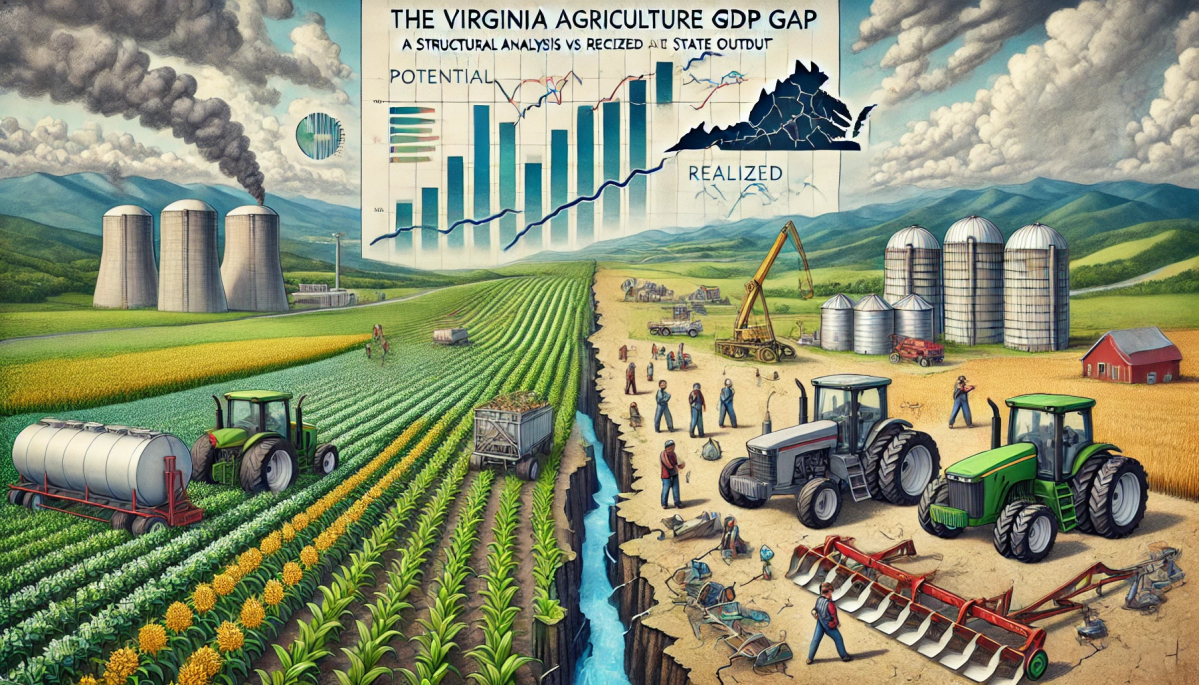
I. Executive Summary and Analytical Framework
The Commonwealth of Virginia’s agriculture sector possesses a structural capacity for output significantly greater than its realized contribution to the Gross State Product (GSP). While the total economic activity generated by agriculture and forestry is substantial, contributing $55.1 billion in value-added impact in 2021 1, the direct farming GSP (Realized N GDP) is comparatively modest and highly susceptible to volatility.2 This gap between actual performance and maximal Potential GSP (Y GDP) is fundamentally driven by two interrelated structural deficits: the rapid, permanent attrition of the agricultural land base and the chronic underutilization of existing cropland due to insufficient capital investment in yield-stabilizing infrastructure, most notably irrigation. The sector’s powerful economic multipliers—where every dollar of value-added results in an additional $1.39 in ancillary economic activity 1—means that targeted policy intervention to close the productivity gap will yield macroeconomic returns far exceeding the initial investment.
Defining the Gap (Potential GDP minus Realized GDP)
The analysis differentiates between the Realized GSP (N GDP) and the Potential GSP (Y GDP). The N GDP is precisely measured by the Bureau of Economic Analysis (BEA) direct GSP contribution of the farming subsector (NAICS 111-112). This figure is characterized by its low scale and volatility, exemplified by the Q2 2025 seasonally adjusted annual rate (SAAR) of 2,365.3 million.2
In contrast, the N GDP is modeled as the achievable output resulting from optimizing key productivity drivers on existing high-quality cropland. These drivers include widespread irrigation adoption, increased double-cropping rates, and a strategic shift in commodity focus toward high-margin specialty crops. The policy priority derived from this structural assessment is not merely volume expansion, but a shift in the value profile of production. Maximizing per-acre value through stable, high-margin production offers the highest marginal return on state investment, leveraging the sector’s robust 2.39x total value-added multiplier.1
II. Structural Dynamics: The Eroding Land Base and Agricultural Footprint
The foundation of Virginia’s agricultural potential is its land base, which is undergoing accelerated erosion, challenging the long-term feasibility of achieving Y GDP targets.
The Land in Farms Trend: Accelerated Decline
Recent data from the Census of Agriculture confirms an alarming rate of land conversion. Between 2017 and 2022, Virginia lost over 488,000 acres of farmland.3 This loss is particularly significant as it surpasses the total acreage loss recorded during the previous fifteen years, when 340,000 acres were removed from agricultural production between 2001 and 2016.3 This rapid conversion primarily targets highly developed and low-density residential land use, ranking Virginia 8th in the nation for this specific threat in one period.3
The current total land in farms stands at 7,309,687 acres as of the 2022 Census.5 Coupled with acreage loss, the state witnessed a 10% decline in the number of operational farms during the same five-year period, leaving 38,995 farms remaining.4 While small and medium farms (under 1,000 acres) decreased in number, farms greater than 1,000 acres saw a slight increase, moving from 1,340 in 2017 to 1,367 in 2022.4 This trend suggests a concentration of agricultural assets. While larger farms may realize greater economies of scale, the rapid loss of overall acreage combined with farm attrition represents a significant reduction in the fundamental resource base for Y GDP. Since land conversion is irreversible, aggressive land preservation measures are necessary to secure the raw input capacity required for future productivity gains, underscoring the importance of programs administered by the Virginia Department of Agriculture and Consumer Services (VDACS).6
Land Use Segmentation and Utilization Profile
An analysis of the remaining land base highlights the areas most critical for intensification. The 7.3 million acres of farmland are segmented into key utilization categories 5:
- Cropland: 2,884,293 acres
- Pastureland: 1,915,266 acres
- Woodland: 2,053,786 acres
The 2.88 million acres designated as cropland represent the maximum area immediately available for high-intensity crop production. Strategies aimed at increasing GSP must prioritize optimizing the use of this area. Furthermore, the demographic profile of the state’s producers presents a non-physical barrier to modernization. The average age of a Virginia farmer increased to 59.2 years in 2022, up from 57.2 in 2012.4 This demographic aging often correlates with an inherent reluctance to adopt the high-capital, high-complexity technological investments required for modern agricultural intensification, thereby impeding the realization of Y GDP.
The following table summarizes the structural challenges facing the land base:
Virginia Farmland Loss and Utilization Profile (2017-2022)
| Metric | 2022 Value | Change from 2017 | Significance to Y GDP |
| Total Land in Farms (Acres) | 7,309,687 | -6% | Defines the maximum potential physical base 5 |
| Farm Acreage Lost (2017-2022) | $>$488,000 | Accelerated Loss | Permanent erosion of productive capacity 3 |
| Number of Farms | 38,995 | -10% | Indicator of structural viability and community impact 4 |
| Total Cropland (Acres) | 2,884,293 | N/A | The critical area for intensification efforts 5 |
| Average Farmer Age (Years) | 59.2 | +2.0 (since 2012) | Proxy for innovation adoption capacity 4 |
III. Realized Economic Contribution (N GDP): Benchmarking Current Output
The overall economic impact of Virginia agriculture is substantial when considering the full supply chain, yet the direct farming contribution remains comparatively low and volatile.
Direct Farming GSP and Volatility
The direct GSP contribution from primary production (NAICS 111-112), which defines the narrowest measure of N GDP, fluctuates significantly. For instance, the Real GSP for Farms in Virginia registered 2,365.3 million (SAAR) in Q2 2025, following a peak of 3,247.2 million in Q1 2025 and a trough of 1,729.0 million in Q2 2024.2 This high volatility reinforces the argument that current production is vulnerable to climatic variability, necessitating stabilization strategies to achieve higher, more consistent Y GDP.
Total Sector Impact and Multipliers
The sector’s true macroeconomic importance is realized through its value-added processing and support chains. The combined agriculture and forestry industries generated a total value-added impact of 55.1 billion in 2021, representing a 10% growth from 2016 levels (50.1 billion in 2021 real dollars).1 Agriculture accounts for 79% of this total value-added impact and 78% of the output and employment impacts.1
Relative to the state economy, the total agriculture industry impact represents approximately 7.4% of Virginia’s GSP.1 This total impact supports a significant portion of the workforce, with 490,295 jobs attributed to the sector in 2021, accounting for 9.4% of total state employment.1 Crucially, the sector exhibits powerful economic magnification effects: every dollar generated in value-added results in another 1.39 value-added within the broader state economy, creating a total value-added multiplier of 2.39x. Similarly, every job created within the core industries results in an additional 1.6 ancillary jobs, yielding a total jobs multiplier of 2.6x.1
Commodity Profile: The Livestock/Feed Concentration
The current production mix limits the revenue potential of Virginia’s cropland, constraining N GDP. A substantial majority of agricultural sales are focused on animal products. Livestock, poultry, and related products account for 66% of the market value of products sold 5, representing 63% of farm cash receipts.7 Top commodities include Broilers (1.3 billion), Cattle and Calves (524 million), and Turkeys (403 million).8
The remaining 34% of sales derived from crops are dominated by field crops that primarily function as feed inputs for the highly successful animal industry. Corn (299 million) and Soybeans (290 million) are the most significant field crops.8 This structural dependence on low-margin, high-acreage feed crops, which are often rain-fed, effectively traps a significant portion of Virginia’s cropland in a low-yield, high-volatility production profile. While this system is necessary to support the animal industry, it consumes the majority of the 2.88 million acres of cropland 5 and restricts overall GSP potential. Achieving Y GDP requires a calculated strategy to increase the per-acre value of this land base by selectively transitioning higher-quality land away from these low-margin inputs toward high-margin specialty crops, without destabilizing the dominant animal production sector.
The economic structure is summarized below:
Virginia Agriculture Economic Impact (2021) and Multipliers
| Metric | Value | Share of VA GDP | Source |
| Total Value-Added Impact (Ag & Forest) | $55.1 Billion | 9.3% | 1 |
| Value-Added Multiplier | 2.39x | N/A | 1 |
| Total Employment Impact (Ag & Forest) | 490,295 jobs | 9.4% | 1 |
| Direct Farming GSP (NAICS 111-112, Annualized est.) | ~$9.4 Billion | ~.5% | 2 |
| Share of Sales: Livestock, Poultry, and Products | 66% | N/A | 5 |
IV. Analysis of Underutilization: Physical and Operational Constraints
The quantifiable gap between N GDP and Y GDP is primarily attributable to underutilization of existing assets, driven by insufficient input control and constrained operational capacity.
The Irrigation Deficit: The Primary Y GDP Barrier
The most significant structural factor limiting Virginia’s agricultural output ceiling is the minimal adoption of stabilized water infrastructure. Irrigation, even in the humid climate of the mid-Atlantic, transforms agriculture from a rain-fed, high-risk endeavor to a managed, high-yield system.
In comparable agricultural states like North Carolina, irrigation is a known enabler for “greater yields, improved crop quality, improved management capabilities”.9 However, the cost is a major deterrent; irrigation equipment may cost more than half as much as the land itself, and annual energy costs can be typical at 25 per acre.9 For Virginia farmers focused on low-margin feed inputs (corn, soybeans), the capital expenditure and energy costs associated with installing and operating efficient systems are difficult to justify based on expected revenue.
This absence of reliable water control forces farmers to rely on lower-risk, lower-margin commodities because they cannot guarantee the stable, high yields required for profitable specialty crops (e.g., specific vegetables, niche produce, processing inputs).5 Investment in irrigation infrastructure must therefore be viewed not merely as a production enhancement tool, but as a critical financial risk-hedging mechanism that enables the sector to shift its production portfolio to high-value commodities, thereby unlocking the state’s Y GDP.
Underutilized Cropland and Double-Cropping Potential
Maximizing the economic potential of the 2.88 million acres of cropland requires moving beyond single-season cropping, a practice known as double-cropping. Given Virginia’s temperate climate, farmers possess the opportunity to plant a second commodity (such as soybeans or hay) following the harvest of a primary crop (such as wheat or early corn). If this practice is not aggressively pursued, up to 50% of the annual potential yield value is forgone, translating directly into a diminished N GDP relative to Y GDP. Detailed information on double-cropped acreage is available through the Census of Agriculture Land Use Practices tables.10 Furthermore, achieving Y GDP also necessitates minimizing the amount of cropland that lies temporarily idle or fallow through advanced crop rotation planning and climate-stable inputs.
Productivity Lag and Innovation Deficit
Virginia’s agricultural productivity growth rate contributes to the broader global concern regarding lagging agricultural output necessary to meet future demands.12 The structural barriers to adopting technology are compounded by the demographic profile of Virginia farmers. The average age of 59.2 years 4 often results in institutional resistance to high-capital, high-complexity technological investments—such as precision agriculture, advanced soil health practices, and large-scale irrigation systems.
The strategy for overcoming this deficit must directly address the specific needs and higher risk tolerance of the state’s emerging farm segment. Virginia is home to 20,378 new and beginning farmers.7 Policy interventions should prioritize financial support and technical training for these younger, technologically adept producers to drive rapid adoption of intensive management practices, thereby accelerating the sector toward its Y GDP target. Conservation assistance, provided through programs such as those available via the Natural Resources Conservation Service (NRCS), can also be leveraged for technical support on issues like high tunnels, soil health, and irrigation management.13
V. Quantifying the Potential (Y GDP) and the Economic Gap
The quantification of Y GDP is achieved by modeling the marginal direct output increase (MΔN_GDP) resulting from intensified management practices on a conservative portion of existing cropland, and subsequently applying the sector’s established value-added multiplier.
Methodology for Y GDP Estimation
The model targets a small, realistic percentage of the existing 2.88 million acres of cropland 5 and applies two primary conservative levers:
- Lever 1: Intensification via Enhanced Double-Cropping: The model estimates the revenue gain from increasing the current double-cropping rate on approximately 10% of total cropland.
- Lever 2: Commodity Shift via Irrigation Stabilization: The model assumes shifting a conservative portion of rain-fed acreage (e.g., 5-10% of total cropland, roughly 144,000 to 288,000 acres) from low-margin feed inputs to high-margin specialty crops (vegetables, berries, nursery stock, or value-added grains).5 This shift relies entirely on the guaranteed yield stability afforded by irrigation infrastructure.
The Productivity Premium Calculation
To illustrate the potential economic magnitude, a conceptual model focuses on the revenue differential achievable through water stabilization and commodity shift.
Consider a baseline scenario where 144,000 acres (5% of total cropland) are currently dedicated to rain-fed soybeans, yielding an assumed 9.80 per bushel.14 By converting this same acreage to high-value produce or specialty crops supported by irrigation, the revenue generated per acre can increase by a factor of three to five, due to stable, high-quality yields.9 The difference between the current revenue derived from volatile row crops and the potential revenue from stabilized, high-value production represents the Direct Marginal Gain (MΔN_GDP).
The Calculated Gap (Y – N GDP)
A conservative estimation assumes that focused capital investment and technological adoption applied to approximately 200,000 highly responsive acres of cropland could yield an average marginal revenue gain of 1.500 per acre annually.
- Direct Marginal Gain (MΔN_GDP): 200,000 acres x $1,500 / acre = $300 Million
- Total Potential Impact (Y – N GDP): Applying the 2.39 value-added multiplier 1 to the direct gain:
- $300 Million x 2.39 = $717 Million Total Annual Value-Added Uplift.
This calculation highlights that the magnification of marginal gains is the core economic principle driving the Y GDP strategy. Because the value-added multiplier is robust, a targeted investment that optimizes less than 10% of the existing cropland can inject nearly three-quarters of a billion dollars in annual GSP expansion. This validates the prioritization of infrastructure investment and value-chain development over broad, unmanaged expansion.
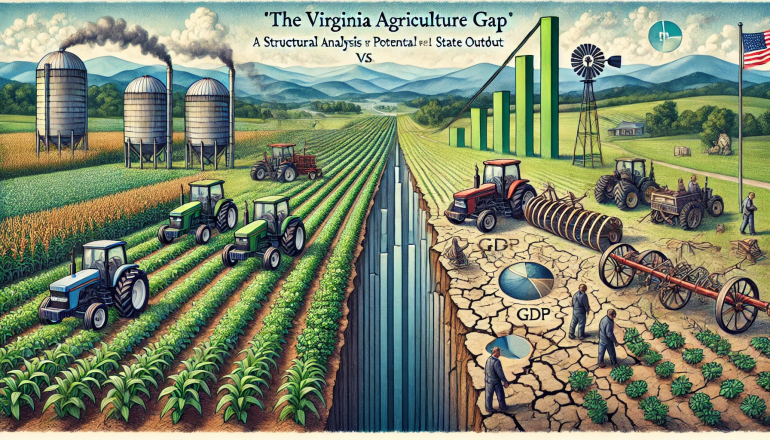
The estimated potential uplift is summarized below:
Estimated Potential Economic Uplift (Y GDP Gap) via Sector Intensification
| Driver of Potential Output | Target Cropland Acres | Estimated Direct Marginal N GDP Increase (Annualized) | Total Value-Added Impact (Multiplier 2.39x) |
| Optimization of Double-Cropping (Target 10%) | 288,429 | $432.6M | $1,034.9B |
| Targeted Irrigation Investment & High-Value Shift (Target 5%) | 144,215 | $216.3M | $516.9M |
| Total Y – N GDP Gap (Conservative Estimate) | 200,000 | $300M | $717M |
| Total Y – N GDP Gap (Full Adoption Case) | 432,644 | $648.9M | $1.55B |
Under a conservative assumption of $1,500 additional revenue per acre, optimizing 288,000 acres through double-cropping yields approximately $433M in direct farm GDP, or about $1.03B in total value-added impact after applying the sector multiplier. A further 144,000 acres of irrigation-supported crop diversification adds roughly $216M in direct GDP and $517M in total impact.
Sensitivity Tables — Direct GDP Increase
Double-Cropping (288,429 acres)
| Gain per Acre | Direct GDP Increase | Total Value-Added Impact |
| $1,000 | $288.4M | $689.3M |
| $1,500 | $432.6M | $1.03B |
| $2,000 | $576.9M | $1.38B |
Irrigation & High-Value Shift (144,215 acres)
| Gain per Acre | Direct GDP Increase | Total Value-Added Impact |
| $1,000 | $144.2M | $344.7M |
| $1,500 | $216.3M | $517.0M |
| $2,000 | $288.4M | $689.3M |
Conservative Policy Scenario (200,000 acres)
| Gain per Acre | Direct GDP Increase | Total Value-Added Impact |
| $1,000 | $200M | $478M |
| $1,500 | $300M | $717M |
| $2,000 | $400M | $956M |
Combined Scenario (432,644 acres)
| Gain per Acre | Direct GDP Increase | Total Value-Added Impact |
| $1,000 | $432.6M | $1.03B |
| $1,500 | $649.0M | $1.55B |
| $2,000 | $865.3M | $2.07B |
Depending on achievable per-acre revenue gains of $1,000–$2,000, the modeled productivity program yields between $1.03B and $2.07B in annual total economic impact across 432,000 acres. Even a conservative 200,000-acre implementation produces $478M–$956M in annual value-added output.
VI. Strategic Pathways for Maximization: A Blueprint for Sector Growth
Realizing the estimated Y GDP requires a coordinated policy blueprint focused on infrastructure stabilization, commodity repositioning, and rigorous land base protection.
Strategy 1: Water Infrastructure and Irrigation Mandate
Stabilized water supply is the foundational requirement for high-value crop production. Public policy must mitigate the high capital risk associated with irrigation installation.
The state should establish dedicated public financing mechanisms, such as low-interest loan or grant programs, specifically for the adoption of high-efficiency, energy-matched irrigation systems.9 This approach directly addresses the financial barrier faced by producers. Furthermore, Virginia should learn from the extensive water management strategies employed in high-productivity states. California, for example, is actively pursuing water recycling, expanded storage (both above and below ground), and increased stormwater capture to secure water supplies in the face of projected climate-driven water losses of 10% by 2040.15 A similar, regionally tailored water management strategy should be developed for Virginia, prioritizing agricultural supply stability and utilizing resources such as the Virginia Drought Monitoring Task Force.6 Technical assistance, possibly through NRCS Conservation Technical Assistance 13, must accompany financial incentives to ensure that installed systems are properly designed for maximum water and energy efficiency.
Strategy 2: Commodity Diversification and Value-Chain Integration
Stabilization through irrigation enables a strategic shift away from commodity dominance toward specialized, high-margin crops.
The state should incentivize the production of specialty commodities such as vegetables, melons, potatoes, sweet potatoes, fruits, tree nuts, berries, and nursery/greenhouse products, which already contribute significantly to the crop market value.5 This shift maximizes the revenue derived from limited high-quality acreage. Crucially, increased primary output must be met with adequate downstream demand. Strategic state investment must focus on expanding regional food, beverage, and fiber processing and manufacturing capacity. Supporting these industries, which have grown employment by 2% over five years 7, ensures that the economic value of higher-margin crops is captured locally, fully leveraging the sector’s economic multipliers and insulating producers from external market volatility.17 Direct policy support should include tax incentives or matching grants for farmers who enter into stable, multi-year production contracts with processors, thereby mitigating market risk during the crucial transition to specialized production.
Strategy 3: Land Preservation and Productive Use Incentives
The integrity of the land base must be secured, and remaining land must be directed toward maximal productivity.
Given the accelerated loss of nearly half a million acres of farmland in five years 3, funding for VDACS Farmland Preservation programs 6 must be substantially increased and accompanied by stronger local zoning protections. Furthermore, state support programs should be reformed to link incentives directly to measures of productivity rather than solely conservation status. For instance, enhanced tax credits or state payments could be offered to farms that demonstrate achieved targets for double-cropping rates or certified adoption of advanced irrigation technology. This approach ensures that preserved land is also land actively contributing to Y GDP. Finally, acknowledging the high value-added potential of specialized, small-footprint operations, existing conservation assistance should be utilized to support urban agriculture, including high tunnels and composting.13
VII. Macroeconomic and Policy Implications of Closing the GDP Gap
The successful realization of the projected Y GDP gap closure holds profound implications for the overall fiscal health, workforce stability, and economic resilience of the Commonwealth.
Fiscal Benefits and Reduced Volatility
The projected annual total value-added uplift of ~$717 million resulting from a targeted productivity increase generates substantial new state and local tax revenue. This increased revenue stems from higher net farm income—which already demonstrated high elasticity, growing 78% between 2017 and 2022 5—enhanced processing activity, and corresponding growth in the ancillary labor force.
Increased farm profitability and yield stability, enabled by irrigation, reduce the agricultural community’s reliance on volatile federal government payments, which totaled 70.5 million in 2022 5, and on costly disaster relief. This fiscal independence and stability mitigate state risk exposure and allow for greater predictability in regional economic planning.
Employment, Workforce Development, and Resilience
The strategic shift to high-value specialty crops and processing is inherently labor-intensive, dramatically leveraging the sector’s 2.6x jobs multiplier.1 The creation of stable, high-value output will translate into the creation of thousands of new, sustained jobs, both directly on farms and throughout the processing, logistics, and supply chain sectors.
This intensification also necessitates a transition toward a higher-skilled workforce proficient in precision agriculture, advanced water management, and post-harvest handling. This demand drives necessary workforce development and technical training, providing opportunities for Virginia’s new and beginning farmers 7 to adopt technical expertise and enter a more profitable profession. Overall, by implementing diversified, managed, and irrigated production systems, the state significantly improves the sector’s resilience against environmental shocks like drought, thereby contributing to robust economic stability and enhanced regional food security.6
Global Competitiveness and Productivity Standard
Virginia’s proactive strategy to close its Y GDP gap serves as a direct response to the broader challenge of lagging global agricultural productivity identified by researchers.12 By focusing capital investment on structural improvements like water infrastructure to maximize output on a rapidly shrinking land base, the Commonwealth establishes a model for intensive, sustainable, and high-value agriculture in the competitive mid-Atlantic region.
VIII. Conclusion and Policy Synthesis
The disparity between Virginia’s realized agricultural output (N GDP) and its modeled potential (Y GDP) is a structural constraint, not an immutable limitation. The analysis confirms that accelerated land loss diminishes the resource base, while chronic underinvestment in water infrastructure limits the value derivable from the remaining cropland, trapping the sector in a lower-margin, volatile production cycle. By addressing the critical infrastructure deficit—the lack of irrigation—the state can unlock a conservative ~$717 million in annual total value-added GSP uplift, generating thousands of jobs and substantial new fiscal revenue through the sector’s powerful multipliers.
Prioritized 5-Year Action Plan (Roadmap to 50% Gap Closure):
- Water Security Investment Act: Authorize a dedicated, revolving state-backed fund offering low-interest loans and substantial grants for the implementation of modern, high-efficiency irrigation systems on commercial cropland (prioritizing operations capable of high-volume, high-value production). This infrastructure investment is the prerequisite for all subsequent productivity gains.
- Productivity Preservation Policy: Significantly enhance funding and enforcement mechanisms for VDACS Farmland Preservation programs to immediately halt the accelerated rate of land conversion. Concurrently, restructure state agricultural support programs to tie incentives (tax relief, direct grants) to demonstrable improvements in land utilization, such as verified increases in double-cropping rates and certified adoption of irrigation on high-value acreage.
- Value-Chain Catalyst Fund: Institute a targeted fund designed to attract, expand, and support food, beverage, and fiber processing facilities within the Commonwealth. This investment ensures local market demand for the anticipated surge in high-value specialty crops enabled by stable irrigation, allowing Virginia to capture the full economic magnification potential of the 2.39x value-added multiplier.
Works cited
- The Economic Impact of Agriculture and Forest Industries in Virginia …, accessed September 28, 2025, https://www.coopercenter.org/research/economic-impact-agriculture-forest-industries-virginia
- Gross Domestic Product: Agriculture, Forestry, Fishing and Hunting (11) in Virginia (VAAGRNQGSP) | FRED – Federal Reserve Bank of St. Louis, accessed September 28, 2025, https://fred.stlouisfed.org/series/VAAGRNQGSP
- Virginia is Losing Farmland at a Record Pace – Capital Region Land Conservancy, accessed September 28, 2025, https://capitalregionland.org/2024/03/virginia-losing-farmland-at-record-pace/
- New census reveals a decrease in farms and farmland – Agriculture – Virginia Farm Bureau, accessed September 28, 2025, https://articles.vafb.com/new-census-reveals-a-decrease-in-farms-and-farmland/
- Virginia – USDA National Agricultural Statistics Service, accessed September 28, 2025, https://www.nass.usda.gov/Publications/AgCensus/2022/Online_Resources/County_Profiles/Virginia/cp99051.pdf
- Conservation & Environmental – The Virginia Department of Agriculture and Consumer Services, accessed September 28, 2025, https://www.vdacs.virginia.gov/conservation-and-environmental.shtml
- Virginia Agriculture Facts & Figures, accessed September 28, 2025, https://www.vdacs.virginia.gov/markets-and-finance-agriculture-facts-and-figures.shtml
- Virginia Farm Bureau – Agriculture Facts, accessed September 28, 2025, https://www.vafb.com/membership-at-work/agriculture/agriculture-facts
- Irrigation Management Strategies to Improve Water and Energy-Use Efficiencies, accessed September 28, 2025, https://content.ces.ncsu.edu/irrigation-management-strategies-to-improve-water-and-energy-use-efficiencies
- Virginia – State and County Data – USDA National Agricultural Statistics Service, accessed September 28, 2025, https://www.nass.usda.gov/Publications/AgCensus/2022/Full_Report/Volume_1,_Chapter_1_State_Level/Virginia/vav1.pdf
- 2022 Census of Agriculture – Volume 1, Chapter 1: State Level Data, accessed September 28, 2025, https://www.nass.usda.gov/Publications/AgCensus/2022/Full_Report/Volume_1,_Chapter_1_State_Level/Virginia/
- Agricultural productivity growth falls short of meeting global demands, Virginia Tech report says, accessed September 28, 2025, https://news.vt.edu/articles/2024/10/cals-GAP-Report-Launch.html
- Virginia Land Use and Protection | Natural Resources Conservation Service, accessed September 28, 2025, https://www.nrcs.usda.gov/state-offices/virginia/virginia-land-use-and-protection
- USDA/NASS 2024 State Agriculture Overview for Virginia, accessed September 28, 2025, https://www.nass.usda.gov/Quick_Stats/Ag_Overview/stateOverview.php?state=VIRGINIA
- California’s Water Supply Strategy: Adapting to a Hotter, Drier Future, accessed September 28, 2025, https://resources.ca.gov/-/media/CNRA-Website/Files/Initiatives/Water-Resilience/CA-Water-Supply-Strategy.pdf
- Water Resource Management Strategies, accessed September 28, 2025, https://water.ca.gov/Programs/California-Water-Plan/Water-Resource-Management-Strategies
- Virginia – Economic Impact of Agriculture |, accessed September 28, 2025, https://economic-impact-of-ag.uada.edu/virginia/
 Jarad Ponce