Executive synthesis and valuation range
Hacienda de San Antonio is best understood not as a “hotel with land,” but as a hybrid trophy asset: a revenue-producing ultra-luxury boutique lodge welded to a multi-thousand‑acre working landscape (ranching, organic agriculture, coffee) and a carefully curated historical narrative. That hybridity breaks conventional hotel valuation shortcuts and forces a triangulation across (i) income capitalization, (ii) sales comparison (thinly disclosed for true peers), and (iii) depreciated replacement cost—then reconciled through a buyer-type lens that explicitly prices intangible heritage, ecological scarcity, and Mexico-specific risk. [1]
Triangulated market value estimate (fee-simple going-concern, USD): $80 million to $150 million, with a central tendency around $105 million. This is not a “single-point” appraisal; it is a probability-weighted valuation for an asset whose marginal buyer is often an UHNWI seeking seclusion + cultural capital (trophy utility) as much as financial yield. [2]
Probabilistic confidence band (model-based): – P5–P95: $69 million–$146 million
– Median: $103 million
These percentiles come from a Monte Carlo framework described in the income section (cap rate, ADR, occupancy, ancillary revenue intensity, disruption risk, and an explicit “estate/land premium” factor). “Confidence” here is model confidence, not a guarantee of transaction observability, because true peers trade privately and disclosure is structurally limited. [3]
Interpretive key: If valued purely as a small remote 25‑key lodge, the property can screen modestly; the valuation expands once the buyer prices (a) estate-scale control of landscape, (b) brand/heritage aura (Gold List stature), and (c) real options (buyouts, branded residences, conservation/carbon monetization). [4]
Asset anatomy: physical, operational, and heritage attributes
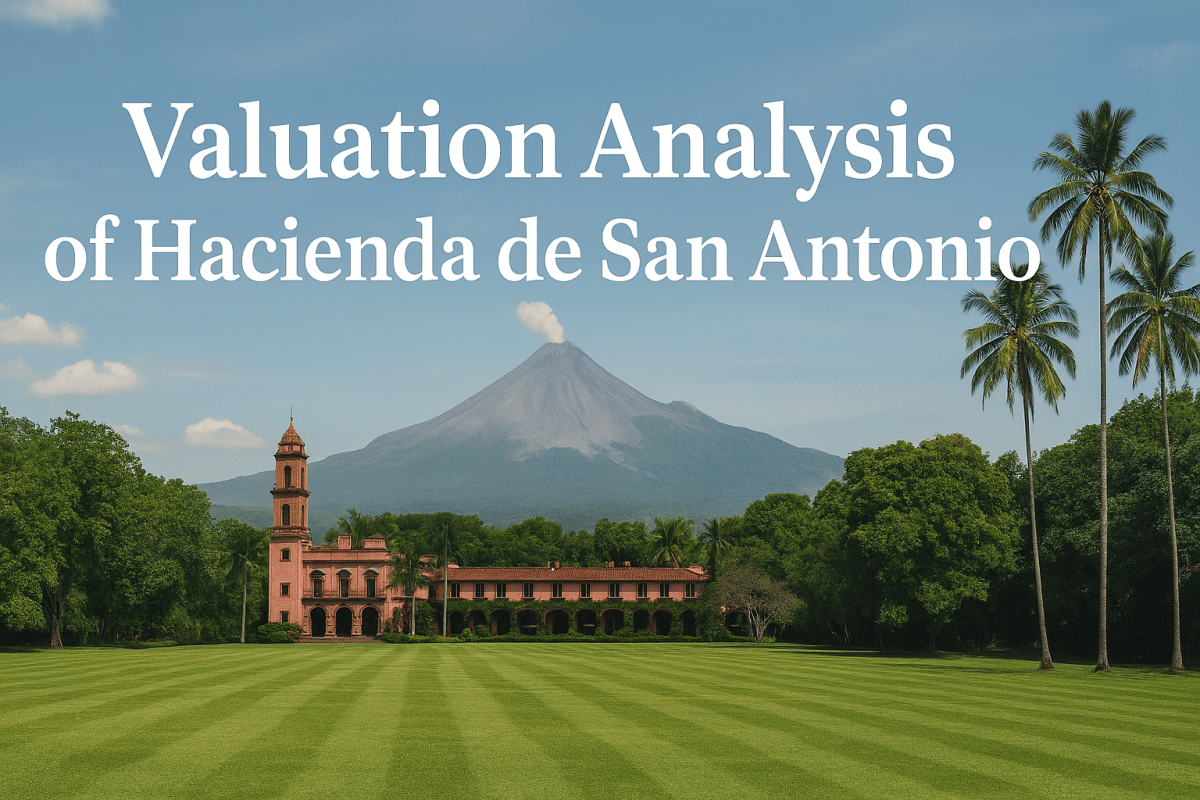
Hacienda de San Antonio is positioned in the highlands of Comala[5], in Colima[6], beneath the visual and risk-bearing presence of Volcán de Colima[7]. [8] The lodgings are intimate—25 rooms/suites—which is central to both pricing power and operational fragility (one group buyout can define a month; one closure can define a quarter). [9]
The property’s “scale paradox” is explicit in third-party descriptions: an estate that is simultaneously “an unexpected luxury” and a “nature reserve” in the thousands of acres. [10] The on-site narrative is not incidental; it is monetizable meaning. A travel account describes the hacienda as a 19th‑century coffee plantation linked to German businessman Arnoldo Vogel and Doña Clotilde Vogel, with a chapel built in 1913 in the context of volcanic threat—an origin story that fuses piety, risk, and place-branding. [11]
This heritage is layered with elite ownership lineage and connoisseur design signaling. A reprint of a The Wall Street Journal[12] piece by David Netto[13] frames the hacienda as an acquired jewel tied to the Goldsmith–Patiño social universe and credits French designer Robert Couturier[14] with restoration and atmosphere. [15] The Patiño link is consistent with broader public descriptions of **Antenor Patiño[16] as the “King of Tin.” [17]
Demand signals are unusually prestigious for so small an asset: Condé Nast Traveler[18] lists the property as Gold List 2020, notes repeated “Readers’ Choice Awards” years, and emphasizes its volcano-foot setting and nature-reserve scale. [19] World Travel Awards[20] records the hacienda as Mexico’s Leading Boutique Hotel (2015) and shows continuing nominations in later years. [21]
Operationally, the property’s farm-and-ranch integration is not a decorative trope. A detailed travel report states that the adjacent ranch produces much of the food used on menus—dairy, beef, honey, fruits and vegetables—linking the hospitality product to an internal supply chain (and to a particular “clean” luxury aesthetic). [11] The ranch narrative is reinforced by the property’s own materials describing biodynamic/organic practices on Rancho Jabalí. [22]
Comparable set and hedonic adjustments
Comparable set selection logic
“Comparable” here must be read in the old appraiser’s sense—assets that illuminate pricing behavior—not in the simplistic “same room count, same market” sense. The closest peers are ultra-low-key-count, high-ADR, high-privacy eco/heritage compounds where guests buy narrative, landscape control, and aesthetic authority.
A practical comp set therefore spans: – Mexico’s ultra-luxury eco-estates (Costalegre)
– Restored hacienda-hotels (Yucatán Peninsula)
– Latin American estancia/lodge estates (Uruguay/Argentina)
– Colombian finca/coffee estates with hospitality potential (to bracket agricultural-land value and eco-tourism optionality)
This produces a hedonic comparison rather than a pure sales grid: we adjust for (i) land scale, (ii) ecological signature, (iii) historical authenticity, (iv) accessibility (airstrips/drive time), (v) hospitality intensity (keys/ADR), and (vi) prestige signals (editorial awards).
Structured comparables table
| Comparable (region) | Keys / lodging intensity | Estate scale (reported) | Nature / heritage anchor | Notable amenities & revenue textures | Price disclosure status |
| Cuixmala[23] (Costalegre) | 40 rooms | “More than 30,000 acres” and 5 km coastline | Eco-resort on a vast coastal reserve; Goldsmith family provenance | Multi-format lodging (suites/bungalows/casitas/casas), wildlife reserve framing | No recent disclosed sale; used as prestige & land-scale benchmark [24] |
| Las Alamandas[25] (Costalegre) | 18 suites + villas | 2,000+ acres nature reserve | Private-beach eco-luxe seclusion | Private beaches; (historically) landing strip; romance/events emphasis | No disclosed sale; used as ultra-low-density coastal eco-luxe benchmark [26] |
| Hacienda Temozón[27] (Yucatán) | ~28 rooms | ~36 hectares (≈89 acres) | Restored estate with cenote/spa lore and plantation history | High-event capacity; heritage restoration model | No disclosed sale; used for restored hacienda hotel economics [28] |
| Estancia Vik José Ignacio[29] (Uruguay) | 12 suites | Frequently described as a ranch estate | Art-integrated estancia luxury | Horse/country leisure product; art as differentiator | No disclosed sale; used for art-as-amenity hedonic premium [30] |
| Estancia Punta del Lago[31] (Patagonia) | Residential/agricultural listing w/ lodge elements | 26,239 hectares / 64,840 acres | Vast landscape + lake frontage | Tourism/eco-project optionality described | Asking price disclosed (~$4.56M); used only to bracket raw land value dispersion vs. improved trophy estates [32] |
| Colombian coffee estate examples (Antioquia/Risaralda) | Mixed: farm + eco-resort potential | Tens of hectares | Waterfalls/coffee terroir | Eco-lodge potential; agricultural revenue | Listings disclosed (~$245k–$1.15M); used to triangulate agro-tourism land pricing floor [33] |
Hedonic differentials and qualitative adjustments
A comparative framework for Hacienda de San Antonio must explicitly separate hotel utility from estate utility:
- Hotel utility driver: A 25‑key asset recognized by elite travel curators can support unusually high ADR for its size, especially when scarcity itself is part of the product. [34]
- Estate utility driver: The “5,000-acre” framing sets it apart from typical restored hacienda hotels (often tens of hectares) and places it closer to eco-estates where land control is a feature, not a backdrop. [35]
- Ecological premium: Biodynamic and on-estate sourcing (produce, dairy, coffee) can justify higher guest willingness-to-pay because it bundles wellness, authenticity, and ethics into the consumption experience. [36]
- Geohazard discount (and aesthetic premium): Proximity to an active volcanic complex is simultaneously a visual moat and a risk premium. Colima is documented as an active volcanic center with a substantial eruptive history. [37]
Because disclosed Mexico transactions for true peers are scarce, the sales comparison approach is best treated as a range discipline: it constrains implausible outcomes and informs the “estate premium” that a purely NOI-based approach would miss.
Income capitalization approach
Rate foundation and revenue architecture
Published rate sheets (archival PDFs indexed by search) show suite-level pricing that credibly supports the user’s stated $1,000–$2,000/night band in peak contexts. Examples: a 2025 rate sheet snippet lists Hacienda Suite prices in the high hundreds to low thousands depending on season, and a 2023 sheet displays Grand Suite figures extending into the mid‑to‑high four-digit range. [38] Traveler commentary also reports realized pricing around $1,800/night in at least one stay narrative, anchoring the practical upper tail. [39]
Operationally, Hacienda de San Antonio behaves less like a “city hotel” and more like a contained micro-destination: guests dine and recreate largely on-property, and the ranch is positioned as a core part of the experience. [40] This matters because ancillary revenue intensity (food & beverage, experiences, events/buyouts) is often the difference between a small lodge that appraises thinly and one that capitalizes richly.
NOI modeling: scenarios rather than a single forecast
Given public non-availability of audited financials, the credible posture is scenario-based. The model below uses the following explicit assumptions (not claims of current performance):
– 25 keys (fixed) [9]
– Occupancy distributed around a mid-case consistent with a high-ADR, remote, award-driven lodge product (scarcity supports ADR; remoteness constrains occupancy) [3]
– Total revenue modeled as a multiple of rooms revenue to capture ranch-driven dining and activities (supported qualitatively by on-estate sourcing narratives) [41]
– Disruption factor to represent episodic volatility (volcanic activity risk; access disruption) [42]
Cap rate selection. For bespoke assets in Mexico, cap rates are not a spreadsheet constant; they are a negotiation between (a) coveted scarcity and (b) locality risk. This property benefits from global luxury travel resilience—JLL notes global hotel investment growth and international arrivals surpassing pre-pandemic levels in 2025—yet remains exposed to Mexico’s macro volatility and local hazard. [43]
Monte Carlo valuation output
A Monte Carlo simulation (20,000 iterations) was run with distributions for: occupancy, ADR (anchored to published rate ranges), ancillary revenue intensity, NOI margin, cap rate, and an explicit “estate/land premium” factor representing the value of landscape control and optionality beyond lodge cash flow (buyouts, additional keys/villas, conservation/carbon). [44]
Outputs (USD): – Median (P50): ~$103M
– P5–P95: ~$69M–$146M
– Central 80% band (P10–P90): ~$75M–$136M
Interpretation. The distribution is driven less by room-rate uncertainty (rates are observable) than by:
1) how large a buyer prices the “estate premium,” and
2) whether the buyer views the property as a stabilized going-concern or as a strategic lifestyle enclave with real options.
Cost approach: depreciated replacement cost and restoration economics
Replacement cost logic for a heritage hacienda
The cost approach is the most philosophically aligned with heritage assets because it prices what markets often ignore: irreplaceability. But it must be handled with restraint: you cannot “replace” a cultural palimpsest; you can only approximate it with costly craftsmanship, thick walls, and patient landscape work—and then still lack the aura premium that editorial recognition confers. [3]
Two anchoring restoration/build-cost signals are relevant:
1) Per-key luxury development costs. Industry reporting (referencing the HVS hotel development cost survey) notes luxury hotel development averaging above $1M per key, with projects reaching $2M per key. [45] A 25‑key property at those levels implies $25M–$50M for “hotel-only” vertical cost—before estate infrastructure, gardens, water systems, staff housing, stables, roads, and the premium attached to artisanal elements.
2) Suite size escalation. The property’s Grand Suites are described at roughly 1,400 sqft, and non-grand suites are repeatedly framed as large-format suites rather than standard rooms—implying a materially higher gross building footprint per key than a typical luxury hotel. [46]
Estate infrastructure and landscape as capitalized works
Unlike a typical boutique hotel, Hacienda de San Antonio’s value proposition includes constructed landscape: formal gardens, water features, and the operational backbone of a working ranch. Narrative sources describe fountains/canals, extensive gardens, a tennis court, libraries, and on-estate agricultural production. [47] These are not merely operating expenses; they are embedded capex that a buyer would struggle to recreate—especially under contemporary environmental scrutiny and rising cost regimes.
On inflation measurement: INEGI[48] reports Mexico’s consumer price index (INPC) levels and ongoing inflation prints (e.g., INPC level 143.042 in December 2025, base mid‑2018=100). While CPI is not a construction-cost index, it establishes the macro reality that renovation and labor costs have been compounding over time. [49] Construction industry commentary similarly highlights continued cost pressure and cost-index movement (e.g., Turner’s building cost index updates). [50]
Depreciation, obsolescence, and the heritage “add-back”
A depreciated replacement cost frame typically subtracts: – Physical depreciation (age, wear)
– Functional obsolescence (historic layouts vs. modern guest expectations)
– External obsolescence (market access constraints, hazard perception) [51]
But for an elite hacienda-hotel, appraisers often re-add premiums for: – Artisanal and archival elements (bespoke craft, antique quality signaling) [52]
– Narrative authenticity (coffee-plantation lineage; chapel origin story) [11]
– Prestige certification-by-editorial (Gold List, awards)—a market proxy for “cultural surplus value.” [34]
In triangulation, the cost approach therefore functions as a value floor with a heritage escalator: it restrains the analysis from underpricing the asset as “just 25 rooms,” while remaining honest that replacement does not necessarily equal realizable transaction value.
Macro, ecological, and geopolitical overlays
Mexico luxury demand and the “quiet-luxury” macro tailwind
Tourism fundamentals matter because they sustain ADR elasticity. A Mexico hotel market outlook notes tourism’s large national footprint—contributing materially to GDP and employment in 2024—with international arrivals and U.S.-sourced demand prominent. [53] Global hotel capital markets commentary similarly points to improving investment volumes and post-pandemic normalization of travel demand. [54]
For Hacienda de San Antonio specifically, “quiet luxury” is not trend-chasing; it is the native design: isolation, low key-count, and the ability to feel like the only guest—an attribute explicitly described in the Condé Nast review. [9]
Currency, foreign ownership mechanics, and investability
From a cross-border buyer’s perspective, the peso is both a cost base and a valuation risk factor. A Reuters poll anticipated the MXN trading within a long-held band, with forecasts of mild weakening—helpful context for USD-denominated investors underwriting long-run cost inflation and repatriation logic. [55]
Foreign ownership restrictions are often misunderstood. Mexico’s own consular guidance explains that foreigners may directly own land outside the constitutionally defined “restricted zone” (within 50 km of the coast and 100 km of borders), implying that an inland hacienda can be structurally simpler than beachfront trophy assets that require trust mechanisms. [56]
Ecological premium and carbon-credit optionality
A credible ecological premium has three channels:
1) Guest willingness-to-pay for on-estate organic/biodynamic provenance and landscape immersion (supported by descriptions of ranch-based sourcing and biodynamic practice). [36]
2) Risk mitigation via diversified revenue (hospitality + agricultural production), which can stabilize cash flow relative to a single-stream lodge. [11]
3) Optionality in environmental markets. Mexico has been progressing climate-policy architecture; the International Carbon Action Partnership outlines the development pathway of Mexico’s emissions trading system. [57] On the voluntary side, market reports (Ecosystem Marketplace) document the scale and price volatility of voluntary carbon credits, meaning carbon monetization is best treated as an option rather than a base-case income line. Standards bodies (e.g., Verra) provide the methodological scaffolding used globally for land-based carbon projects, relevant to a large estate with potential afforestation/soil-carbon initiatives. [58]
Geophysical risk as an explicit pricing input
The volcanic context is not rhetorical. Smithsonian/USGS reporting characterizes the Colima volcanic complex as a prominent active center with documented ashfall events and eruptive episodes. [37] For valuation, this is translated into: – higher required yields (cap rate uplift),
– higher insurance/contingency costs, and
– a stochastic “disruption factor” in revenue (closure days, access interruptions).
Notably, the same volcano is also a view premium that strengthens the property’s differentiation moat, a duality directly implied in travel descriptions emphasizing the volcano as part of the experience. [59]
Triangulation, sensitivity, and the final appraisal view
Reconciliation of the three classical approaches
Income approach (primary weight): Most defensible for a going-concern, but must include (i) ancillary intensity and (ii) an explicit estate premium because the cash flow alone can understate the motive of the marginal buyer. [60]
Sales comparison (discipline weight): Direct disclosed Mexico peer transactions are limited; however, comparable eco-estates demonstrate the market’s willingness to pay for low-density seclusion (Costalegre) and art/heritage positioning (estancia model). Meanwhile, disclosed estancia and finca listings help bracket the massive dispersion between raw land and narrative-rich estates—supporting why “acres alone” can be cheap, while “acres + story + hospitality” can be dear. [61]
Cost approach (floor + heritage escalator): Luxury per-key replacement costs establish a meaningful floor for the lodging core, and the estate’s integrated landscapes/infrastructure justify additional replacement-cost layers that ordinary boutique hotels do not carry. [62]
Sensitivities that dominate the value
The valuation is most sensitive to four parameters:
- Cap rate / required yield. A move from ~6.5% to ~8.0% can compress value meaningfully because stabilized NOI for a 25-key asset is finite. [63]
- Estate premium factor. This is the largest “nonlinear” driver, reflecting that many buyers are not purely yield buyers; they are buying controlled landscape and cultural capital. [3]
- Ancillary monetization. Ranch-driven dining and experiences can materially change margins; the property’s own narrative emphasizes internal sourcing and on-estate activities, which supports (but does not guarantee) high capture rates. [64]
- Disruption/closure risk. This is tied to the volcanic complex’s activity history and is priced as probabilistic downtime rather than sensationalized hazard. [42]
Final valuation range in USD
Concluded valuation range: $80M–$150M (USD).
Point of highest probability (median model outcome): ~$103M.
This conclusion reflects the property’s status as a refined enclave: a place where the guest experience is inseparable from the estate’s ecological and historical architecture, and where ownership is as much stewardship of a cultural landscape as operation of a hotel. The valuation therefore recognizes the asset not merely as rooms and RevPAR, but as an actively curated mythos—an economic engine built atop inheritance, design authorship, and the rare luxury of controlled silence beneath an awake volcano. [65]
[1] [2] [3] [4] [6] [7] [8] [9] [10] [16] [19] [25] [31] [34] [35] [40] [51] [59] [60] [65] https://www.cntraveler.com/hotels/comala/hacienda-de-san-antonio
https://www.cntraveler.com/hotels/comala/hacienda-de-san-antonio
[5] [15] [52] https://lprluxury.com/haciendadesanantonio/
https://lprluxury.com/haciendadesanantonio/
[11] [20] [27] [36] [41] [47] [48] [64] https://mexiconewsdaily.com/travel/hacienda-de-san-antonio-two-nights/
https://mexiconewsdaily.com/travel/hacienda-de-san-antonio-two-nights/
[12] [53] https://horwathhtl.com/publication/mexico-hotel-market-2024/
[13] [23] [55] https://www.reuters.com/world/americas/mexicos-peso-trade-within-decade-old-range-2026-2025-12-03/
https://www.reuters.com/world/americas/mexicos-peso-trade-within-decade-old-range-2026-2025-12-03/
[14] [42] https://volcano.si.edu/showreport.cfm?doi=10.5479%2Fsi.GVP.BGVN201601-341040
https://volcano.si.edu/showreport.cfm?doi=10.5479%2Fsi.GVP.BGVN201601-341040
https://en.wikipedia.org/wiki/Antenor_Pati%C3%B1o?utm_source=chatgpt.com
[18] [56] https://consulmex.sre.gob.mx/reinounido/index.php/en/servicios/218-acquisition-of-properties-in-mexico
[21] https://www.worldtravelawards.com/profile-34263-hacienda-de-san-antonio
https://www.worldtravelawards.com/profile-34263-hacienda-de-san-antonio
[22] https://haciendadesanantonio.com/rancho-jabali-og/
[26] [61] https://www.alamandas.com/
[28] https://www.jacadatravel.com/latin-america/mexico/around-merida/accommodation/hacienda-temozon/
https://www.jacadatravel.com/latin-america/mexico/around-merida/accommodation/hacienda-temozon/
[30] https://www.estanciavik.com/en/
https://www.estanciavik.com/en/
[32] https://www.realtor.ca/real-estate/28095357/-estancia-punta-del-lago-argentina
https://www.realtor.ca/real-estate/28095357/-estancia-punta-del-lago-argentina
[33] https://coffeecountryrealestate.com/properties/details/?id=00084
https://coffeecountryrealestate.com/properties/details/?id=00084
[37] https://volcano.si.edu/showreport.cfm?wvar=GVP.WVAR20150708-341040
https://volcano.si.edu/showreport.cfm?wvar=GVP.WVAR20150708-341040
[38] [44] https://haciendadesanantonio.com/wp-content/uploads/2025/06/2025_Public_Room_Rates.pdf
[39] https://www.tripadvisor.com/Hotel_Review-g1744419-d625594-Reviews-Hacienda_De_San_Antonio-Comala_Pacific_Coast.html
[43] [54] [63] https://www.jll.com/en-us/insights/market-outlook/global-hotel-investment
https://www.jll.com/en-us/insights/market-outlook/global-hotel-investment
[45] [62] https://hotelsmag.com/news/luxury-hotels-are-more-expensive-than-ever-to-build-it-doesnt-mean-they-arent-getting-done/
[46] https://haciendadesanantonio.com/accommodation/grand-suite/
[49] https://www.inegi.org.mx/contenidos/saladeprensa/boletines/2026/inpc/inpc_2q2026_01.pdf
[50] https://www.turnerconstruction.com/insights/turner-building-cost-index-shows-growth-in-q4-2025-amid-strong-data-center-and-manufacturing-demand
[57] https://es.wikipedia.org/wiki/Antigua_Hacienda_de_San_Antonio_Claver%C3%ADa
https://es.wikipedia.org/wiki/Antigua_Hacienda_de_San_Antonio_Claver%C3%ADa
[58] https://es.wikipedia.org/wiki/Hacienda_de_San_Antonio_del_Muerto
https://es.wikipedia.org/wiki/Hacienda_de_San_Antonio_del_Muerto
 Jarad Ponce