Executive Summary
Wine bottles are not merely containers; they are a technological system that co-evolved with trade, law, and sensory expectations. In antiquity, fermented beverages (including wine) moved largely in ceramic transport amphorae—durable in the archaeological record, stamped and labeled, and optimized for shipping and handling—well before glass became a dominant packaging substrate. [1] The pivotal enablers for modern “bottle-aged” wine were: (1) glassblowing and later industrial glassmaking, and (2) closures capable of maintaining an effective seal over years (notably cork), together creating a stable, small-volume package suitable for predictable aging and long-distance commerce. [2]
By the 17th century, stronger, darker English bottle-glass made in coal-fired furnaces—and documentary evidence associating early “glass bottle” innovation with Sir Kenelm Digby[3]—helped shift wine from barrels and fragile vessels toward standardized glass packages. [4] Industrialization then transformed the bottle from artisanal variability to machine repeatability, notably via Michael J. Owens[5]’ 1904 “glass-shaping machine” patent, which helped scale bottle production and reduce unit costs. [6]
In parallel, regional bottle forms (e.g., Bordeaux/“claret,” Burgundy, Champagne) became culturally legible “signals” while also reflecting functional constraints: sparkling-wine bottles require thicker glass and safety margins because they contain high internal pressure; the official Comité Champagne[7] describes today’s Champagne bottles as designed to withstand ~20 bar—about three times Champagne’s natural pressure—underscoring the engineering embedded in a familiar silhouette. [8] At the same time, law and regulation increasingly standardized volumes (e.g., EU “nominal volumes” such as 0.75 L) and constrained certain bottle shapes as protected indications of origin. [9]
Technologically, the “wine bottle system” hinges on glass composition (most commonly soda–lime glass), manufacturing method (blow-and-blow vs press-and-blow families on I.S. machines), and closure oxygen transmission rate (OTR). [10] These variables materially affect wine development: oxygen ingress can preserve fruit (low OTR), push wines toward oxidative notes (high OTR), or—if too low—raise the risk of reductive off-aromas, while light transmission through glass (especially clear/flint) can catalyze “light-struck” faults in sensitive wines. [11]
Contemporary issues increasingly revolve around sustainability, logistics, and consumer perception. The carbon footprint of single-use glass bottles is strongly influenced by bottle weight and recycled content (cullet): European container-glass industry sources cite ~3% furnace energy reduction for each +10% cullet, alongside greenhouse-gas reductions; meanwhile recycling outcomes diverge across regions (high in much of the EU, lower in the U.S. historically). [12] Recent industry initiatives target “lightweighting” (e.g., a still-wine 750 mL average weight around ~550 g with targets <420 g by end-2026 in some programs) and product innovations such as a 300 g Burgundy-format bottle. [13]
Origins and Timeline
The deep history of wine packaging begins with ceramics. “Commercial transport amphoras” functioned as large, standardized-by-practice shipping containers across the Mediterranean for centuries, used for wine and other bulk liquids and commodities; their shapes facilitated storage (stacking in ship holds), handling, and sealing, while stamps and inscriptions acted as early “packaging information systems.” [14] Importantly, amphora “standardization” was real but not uniform in the modern industrial sense; archaeological scholarship emphasizes that capacities varied and are challenging to treat as tightly standardized across regions and periods. [15]
Glass containers existed in the Roman world, but a key inflection point was the emergence of true glassblowing. The Corning Museum of Glass[16] summarizes archaeological evidence for the earliest closely datable inflated-glass artifacts (mid-1st century BCE, ~50–40 BC) from Jerusalem, often treated as the strongest early material evidence for the glassblowing revolution. [17] By the early Imperial period, glass vessels became widely used in the Roman world, though wine packaging for trade still leaned heavily on ceramics and wood (barrels), given economics and logistics. [18]
Early modern Europe then produced the recognizable ancestor of today’s wine bottle. A Historic England[19] research report synthesizes documentary evidence from the 1660s about glass bottle invention and public use; it cites an Attorney General’s report attributing early invention to Sir Kenelm Digby “nearly 30 years” earlier—implying ~1631–1632—while also noting the contested nature of credit among glassmakers. [4] This period also coincided with transitions in furnace design and fuels (e.g., coal) that supported darker, thicker bottle glass with improved strength—features tightly linked to storing and shipping wine in glass. [4]
Industrial bottle-making was a second revolution. Owens’s 1904 patent (“Glass-shaping machine,” US 766,768) exemplifies the shift toward automated forming that scaled output and improved dimensional repeatability. [20] This changed not only cost but also what regulators and logistics systems could assume about bottle finishes, closures, and case/pallet standardization. [21]
Regulation then helped lock in modern “standards.” EU law on nominal quantities for certain prepacked liquids explicitly lists permitted volumes for still and sparkling wines among other categories. In European Union[22] Directive 75/106/EEC (Annex III), “wine of fresh grapes” includes 0.75 L (and also 0.375, 0.5, 1.0, 1.5, etc.), reinforcing the 75 cL bottle as a core commercial unit in the European market architecture. [23] In the U.S., standards of fill for wine were metricated in the late 1970s, shaping the dominance of 750 mL in American retail.
A final modern trajectory is transparency and sustainability regulation: e.g., new EU wine labeling rules (including pathways for ingredient and nutrition disclosure via e-label mechanisms) apply from December 8, 2023, with official Commission guidance clarifying compliance approaches. [24]
Milestones Timeline
The table below consolidates major milestones (technology, policy, and practice) that shaped the modern wine bottle, drawn from archaeological scholarship, patents, and regulatory texts. [25]
| Era | Milestone | Why it mattered for wine packaging |
| ~1500 BCE–500 CE | Transport amphoras used at scale for Mediterranean liquid trade | Established durable, information-bearing containers; enabled long-distance wine commerce and proto-standard packaging logic. [26] |
| ~50–40 BCE | Earliest closely datable inflated glass artifacts (blowpipe tradition) | Glassblowing lowered the cost of hollow glass vessels and enabled multiple bottle-like forms. [17] |
| 1st century CE | Regionally standardized amphora types (e.g., “Gaulois 4,” ~30 L) | Demonstrates packaging-technology coevolving with regional wine production and trade routes. [27] |
| 1630s–1660s | Documentary evidence tying early English wine-bottle invention to Digby era (~1631–1632) | Stronger bottle-glass plus tighter sealing made long-term bottle storage more practical; contested inventor credit illustrates “technology as ecosystem.” [4] |
| 1844 | Patent activity for sparkling-wine cork restraint components (tin “plaque” under ties) by Adolphe Jacquesson[28] | Bottles for sparkling wine required closure systems that could withstand pressure without leakage (“recoulage”), linking bottle form to closure engineering. [29] |
| 1892 | Multiple U.S. patents by **William Painter[30] related to crown closures (e.g., 468,226 and 468,258 cited by different historical summaries) | Industrial closure systems helped standardize finishes and enabled high-speed bottling; crown closures became essential for many carbonated beverages and are used in parts of sparkling-wine production workflows. [31] |
| 1904 | Owens patent US 766,768 | Automation made bottles cheaper and more uniform, enabling modern mass-market wine distribution. [32] |
| 1975 | EU Directive 75/106/EEC lists permitted nominal volumes (including 0.75 L for still and sparkling wines) | Legal standardization of fill sizes reinforced supply-chain uniformity across markets. [33] |
| Dec 8, 2023 | EU nutrition/ingredient labeling reforms take effect (with guidance on allergens and presentation) | Expanded the bottle’s “information layer,” including regulated use of e-label mechanisms. [24] |
| Jan 1, 2024 | California begins including wine and liquor containers in its deposit system | Deposit-return inclusion changes end-of-life economics for wine containers in a major U.S. market. [34] |
| 2025 | Ultra-light Burgundy-format bottle (300 g) announced by Verallia[35] | Shows how lightweighting has become a competitive and sustainability strategy while preserving traditional aesthetics. [36] |
Regional Shapes and the Semiotics of Form
Bottle shapes became “regional dialects” with both functional roots and cultural afterlives. In practice, many shapes began as pragmatic responses to what glassmakers could reliably form, how bottles could be stored (stacking, cellar racking), and how closures behaved—yet over time they became strong identity markers that help consumers infer style and origin at a glance. [37]
One clear case where function is explicit is sparkling wine. The Comité Champagne explains that Champagne bottles are integral working tools for production (secondary fermentation in bottle) and that bottle strength had to increase historically because breakage was linked to internal pressure; modern bottles are designed to withstand ~20 bar for safety. [8] This is why Champagne bottles are typically heavier, with thicker walls and engineered bases—constraints that then inform what “Champagne bottle shape” looks like worldwide. [38]
Another layer is legal protection of certain shapes as indicators of origin. Germany’s customs authority notes that (at least in its FAQ framing) there are protected bottle types including “Flûte d’Alsace,” “Bocksbeutel/Cantil,” “Clavelin,” and “Tokaj,” explicitly linking packaging form to geographical identity and trade rules. [39] EU wine-sector regulation also formalized a mechanism for reserving certain bottle types, requiring (among other criteria) genuine traditional use over time and a relationship between the bottle type and evoked origin/characteristics. [40] The famous “Bocksbeutel” disputes reached the Court of Justice, illustrating that bottle-shape restrictions can collide with free-movement principles when similar shapes are used traditionally across borders. [41]
In Alsace, the regional interprofessional body Vins d’Alsace[42] states that Alsace AOC wines are sold in the “Wine of the Rhine” bottle (Flute of Alsace), required by law, and—since 1972—must be bottled in the production region. [43] This makes Alsace an unusually strong example where bottle shape is not just convention but regulated identity infrastructure. [44]
Comparative Table of Major Bottle Shapes and Regional Variants
The table below combines widely recognized “global archetypes” (Bordeaux/Claret, Burgundy, Champagne) with legally protected regional bottle-type examples (Flûte d’Alsace, Bocksbeutel/Cantil, Clavelin, Tokaj). Physical descriptors of the major archetypes are commonly referenced in wine education and trade literature, while legal status and definitions for protected forms are supported by official or regulatory sources cited in the notes above. [45]
| Bottle form | Typical geometry cues | Typical wine uses | Regional / legal notes |
| Bordeaux / “Claret” | Tall, straight sides; pronounced shoulders; cylindrical body | Many red blends and varietal reds/whites globally; broad “default” still-wine form | “Claret” is historically associated with Bordeaux-style bottling in Anglophone markets; not typically protected as a shape in the EU sense. [46] |
| Burgundy | Slightly wider body; sloping shoulders; often a softer profile than Bordeaux | Pinot Noir and Chardonnay traditions; also widely used for other styles | Widely used beyond Burgundy; primarily a convention rather than a protected legal bottle type. [46] |
| Champagne | Heavy glass; engineered for pressure, often with a pronounced punt | Traditional-method sparkling wines (including Champagne) | Champagne bottles designed as a production “tool” and engineered to withstand high pressure (~20 bar design strength per the Comité Champagne). [8] |
| Flûte d’Alsace / “Vin du Rhin” | Tall, narrow “flute” | Alsace AOC wines; also visually associated with Germanic white-wine styles | Protected bottle type listed by German customs; Alsace interprofessional body states legal requirement in-region since 1972. [44] |
| Bocksbeutel / Cantil | Flattened, ellipsoid “flask-like” body | Franconian wines (and certain other traditional uses) | Protected type in EU framework; subject of free-movement litigation (Prantl case) illustrating cross-border tradition complexities. [47] |
| Clavelin (62 cl) | Short, distinctive bottle | Vin Jaune / Jura “yellow wine” tradition | Protected type listed by German customs; EU notice reiterates clavelin use (62 cl) for Vin Jaune. [48] |
| Tokaj | Distinctive regional bottle type | Tokaj wines (as protected-type framing) | Listed among protected types by German customs; functions as an origin signal. [39] |
Materials, Manufacturing, and Closures
Glass as a material system
Modern wine bottles are usually made from soda–lime glass, valued for chemical durability, manufacturability, and recyclability. Encyclopaedia Britannica summarizes soda–lime glass composition as roughly ~70% silica, ~15% soda (sodium oxide), and ~9% lime (calcium oxide), with smaller amounts of other compounds to tune properties. [49] Color is not merely aesthetic: variations in trace components and additives (including iron compounds) can produce green or amber glass, affecting both consumer cues and photoprotection. [50]
From hand-blown to industrial forming
The core change from artisanal bottle-making to modern production is repeatability at speed. Contemporary container glass is typically formed on I.S. (individual section) machines using process families such as blow-and-blow and press-and-blow derivatives; Emhart Glass[51] explains that both are widely used, with blow-and-blow primarily used for bottles and press-and-blow mainly for jars (and variants for narrow-neck containers). [52] Major container-glass manufacturers describe industrial steps including melting with cullet in the batch, forming, and annealing in a “lehr” to remove stress—an important step for mechanical integrity and breakage reduction. [53]
Historically, the move to automation was a discontinuity. Owens’s 1904 patent (US 766,768) describes a “glass-shaping machine” architecture that gathers, shapes, and blows bottles with continuous, automated operations, linking industrial engineering to a new era of packaging scale. [32]
Closures: oxygen barriers, variability, and new engineering targets
Closures are the primary oxygen barrier for bottled wine; the Australian Wine Research Institute explicitly frames OTR (oxygen transmission rate) as the volume of oxygen diffusing through the barrier over time, with closure choice strongly affecting shelf life and flavor trajectories. [54] The AWRI also reports that globally cork-based closures (natural + agglomerated/technical) still account for ~70% of closures, with screwcaps and synthetics sharing most of the remaining ~30%; in Australia, screwcaps dominate (~90% of bottled wine). [54]
A critical nuance is that “closure oxygen contribution” is not just steady-state OTR: oxygen can be introduced at bottling (headspace, dissolved oxygen), and some systems can introduce oxygen from the closure itself at the moment of sealing. In a classic closure-oxygen ingress study (supporting information), Lopes et al. report that screwcaps (tin liner) can contribute a relatively large oxygen amount “at moment of bottling” (<500 µL) but then allow consistent low ingress (0.2–0.7 µL/day), while technical corks show low permeation (0.1–0.4 µL/day) and synthetic closures can show much higher ingress. [55] The AWRI separately notes that very low OTR can increase risk of reductive attributes in some wines, while high OTR can drive faster oxidative development, and that OTR measurement methods vary (e.g., Mocon Ox-tran vs chemiluminescence). [54]
Closure oxygen transmission comparison
The table below synthesizes OTR/ingress ranges from published closure studies and converts them into approximate mg O₂/year for comparability (assuming ~1.429 mg O₂ per mL at STP; thus 1 µL/day ≈ 0.52 mg/year). Values are indicative; closure behavior depends on material, humidity, bottle/finish tolerances, storage conditions, and measurement method. [56]
| Closure type | Reported oxygen ingress / OTR metric | Approx. mg O₂/year equivalent (order-of-magnitude) | Practical implications in aging literature |
| Flame-sealed control | “Completely air-tight” control in closure ingress experiments | ~0 | Baseline for “no ingress” comparisons; not a commercial wine practice. [55] |
| Screwcap (tin liner) | <500 µL oxygen at bottling; then 0.2–0.7 µL/day | Bottling contribution <0.7 mg, then ~0.10–0.37 mg/year | Very consistent low ingress; can preserve fruit but may increase reduction risk in susceptible wines if oxygen is too low. [57] |
| Technical/agglomerated cork | 0.1–0.4 µL/day (horizontal); 0.1–0.9 µL/day (vertical) | ~0.05–0.21 mg/year (horizontal) | Lower variability than natural cork in some studies; positioned as “managed oxygen” option. [57] |
| Natural cork | 1.7–6.1 µL/day (2–12 months, horizontal); then 0.1–2.3 µL/day (later period) | ~0.89–3.18 mg/year early period; ~0.05–1.20 mg/year later | Intermediate oxygen behavior but variable; studies emphasize moisture/liquid-contact effects on permeability and time-varying ingress. [57] |
| Synthetic closures (examples) | ~6–15 µL/day in cited closure set | ~3.1–7.8 mg/year | Higher ingress associated with faster oxidative development in multiple trials; variability between products is significant. [57] |
| Glass closure (Vinolok/Vinoseal sample set) | 0.0026–0.0031 cc/day (i.e., mL/day) measured by AWRI | ~1.36–1.62 mg/year (if treated as 2.6–3.1 µL/day) | Performance depends on sealing-ring design; AWRI testing emphasizes low OTR and consistency across replicates. [58] |
Manufacturing, materials, and environmental impact as a coupled system
Wine bottles sit at the intersection of (a) forming technology, (b) design targets (including lightweighting), and (c) materials policy (especially cullet and recycling). European container-glass industry sources emphasize that replacing virgin raw materials with recycled glass can reduce energy demand and CO₂ emissions (e.g., ~3% energy reduction for each +10% cullet; and associated greenhouse-gas reductions). [59] This makes end-of-life capture systems (deposit return, separate collection) not just “waste policy” but upstream manufacturing decarbonization policy. [60]
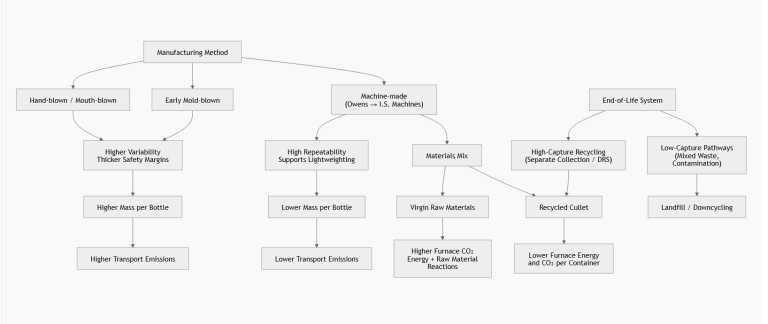
This diagram reflects relationships documented in container-glass sustainability positions (cullet reduces furnace energy/CO₂), and the historical industrialization pathway from artisan to automated bottle forming that enables precise glass distribution (a prerequisite for lightweight designs). [61]
The Bottle as an Aging Reactor
A filled, sealed bottle is a controlled micro-reactor. Its main “control levers” are oxygen ingress (closures + bottling operations), light transmission (glass color and retail display conditions), and geometric/volume effects (surface-to-headspace ratios, sediment behavior, temperature stability). [62]
Oxygen, sulfur dioxide, and sensory evolution
The AWRI stresses that oxygen drives many sensory changes during bottle aging and indirectly causes the degradation of sulfur dioxide (SO₂), a key wine antioxidant often used as an indicator of wine’s development. [54] This frames closure selection as a deliberate “oxygen dosing” decision rather than a purely traditional choice. Lopes et al. similarly argue that bottle aging occurs under micro-oxygenation and that the practical challenge is matching closure oxygen transmission to wine style and winemaking practices to avoid oxidation or reduction. [55]
A second nuance is that oxygen may enter at bottling—through dissolved oxygen, headspace, and closure application. AWRI technical writing on oxygen management at bottling emphasizes that oxygen ingress management is a significant quality issue and the subject of benchmarking and process improvements. [63] In other words, two wines under the same closure can still age differently if bottling oxygen pickup differs—making line design, inerting, and process control part of “bottle aging technology.” [64]
Light exposure, glass color, and “light-struck” risk
While oxygen is a slow, pervasive driver, light exposure can create rapid faults in some wines. Research on visible-light effects shows that flint (clear) bottles can allow photo-induced degradation and altered aroma profiles; controlled analyses report that wine in flint glass can degrade faster under realistic illumination than wine in colored bottles. [65] Work on “light-strike” in white wine similarly reports that green glass can protect wine quality over tested exposure periods while flint bottles developed faults more quickly under shelf-like exposure, implying a measurable protective function for darker glass in retail contexts. [66]
For producers, this creates an inherent tension: clear glass can signal rosé color and “freshness,” but it trades off photoprotection—pushing mitigation onto secondary packaging, supply-chain conditions, and turnover speed. [67]
Bottle size and developmental kinetics
Bottle volume changes aging kinetics partly through oxygen-to-wine ratios. The Comité Champagne explicitly notes that bottle size influences how the wine develops and that magnums provide superior aging conditions compared with standard bottles—an industry articulation of a common wine-science principle. [8] Mechanistically, if closure-mediated oxygen ingress is similar per bottle (not per liter), larger formats dilute the oxygen dose per unit volume, often slowing oxidation-linked development. [68]
Orientation and the glass–closure interface
A persistent folk claim is that bottles “must” be stored on their side to keep corks wet. Closure science complicates this: under controlled conditions, Lopes et al. report that bottle orientation had little impact on oxygen ingress through most closures over the first 28 months in their study, and argue that internal humidity can remain high even in upright storage, affecting cork moisture. [55] Meanwhile, recent scientific work emphasizes that oxygen transfer depends not only on stopper permeability in isolation but on the stopper–glass bottleneck interface as a system, reinforcing that bottling tolerances and materials aging behavior matter. [69]
Packaging, Logistics, and Market Infrastructure
Wine bottles must survive filling lines, warehouses, retail shelves, and long-haul transport—often as a commodity package—while also operating as a premium signaling device. This dual role explains many “design oddities”: deep punts, thick glass, standardized sizes, and legally constrained shapes. [70]
Bottle sizes, standardization, and why 750 mL dominates
The EU’s nominal-quantity directive enumerates permitted volumes for still and sparkling wines (including 0.75 L), supporting harmonized commerce and reducing packaging-driven friction in cross-border trade. [23] In the U.S., standardized fill sizes—including the modern dominance of 750 mL—were reinforced through metrication-era policy and regulation.
The persistence of the “750 mL = glassblower’s lung capacity” story is widespread, but industry and historical analyses often treat it more as a post-hoc narrative than a true determinant; the uploaded synthesis on bottle-size evolution explicitly frames this as a myth and instead emphasizes bureaucracy, trade standardization, and practical serving/logistics considerations as drivers of 750 mL dominance.
Punts, pressure, and structural design
The punt is often explained socially (“premium cue”) and mechanically (“strength”). Engineering work on Champagne-bottle base geometry supports a real stress-distribution role: finite-element simulation of champagne bottles under internal pressure found that bottom shape meaningfully changes principal stresses, showing benefits up to a point (with diminishing returns and weight trade-offs). [71] The Comité Champagne’s focus on pressure safety provides the macro rationale: bottle breakage historically imposed large losses, and thicker, safer bottles were required as producers learned to control internal pressure. [8]
Sizes and uses table
The size table below focuses on formats that matter most for logistics, aging behavior, and market conventions rather than attempting to list every regional name. Champagne’s official materials highlight not only the use cases but also the physical reality: very large bottles are extremely heavy and require handling assistance, turning packaging into an operational constraint. [72]
| Nominal volume | Common format name (where widely used) | Typical uses | Logistics/aging notes |
| 0.1875 L | “Split” / piccolo (common in sparkling) | Single-serve, airlines, events | Higher oxygen-per-volume; primarily for immediate consumption. [73] |
| 0.375 L | Half-bottle | Restaurant by-the-glass programs, sampling | Faster development risk vs 750 mL; packaging efficiency for smaller servings. [33] |
| 0.75 L | Standard bottle | Global retail default | Anchor unit of case/pallet systems; standardized in EU nominal quantities and U.S. standards of fill. [74] |
| 1.5 L | Magnum | Celebrations, gifting, cellar aging | Often cited as superior aging format; Champagne body notes better aging conditions than standard. [8] |
| 3.0 L | Jeroboam (common in Champagne naming traditions) | Events, prestige formats | Naming traditions explicitly described as 19th-century Champagne-house practice. [8] |
| 6.0 L+ | Large formats (Methuselah, Salmanazar, etc. in sparkling traditions) | Ceremonial, marketing, luxury | Very heavy (e.g., Comité Champagne cites multi-dozen-kg examples), high handling constraints. [8] |
Labeling and regulation as part of “bottle infrastructure”
A bottle’s label is legally regulated information architecture—identifying origin, alcohol content, allergens, producer, and other required particulars. The International Organisation of Vine and Wine[75] provides an international labeling standard framing the scope of wine labeling, compulsory information, and conditions under which ingredient lists may be required and displayed (including via e-labels). [76] In the EU, Commission guidance documents clarify implementation details for allergens and labeling approaches under the post-2023 regime. [77]
In the U.S., wine labeling is regulated under 27 CFR Part 4. TTB guidance emphasizes mandatory elements such as the alcohol health warning and sulfite declarations when SO₂ is ≥10 ppm (measured as total SO₂). [78] These requirements interact with packaging design in practical ways (label real estate; back-label conventions; QR/e-label strategies; multilingual export labeling). [79]
Sustainability, Recycling, and Future Directions
Lightweighting: from “premium cue” to climate lever
Bottle weight is now a central battleground because it influences both manufacturing emissions and transport emissions. The Comité Champagne provides a concrete case study: shifting from a 900 g to an 835 g Champagne bottle is presented as reducing carbon footprint in glass manufacturing and transportation, amounting to a reported 17,000 tons CO₂ saved in aggregate framing. [8] For still wine, industry sustainability initiatives increasingly target aggressive lightweighting; a major sustainability slide deck summarizing current initiatives cites an average 750 mL still-wine bottle weight around ~550 g and a target of <420 g by end of 2026 in an accord framework. [80]
Innovation is accelerating. Verallia’s 2025 press release describes a 300 g Burgundy-format bottle (“Burgundy Air 300G”) positioned explicitly as a lightweighting breakthrough while maintaining traditional aesthetics. [36] This illustrates a broader technical trend: advanced glass distribution engineering (enabled by modern forming control) can preserve perceived luxury cues while reducing mass. [81]
Recycling performance and cullet as decarbonization strategy
Glass is often described as “infinitely recyclable” in principle, but realized circularity depends on collection, sorting, and re-melt economics. Eurostat’s packaging-waste statistics provide a high-level EU view of packaging waste and recycling trends, reflecting the EU’s relatively mature packaging-recycling infrastructure. [82] In contrast, U.S. EPA material-specific data (based on 2018 data tables) reports a glass-container recycling rate of 31.3% in 2018. [83] (This is a key interpretive caution: U.S. recycling rates cited in wine sustainability discussions can be out of step with EU rates and may be sensitive to measurement methodology and year selection.) [84]
Recycled content reduces furnace burden. FEVE states that every tonne of recycled glass saves virgin raw materials and cites ~3% energy reduction for each +10% recycled glass in the furnace, along with an associated greenhouse-gas reduction framing. [85] The Glass Packaging Institute similarly reports energy-cost reductions with higher cullet use and provides additional benefit framing (including CO₂ reduction relationships) used widely by policymakers and packaging decarbonization programs. [86]
Policy shifts: deposit return and expanded scope
Deposit systems can change the economics of collecting intact glass or at least high-quality cullet. California’s announcement adding wine and liquor containers (bottles, cans, boxes, pouches) to its beverage container recycling program starting January 1, 2024 is an example of a policy lever that directly changes end-of-life outcomes for wine packaging in a major market. [34] Such policy extensions matter because they can increase material capture, reduce contamination, and (in reuse-oriented extensions) potentially support refillable models—though many DRS implementations prioritize recycling rather than reuse. [87]
Consumer perception and the cultural cost of heavy glass
A persistent barrier to lightweight adoption is the belief that heavier bottles signal better wine. Empirical work in sensory and marketing research shows that packaging weight can bias expectations and perceived value, even when it is orthogonal to intrinsic quality; studies of wine bottle weight as an extrinsic cue examine correlations between bottle weight and price/quality signals in real retail contexts. [88] Additional consumer research on packaging elements (including bottle weight and closure cues) finds that bottle and closure choices can change inferred quality and willingness to pay, reinforcing why “premium heavy glass” persisted. [89]
The punt, too, has a dual role: it may be mechanically relevant for pressure bottles and sediment handling in some contexts, but it also operates as a luxury cue because it increases glass usage and cost. Wine media analysis emphasizes that punt depth is a poor proxy for actual wine quality even if it correlates with heavier glass. [90]
Contemporary “closure wars” and fault management
Closures are also sustainability and quality decisions. Cork offers renewable-material narratives and long cultural association with fine wine, but it carries fault risks such as cork taint, commonly linked to 2,4,6-trichloroanisole (TCA); foundational scientific identification of TCA as a potent musty compound dates to the early 1980s, and microbiological work shows fungal pathways that can generate TCA from precursors (e.g., O-methylation of chlorophenols). [91] Meanwhile, screwcaps and engineered closures can reduce cork-taint risk and deliver consistent low oxygen ingress, but can increase reduction risk for some wines. [92] This is one reason modern closure design increasingly includes “tunable OTR” architectures—so closures can be matched to wine style—and why patents explicitly targeting closure oxygen transmission exist. [93]
Assumptions and Method Notes
Several details in wine-bottle research are inherently range-based or method-dependent; the article makes the following assumptions and clarifications to keep comparisons meaningful:
Assumptions on oxygen calculations: conversions of OTR/ingress to mg O₂/year assume oxygen volume at STP with ~1.429 mg O₂ per mL (cc). This is an approximation intended for comparability across closure studies; it does not model temperature/pressure variation in real cellars. [92]
Assumptions on closure behavior: closure OTR/ingress varies by lot, manufacturer, liner material, cork moisture exposure, bottle finish tolerances, orientation, and measurement method (e.g., Mocon vs in-bottle chemiluminescence approaches). Values are presented as indicative ranges rather than universal constants. [92]
Assumptions on bottle-shape descriptions: physical descriptors of Bordeaux/Burgundy archetypes are treated as widely observed trade conventions; legal protection claims are limited to those explicitly supported by official/regulatory sources (e.g., protected types cited by German customs and EU regulation mechanisms). [94]
Assumptions on “punt function”: where engineering claims are made, they are grounded in an engineering simulation paper on Champagne-bottle base geometry and in Champagne’s official pressure-safety framing; broader folk explanations (sediment, grip, luxury cue) are treated as context-dependent and not quality determinants. [95]
Assumptions on standardization history: the 750 mL “lung capacity” story is treated as a mythic explanation rather than a primary causal mechanism; emphasis is placed on regulatory standardization, commercial harmonization, and logistics. This interpretive stance draws on the uploaded synthesis on bottle-size evolution, alongside EU and U.S. regulatory sources that concretely list permitted/required fills. [74]
[1] [14] [16] [25] [26] https://ojs.library.carleton.ca/index.php/pcharm/article/view/1741/1571
https://ojs.library.carleton.ca/index.php/pcharm/article/view/1741/1571
[2] [17] [30] [51] https://renvenetian.cmog.org/chapter/earliest-inflated-glass
https://renvenetian.cmog.org/chapter/earliest-inflated-glass
[3] [34] [87] https://calrecycle.ca.gov/2023/12/26/press-release-23-11/
https://calrecycle.ca.gov/2023/12/26/press-release-23-11
[4] [7] [42] RESEARCH DEPARTMENT REPORT SERIES NO ###-20##
[5] [83] [84] https://www.epa.gov/facts-and-figures-about-materials-waste-and-recycling/glass-material-specific-data
[6] [20] [32] US766768A – Glass-shaping machine. – Google Patents
https://patents.google.com/patent/US766768A/en
[8] [38] [68] [70] [72] [75] https://www.champagne.fr/en/about-champagne/a-great-blended-wine/champagne-bottles-bottling
https://www.champagne.fr/en/about-champagne/a-great-blended-wine/champagne-bottles-bottling
[9] [23] [33] [73] [74] https://eur-lex.europa.eu/legal-content/EN/TXT/PDF/?uri=CELEX%3A31975L0106
https://eur-lex.europa.eu/legal-content/EN/TXT/PDF/?uri=CELEX%3A31975L0106
[10] [49] [50] https://www.britannica.com/technology/soda-lime-glass
https://www.britannica.com/technology/soda-lime-glass
[11] [19] [35] [54] [56] [62] [92] https://www.awri.com.au/wp-content/uploads/2019/03/oxygen-transmission-rate.pdf
[12] [59] [61] [85] https://feve.org/glass-industry-positions/sustainability-climate-neutral/
[13] [80] Rinse & Repeat Slides
[15] https://www.ancientportsantiques.com/wp-content/uploads/Documents/ETUDESarchivees/Containers/Documents/Amphorae-Lund2023.pdf
[18] https://archive.archaeology.org/online/reviews/roman/
https://archive.archaeology.org/online/reviews/roman/
[21] Owens the Innovator
[22] [53] 2022 Sustainability Report – O-I Glass
[24] [77] https://eur-lex.europa.eu/legal-content/EN/TXT/PDF/?uri=OJ%3AC_202301190
https://eur-lex.europa.eu/legal-content/EN/TXT/PDF/?uri=OJ%3AC_202301190
[27] https://archeologie.culture.gouv.fr/villa/en/amphorae-wine-trade
https://archeologie.culture.gouv.fr/villa/en/amphorae-wine-trade
[29] https://pibd.inpi.fr/sites/default/files/2022-01/INPI%20LAW%20JOURNAL%20%231%20January%202022.pdf
[31] US468226A – Bottle-sealing device – Google Patents
https://patents.google.com/patent/US468226A/en
[36] [81] The world’s lightest burgundy bottle
[37] [45] [46] [94] https://www.foodandwine.com/common-wine-bottle-shapes-8633568
https://www.foodandwine.com/common-wine-bottle-shapes-8633568
[39] [44] [48] https://www.zoll.de/EN/Businesses/Movement-of-goods/Import/Restrictions/Goods/Protection-of-industrial-property/Indications-of-geographical-source/Terminology/marginalspalte_faq2.html
[40] [47] https://eur-lex.europa.eu/LexUriServ/LexUriServ.do?uri=CONSLEG%3A2002R0753%3A20071214%3AEN%3APDF
https://eur-lex.europa.eu/LexUriServ/LexUriServ.do?uri=CONSLEG%3A2002R0753%3A20071214%3AEN%3APDF
[41] https://eur-lex.europa.eu/legal-content/EN/TXT/HTML/?uri=CELEX%3A61983CJ0016
https://eur-lex.europa.eu/legal-content/EN/TXT/HTML/?uri=CELEX%3A61983CJ0016
[43] https://www.vinsalsace.com/en/gouts-et-couleurs/aoc/aoc-alsace/
https://www.vinsalsace.com/en/gouts-et-couleurs/aoc/aoc-alsace/
[52] Making Glass Containers
https://www.emhartglass.com/node/26?utm_source=chatgpt.com
[58] https://vinolok.com/awri-report.pdf
[60] https://environment.ec.europa.eu/system/files/2021-10/Deposit%20Refund%20Schemes.pdf
[63] [64] https://www.awri.com.au/wp-content/uploads/wij_24_1_24-29.pdf
[65] https://www.berlinpackaging.com/insights/sustainability/how-packaging-can-drive-a-sustainable-wine-industry?srsltid=AfmBOoosHNM_7RRGlfLf_q6P1p-eGi2xpsguvidsvoBTeScTb7dZp2xH
[66] https://ives-openscience.eu/8404/
[67] https://www.thewinesociety.com/globalassets/pdfs/sustainability/2024_the-wine-society-annual-sustainability-report-v7.pdf
[69] https://pmc.ncbi.nlm.nih.gov/articles/PMC10629979/
https://pmc.ncbi.nlm.nih.gov/articles/PMC10629979/
[71] [95] (PDF) Influence of the Punt Size over some Physical Quantities of a Champagne Bottle
[76] [79] https://www.oiv.int/sites/default/files/publication/2025-03/OIV%20Wine%20Labelling%20Standard%20EN_2025%20complet.pdf
[78] https://www.ecfr.gov/current/title-27/chapter-I/subchapter-A/part-4
https://www.ecfr.gov/current/title-27/chapter-I/subchapter-A/part-4
[82] https://ec.europa.eu/eurostat/statistics-explained/index.php/Packaging_waste_statistics
https://ec.europa.eu/eurostat/statistics-explained/index.php/Packaging_waste_statistics
[86] https://www.gpi.org/facts-about-glass-recycling
https://www.gpi.org/facts-about-glass-recycling
[88] https://www.researchgate.net/publication/362052606_Evaluation_of_the_Carbon_Footprint_of_the_Life_Cycle_of_Wine_Production_A_Review
[89] https://www.infowine.com/en/international-bottle-weight-accord-sustainable-wine-round-table/
[90] Does a wine bottle punt mean better quality?
[91] https://pubs.acs.org/doi/10.1021/jf00110a037
https://pubs.acs.org/doi/10.1021/jf00110a037
 Jarad Ponce