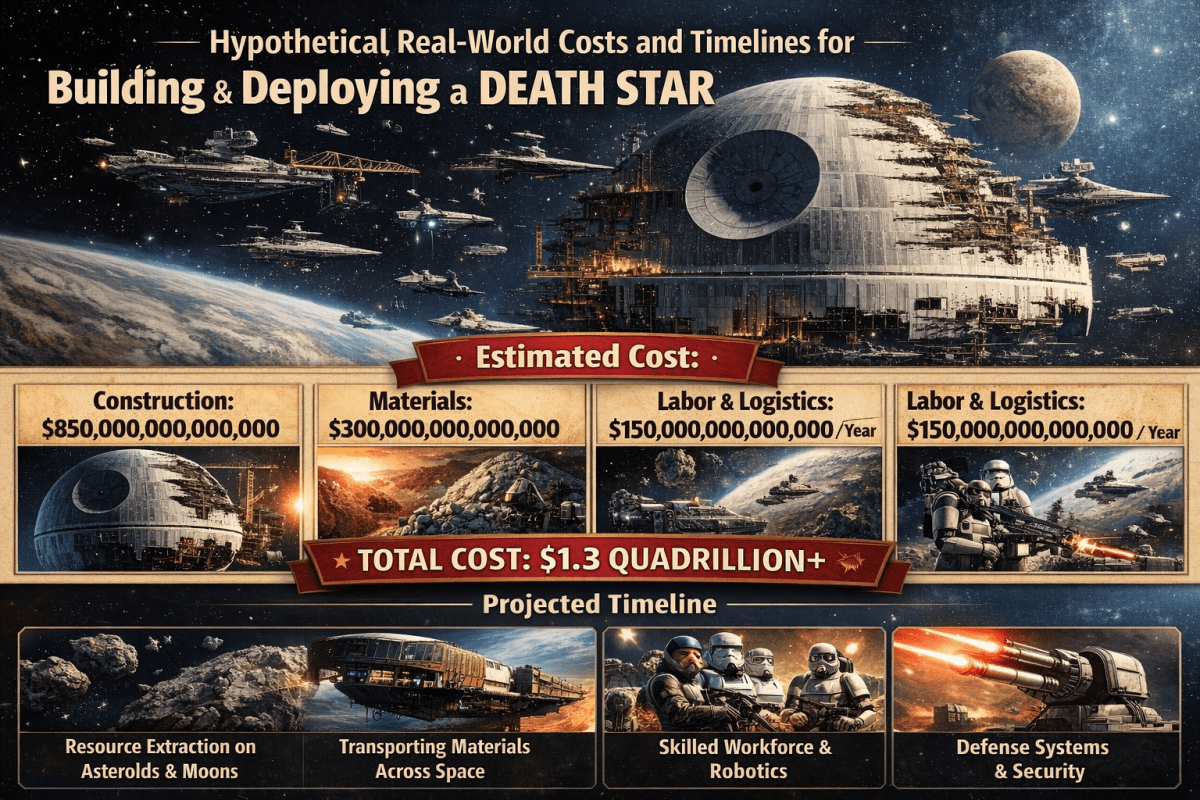
Canonical specifications and implied project scale
The first Death Star (often cataloged as the DS-1 Orbital Battle Station) is portrayed as a moon-sized, fully mobile military-industrial megaproject. A frequently cited lore specification is a spheroidal station about 160 km in diameter, with 357 internal levels and surface area >45,000 km². [1] This is large enough that essentially every “real-world megaproject” analogy (naval ships, nuclear facilities, particle accelerators, space stations) is an extrapolation far beyond its validated scaling regime.
On structure and systems, lore sources describe (at minimum) an outer hull built from quadanium steel plates, a largely hollow interior containing a hypermatter reactor, a hyperdrive, and 123 sublight engines, and a planet-killing superlaser. [1] The superlaser is framed as a reactor-fed beam system routed through multiple beamlines; one description specifies energy redirected into eight tributary beam shafts that converge into one beam capable of destroying a planet. [1]
On staffing, lore emphasizes personnel requirements that resemble a self-contained city-state with its own logistics, medical capacity, security apparatus, and fighter complement. One detailed breakdown lists 342,953 Imperial Army/Navy, 25,984 stormtroopers, plus nearly 2 million total personnel of varying combat eligibility. [1] Even if one disputes precise headcounts, “order-of-millions” is the relevant operational scale, implying a life-support, provisioning, maintenance, and training burden closer to a large metropolis than a conventional weapons platform.
On timeline, an official continuity feature (posted on StarWars.com[2] under Lucasfilm[3]) states that construction began around the onset of the Clone Wars, with centralized oversight and scientific subprograms aimed at solving the superlaser’s power problem; the article attributes key continuity details to Emily Shkoukani[4] and describes the role of Galen Erso[5] in weaponizing kyber crystals. [6] In a synthesized lore narrative, the project reaches completion almost twenty years after conception and includes a partial-power test strike that devastates a city on Jedha before the station is used for full planetary destruction later. [1]
Scaling references and real-world analogues
The closest “real-world” analogues are useful mainly to highlight how and why Death Star scaling breaks conventional engineering economics.
A modern U.S. nuclear supercarrier—USS Gerald R. Ford[7]—is a good proxy for a “floating weapons-and-logistics ecosystem.” Recent congressional-reporting summaries place the lead ship’s procurement cost in the low–mid teens of billions of dollars (often cited around $13.3B in then-year dollars for CVN‑78) with a complex cost/schedule history typical of frontier defense-industrial programs. [8] The point is not “multiply a carrier by 10¹⁰,” but rather: on real projects, raw structural material costs are usually a small fraction of total delivered capability cost, which is dominated by systems integration, skilled labor, testing, and program risk.
The International Space Station[9] is a useful analogue for “assembled in orbit, multinational, decades-long, heavy systems integration, extraordinary logistics.” A European space-agency explainer pegs the ISS program’s cost on the order of €100 billion (development + assembly + operations over roughly a decade in the cited framing). [10] An audit report notes that annual U.S. costs to support ISS operations have been roughly $3 billion per year in recent years (with variations depending on accounting scope). [11]
These analogues illustrate a core lesson: space construction is dominated by logistics and integration, not “buying metal.” Even decades after ISS began assembly, government tech assessments still describe in-space servicing/assembly/manufacturing as an emerging field, with limited operational maturity for large-scale robotic assembly compared with servicing.
Cost model for construction and deployment
A credible “real-world USD” estimate needs two layers:
1) A resource-and-throughput layer: what mass and energy does the station embody? 2) A program-economics layer: what fraction of total cost is structure vs systems vs R&D vs labor vs logistics?
Materials procurement
The most widely circulated baseline is the Lehigh/Centives steel-only estimate, often summarized as: if the station is modeled with a steel density similar to a modern warship, a 140 km-diameter Death Star requires about 1.08×10¹⁵ tonnes of steel. [12] This is the assumption set that produces the famous $852 quadrillion steel-cost figure in 2012 USD. [13]
That estimate was salient enough that Paul Shawcross[14] referenced essentially the same order of magnitude in the official archived U.S. petition response: “more than $850,000,000,000,000,000” for construction. [15]
Inflation update to early 2026
To normalize the 2012 estimate into today’s dollars, one simple approach is CPI-U scaling. CPI-U annual average for 2012 is 229.594. CPI-U index level for January 2026 is 325.252. That implies an inflation factor of roughly 325.252 / 229.594 ≈ 1.417.
Applying that scaling:
- Steel-only at 140 km: $852 quadrillion (2012) → ≈ $1.21 quintillion (early-2026 USD). [16]
- A larger-diameter variant raises cost materially. A finance-focused paper by Zachary Feinstein[17] notes that if the diameter were taken as 160 km, the same steel-only logic rises to $1.272 quintillion (2012 USD). That inflates to ≈ $1.80 quintillion (early-2026 USD) using the same CPI method.
Rare/special materials (kyber analogue)
Materials cost in Star Wars is not “all steel.” The superlaser explicitly depends on kyber-crystal weaponization research (and, in lore, that scientific breakthrough is a centerpiece of the program). [18] In real-world mapping, this is where cost modeling becomes highly underdetermined: if the critical component is a “rare, high-purity, high-energy-density focusing medium,” cost is dominated by scarcity, purification yield, and security, not commodity steel pricing.
Industrial throughput, energy, and infrastructure
A reality check: global crude steel production in 2025 was about 1,849.4 million tonnes. [19] If the Death Star requires 1.08×10¹⁵ tonnes, then producing that quantity at current Earth scale would take:
- ≈ 1.08×10¹⁵ / 1.8494×10⁹ ≈ 584,000 years. [20]
This is close (though not identical) to the older “~833,000 years” headline sometimes quoted, which used a smaller annual steel-production figure (~1.3B tonnes/year) in the original blog logic and in later popular re-tellings. [21]
Energy intensity of steel at Death Star scale
A materials-only estimate ignores the energy system needed to mine, refine, and fabricate. A widely cited industry metric: the global steel sector’s average final energy intensity has been reported around 21.27 GJ per tonne of crude steel (with associated CO₂ intensity around 1.92 tCO₂ per tonne). [22]
If we apply those factors to 1.08×10¹⁵ tonnes:
- Energy: 1.08×10¹⁵ t × 21.27 GJ/t ≈ 2.3×10¹⁶ GJ ≈ 2.3×10²⁵ J. [23]
- CO₂ (if produced with current-average emissions intensity): ≈ 2.1×10¹⁵ tonnes CO₂. [23]
For context, global energy demand in 2024 was on the order of 650 EJ (6.5×10²⁰ J). [24] On that basis, Death Star steel alone would embody energy comparable to tens of thousands of years of current global energy demand—before adding any energy for orbital construction, propulsion systems, or the superlaser. [25]
Labor, manufacturing, and deployment logistics
Even if materials are “available,” the binding constraints become: (a) fabrication capacity, (b) skilled labor and automation, (c) orbital assembly infrastructure, and (d) security/quality assurance.
A classic NASA-era synthesis of large space-structure construction emphasizes that while space construction avoids some Earth constraints, transportation and logistics cost can dominate system cost depending on architecture. [26] Current U.S. government tech assessments similarly emphasize that robotic in-space assembly/manufacturing is not yet routinely used, and that assembly/manufacturing are less mature than servicing.
In a “near-term Earth tech” scenario, moving anything like 10¹⁵ tonnes off Earth is decisively infeasible (orders of magnitude beyond total lifetime launch mass). In a “galactic empire” scenario, the lore effectively assumes: asteroid/planetary mining at enormous scale, cheap high-thrust/high-Isp propulsion, and mature autonomous construction.
Time model for extraction, manufacturing, and readiness
A practical schedule estimate is best expressed as phases with throughput requirements, rather than a single “years to build” number.
Concept, R&D, and prototyping
Even in lore, the station’s superlaser and power system are the “hard part,” with dedicated research subprojects and long-running personnel searches to complete the weapons research. [18] In real-world terms, the closest analogues are crash programs like the Manhattan Project or Apollo—not because of “similar physics,” but because of organizational intensity and uncertainty:
- Manhattan Project: widely reported as costing about $2.2B in 1945 dollars and employing on the order of 130,000 workers at peak. [27]
- Apollo: historical accounting commonly cites ~$25B in then-year dollars (often quoted as ~$25.8B), a program so large that it materially reshaped national industrial priorities. [28]
Resource extraction and refining
Using the Centives steel mass (1.08×10¹⁵ tonnes) and 2025 world steel output (1.849B tonnes/year), the extraction/refining phase alone spans ~584 millennia at Earth-scale unless production is massively parallelized. [20]
If the goal is a ~20-year end-to-end timeline—consistent with lore’s “began around the onset of the Clone Wars” framing and “completed almost twenty years after conception” phrasing—then steel throughput must be:
- 1.08×10¹⁵ tonnes / 20 years ≈ 5.4×10¹³ tonnes per year, about 29,000× contemporary Earth crude-steel output. [29]
That magnitude implies an industrial base spanning many planets and asteroid belts, plus extreme automation.
Fabrication, orbital assembly, and integration
ISS provides a conservative cautionary tale: the project required long-duration international coordination, dozens of launches, and slow integration even for an object that is tiny compared to Death Star scale. [30] Modern in-space manufacturing progress exists (e.g., the first 3D-printed object made on ISS), but it is far from “planet-scale shipyard automation.” [31]
Crew training and deployment readiness
With lore-scale staffing on the order of millions, readiness is not just “construction complete” but also training, doctrine development, logistics pipelines, and operational testing. [32] Lore also illustrates a “test and shakedown” phase in the form of partial-power strikes before full operational deployment. [1]
Sensitivity analysis and scenario comparison
Because the problem is dominated by uncertain assumptions, sensitivity ranges are more honest than single-point answers. Below are illustrative scenarios using the best-documented steel-only baseline, CPI-adjusted to early 2026.
Construction cost sensitivity table
Assumptions: – Steel-only cost (140 km): $1.21 quintillion (CPI-adjusted from $852 quadrillion). [16]
– Steel-only cost (160 km): $1.80 quintillion (CPI-adjusted from $1.272 quintillion).
– “Total program cost multiplier” is a stand-in for: non-steel structure, labor, robotics/droids, shipyards, power systems, weapons, software, testing, QA, security, and R&D risk.
| Diameter assumption | Steel-only (≈2026 USD) | Total multiplier | Total program cost (≈2026 USD) |
| 140 km | $1.21 quintillion | 50× | $60 quintillion |
| 140 km | $1.21 quintillion | 200× | $242 quintillion |
| 140 km | $1.21 quintillion | 400× | $484 quintillion |
| 160 km | $1.80 quintillion | 50× | $90 quintillion |
| 160 km | $1.80 quintillion | 200× | $360 quintillion |
| 160 km | $1.80 quintillion | 400× | $720 quintillion |
A commonly quoted “high-end” figure sits in this general band: Zachary Feinstein[17] (Washington University in St. Louis[33]) published a finance-oriented analysis that adopts the steel-only baseline and assumes a warship-like ratio of steel cost to total cost, yielding $193 quintillion (2012 USD) for DS‑1 “including R&D,” and $419 quintillion (2012 USD) for DS‑2 (with explicit notes about lower bounds and disputed assumptions). This corresponds to an implied multiplier of ~226× above the $852Q steel-only figure in that framing. [34]
Timeline sensitivity table
Using the steel mass 1.08×10¹⁵ tonnes: [35]
| Steel output regime | Annual steel output | Time to produce 1.08×10¹⁵ t |
| Current Earth scale (2025) | 1.85×10⁹ t/year | ~584,000 years [36] |
| “Classic headline” Earth scale | 1.3×10⁹ t/year | ~833,000 years [21] |
| Canon-like 20-year buildup | 5.4×10¹³ t/year | 20 years (requires ~29,000× Earth 2025 scale) [37] |

Feasibility constraints and macroeconomic implications
Physics and energy realism
Even if a Dyson-scale civilization could fabricate a 160 km battle station, the superlaser is the dominant “physics plausibility” problem. A conservative lower bound for completely dispersing an Earth-like planet is on the order of its gravitational binding energy, often cited around ~2×10³² J. [38] This dwarfs any industrial energy scale implied by steel fabrication alone. On Earth, the ability to store, channel, and radiate that energy on operational timescales is not a “cost problem” but a “technology regime change” problem.
Macroeconomic scale
Just the CPI-updated steel-only estimate (~$1–2 quintillion) is orders of magnitude beyond Earth-scale finance. World GDP (current USD) for 2024 is about $111 trillion. [39] That makes steel-only materials roughly ~10,000× annual world output, before counting weapons systems, labor, and R&D. [40]
One way to reconcile lore timelines is to assume the relevant economy is vastly larger. The Feinstein paper explicitly takes this route by normalizing Death Star cost to a “Gross Galactic Product” proxy, arguing that if DS‑1 took ~20 years and had a Manhattan-Project-like expenditure profile, DS‑1 spending might correspond to ~0.21% of GGP spread over the build period; in that calibration, total 20-year GGP is inferred on the order of $92 sextillion. This is not “canon,” but it is a coherent way to express the economic implication: a Death Star is only buildable on a politically centralized, multi-planet industrial tax base.
Operations cost as an upper-bound thought experiment
A highly publicized operational-cost model by OVO Energy[41] (popularized via business and entertainment press) estimated daily operating costs around £6.2 octillion (≈ $7.8 octillion) per day, driven overwhelmingly by energy assumptions for laser recharge and hyperspace travel priced at Earth-like energy costs. [42] The same coverage highlights that a single recharge might require a power source “three million times” the Sun in the model’s framing—useful as a narrative illustration of scale, but not a physically grounded engineering design. [43]
Automation and in-space manufacturing “cuts”
Could advanced automation and orbital 3D printing cut costs/time by large factors? Potentially—but real-world evidence suggests the field is still early: – First in-space 3D printing milestones exist, but at small scale. [44]
– Government assessments note that robotic in-space servicing is more mature than true assembly/manufacturing, and highlight that DOD and NASA together have spent >$2B over the past decade on ISAM demonstration missions.
So, while one can plausibly argue that a sufficiently advanced civilization could reduce labor intensity by, say, 10×–100× versus human-skilled labor, the materials throughput and energy regime still dominate the plausibility boundary unless “new physics” or radically cheaper energy is assumed.
Bibliography
Star Wars Inside Intel continuity feature on the project’s start timing (“around the onset of the Clone Wars”) and the kyber-crystal weaponization storyline. [6]
Geonosis databank entry used to ground the secrecy/industrialization context around early Death Star development. [45]
Project Stardust lore summary used for construction program framing. [46]
DS‑1 lore entry used for physical size, internal levels, propulsion/power components, armaments, staffing, and “~20 years” completion framing. [1]
Centives/Lehigh student methodology for scaling steel mass to ~1.08×10¹⁵ tonnes and for “hundreds of thousands of years” production-time intuition. [12]
University newsroom summary that helped popularize the $852 quadrillion steel-cost figure. [47]
Archived U.S. petition response stating “more than $850,000,000,000,000,000” and rejecting the project on cost/ethics/design-defect grounds. [15]
Feinstein paper “It’s a Trap: Emperor Palpatine’s Poison Pill” providing $193 quintillion/$419 quintillion scaling and the “GGP normalization” framework.
Global crude steel production total for 2025 (1,849.4 Mt). [19]
Industry summary providing steel-sector energy intensity (~21.27 GJ/t) and CO₂ intensity (~1.92 tCO₂/t). [22]
CPI-U index level (Jan 2026: 325.252).
Historical CPI-U annual average table (2012: 229.594) used for inflation scaling.
World GDP (current USD) 2024 value used for macro-scale comparisons. [39]
Global energy demand context (2024 ≈ 650 EJ) used to benchmark steel-production energy magnitude. [24]
Scientific discussion of the energy scale required to destroy a planet (order-of-magnitude ~10³² J) used as a physics “floor” for superlaser energy. [38]
ISS cost overview estimating program scale on the order of €100 billion. [10]
ISS annual cost context used for “megaproject operations” scaling intuition (~$3B/year). [11]
Congressional-reporting summary used for modern nuclear supercarrier procurement order-of-magnitude (CVN‑78). [8]
NASA technical abstract on large space-structure construction/assembly emphasizing transportation-system cost dominance under many architectures. [26]
NASA article documenting early in-space 3D printing milestone (first printed object in space). [44]
GAO technology assessment highlighting the maturity gap between servicing vs assembly/manufacturing and noting >$2B of recent U.S. spending on demonstration missions.
Manhattan Project cost and workforce magnitude used as an R&D “crash program” analogue. [27]
Apollo cost magnitude used as a second, larger R&D/production analogue. [28]
CERN cost estimate for a post‑LHC collider concept used as a modern “big science” cost comparator. [48]
Business coverage summarizing OVO’s daily operations estimate (~$7.8 octillion/day) and the model’s dominant energy assumptions. [42]
Fan and community perspectives used to represent “in-universe finance” debate and lore triangulation. [49]
[1] [2] [32] DS-1 Orbital Battle Station | Wookieepedia | Fandom
https://starwars.fandom.com/wiki/DS-1_Orbital_Battle_Station?utm_source=chatgpt.com
[3] [22] [25] World Steel in Figures 2025 – worldsteel.org
[4] [7] [12] [13] [14] [16] [20] [21] [23] [29] [34] [35] How Much Would It Cost To Build The Death Star? | Centives
[5] [39] [40] GDP (current US$) – World
[6] [18] Star Wars Inside Intel: The Death Star | StarWars.com
https://www.starwars.com/news/star-wars-inside-intel-the-death-star?utm_source=chatgpt.com
[8] Report to Congress on Gerald R. Ford Aircraft Carrier Program
[9] [47] So You Want to Build the Death Star?
https://news.lehigh.edu/so-you-want-build-death-star?utm_source=chatgpt.com
[10] [30] How much does it cost?
[11] [41] NASA’s Management of the International Space Station …
https://oig.nasa.gov/docs/IG-22-005.pdf?utm_source=chatgpt.com
[15] This Isn’t the Petition Response You’re Looking For
[17] [27] Manhattan Project Background Information and …
[19] [36] [37] December 2025 crude steel production and 2025 global crude steel production totals – worldsteel.org
[24] Global trends – Global Energy Review 2025 – Analysis
https://www.iea.org/reports/global-energy-review-2025/global-trends?utm_source=chatgpt.com
[26] Construction and assembly of large space structures
https://ntrs.nasa.gov/citations/19810033842?utm_source=chatgpt.com
[28] How much did the Apollo program cost?
https://www.planetary.org/space-policy/cost-of-apollo?utm_source=chatgpt.com
[31] [44] Open for Business: 3-D Printer Creates First Object in …
[33] [38] How Much Energy Would It Take to Blow the Earth …
[42] [43] The Death Star Would Cost $7.8 Octillion a Day to Run
https://fortune.com/2016/12/03/death-star-operating-costs/?utm_source=chatgpt.com
[45] Geonosis
https://www.starwars.com/databank/geonosis?utm_source=chatgpt.com
[46] Project Stardust | Wookieepedia | Fandom
https://starwars.fandom.com/wiki/Project_Stardust?utm_source=chatgpt.com
[48] International collaboration publishes concept design for a …
[49] Death Star Construction at Geonosis (Catalyst / Tarkin Books)
 Jarad Ponce