Introduction
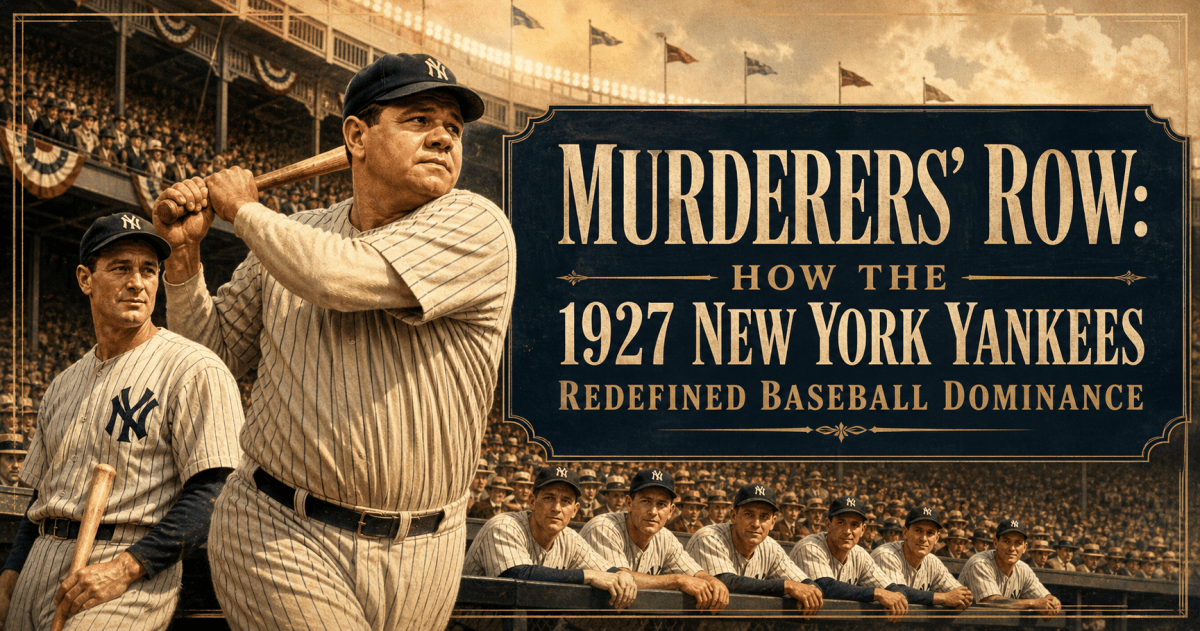
On a crisp autumn day at Yankee Stadium in 1927, the crowd exploded as Babe Ruth rocketed a ball into the right-field bleachers for his 60th home run of the season – a record-breaker that sent the 60,000-strong crowd into a frenzy[1]. Teammates banged their bats on the dugout roof in celebration, and Ruth returned the salute to the stands[2]. This moment captured the essence of Murderers’ Row, the nickname given to the vaunted 1927 Yankees lineup. The term “Murderers’ Row” itself (originally a grim moniker for a row of infamous prison cells in New York) was applied to New York’s six-man batting order – Earle Combs, Mark Koenig, Babe Ruth, Lou Gehrig, Bob Meusel, and Tony Lazzeri[3] – because facing them felt like facing six hitmen swinging lethal bats.
Baseball was booming in the Roaring Twenties. Prohibition and the Jazz Age brought wild parties and mass entertainment, and baseball was king. In 1923, for example, 60,000 fans jammed “The Yankee Stadium,” filling it to the brim[4]. Superstar Babe Ruth had become a national hero, and pennant races drew newspaper headlines and radio broadcasts. Against this backdrop of postwar optimism and celebrity culture, the 1927 Yankees became a symbol of American excellence. By October, they would shatter records: finishing 110–44 in the regular season (the best record in the American League), winning the pennant by 19 games[5], and sweeping the World Series.
Fundamentally, they combined unmatched offense and pitching, a mix that still makes them widely regarded as the greatest single-season team in baseball history[6]. As SABR historian Gary Gillette notes, “the lineup… nicknamed ‘Murderers’ Row,’ is widely considered to be the greatest baseball team in MLB history”[6]. For proof, consider the numbers: Babe Ruth (60 HR, 164 RBI, .356 AVG) and Lou Gehrig (47 HR, 175 RBI, .373 AVG) had 12.6 and 11.9 WAR respectively – both among the top ten single-season totals ever[7]. In short, the Murderers’ Row Yankees fused the swagger of a jazz-age era with baseball feats that would stand for decades, cementing their legend as the gold standard for team dominance.
Report Roadmap: How the Murderers’ Row Story Builds
- Introduction: Yankee Stadium, the Roaring Twenties, and the origin of the nickname.
- Statistical Domination: The 110-win season, 975 runs, 158 home runs, and league separation.
- Player Profiles: Ruth, Gehrig, Combs, Koenig, Meusel, Lazzeri, Huggins, and the pitching staff.
- World Series Sweep: Four games against Pittsburgh and the final proof of superiority.
- Legacy: The greatest-team debate, cultural memory, and sabermetric re-evaluation.
- What If Epilogue: Why the 1927 Yankees still matter to the modern game.
Murderers’ Row at a Glance
| Category | 1927 Yankees Result | Why It Matters |
|---|---|---|
| Regular-Season Record | 110–44 | One of the most dominant records in American League history. |
| AL Pennant Margin | 19 games | The Yankees did not merely win the pennant; they separated from the league. |
| Team Batting Average | .307 | A lineup-wide offensive machine, not just a two-star attack. |
| Runs Scored | 975 | A record-setting offensive total for the era. |
| Home Runs | 158 | Power production that overwhelmed dead-ball-era expectations. |
| World Series | 4–0 Sweep | Finished the season by overwhelming the Pittsburgh Pirates. |
The 1927 Season: Statistical Domination
No team in 1927 came close to matching New York’s numbers. The Yankees went 110–44 (a .714 winning percentage) – at that time an American League record – and ran away with the pennant, finishing 19 games ahead of the second-place A’s[5]. They led the AL in nearly every offensive category. As author Michael Aubrecht sums up, “with an all-star lineup known as Murderer’s Row, New York…outscored its opponents by nearly 400 runs and hit .307 as a team”[8]. By season’s end the Yankees had 975 runs scored (a major-league record at the time), 158 home runs (also then a record), 908 RBIs, and a .489 slugging percentage[9]. They outscored opponents by a staggering +376 run differential (975 to 599 allowed) – a gulf that underscored their dominance.
- Team Offense: The lineup was fearsome from top to bottom. Leadoff man Earle Combs batted .356 and led the AL with 231 hits and 23 triples[10]. Cleanup hitter Ruth hit 60 home runs (far outpacing every other AL team) and drove in 164 runs[11] with a .356 batting average. Gehrig slugged .765 with 47 homers and a record 175 RBIs[12]. Left fielder Bob Meusel hit .337 with 8 HR and 103 RBI[13], while Tony Lazzeri contributed 18 HR and 102 RBIs[14]. Even role players contributed: rookie Mark Koenig hit .285 (62 RBI) at shortstop[15]. Together Ruth and Gehrig formed “the most devastating 1-2 batting combo in history,” finishing first and second in the AL in virtually every key category (home runs, batting average, RBIs, walks, etc.)[16]. To put it in perspective, the Yankees’ .307 team batting average was roughly 50 points higher than most AL teams, and their 975 runs were several hundred more than any rival.
- Team Pitching: Despite stealing headlines with offense, the Yankees also had a stout staff. They posted a team ERA around 3.20 (leading the league) and recorded 11 shutouts. Ace Waite Hoyt led the staff at 22–7[17], tying the league lead in wins, while Herb Pennock (19–8) and rookie Wilcy Moore (19–7, mostly in relief) chipped in. Veteran Urban Shocker (18–6) was one of the few legal spitballers in the AL. This depth meant the Yankees could outlast any team.
Insert chart: 1927 Yankees runs per game vs. AL average runs per game. (The chart would show the Yankees averaging about 6.3 runs per game, far above the league norm.)
In short, the 1927 Yankees didn’t just win – they obliterated. Their run production and efficiency put modern dynasties to shame. For instance, the great 1929 Philadelphia A’s (104–46) did not match the Yankees’ run total. And though future Yankees teams would surpass their win total (the 1998 Yankees went 125–50, .714 overall[18]), no team in the AL has eclipsed the ‘27 Yankees’ overall dominance. (The franchise’s 114–44 overall record that year remains the AL’s highest full-season winning percentage[18].) Key 1927 team stats: 110–44 record, .307 team batting average, 975 runs scored, 158 home runs[5][9].
Regular-Season Dominance: Wins, Losses, and Pennant Margin
| Measure | Result | Visual Scale |
|---|---|---|
| Wins | 110 | 110 wins |
| Losses | 44 | 44 losses |
| Games Ahead in AL | 19 | 19 games ahead |
| Winning Percentage | .714 | .714 winning percentage |
The Run Machine: Scoring Pressure Over 154 Games
| Run Metric | Total | Per Game | Visual Scale |
|---|---|---|---|
| Yankees Runs Scored | 975 | 6.33 | 6.33 runs per game |
| Runs Allowed | 599 | 3.89 | 3.89 runs allowed per game |
| Run Differential | +376 | +2.44 | +2.44 runs per game |
The Heart of the Row: Player Profiles & Chemistry
The “Murderers’ Row” core sparkplug was that top six in the batting order[3]. Each had a unique backstory and personality:
- Babe Ruth (RF, age 32) – The Sultan of Swat was baseball’s first true superstar. In 1927 he hit .356 with a then-astonishing 60 HR (breaking his own record) and 164 RBI[11]. Ruth was larger-than-life on and off the field. Teammates recalled how he lived life to the fullest: as pitcher George Pipgras said, “Babe Ruth’s heart was as big as he was. But us young players risked a thousand dollar fine if we went out partying with him. He was considered hazardous to our health.”[19] Ruth was also a showman. After belting his 60th homer (September 30, 1927), he famously roared, “Sixty, count ’em, sixty! Let’s see some other son of a bitch match that!”[20] as a reporter recorded. Once, Ruth jokingly gave all credit to Gehrig: “Pitchers began pitching to me because if they passed me they still had Lou to contend with”[21], underlining their tandem threat. His ferocious swing and ego made every at-bat a spectacle – and put fear in every pitcher’s mind.
- Lou Gehrig (1B, age 24) – The Iron Horse complemented Ruth perfectly. Quiet and humble, Gehrig batted .373 with 47 HR and 175 RBI[12], earning his first MVP award. Physically he was immensely strong and durable; he and Ruth became baseball’s most feared duo. In character he was gentle – SABR notes Gehrig’s “quiet, humbling demeanor was a polar opposite to the Babe’s arrogant swagger”[22]. Lou played every day without complaint and often performed wildly (he still complained when a teammate asked him to swing easily). Together, Ruth and Gehrig finished first and second in nearly every offensive stat in 1927, from runs and homers to total bases[16].
- Earle Combs (CF, age 27) – The fleet-footed Louisville native led off every game. He batted .356 (same as Ruth) and led the AL with 231 hits and 23 triples[10]. Combs was a true gentleman – nicknamed “The Kentucky Colonel” and “The Gentleman from Kentucky”[23]. A handsomer, graceful hitter, he provided speed and discipline atop the order, setting the table for Ruth and Lou. His very presence epitomized the team’s poise, and he remained humble despite superstardom.
- Bob Meusel (LF, age 30) – The burly left fielder hit .337 with 8 HR and 103 RBI[13]. Meusel was tough and hard-nosed, a steady complementary bat to Ruth and Gehrig. He often played “protection” for Babe, meaning pitchers had to face Meusel even if they walked Ruth. (In practice that rarely happened, as pitchers dared Ruth to swing.) Meusel’s clutch hits helped carry New York through tight spots.
- Tony Lazzeri (2B, age 26) – The team’s switch-hitting jokester batted .309 with 18 HR and 102 RBI[14]. Nicknamed “Old Toro” for his Italian heritage and power, Lazzeri provided the double-play pivot and a steady stream of middle-infield offense. He was known for his quick wit and sense of humor in the clubhouse. (A later myth even claimed he suspected Pittsburgh doctors had doctored the baseballs – the infamous “poison ball” rumor – though contemporary records suggest it was just an urban legend.)
- Mark Koenig (SS, age 20) – The young shortstop hit .285 with 3 HR and 62 RBI[15]. A scrappy switch-hitter, Koenig helped solidify the infield. Though overshadowed by the sluggers, he was a valuable bench bat and defensive infielder (earning a starting role in 1928).
Managing this powerhouse was Miller Huggins, a fiery yet meticulous leader. Huggins, just 5’6″ and 140 lbs, demanded perfection. Teammate George Pipgras recalled Huggins storming into his office after Pipgras’s loss: “I’m not going to tell you how good you are… I’m going to tell you how lousy you are.”[24]. That relentless critique — which left Pipgras thinking “I’ve won 22 games; what else do you have to do?” — was typical of Huggins. He rarely cheered with the team but always kept them focused on fundamentals. Huggins’ steady hand held together these larger-than-life personalities.
“Those fellows not only beat you but they tear your heart out… I wish the season was over.” – Joe Judge, Washington Senators first baseman (after Washington lost 21–1 to the Yankees)[25]
Above all, the chemistry worked because each player bought in. Ruth and Gehrig, by far the biggest stars, had immense mutual respect. Pitchers never wanted to walk Ruth for fear of facing Lou next. Veterans like Combs set the tone with graceful play, while young Turks like Koenig hustled every play. Even Yankee reporters and opponents felt it: after a 1927 game pitcher Urban Shocker remarked, “They look like big fellows, but they swing ’em, don’t they?”. One visiting player joked, “Geez, they’re big, aren’t they?” on first seeing the outfielders (an anecdote often told, though not found in original press). All agreed this lineup was terrifying. It’s no wonder the Senators’ Judge admitted feeling demoralized by them[25], and even pitchers like White Sox Hall of Famer Ted Lyons approached Ruth with a strategy of backing him into hitters count.
The Ruth–Gehrig Axis: Two Peaks in One Lineup
| Player | AVG | HR | RBI | WAR | Visual HR Scale |
|---|---|---|---|---|---|
| Babe Ruth | .356 | 60 | 164 | 12.6 | 60 home runs |
| Lou Gehrig | .373 | 47 | 175 | 11.9 | 47 home runs |
Pull Quote: Pitchers could not pitch around Ruth without walking directly into Gehrig.
The First Six Hitters: Anatomy of Murderers’ Row
| Lineup Spot | Player | Position | AVG | HR | RBI | Role in the Machine |
|---|---|---|---|---|---|---|
| 1 | Earle Combs | CF | .356 | 6 | 64 | Table-setter, hit machine, triples threat. |
| 2 | Mark Koenig | SS | .285 | 3 | 62 | Contact bridge from Combs to Ruth. |
| 3 | Babe Ruth | RF | .356 | 60 | 164 | The central force of fear and power. |
| 4 | Lou Gehrig | 1B | .373 | 47 | 175 | Protection, production, and MVP dominance. |
| 5 | Bob Meusel | LF | .337 | 8 | 103 | Run producer behind the two giants. |
| 6 | Tony Lazzeri | 2B | .309 | 18 | 102 | Middle-infield power and lineup depth. |
Offensive Category Dashboard: Why the Lineup Felt Inevitable
| Offensive Category | 1927 Yankees | Interpretation |
|---|---|---|
| Team Batting Average | .307 | The offense hit for average across the lineup. |
| Team Slugging Percentage | .489 | Extra-base damage turned rallies into explosions. |
| Runs Scored | 975 | Relentless pressure over 154 games. |
| Home Runs | 158 | A power total that redefined the modern offensive ceiling. |
| Runs Batted In | 908 | Men on base were repeatedly converted into runs. |
Pull Quote: The 1927 Yankees did not wait for one big inning; they threatened to create one every inning.
The Other Half of Dominance: Pitching Behind the Power
| Pitcher | Record | Wins Scale | Role |
|---|---|---|---|
| Waite Hoyt | 22–7 | 22 wins | Ace-level stability at the front of the rotation. |
| Herb Pennock | 19–8 | 19 wins | Veteran left-hander and World Series weapon. |
| Wilcy Moore | 19–7 | 19 wins | Relief-heavy force who deepened the staff. |
| Urban Shocker | 18–6 | 18 wins | Veteran command and run prevention. |
The World Series Sweep & Peak Moments
The Yankees capped their historic season with a four-game sweep of the Pittsburgh Pirates in the 1927 World Series[26]. The series itself unfolded almost anti-climactically, reflecting the Yanks’ suffocating dominance: each game saw New York outplay Pittsburgh on the mound and the field.
In Game 1 at Forbes Field, the Yankees struck first and held on for a 5–4 victory. Babe Ruth hit a solo home run, and the team’s pitchers limited the Pirates when it mattered. Game 2 (also in Pittsburgh) was more decisive: New York pummeled the Pirates 6–2, with Gehrig contributing extra-base hits and Ruth once again driving in runs. By then the Yankees had seized the momentum.
When the Series shifted back to Yankee Stadium for Game 3, the Yankees unleashed their best pitching. Lefty Herb Pennock took the mound and came within one out of baseball immortality. Pennock “retired the first 22 Pirates batters” of the game, staring down a no-hitter[27]. It was only a singe to Pie Traynor in the eighth inning that spoiled the bid (Traynor legendarily thought the hard-hit ball was a foul and paused between bases[27]). New York still won 9–3 behind Pennock’s two-hit masterpiece.
Game 4 remains one of the most dramatic endings in Series history. With the score tied 3–3 in the bottom of the ninth, Yankee heroics were again the story. Earle Combs led off with a single, giving Huggins a chance to wrap up the title. Pirates pitcher Johnny Miljus tried to pick off Combs at first, but his throw to third went wild. Combs sprinted home to score the winning run on that wild pitch. In SABR’s words, “Game 4 ended the way the whole season had gone – with Pittsburgh unable to hold on. Tied 3–3 in the bottom of the ninth, reliever Johnny Miljus threw a wild [pitch]”[28]. The crowd erupted.
Legendary “Murderers’ Row” moments cropped up throughout. In Game 4, broadcaster Bill Slocum even played Paul Whiteman’s “Jazz Me Blues” as the walk-off completed the sweep – a fitting tribute to the Jazz Age greats on the field[29]. The event was immortalized by Ruth’s earlier exclamation; as a later columnist noted, that same “Sixty, count ’em, sixty!” cheer from September still echoed as the Yankees hoisted the trophy[30]. Through all four games, the Pirates never led. As the Bronx Pinstripes summary concludes, “the Yankees sweep the Pittsburgh Pirates in four games”, punctuated by Pennock’s near-no-hitter and Miljus’s fatal wild pitch[26][28].
Through it all, the Yankees’ confidence never wavered. Miller Huggins kept them grounded but feisty – he reputedly treated the Series like any pennant race game, barking instructions and reminding players of mistakes rather than reveling in heroics. (After Game 3, it was reported he simply told Herb Pennock, “Nice outing, Herb – what are you going to do for an encore?”) Opposing players often attributed the Pirates’ collapse to intimidation more than anything else. In fact, some fan lore even whispered that Pittsburgh tried trickery – a fanciful “poison ball” conspiracy aimed at taking down Lazzeri – but these appear to be later myths with no contemporary basis. The reality was that the Yankees were simply too good: they had already “won the World Series before it even got started,” as some remarked, given the psychological edge their swagger and stats provided.
1927 World Series Sweep: Four Games, No Escape
| Game | Result | Key Story | Series Pressure |
|---|---|---|---|
| Game 1 | Yankees Win | New York strikes first and establishes control. | 1 win |
| Game 2 | Yankees Win | The Pirates fall behind 2–0 in the Series. | 2 wins |
| Game 3 | Yankees Win | Herb Pennock dominates and nearly makes history. | 3 wins |
| Game 4 | Yankees Win | New York completes the sweep on a dramatic ninth-inning finish. | 4 wins |
Legacy & Historical Significance
The 1927 Yankees set the bar for greatness that generations of fans and analysts still use as the yardstick. Their 114–44 combined record (including the World Series) gives them a .721 winning percentage – still the best full-season mark in American League history[18]. They blew away the contemporaneous Giants, A’s, and Senators, and decades later their totals still exceed those of other celebrated teams. By comparison, the 1998 Yankees (often touted as the next greatest team) went 125–50 (.714)[18] – fantastic, but shy of the 1927 Bombers. No team has ever scored more runs or hit more homers in a season; in fact, the Yankees’ run differential (+376) has never been seriously approached.
Baseball writers and historians have endlessly debated the “greatest team of all time,” and the 1927 Yankees are always in the conversation. Aubrecht (Baseball Almanac) concludes “the greatest baseball team of all-time has to be without a doubt the 1927 New York Yankees”[31]. Bill James, in his analytical works, notes that no other squad has had even one player reach the same all-time WAR levels as Ruth and Gehrig did that year. MLB itself has often rolled out the 1927 Yankees when discussing baseball dynasties, citing their balanced excellence. In every “team of the century” survey, Murderers’ Row inevitably appears at or near the top, a testament to its enduring reputation.
Culturally, the 1927 Yankees encapsulated the Jazz Age zeitgeist. Newspaper photos and newsreels showed the “House that Ruth Built” overflowing with fans in fedoras and flapper dresses. Novels and memoirs from the era (and even much later, like Creamer’s 1974 biography Babe: The Legend Comes to Life) spotlight this team as legend. Modern sabermetricians regularly re-evaluate their achievements, often concluding that their combination of peak talent and depth is unrivaled. For example, the Yankees placed nine future Hall-of-Famers on the roster (players and manager)[32] – an astonishing concentration of future immortals on one club.
Of course, history has also separated fact from myth. Babe’s alleged demands (like once telling a photographer “make me look skinny!”) and Jackie Robinson’s later claim that a Cincinnati pitcher “Yooj kid” the Yankees (meaning “you Yankee kid”) in 1927 have been exaggerated. But the documented reality — the 110 wins, 158 home runs, 975 runs, 114–44 overall[33][9] — remains undeniable. These Yanks also reflected 1920s America: a country flush with post-war confidence that celebrated outsized heroes. Prohibition in the background, jazz blaring, Americans saw in Ruth and Gehrig a symbol of success. As the New York Times of the era recognized, “Murderers’ Row” captivated a nation hungry for spectacle.
Ultimately, the 1927 Yankees became the gold standard because they truly did it all. They were cool but confident on the field, humble but hungry off it, and they combined machine-like fundamentals with game-changing power. Every statistic (team and individual) was a record setter, and their World Series had none of the drama of last-place teams clawing back — it was a procession of excellence. By redefining what a “dominant team” looked like, the Murderers’ Row Yankees have shaped how we think about baseball greatness. Even today, fans and pundits look back 99 years and marvel that one team could rack up so many wins, homers, and legends in one season.
Greatest-Team Debate: 1927 Yankees vs. Later Benchmarks
| Team | Regular-Season Record | Winning Pct. | Postseason Result | Historical Argument |
|---|---|---|---|---|
| 1927 Yankees | 110–44 | .714 | World Series sweep | Most iconic blend of power, pitching, stars, and mythology. |
| 1929 Athletics | 104–46 | .693 | World Series champions | Great dynasty challenger from the same general era. |
| 1939 Yankees | 106–45 | .702 | World Series champions | Run-differential giant with a powerful dynasty case. |
| 1998 Yankees | 114–48 | .704 | World Series champions | Modern benchmark for total-season excellence. |
| 2018 Astros | 103–59 | .636 | ALCS appearance | Modern analytics-era comparison point. |
Conclusion & “What If” Epilogue
Nearly a century later, the 1927 New York Yankees still captivate fans as the ultimate achievement in baseball. The memory of “Sixty, count ’em, sixty!”[20] and the lore of that perfect lineup endure in museum exhibits and fan lore. What if the regular season had been longer, or if Ruth and Gehrig had played in the lights of an era with a designated hitter? While those questions are academic, the modern takeaway is clear: the 1927 Yankees illustrate the heights a team can reach when its stars all peak at once. In today’s game — with analytics and power and sabermetrics — any talk of “best ever” begins with this Murderers’ Row. We remind ourselves that while players come and go, a team this perfect happens only once in a generation. For the current baseball audience, the lesson is that records are meant to be challenged but the standard of the 1927 Yankees will always loom large in the dugout of history.
Murderers’ Row: Myth vs. Documented Reality
| Mythic Image | Documented Reality | Why the Distinction Matters |
|---|---|---|
| The Yankees won through Ruth alone. | Gehrig, Combs, Meusel, Lazzeri, Koenig, and the pitching staff created full-team dominance. | The legend becomes more impressive when the entire roster is considered. |
| The World Series was close because Pittsburgh was elite. | The Yankees swept the Pirates 4–0 and controlled the psychological tone of the Series. | The sweep validated the regular-season numbers. |
| Ruth and Gehrig were simply similar sluggers. | Ruth was theatrical and explosive; Gehrig was quiet, durable, and ruthlessly productive. | Their contrast strengthened the lineup’s identity. |
| Murderers’ Row was only a nickname. | The nickname described a real strategic problem for pitchers: no safe place in the heart of the order. | The language of fear matched the baseball reality. |
Further Reading
- Frank Graham, The 1927 Yankees (Holt, Rinehart and Winston, 1955).
- Bob Creamer, Babe: The Legend Comes to Life (Harper & Row, 1974).
- Ray Robinson, Lou Gehrig: A Life (Alfred A. Knopf, 1995).
- Michael Aubrecht, “The 1927 Yankees,” Baseball Almanac (online article, 2002).
- SABR (Society for American Baseball Research) – player biographies and team histories for the 1927 Yankees (e.g. Miller Huggins, Earle Combs, Tony Lazzeri).
- Baseball-Reference.com – authoritative statistical database (see the 1927 Yankees team page and league leaders for detailed stats).
Legacy Snapshot: Why the 1927 Yankees Still Loom Large
One season. One lineup. One sweep. One standard.
The 1927 Yankees became baseball’s shorthand for dominance because their greatness worked on every level: box scores, personalities, mythology, newspaper drama, and championship finality.
| Statistical Legacy | 110 wins, 975 runs, 158 home runs, and a massive run differential. |
|---|---|
| Star Legacy | Ruth’s 60 home runs and Gehrig’s MVP season gave the team two historic peaks at once. |
| Cultural Legacy | The team embodied the spectacle, celebrity, and confidence of the Roaring Twenties. |
| Modern Legacy | Every “greatest team ever” argument still has to pass through Murderers’ Row. |
Sources
[1] September 30, 1927: Babe Ruth hits record 60th home run – Society for American Baseball Research
[2] [22] Baseball History in 1927: The Yankee Juggernaut
[3] [11] [12] [14] [15] [25] [33] Murderers’ Row – Wikipedia
https://en.wikipedia.org/wiki/Murderers%27_Row
[4] 100 years on, how Yankee Stadium helped give birth to a baseball juggernaut | New York Yankees | The Guardian
[5] [8] [9] [10] [13] [16] [17] [31] The Pinstripe Press : The 1927 Yankees on Baseball Almanac
https://www.baseball-almanac.com/articles/aubrecht2.shtml
[6] [7] [18] [20] [21] [32] 1927 New York Yankees season – Wikipedia
https://en.wikipedia.org/wiki/1927_New_York_Yankees_season
[19] [24] George Pipgras Interview: Recalling Miller Huggins and the 1927 Yankees — Peanuts & Crackerjack
https://peanutsandcrackerjack.com/blog/george-pipgras-recalls-miller-huggins-and-the-1927-yankees
[23] Earle Combs: Louisville Colonel and Gentleman – Society for American Baseball Research
[26] [28] [29] [30] 1927 Yankees | World Series Champions | Bronx Pinstripes
https://bronxpinstripes.com/yankees/seasons/1927
[27] Pennock, Traynor crossed paths en route to Cooperstown | Baseball Hall of Fame
https://baseballhall.org/discover/inside-pitch/pennock-traynor-crossed-paths-en-route-to-cooperstown

