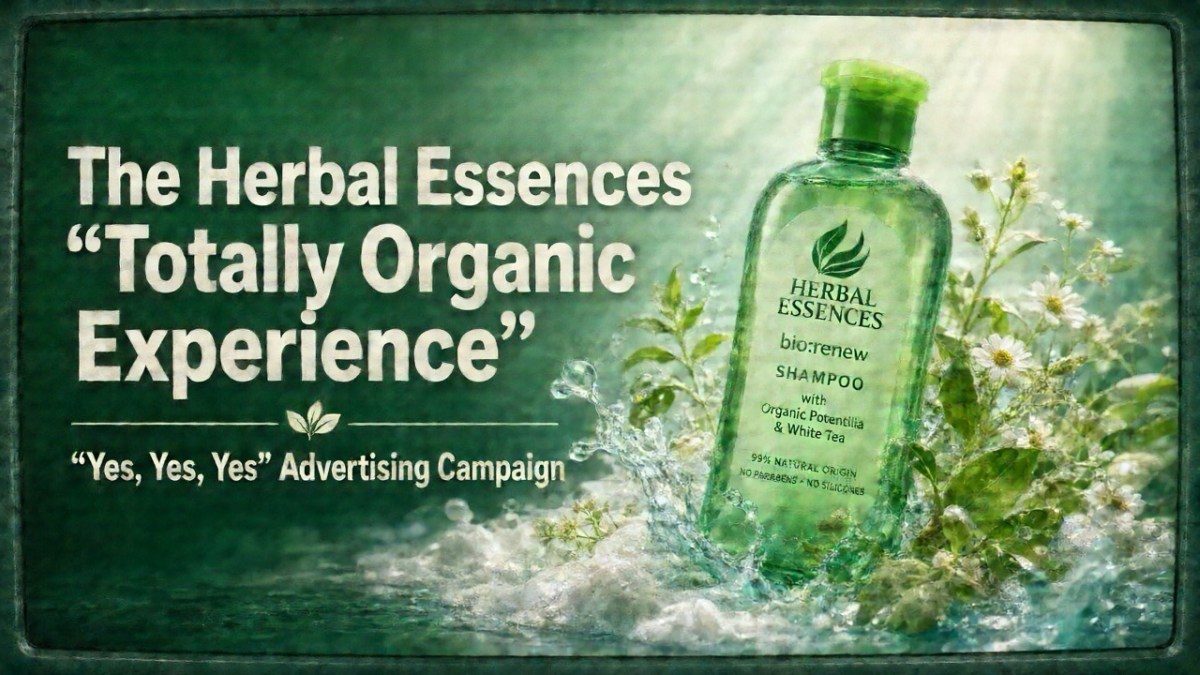
Executive Summary
The Herbal Essences “Totally Organic Experience” (frequently remembered as the “Yes, Yes, Yes” campaign) stands as one of the most disruptive, commercially explosive, and culturally defining personal-care marketing efforts of the late 20th century. Launched in 1994–1995 by Clairol (then a division of Bristol-Myers Squibb) and developed by the advertising agency Wells Rich Greene BDDP (under the creative leadership of Linda Kaplan Thaler), the campaign completely rescued a moribund brand whose sales had collapsed to roughly $1–2 million.
By deliberately discarding conventional, clinical shampoo marketing tropes—such as functional claims regarding hair shine, health, or volume—the campaign opted instead for a radical sensory strategy. It used exaggerated, orgasmic-level simulations of pleasure in everyday public settings to equate washing hair with a cathartic, sensual experience. Despite drawing regulatory friction, polarizing reviews, and mixed ad-likability scores, the campaign propelled Herbal Essences to the #2 shampoo brand in the United States, generated hundreds of millions of dollars in revenue, and redefined how mass-market brands leverage sexual innuendo and humor.
1. Origins and Creative Development
Brand Background and Relaunch Timeline
Originally introduced in 1971 as a singular “Herbal Essence” shampoo, the product was built on a 1970s “flower-power” and natural-botanical ethos. By the early 1990s, the brand had severely faded, retaining a niche following primarily in California while generating minimal national sales ($1–2 million). In 1994–1995, Clairol undertook a complete brand overhaul, relaunching it pluralized as Herbal Essences with biodegradable formulas, recyclable packaging, fresh botanical fragrances, and pure mountain water claims.
Agency and Creative Authorship
The breakthrough creative work was designed by New York ad agency Wells Rich Greene BDDP. Executive Creative Director Linda Kaplan Thaler is universally credited as the master architect behind the concept. Kaplan Thaler famously diagnosed the brand’s malaise by declaring in an internal meeting, “What this brand needs is an orgasm.” When Kaplan Thaler later founded the Kaplan Thaler Group in 1997, she successfully brought the Clairol/Herbal Essences account to her new agency, ensuring continuity for the creative vision.
Conceptual Influences and Disruption Theory
- Cultural Touchstones: The central conceit drew heavy inspiration from the iconic deli orgasm scene in the 1989 film When Harry Met Sally, translating public simulation of ecstasy into a hair-care context.
- The Theory of Disruption: Rather than matching competitors’ clinical data points, Kaplan Thaler utilized disruption theory. Washing hair was reframed not as a chore, but as a deeply intimate, private, and cathartic sensory ritual made public through comedic absurdity.
- Cultural Climate: The ads capitalized on the mid-1990s television permissiveness mirrored in pop culture phenomena like Seinfeld, Friends, and MTV.
2. Campaign Duration and Evolution
- Core Phase (~1994–2004): The foundational “Totally Organic Experience” media push initiated with a roughly $15–20 million ad budget and sustained variations through the late 1990s and early 2000s, surviving Procter & Gamble’s acquisition of Clairol in 2001 for $4.95 billion.
- The “Urge to Herbal” Sub-Campaign (2000): To target a slightly younger demographic (expanding the core 18–49 female bracket down to 16–49), P&G introduced music-driven extensions. Pop star Britney Spears recorded the promotional track “I’ve Got the Urge to Herbal” alongside tie-ins with boy bands like ‘N Sync and 98 Degrees.
- Decline and Phase-Out (Mid-2000s): By the mid-2000s, the orgasmic format experienced creative fatigue, regulatory pushback (such as rulings by the UK Advertising Standards Authority), and market-share erosion from rivals like L’Oréal Garnier Fructis. P&G shifted creative duties away from Kaplan Thaler to Leo Burnett in late 2006, leading to a major rebrand focusing on natural formulations and tropical scents (e.g., Hello Hydration).
- Nostalgic Echoes: Occasional throwbacks surfaced later, including a 2014 revival campaign featuring Nicole Scherzinger.
3. Commercial and Financial Impact
Quantitative Performance Metrics
| Period / Milestone | Revenue / Sales Metrics | Market Share / Standing | Strategic Context |
|---|---|---|---|
| Early 1990s (Pre-Relaunch) | $1–2 million annually | Near zero nationally | Fading botanical brand on life support. |
| August 1996 (Post-Launch) | Shampoo sales up ~89% ($52.8M); Conditioner up ~94% ($31.8M); Q2 1996 hit $33.7M (up 134%) | Rapid market ascension | Initial $15–20M ad blitz and styling line expansion. |
| 1997–1998 | Full-line sales reached $351 million (1997); approaching $300M–$500M by 1998–2000 | Tripled market share; #2 shampoo brand in the U.S. (behind Pantene) | Clairol’s most successful product launch in history. |
| 2001 (P&G Acquisition) | Contingently drove massive portfolio valuation ($4.95B total Clairol buy) | Global footprint in 40+ countries | Scaled into body wash, facial care, and styling items. |
Note on ROI: While exact proprietary internal ROI metrics were kept private by Clairol and P&G, retail scanner data (such as IRI reports) and corporate disclosures confirmed it as an unprecedented category turnaround.
4. Creative Execution and Notable Executions
- Core Settings: Commercials placed unsuspecting women in mundane, public environments—such as crowded supermarkets, airplane bathrooms, elevators, corporate boardrooms, and hospital waiting rooms—experiencing full-body euphoria while washing their hair.
- The Narrative Structure: Spots characteristically opened with a hushed, intense voiceover or internal monologue, transitioned into audible moaning and breathless repetition of “Yes… yes… yes!”, and concluded with a comedic deadpan punchline from a bewildered bystander.
- Celebrity Cameos: Early iterations featured recognizable pop-culture figures like sex therapist Dr. Ruth Westheimer, reinforcing the double entendre with authoritative humor.
5. Reception, Controversies, and Cultural Legacy
- Critical Polarization: Media critics, such as Bob Garfield of Advertising Age, categorized the work as classic “shock advertising” that deliberately walked the line of public offense. Consumer tracking scores occasionally registered mixed likability, yet purchase intent remained remarkably high.
- Regulatory Pushback: Several spots faced complaints regarding decency in international markets, leading to broadcast restrictions or bans by regulatory bodies like the UK Advertising Standards Authority (ASA).
- Parody and Pop Culture: The campaign permeated popular culture, most famously parodied on sketch programs like Saturday Night Live. It permanently cemented “Totally Organic” as a cultural synonym for sensual self-care.
6. Strategic Analysis: Why It Succeeded
The campaign’s triumph offers key lessons in brand strategy:
- Breaking Category Clutter: In a sea of identical functional ads promising “extra shine” or “split-end repair,” the campaign engaged consumers on an emotional, visceral wavelength.
- Humor as a Shield: By leaning heavily into self-aware absurdity, the brand disarmed potential prudish backlash; the joke provided a safe harbor for high-octane innuendo.
- Sensory Authenticity: Despite the hyperbole, the focus on rich botanical fragrances and lather delivered a credible sensory payoff when consumers actually used the product in the shower.
7. Chronological Timeline
- 1971: Original “Herbal Essence” (singular) launched under a 1970s flower-power aesthetic.
- Early 1990s: Sales collapse to historic lows ($1–2 million).
- 1994–1995: Clairol and Wells Rich Greene BDDP relaunch the line as Herbal Essences (plural) with the “Totally Organic Experience” campaign.
- 1996: Sales skyrocket past double-digit growth milestones; styling line introduced.
- 1997: Linda Kaplan Thaler’s agency takes over the account; annual sales reach $351 million.
- 1999–2000: Brand captures the #2 market share spot in the U.S.; Britney Spears “Urge to Herbal” sub-campaign launches.
- 2001: Procter & Gamble acquires Clairol for $4.95 billion; continues the campaign framework.
- 2004–2006: Core orgasmic campaign retired; creative shifts to Leo Burnett in late 2006 for a natural formulation pivot.
8. Bibliography & Sources
- Advertising Age / Adweek: Contemporary coverage of the Wells Rich Greene BDDP launch strategy and Bob Garfield’s critical commentary on shock advertising.
- Encyclopedia.com: Clairol, Inc. corporate history and brand evolution files.
- Citeline / Pink Sheet: Financial disclosures from Bristol-Myers Squibb regarding quarterly sales milestones (e.g., Q2 1996 data).
- MediaPost & AdExchanger: Retrospective analysis on P&G’s 2006 agency reassignments and historical brand valuations.
- Kaplan Thaler, Linda: Executive interviews and biographical literature (My Life in 30 Seconds) detailing the genesis of the creative strategy.
The Woman Behind the Famous Herbal Essences “Yes” Campaign!
This short video provides direct commentary from campaign creator Linda Kaplan Thaler detailing the strategy and creative rationale behind the iconic messaging.

