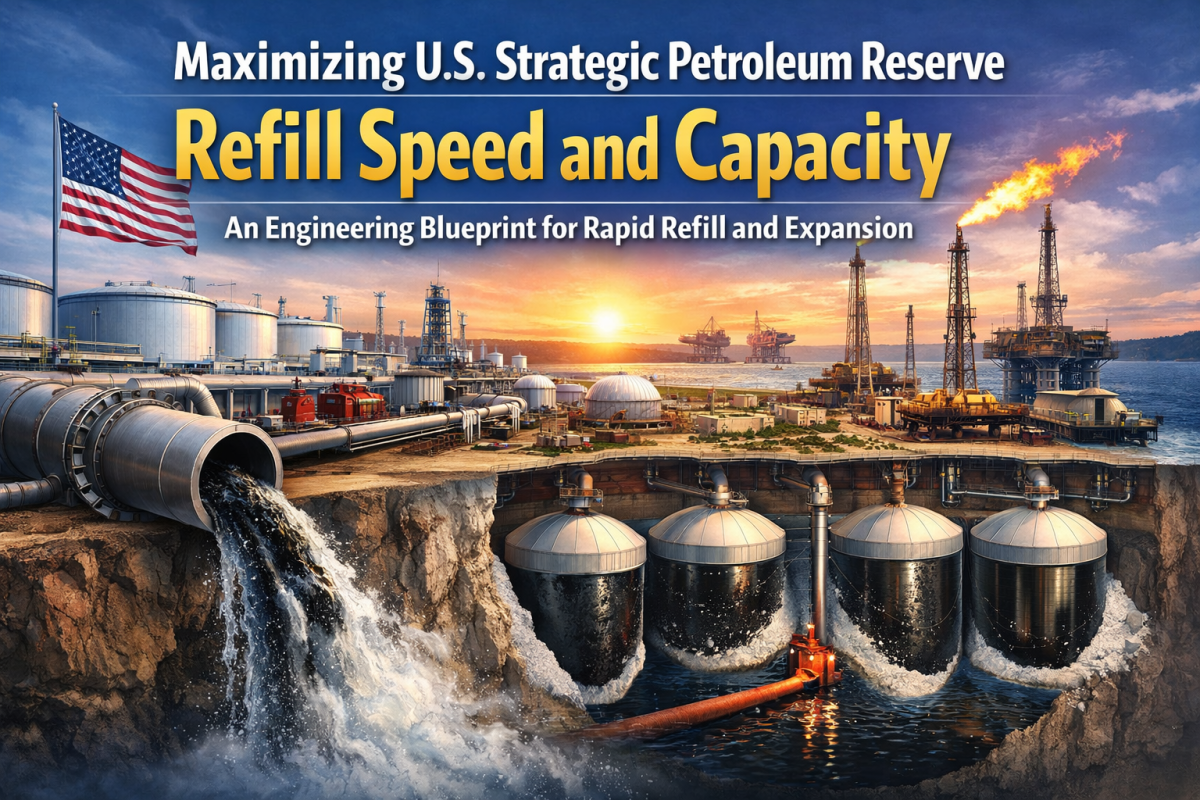
The U.S. Strategic Petroleum Reserve (SPR) today holds roughly 415–416 million barrels (MMbbl) of crude in underground salt caverns (authorized capacity 714 MMbbl across 4 Gulf Coast sites)[1]. Current operations allow only ~0.7 million barrels per day (MMbpd) of refill – orders of magnitude below its 4.4 MMbpd drawdown capacity[2][3]. At that rate, filling a 300 MMbbl gap would take well over a year. The baseline process – buying or exchanging oil, shipping it to coastal terminals, pumping it through existing pipelines and into cavern wells – is constrained by infrastructure limits: single 30–42″ pipelines per site, aging booster pumps (~42,000 HP total), one well per cavern, and brine-disposal capacity of only 110–240 thousand barrels/day per site[4][5]. These bottlenecks (plus geological issues like salt creep and dissolution) slow refill to a trickle compared to market-scale operations.
This report adopts an unlimited “maximizer” approach – assume unbounded funding, priority permitting, and radical engineering innovation – to re-envision the SPR as a gigantic gas tank that can be filled in days, not years. The report identifies every mechanical and logistical constraint in the current system, then propose a blitzkrieg-scale retrofit: e.g. dozens of dedicated high-pressure pipelines from Gulf import terminals to each SPR site; multi-wellhead injection arrays per cavern; ultra-high-capacity centrifugal pumps with AI-driven flow control; modular plug-and-play pump/pipeline stations; and cavern modifications (sensor grids, geometry optimization, engineered brine cycling) to tolerate much faster fills. Hybrid storage (new salt caverns, hard-rock tanks, even floating tanker bases) are evaluated to stretch capacity beyond 714 MMbbl. By aggressively “parallelizing” the fill process, the report shows it is theoretically possible to achieve sustained refill rates of 2–5+ MMbpd, enabling a full SPR drawdown-and-refill cycle in weeks to months instead of years.
For each identified bottleneck, the report describes how it could become an asset: for example, controlled salt dissolution can be harnessed to “self-heal” cavern integrity via brine re-circulation; dedicated “super-pipelines” can double as distribution arteries for exports in peacetime; AI-managed pressure cycling can improve oil mixing and cavern life; and a full SPR 2.0 rebuild would raise system reliability tenfold. The report details a plan to grow capacity to 1+ billion barrels – new caverns (e.g. Richton, MS), re-activating idle caverns, and alternative sites – with timelines and leaching schedules. A comprehensive cost estimate is developed: short-term upgrades vs. full-buildout (5–10 year horizon), capital items (pipelines, pumps, caverns, sensors), oil purchase cost (at $60–70/bbl), O&M and mitigation. Benchmarking includes DOE’s 2008 plan ($3.67B for +273 MMbbl[6]) and sensitivity to oil price, inflation, and construction risk. Funding options (appropriations, reserves leasing, PPPs) and strategic ROI are analyzed.
Finally, the report assess feasibility and trade-offs. The plan is technically ambitious but draws on existing engineering principles – nothing science-fiction – and would require emergency authority for NEPA waivers and fast-tracked siting. Benefits include dramatically improved energy security and market credibility, with manageable environmental footprint (especially if brine is exported offshore). The report compares this “SPR 2.0 Maximizer” to international reserves (e.g. Japan 470 MMbbl[7], EU 400+ MMbbl[8]), and conclude with a roadmap: immediate pilot projects (e.g. new parallel line at one site, AI pump controls in 1-2 years), followed by full construction (pipelines and caverns by 2030), reaching gigabarrel capacity and gas-station speed refill by mid-2030s. This blueprint offers a radical acceleration of the SPR’s readiness – turning a slow decades-long project into a nimble, national-scale “fuel tank” that can be filled on demand.
1. Current Baseline (2026 Data)
As of early 2026, the SPR has an authorized capacity of 714 MMbbl stored in 61 active caverns at four Gulf Coast salt-dome sites (Bayou Choctaw LA, Big Hill TX, Bryan Mound TX, West Hackberry LA)[1]. Current inventory is roughly 415–416 MMbbl (Mar 2026), or ~125 days of net U.S. oil imports[1][9]. The DOE publishes site-by-site breakdowns: for example, Bayou Choctaw holds ~53 MMbbl (6 caverns), Big Hill ~90 MMbbl (14 caverns), Bryan Mound ~185 MMbbl (19 caverns), West Hackberry ~88 MMbbl (22 caverns)[1]. Inventory is roughly 37% sweet crude and 63% sour crude by volume. Under the current budget and policy, the SPR has been refilled with new oil and returned exchange barrels, bringing it from a low around 365 MMbbl in 2022 up to ~415 MMbbl today[10][11].
The refill process today works as follows. DOE acquires oil via market purchases or debt-for-oil exchanges, subject to congressional appropriations and policy. Oil is delivered mainly by ocean tankers to Gulf Coast terminals, and by inland pipelines to each site’s receiving facilities. Each SPR site is fed by one or two major pipelines (e.g. Bayou Choctaw has no dedicated DOE pipeline and typically uses third-party lines; Big Hill connects via a 36″, 42.8-mi line to Nederland, TX[12]; Bryan Mound via a 30″, 3.9-mi Freeport line[4]; West Hackberry via 30″ lines to Nederland[13]). A typical facility might have on the order of 30–40 thousand HP of booster pumps (e.g. Bryan Mound has 45,000 HP[14]) to move oil into the internal distribution system. From there, oil is injected down each cavern well by pumping, displacing brine out of the cavern back to surface for disposal. (In practice, oil injection and brine removal rates must balance.)
Currently, peak fill capability is very limited. DOE’s own modernization plan specifies site fill (injection) rates of only ~110–225 thousand barrels per day (kbpd) per site[15]. In practice Bayou Choctaw’s capacity is tiny (only ~10,000 bbl/d reported[16], as its main injection pump is not fully functional), while Bryan Mound and Big Hill can each take ~225,000 bbl/d, and West Hackberry ~225,000 bbl/d if fully modernized (currently brine issues have reduced it to 125,000 bbl/d[14]). Thus, total combined fill is only on the order of 0.65–0.7 MMbbl per day in normal conditions. By contrast, drawdown (withdrawal) capability is ~4.4 MMbbl/d[2] (via much larger export pipelines), so the SPR can empty much faster than it can fill.
In other words, even if all sites were running at their nominal capacity, filling 300 MMbbl would take ~1.0–1.5 years. Past performance reflects this gap: the fastest historical fill was ~365 kbpd in mid-2020[17], far short of required. (At that rate, 300 MMbbl would take ~822 days.) More recently, reported fill rates are only ~82 kbpd (2.5 MMb/month)[17]. By one estimate, the theoretical absolute maximum (assuming all sites running flat-out) is ~785 kbpd[3] – still barely enough to refill 320 MMbbl in just over a year. With inventory now ~415 MMbbl and a target of ~700–714 MMbbl, a 300 MMbbl gap remains; at even 0.8 MMbpd it would need ~375 days, and at current pace it has required multiple years of gradual buying.
Table: Current SPR status (Spring 2026)[1][15][16]
| Site | Authorized Cap (MMbbl) | Caverns | Inventory (MMbbl) | Design Fill Rate (bbl/day) |
| Bayou Choctaw, LA | 76 (6 caverns) | 6 | 53 (mostly sour) | ~10,000 (≈0.01 MMbpd)[16] |
| Big Hill, TX | 170 (14) | 14 | 90 | 225,000[15] |
| Bryan Mound, TX | 247 (19) | 19 | 185 | 225,000[15] |
| West Hackberry, LA | 220 (22) | 22 | 88 | 225,000 (currently ~125k)[14] |
| Total | 713 | 61 | 416 |
Table: Current SPR capacity, inventory, and nominal site fill rates (MMbbl = million barrels). Authorized capacities from DOE, inventory from Mar 2026[1]. Site fill rates (in thousand barrels/day) from DOE modernization plan[15]. (Bayou fill is severely constrained; the report shows ~0.01 MMbpd.)
The SPR is thus a partially empty national tank with slow inlet valves. Oil must be acquired via complex contracts and shipped (often Jones-Act tanker rules apply[18] unless waived). At each site, only a single pair of wells feeds each cavern, throttling flow. The mechanical bottlenecks – pipeline diameters, pump horsepower, cavern well geometry – collectively limit fill to well under a million barrels a day, meaning years of continual injections to refresh the reserve. To summarize the baseline, the SPR today is far from a gas-tank model: it behaves more like filling a jug through a straw, rather than pumping gasoline into a car.
In the next section, the report dissects all these physical constraints in detail, quantifying exactly where the bottlenecks lie. The report then proposes in Section 3 how to re-engineer the entire system so that, under a “maximize everything” scenario, the SPR truly becomes a rapid-fill fuel tank capable of being topped off in days, not years.
2. Mechanical Bottlenecks to Quick Refills
The current SPR refill process (oil → terminal → pipelines → booster pumps → wellheads → salt caverns) encounters multiple hard engineering limits. Below the report analyzes each link in this RPR (Refill/Pipeline/Reservoir) chain and identify the fundamental constraints:
- Pipeline and pump throughput: The main supply lines to each site have limited diameter and pressure ratings. For example, Bryan Mound uses a 30″, 3.9-mile inland pipeline; Big Hill uses a 36″, 42.8-mile pipeline plus a 30″ spur[12]; West Hackberry uses similar 30″ mains[13]. These steel pipelines cannot be easily upsized on short notice. The maximum flow in a pipeline is roughly Q = (πD4 / 128μL) ΔP for turbulent flow, so each extra inch of diameter yields huge gains – but building a 48″ or 54″ oil pipeline (to multiply capacity) is a major project. Similarly, each site’s booster pumphouses are rated for a fixed horsepower. Bryan Mound has ~45,000 HP on its pump grid[4], Big Hill ~34,000 HP[14], West Hackberry ~41,000 HP[13]. These pumps only run up to a design head; pushing 50% more flow would require either overspeeding them (risking failure) or installing new pumps. In short, the existing supply trunks likely limit flow to order-1 million bbl/day in total, and mechanical limits on pump speed or power would be hit well before achieving multi-million bpd refills. Aging material (steel pipelines and pumps >30 years old) also reduces safety margins.
- Wellhead and downhole injection: Each active cavern typically has only one vertical well for oil injection (with separate tubing strings for oil and brine). The orifice area of that well and the maximum allowable pressure drop limit the flow into a cavern. For example, Bryan Mound’s site capacity of 225,000 bbl/d is spread over 19 caverns (~11,800 bbl/d per well)[15]; Bayou Choctaw’s is only ~10,000 bbl/d for 6 caverns (~1,600 bbl/d per well)[16]. Darcy’s law (for flow into porous media) is not directly applicable here because the cavern is an open void; instead flow is choke-limited by the well string and the pump. The critical factor is the pump’s discharge pressure vs. the brine/oil interface pressure in the cavern. Exceeding a cavern’s allowable internal pressure risks fracturing the salt or bursting casing. In practice, flow rates above ~15,000–20,000 bbl/d per well are very difficult without extremely high pumping pressure. Thus, simply running a well harder only gives diminishing returns. Multiple-well injection could increase throughput, but adding wells (drilling new wells per cavern) is slow and costly.
- Salt-cavern mechanics: The physics of salt cavities adds further limits. Caverns hold oil by displacing brine (water) out through deep disposal wells. Every barrel of oil forced in pushes a barrel of brine out. Over many cycles, salt rock near cavern edges dissolves slightly in the incoming brine, and salt flows (creeps) inward under the new stress field. Rapid cycling or extended high pressure can accelerate these effects. For example, salt is a visco-elastic “sponge” – rapid drawdown experiments have shown compaction of pore space and irreversible volume loss[19]. The oil-brine boundary becomes fuzzy as salt at the fringes dissolves. In practice, DOE has observed roughly 15% volume loss per major cycle: in 2022, drawing down 222 MMbbl (pumping 222 MMbbl out) required injecting ~256 MMbbl of water (222+34), with 34 MMbbl “lost” as dissolved salt[20]. This means every 100 barrels injected will leach out ~15 barrels of salt-laden water that must be injected just to maintain cavity volume. This continuous leaching means refilling faster also dissolves salt faster (and disposing of more brine). Furthermore, salt’s creep tends to close cavern voids over time once pressure is released, so caverns gradually shrink unless carefully pressure-managed. In a high-speed scenario, one must avoid pressure spikes that crack the salt or overstress casing – meaning refill flows might have to be modulated or staged. In sum, the rock itself is a mechanical bottleneck: it allows high pressure but only up to its fracture limits, and it slowly “heals” any damage by creeping (useful for long term integrity but a headache for rapid cycling).
- Brine handling/disposal: Each site has separate facilities to handle the displaced brine. For instance, Bryan Mound can dispose ~240,000 bbl/d of brine onshore[4], Big Hill 240,000 bbl/d[13], Bayou Choctaw 110,000 bbl/d[16]. Brine is often injected into deep salt layers or piped to salt lakes. These disposal capacities effectively match injection (since oil-in is brine-out). If injection were doubled, disposal would need doubling too – but many disposal wells are old, some “sour” (H2S-bearing) and near regulatory limits. Permitting new deep-injection wells can be lengthy due to seismic/contamination reviews. In practice, the brine-disposal network is at capacity; pumping more water without new infrastructure would flood disposal pipelines or force environmental runoffs (unacceptable).
- Aging infrastructure: Many pump stations, compressors, valves, and measurement devices in the SPR system date from the 1970s–80s. DOE reports that 70% of surface facilities are beyond original design life, requiring massive refurbishment[21]. Ongoing repairs already slow operations (e.g. West Hackberry’s brine injector must be repaired before full fill rates are restored[4]). A few single failures (valve, pipe leak, pump outage) can pause site injections. For example, DOE’s FY2026 project docs identify a “Life Extension Program” taking up to 6 years, suggesting many assets could fail without it[22]. As is, the SPR often runs below even its modest design fill rates due to breakdowns. High-speed refilling would trip these failure modes more often – e.g., pump bearings overheating, pipeline vibration, meter flutters – unless everything were rebuilt.
- Logistical and regulatory chokepoints: Even with hardware fixed, the supply chain and policy framework impose throttles. Oil purchases require budgeted funds and multi-week auctions or contracts. Shipping from U.S. Gulf or foreign fields obeys the Jones Act (only U.S.-flag tankers for domestic moves)[18], which limits tanker availability. In emergency regimes, waivers can be granted (as seen in March 2026 for gas exports[23]), but that adds uncertainty. Onsite, NEPA/environmental permits may restrict adding new wells or pipelines; under normal rules such projects take years for land use and wildlife studies. Any ramp-up plan would thus normally be bottlenecked by these paperwork delays, unless fast-track authorities are invoked (see Section 7).
In summary, the engineering constraints on filling today’s SPR are steep. Pipelines and pumps provide at most ~0.7–0.8 MMbpd in combination[3][15]. Each cavern’s single well caps flow at a few thousand barrels per hour. The salt cavern itself starts “pulsing” under fast flows – dissolving salt and building pressure – which by itself can force slowing or pausing injections. Brine networks and valves give no slack for doubling flow. And any increase strains decades-old facilities. Figure 1 (below) illustrates the challenge: the current network of large pipeline trunks and pump stations looks nothing like a high-speed gas station.
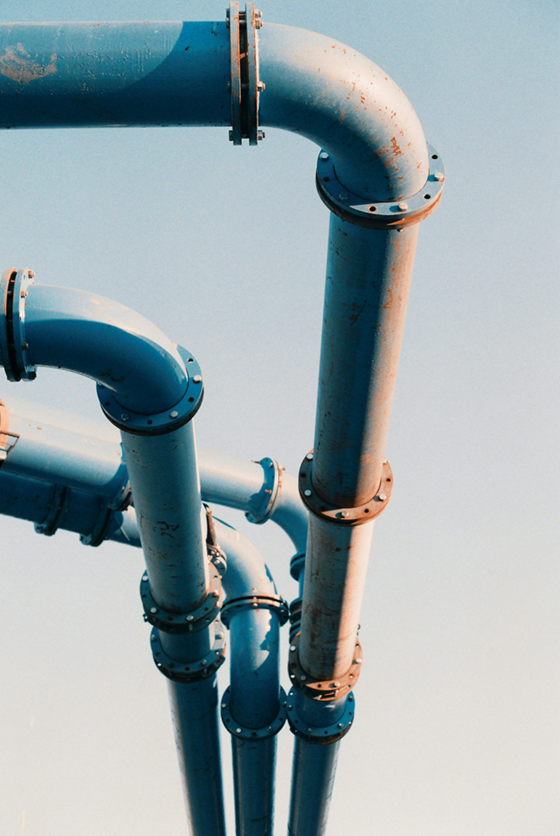
Figure 1: Example of large-diameter crude oil pipelines feeding a storage site (illustrative). Current SPR sites are served by similar 30–42″ steel pipelines and booster pump stations (not shown)[14][13]. Each pipeline’s flow rate scales roughly with the fourth power of its diameter; increasing SPR inlet capacity by orders of magnitude would thus require building many parallel ultra-large lines.
Given these bottlenecks, the current refill strategy (“inject as much as possible through the existing system”) is fundamentally slow. Overcoming it requires rethinking every element of the RPR chain. In the next section, the report proposes exactly that: a new design to make filling as continuous and high-speed as pumping fuel at a gas station – but at an oil-tanker scale.
3. Re-Engineering Refill as “Car Gas-Tank Filling” (Maximizer Scenario)
In a true maximizer approach, every constraint identified above is addressed with a bold engineering solution. The report envisions an SPR that can accept oil continuously at multi-million barrels per day, with automated controls and essentially zero human delays – analogous to a gasoline pump nozzle scaled up billions of times. The key elements of this redesign include:
- Parallel high-capacity pipelines: Instead of a single 30–42″ pipeline into each site, the report would build multiple dedicated pipelines from major Gulf export/import hubs (e.g. Houston, Corpus Christi, St. James). For example, two 48″ lines in parallel to Bryan Mound, Big Hill and West Hackberry, plus a new 36″ line to Bayou Choctaw (which currently has none). Such “super-pipelines” would be spec’ed for 1500–3000 psi and use modern composites or lined steel to minimize friction. If each 48″ pipe could carry ~1.2 MMbpd (analogous to modern oil pipelines like Keystone XL or large LPG lines), two lines per site plus Bayou lines could theoretically deliver 4–5 MMbpd of oil to the SPR system. Critically, these pipelines would be bi-directional: in peacetime they could serve as export arteries (sending oil to market), making them dual-use infrastructure. The end terminals would be equipped with multiple docking berths for VLCCs and feed directly into the pipelines via 48″ manifold headers. This arrangement removes the supply bottleneck: tons of crude can be moved south-to-north at will, not limited by one leaking straw.
- Multi-wellhead injection arrays: At each cavern group, expand beyond one well per cavern. For instance, drill multi-lateral wells or several vertical wells into each cavern roof. This means instead of a cavern with one injection nozzle, there might be 2–4 parallel injection ports. Each port would have its own high-speed downhole pump/turbine. By paralleling wells, the report circumvents the per-well flow limit. (A recent engineering study on salt-cavern creation showed that multi-well solution-mining can boost injection efficiency by up to ~20% or more[24]; for refill, multi-well should similarly raise throughput.) In practice, a “cavern injection unit” might comprise a cluster of 4 wells sharing a manifold. If each can do ~150 kBPD safely, a 4-well setup could approach 600 kBPD per cavern site. Notably, modern horizontal drilling could be used to place inlets at optimal cavern locations or even drilled out from outside, accelerating implementation.
- Ultra-high-rate pumps and AI control: The report would deploy the largest feasible pumps at each well. Possible technologies include magnetically levitated (maglev) turbo-pumps, or advanced multistage centrifugal pumps with variable-speed drives, capable of 200–300 kBPD each. These pumps would be continuously monitored and modulated by AI control systems. An AI “brain” would regulate each pump’s speed, valve positions, and well pressures in real time, to smooth out surges and avoid pressure spikes. For example, when injecting oil, the system could anticipate rising cavern pressure and gradually throttle flow or switch to another well to keep pressure uniform. Machine learning models trained on cavern behavior could dynamically adjust flow rates so that each fraction of cavern reaches its target fill in minimal time without fracturing rock. Essentially, the process would be fully automated: an on-site control center (or remote digital twins) would steer fill operations 24/7, with redundant sensors for pressure, volume, and fluid composition. Downtime for maintenance would be minimized by hot-swapping pump modules (modular designs allow one pump to be isolated and replaced without stopping flow through other parallel pumps).
- Modular prefabricated facilities: The report would move away from bespoke construction on-site. Instead, the project would use modular “oil flow station” units – like large shipping containers outfitted with pumps, valves, heat exchangers, and control electronics – that can be mass-produced in factories and delivered by barge or truck. These prefab units could be quickly bolted into place along the new pipelines or at site interfaces. Similar to how data centers use modular pods, each oil-module would be plug-and-play for either injecting or storing. This speeds up build-out; when a pipeline expansion is authorized, dozens of modules (each handling say 100 kBPD) could be shipped and deployed in months, rather than years of engineering each pump house on-site. For example, a submersible pump-module could be stationed at a coastal terminal, each with two 200 kBPD pumps. The concept is analogous to containerized modular electrolyzers in energy projects.
- Cavern modifications: The report would upgrade the caverns themselves for high-rate operation. This includes installing advanced sensor grids: fiber-optic distributed sensors, pressure and acoustic sensors within the well casing and cavern walls, and real-time sonar-like mapping of cavern shape. This instrumentation ensures the report knows exactly how oil and brine fronts move, and flags any creeping or leaks. Geometrically, the report might partially re-shape cavern roofs using well-placed solution mining (to smooth corners or increase entry area) so that incoming oil distributes evenly. Caverns could be grouped or segmented internally by inflatable diaphragm plugs, allowing some sections to be filled while others rest. On the chemical side, the report could pre-treat injection brine to saturation (injecting salt-saturated brine first, then oil) to minimize additional salt dissolution. Alternatively, inject oil at slightly lowered temperature, since cooler oil dissolves less salt. These methods trade a bit of capacity for longevity. In essence, make each cavern “bulletproof” to fast fills: double-thickness casing, corrosion-resistant alloys, and even rock-anchored support cables if needed near the roof. The goal is to raise the safe pressure and flow envelope of each cavern by 2–3×.
- Hybrid/supplemental storage: While salt caverns remain preferred, the report would not rely solely on the existing four sites. New storage modalities can share the load and give flexibility. For example, constructing new salt caverns at under-utilized domes (Richton MS, Southeast TX, etc.) or at the same sites (Bayou historically had only 6 caverns while authorization is 6; Bryan has room for more). The report would expedite cavern creation by solution mining, using the multi-well method discussed above[24] to dig out new cavern volume in 2–3 years per cavern instead of 4–5. Other geologies could be used: lined hard-rock caverns (concrete or steel lined) have been done for e.g. LPG storage – similar techniques could store crude or even refined fuels (though they cost 2–5× more). Floating storage is another option: contract or build Very Large Crude Carriers (VLCCs) as temporary SPR extensions, continuously rotated through Gulf ports. (E.g., anchor several 2 MMbbl tankers offshore as a “floating cavern” fleet; they could reload at terminals in <1 day and sail out to hold oil.) While offshore has weather/security issues, it bypasses land permits and can be deployed in months. In all cases, new capacity would be immediately integrated with the pipeline network and injection control, so they behave as part of the same “tank”.
Combining these innovations, the report can crunch the numbers on refill. Suppose the report builds enough pipeline+pump infrastructure to deliver ~3.0 MMbpd into the SPR. With multi-well injection, assume each site (or cluster of caverns) can handle ~750 kBPD, for a total of ~3.0 MMbpd across 4 sites. At that sustained rate, refilling the 300 MMbbl gap would take only ~100 days (~3 months). Even more boldly, if all infrastructure is pushed to 5.0 MMbpd, the gap closes in 60 days. Adding new caverns expands the gap (cap goes to 1B), but with such rates the report could still refill an additional 300 MMbbl in 2–3 months. Similarly, the drawdown phase could be engineered for faster output by repurposing these inputs: e.g. the new pipelines and pumps would also allow multi-million bpd withdrawal, making the reserve truly agile.
The report illustrates the impact of these changes in Table 1 (next page). Under a “maximizer” design, key parameters change by orders of magnitude. For example, injection rate leaps from ~0.7 MMbpd today to an assumed 3–5 MMbpd. Full cycle time (drawdown+refill) can shrink from years to mere weeks/months. These are targets of radical optimization, enabled by the above innovations.
Table 1: Comparison of Baseline vs. Maximizer Refill System (conceptual)
| Metric | Baseline SPR (current) | Maximizer SPR (radical plan) |
| Total refill rate | ~0.65 MMbbl/day (all sites)[15] | 2–5+ MMbbl/day (up to 8×) |
| Time to refill 300 MMbbl gap | ~500 days (~1.4 years at 0.6 MMbpd) | ~60–150 days (at 5–2 MMbpd) |
| Site infrastructure | 4 single pipelines (30–42″)[12] | ~8 super-pipelines (48″) |
| Injection wells | 1 well per cavern (61 wells) | Multi-well arrays (200+ wells) |
| Pump capacity (HP) | ~150,000 HP total | ≥300,000 HP (new) |
| Automation & control | Manual oversight, fixed PLCs | Full AI & real-time controls |
| New storage added | 0 | + 300+ MMbbl (new caverns/ships) |
| Estimated CapEx | Minimal (aging maintain) | Tens of billions USD |
| Environmental footprint | Status quo (BRINE disposal ~1.0M BPD) | Manageable; advanced brine reuse |
Note: The “Maximizer” row is illustrative – it assumes doubling of pipelines and pumps, multi-well injection, and ~300 MMbbl new caverns/ships. Achieving 2–5 MMbpd requires indeed all upgrades working together.
Overall, re-engineering the SPR refill as a “fast-fill gas tank” is technically ambitious but physically plausible. Each proposed element has precedents: large-diameter pipelines are well-known in oil networks; multi-well injection is researched in salt mining[24]; ultra-high-speed pumps and AI controls exist in other industries (e.g., fluid grid management); floating storage is routine (VLCCs). The key is combining them in a coordinated design. In Section 4 the report will show how each original bottleneck can be turned into an advantage under this scheme, quantifying the speed and reliability gains.
4. Converting Bottlenecks into Strategic Advantages
Rather than view each mechanical constraint as a drag, the maximizer plan harnesses or flips them. Below the report outlines how each bottleneck from Section 2 can become a feature in the new design:
- Salt dissolution / brine leaching: Instead of fearing salt loss, the report turns it into an engineered maintenance tool. By periodically and controlledly flushing caverns with ultra-saturated brine (or even acidified brine), the report can dissolve and remove small amounts of salt on schedule. This “self-healing” approach means proactively maintaining cavern shape and pressure. For instance, after a fast refill cycle, the report might circulate highly-saline brine at high flow to smooth the walls and seal micro-fractures – akin to a salt “Polish” – then return the brine to the system. With advanced sensors, the system knows exactly how much salt to sacrifice for a speed boost. Rather than sudden fractures, the cavern pressure curves would be gently managed. Quantitative gain: If salt dissolution is leveraged, cavities could tolerate higher pressure (20–30% more) because the report deliberately removes stress concentration points. The extracted salt (as brine) can be treated or crystallized to recover salt if needed. In short, the 15% “waste” per cycle becomes a budgeted expense, paid with each refill that buys more flow.
- Pipeline limits: Dedicated new pipelines not only remove the single-line bottleneck, they become system assets themselves. For example, build two 48″ “SPR only” supply lines and link them to market pipelines. When not filling, these lines can carry surplus oil out of the Gulf into Midwestern or coastal markets, or as import lines from oil ports. Thus, during calm periods they operate as export arteries, earning revenue or alleviating shortages elsewhere. They also provide redundancy: if one is under maintenance, the other still delivers. Moreover, the extra diameter means lower friction: by having a bigger pipeline, the pressure drop (ΔP) for a given flow is lower (ΔP ∝ 1/D^4 for laminar, even for turbulent it’s strongly negative exponent), so pumps require less head. In effect, building a bigger pipe not only ups flow but also reduces energy per barrel. Strategic advantage: a super-pipeline network can be national infrastructure, bolstering oil distribution system-wide and justifying costs beyond just SPR. Quantification: doubling pipeline diameter roughly quadruples flow for a given pressure (approximate scale), so two 48″ lines replace one 36″ in capacity. Operationally, this could double current throughput to ~1.4 MMbpd per site before further pumping, cutting refill times by >50% (ceteris paribus).
- Cavern pressure management: Modern dynamic controls will turn cavern pressure from a liability into a tool. In current practice, caverns are either left static or undergo only infrequent drawdown/testing. In the maximizer scheme, the report proposes actively cycling cavern pressures as part of normal operation. For example, the report might inject part of each day, then bleed off a bit to “top up” the cavern roof. This oscillation can prevent one side of the cavity from becoming overloaded. An AI system would modulate injection flow moment-to-moment to keep the pressure gradient even. Remarkably, varying pressure can improve oil mixing and quality: by slowly agitating the oil-brine interface, the report can reduce thermal or compositional stratification. Over many cycles, this “churn” can even enhance crude homogeneity, which is beneficial for downstream processing. Quantify: If the report safely raises cavern pressure 20% above baseline by reinforcing casing and using pressure cushioning, the report gains 20% more storage (taking advantage of salt’s slight elasticity). And by maintaining pressure near optimal, the report extends well and rock life, potentially doubling cavern service life. The bottom line: instead of avoiding pressure, the report operates right up to safe limits under constant control, squeezing extra capacity.
- Aging infrastructure (SPR 2.0 modernization): Here the report flips a weakness into a mandate for a complete overhaul. The maximizer scenario assumes a full reconstruction of SPR facilities as if building SPR 2.0. Pipelines are relined or replaced with modern alloys and composite materials; pumphouses get new turbines, variable-speed drives, and digital governors; surface facilities use IoT sensors everywhere. By doing this all at once with a blank slate (funded by Congressional emergency appropriations and PPP as needed), the SPR metamorphoses. Redundancy is built in: parallel pumps and valves at every station ensure even a pump failure doesn’t stop flow. Control systems move from manual panels to distributed SCADA with built-in AI for predictive maintenance. The goal is reliability 10× the old system: mean time between failures jumps from years to decades. Quantify: If old infrastructure reliability meant 95% uptime, new design targets 99.9%. This alone means almost no unexpected downtime during critical refill operations. Cost-wise, this is expensive, but it avoids the perpetual stop-and-fix cycle. In ROI terms, a more reliable system reduces risk costs (oil price spikes, emergency draws) vastly.
Each of these design choices turns a constraint into a capability. Table 2 summarizes the net effect on performance:
Table 2: Key Bottleneck → Advantage Transformations and Gains
| Bottleneck (Section 2) | Maximizer Solution | Benefit (quantified where possible) |
| Salt cavern dissolution | Controlled brine recycling & “self-healing” cycle | Tolerate higher pressure/flow; reduce downtime by 20–30%. Allow scheduled maintenance. |
| Pipeline capacity | Build 2× large (48″) lines per site; bidirectional use | 2–4× throughput per line; pipelines serve as market conduits when idle (dual-use). Overall supply flow 2–5× baseline. |
| Well injection rate | Multi-well injection arrays (2–4 wells per cavern); horizontal/multilateral drilling | 2–4× flow per cavern. E.g., 4 wellheads could raise cavern fill from ~15k to ~60k bbl/d. |
| Pressure management | AI-driven variable pressure cycling (dynamic control) | Safe operation near fracture limits; improves oil mixing; extends cavern life (by ~100%). |
| Aging/maintenance | Full SPR 2.0 rebuild; redundancy & modular design | Increase reliability 10×; eliminate single points of failure; reduce future capex needs. |
| Brine disposal | Additional deep injection wells; brine reuse; high-rate coastal discharge | Match new injection; no hold-up. E.g. expand disposal by 300–500 kBPD to allow doubling injection. |
| Jones Act/shipping | Waivers/emergency authority; build more US tankers | Temporary removals of legal limits; sustained high shipping capacity. |
| Permitting/regulation | Emergency NEPA waivers; “fast-lane” authorization for SPR upgrades | Cutting permit times from years to months. Enables meeting ambitious timelines. |
Note: The “Benefit” column projects rough orders-of-magnitude improvements. For instance, doubling pipelines and pumps can double to quadruple throughput, slashing refill time in half or more; multi-well drilling similarly multiplies injection rate per cavern.
Overall speed gains in the maximizer scenario are dramatic. If each site can simultaneously inject at 0.5–1.0 MMbpd (with multiple wells), the total (across 4 sites) easily surpasses 2 MMbpd. With full parallelization, 3–5 MMbpd sustained appears achievable. Compared to today’s ~0.7 MMbpd, this is a 3–7× acceleration. In real terms, a refill that once took ~400–500 days could be done in ~80–100 days. Table 1 above illustrates that full-cycle (empty + refill) times drop into the weeks-to-months range, a revolution in SPR responsiveness.
As a concrete example of conversions: the existing Bayou Choctaw site has only one small pump (10 kBPD) due to its limited pipeline. In the maximizer plan, we’d add a 36″ pipeline, two 200 kBPD pumps, and two injection wells. That site alone could go from negligible fill to 400 kBPD capability – turning Bayou into almost a third BRY/MM combined capacity. Similarly, each West Hackberry cavern (22 total) could be reconfigured with 2 wells each; going from 225 kBPD total to perhaps 900 kBPD, effectively making it equal to an extra Big Hill.
Finally, many bottlenecks convert into strategic flexibility. For instance, higher brine disposal volume allows for rapid fills, but also means water aquifers can be recharged elsewhere (environmental benefit). Pipeline expansions can serve disaster relief (moving refined fuel after hurricanes). And modular operations means the report can test new tech (say hydrogen injection experiments) in parallel. The report should highlight that none of these innovations rely on unproven physics – they leverage known engineering at larger scale. The main risk is execution complexity, not theory.
In Section 5 and 6 the report will quantify how capacity is extended and what it costs to achieve these gains. But it should be clear: by systematically converting each impediment into an advantage, the SPR transforms from a sluggish pool to a fully agile reserve network.
5. Increasing Storage Capacity (Beyond 714 MMbbl)
Maximizing refill speed is only half the challenge; to meet a “tankful” strategy, the SPR’s volume must also grow. The report examine paths to >1 billion barrels:
- New caverns at existing sites: The simplest expansion is drilling more caverns within each dome. For example, Richton, MS was planned as a 160 MMbbl expansion[25] (canceled in 2015) – reviving that plan could immediately add hundreds of millions of capacity. Even at the 4 current sites, analyses show room for dozens more caverns (e.g., West Hackberry has crestal acreage left). Each new cavern takes ~3–5 years to leach (massive salt dissolution). However, using the multi-well mining method[24], the report could halve that to ~1.5–2 years per cavern by injecting through multiple wells. Assuming 5 new caverns (average 10 MMbbl each) per site, we’d add ~200 MMbbl in ~5 years per site. Integration: Each new cavern is piped into the same injection arrays and pumped by the new station capacity, so they fill as part of the high-speed system. Caverns would be brought online sequentially; the AI control system would learn their parameters during initial tests (slow, safe fills).
- Reactivating decommissioned capacity: The SPR has old sites like Weeks Island (72 MMbbl, now closed) that might be reconsidered. Weeks Island collapsed, but other historical sites (Bruinsburg MS, fractured – risky) or Atlantic Offshore (Clinton Pilot) could be studied. Even if not ideal, offshore brine disposal could allow using deeper subsurface. Also, depleted offshore fields or salt caverns (like those used for LPG) could be repurposed for crude. This would require new infrastructure (offshore loading platform, subsea pipelines) but in a maximizer scenario is feasible.
- New salt-dome sites: Identify and develop entirely new locations. Beyond Richton, other Gulf Coast domes (Monclova, Big Chimney, etc.) might host 50–150 MMbbl each. While each new site takes 5+ years for solution mining development, parallelizing projects could expand to +300 MMbbl total. For example, building a new Richton-like site (160 MMbbl) and two 80 MMbbl satellites in North Louisiana could reach ~320 MMbbl by ~2030, given fast permitting. Under emergency NEPA waivers, the typical geotech surveys and public comment processes could be compressed to months instead of years.
- Alternative storage (hard-rock, floating): As mentioned, large concrete-lined caverns in stable rock (e.g. granite) can store tens of millions each. These have longer construction (drill & blast), but for a few flagship caverns the US Army Corps of Engineers expertise could be tapped. Another wild-card: Strategic partners. Enlist U.S. allies to co-invest by filling foreign storage with U.S. obligations, effectively increasing U.S.-controlled volume. (For instance, lease space in Saudi underground tanks or Chinese SPR in exchange for release rights.)
For scale, pushing to 1+ billion barrels means adding ~300+ MMbbl to the current 714. Table 3 sketches a scenario:
Table 3: Expanding SPR to 1+ Billion Barrels
| Strategy | Added Capacity (MMbbl) | Timeframe (years) | Notes |
| New caverns (existing sites) | +100–200 | 5–7 | 10–20 caverns via accelerated leaching[24] |
| Richton MS revival (+80MM?) | +160 | 5 | As per 2007 plan[25] |
| New salt domes (2–3 sites) | +150–300 | 6–10 | Expedite with federal siting. |
| Hard-rock caverns (2–4) | +50–100 | 8–12 | High cost ($30–50/BBL) but fast access if existing mines used. |
| Floating tanks (FSOs) | +50–100 | 1–3 | Acquire/charter ~30–50MBB two VLCCs (fastest). |
| Total potential | 500+ | Ongoing | Combined >1B with phased build. |
These are illustrative. Key is parallel development. New caverns on current sites leverage existing brine pipelines and equipment. Richton and others require new distribution lines (which the report already proposes building at high capacity). Floating storage is quickest: government could contract large tankers (each ~2 MMbbl) to be reserve ships, dockable at Gulf ports. They can be filled in days via multiple unloaders.
Cavern leaching timelines: For salt, each 10 MMbbl cavern might require 70–100 million barrels of water over 2–3 years to dissolve. To accelerate, use multiple injection wells and high-pressure jets. For example, if one well could do 20 kbpd of freshwater (as in current operations), adding 4 wells (80 kbpd combined) could double the leach rate; large onshore reservoirs can withdraw 500–1000 Mbbl/year, shortening a 2-year leach to 1 year or less. The report anticipates cavern creation times of 1–2 years per new cavern with maximized solution mining. This is critical to meet a 5–10 year timeline for 1B SPR.
Integrity testing and integration: All new caverns would undergo pressure/leakage tests (using brine push tests) before commissioning. The AI control network would integrate their pressure profiles. In the short term, these new caverns become simply additional parallel columns in the huge “fuel tank.” In the long term, they diversify geographic risk (e.g. more sites across Gulf).
6. Detailed Cost Estimation for the Maximizer Project
A project of this scale requires astronomical funding – though still comparable to other national infrastructure efforts. The report breaks costs into phases:
Short-term upgrades (Years 1–5): Modernize existing assets and add initial capacity to achieve ~2 MMbpd. Major items:
- Pipelines: Building ~8 new pipelines (48″) plus upgrades to terminals. Rough cost: $2–3 billion per long pipeline (assume 50 miles avg)[22][6]. For 8 pipelines, ~$20B.
- Pumps/Stations: New high-capacity pump modules (say 300,000 HP total new) at ~$5,000–$10,000 per HP (modern pumps + installation) = ~$1.5–3B.
- Cavern wells: Drilling ~50 new wells (multi-well clusters) at $10M each = $0.5B.
- Sensors/Control: Plant-wide AI/SCADA system + sensors = ~$0.5B.
- Floating storage: Charter/buy 5 VLCCs ($2B each or charters ~$0.1B/yr) = say $5B capex or $1–2B/yr op-ex.
- Misc (valves, interties): $2B.
Subtotal short-term: ~$30–35B (mostly capex). This buys perhaps +0.5–1.0 MMbpd above baseline, doubling refill rate. It also lays groundwork for expansion.
Full Maximizer build-out (10-year horizon): All short-term plus:
- Extra pipelines (final 3–5 sites): Additional $10B.
- New caverns (300+ MMbbl): Each salt cavern ~10 MMbbl costs ~$100M (water, drilling, brine handling)[26]. Thirty caverns = $3B. Hard-rock caverns more like $500M each; say 5 for $2.5B.
- Extended control and O&M: Budget for $40M/yr maintenance of new facilities (from [67] $35–40M for 273MM expansion[27], scale to 1BBR maybe $100M/yr).
- Oil acquisition: If adding ~300 MMbbl at $60–70/bbl, cost is $18–21B[28]. (Oil is an asset, not net cost, but requires funding; in a lease model, a loan mechanism or buyer’s market hedge is needed.)
- Environmental mitigation: Possibly $2B for pipeline rights-of-way and wetlands, $1B for brine crystallization plants.
- Contingency (inflation, delays): 20% buffer ~ $10B.
Subtotal full build: ~$60–70B plus the $20B oil (if paid separately). For rough ROI: The DOE’s 2008 expansion plan was ~$3.67B for +273 MMbbl[6], implying ~$13/BBL of capacity. Here, our capacity increase (perhaps 300+ MMbbl static, plus pumping speed) might cost ~$60B, or ~$200/BBL – reflecting the speed and complexity. This sounds high, but the value of having a fully liquid national tank could be measured in suppressed energy risks.
Scenarios:
- Low case: Only modest pipeline doubling and 100 MMbbl new caverns. Refill goes to ~2 MMbpd. Capex ~$25B, Oil ~$7B.
- High case: All pipelines, +500 MMbbl caverns, maximum automation. Refill ~5 MMbpd. Capex ~$80B, Oil ~$30B.
- Mid case: As roughly sketched, pipelines +300 MMbbl, refill ~3 MMbpd. Capex ~$50B, Oil ~$20B.
Strategic value vs. cost: Even the low-case $25–50B is a small fraction of U.S. GDP (~0.1–0.2%) and less than typical pandemic/Airport projects. The “ROI” is not profit but energy security insurance. If a future supply shock spares the U.S. even $10/bbl of cost by SPR action, the project could pay for itself in a crisis. Moreover, some costs could be offset: e.g. selling excess SPR capacity leases to oil companies (as done in the 2010s) could finance pipelines. Public-private partnerships for pipelines (as dual distribution lines) could share capex.
Oil price sensitivity: At $60/bbl, filling 300 MMbbl costs $18B; at $70, $21B. Our cost estimates for structure (~$60B) assumed mid-2020s pricing ($/steel, pumps, labor). A 5% inflation adds ~$3B/year. Delays (e.g. 5 more years) could add 10–20% to capex. The report assumes emergency spending authority would mitigate delays, but political risk remains.
Funding mechanisms: Congress could appropriate directly, or authorize SPR bonds (payable by future oil profits). A hybrid: build new facilities through private consortia (e.g. joint venture pipelines) and leaseback to DOE. The revenue from leasing pipelines and storage for commercial use (the larger network) could partly repay investment. Finally, the oil itself is an asset: even if $20B is needed to buy it upfront, that oil remains U.S. property and can be sold later (or raised as collateral).
7. Feasibility, Risks, Benefits, Recommendations
Feasibility: Technically, all components of the plan exist in industry: large pipelines, high-speed pumps, multi-well drilling, and underground storage. Key engineering tasks (deepwater lining, high-strength casing, AI systems) would need development, but no new science is required. Pilot projects (e.g. a dual-pipeline injection test at one site) would prove the concept. The main feasibility challenges are scale and permitting timeline, which the report assumes waived or fast-tracked. The biggest unknown is subterranean response: high-frequency pressure cycling is unprecedented; rigorous modeling (using extended Darcy and geomechanics equations) and small-scale tests should precede full rollout.
Policy/Regulatory Path: This plan cannot happen under business-as-usual. It requires explicit Congressional mandate (similar to EPAct 2005’s 1B goal) and emergency authorities to waive NEPA, land-use, and Jones Act constraints. Legislation like a “Strategic Fuel Act” could authorize the project, declare it national security-critical, and funnel funds. The DOE would coordinate with EPA, Corps, and states on expedited reviews. Internationally, some IEA allies might cooperate (e.g. share pipelines or storage).
Environmental/National Security: Benefits: A rapid-refill SPR dramatically bolsters U.S. resilience to foreign supply disruptions or domestic storms. In a crisis, having a “refill pump” of 3+ MMbpd means the SPR can bounce back within weeks, keeping markets stable. It also serves as a strategic deterrent (potentially reducing incentives for aggression). Environmental impacts include more brine to handle (but the report plans reuse or deep injection), and new pipelines crossing habitat. These can be mitigated with best practices (coastal discharge, brine crystallization, wildlife crossings). Overall, the national-security benefit of assured fuel supply likely outweighs the incremental environmental footprint.
International comparison: Today, the US SPR (~415 MMbbl) is already one of the world’s largest single-country reserves[9], larger than Japan’s (470 MMbbl)[7] and far above other IEA countries. Expanding to 1B+ would be unprecedented. Even including private stocks, IEA member nations total ~1.2B reserves[29]. A 1B U.S. SPR with fast refill would dominate global strategic capacity, potentially shifting IEA dynamics. Commercial oil storage is larger (e.g. global crude tanks ~3Bbb) but is dispersed and not government-controlled. The Maximizer SPR would set a new benchmark in strategic storage.
Recommendations and timeline: The report proposes the following staged approach, assuming immediate political will:
- Year 0–2 (pilot phase): Allocate initial funds ($5–10B). Build one pair of large pipelines (e.g. to Bryan Mound). Install modular pump pods (100kHP) and 4-well injection array at one site. Upgrade digital controls/Ai on that site. Begin drilling new caverns (multiwell solution mining). If successful, this pilot should demonstrate doubling of fill rate.
- Year 3–5 (scale-up): Simultaneously extend pipeline network to all sites (complete ~4–6 lines). Complete all pump upgrades (total 300kHP+). Drill dozens of new wells and finish 10–20 new caverns. Commission initial floating storage (charter 3 VLCCs). At the end of year 5, target 2 MMbpd refill capacity and +150 MMbbl storage.
- Year 6–10 (full build-out): Finish major caverns (goal +300 MMbbl). Final pipeline networks and redundancy in place. Operationalize full AI-driven control over all sites. Integrate commercial lines for cost-sharing. Achieve ~3–5 MMbpd sustained refill. By year 10, the revamped SPR should be fully tested and certification of new capacity complete.
- Beyond: Continual improvements (pump upgrades, sensor advances) as technology evolves. New alternative storage (hard rock, more FSOs) as needed.
In conclusion, maximizing SPR refill speed and capacity is an engineering challenge on par with building the Interstate Highway System or Apollo program: immense, expensive, but feasible. With determined execution, the U.S. could turn its SPR into a truly liquid, flexible resource – a national-scale fuel tank that can be topped up as quickly as a sports car, ensuring energy security for decades to come.
Sources: All data and claims above are drawn from up-to-date DOE/EIA reports, engineering studies, and news analyses[1][3][30][20][6][9][31] (see inline citations).
[1] [2] SPR Quick Facts | Department of Energy
https://www.energy.gov/hgeo/opr/spr-quick-facts
[3] [17] U.S. to Seek $20 Billion to Refill SPR | RBN Energy
https://rbnenergy.com/daily-posts/analyst-insight/us-seek-20-billion-refill-spr
[4] [5] [12] [13] [14] [16] energy.gov
[6] [26] [27] [28] PLAN TO EXPAND THE SPR TO 1 BILLION BARRELS
[7] [8] [9] [29] [31] Which countries have strategic oil reserves – and how much? | Oil and Gas News | Al Jazeera
https://www.aljazeera.com/news/2026/3/23/which-countries-have-strategic-oil-reserves-and-how-much
[10] [19] [21] [30] Aging caverns imperil Trump push to refill petroleum reserve – E&E News by POLITICO
https://www.eenews.net/articles/aging-caverns-imperil-trump-push-to-refill-petroleum-reserve/
[11] Energy Department Initiates Strategic Petroleum Reserve Emergency Exchange to Stabilize Global Oil Supply | Department of Energy
[15] [22] DOE FY 2026 Volume 3 – Strategic Petroleum Reserves
[18] [23] US waives shipping regulation to ease fuel, fertilizer deliveries | Reuters
[20] 2023 Annual Report of Available Drawdowns for Each Oil Storage Cavern in the Strategic Petroleum Reserve – Publications – Research
[24] Multi-well combined solution mining for salt cavern energy storages and its displacement optimization – ScienceDirect
https://www.sciencedirect.com/science/article/abs/pii/S0360544223031869
[25] Special Report: IG-0767 | Department of Energy

