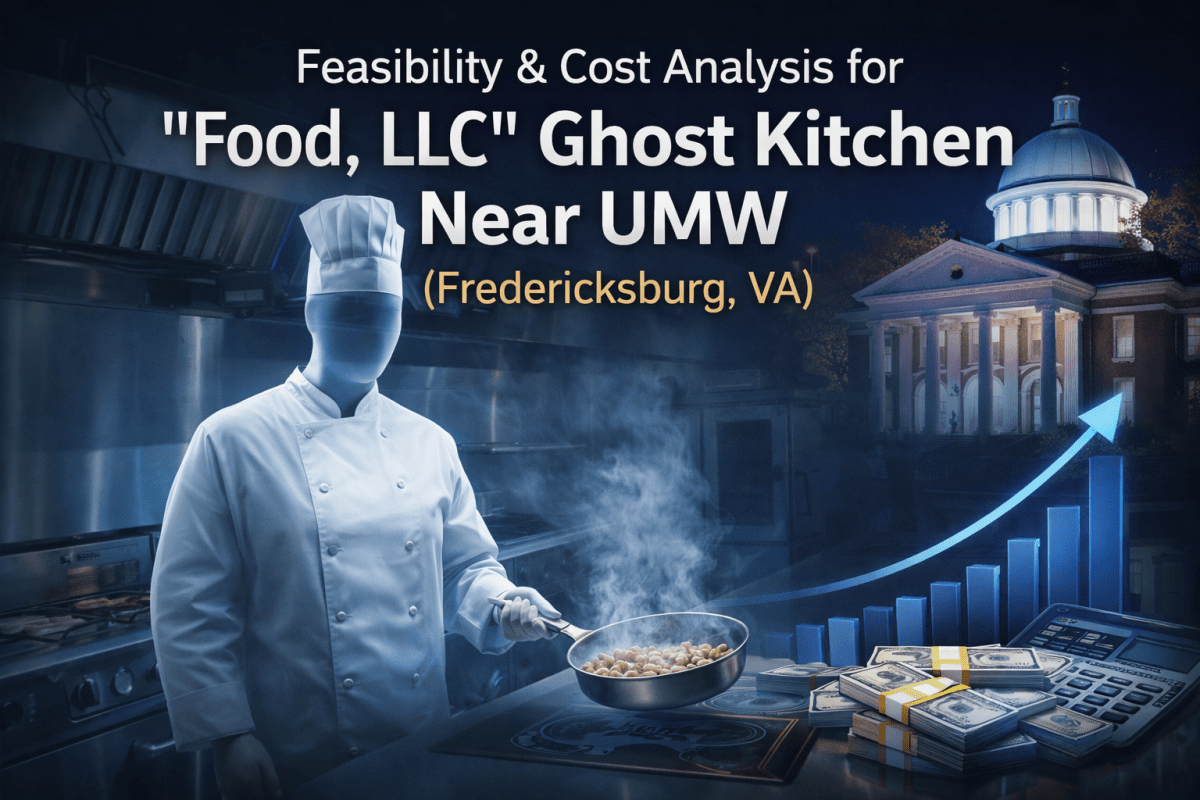
Prepared for: Food, LLC (DBA: Food)
Concept: CloudKitchens-style ghost kitchen, leasing space & equipment. Focus on a simple bowl-based menu (one in-house brand). Target market: University of Mary Washington (UMW) community & nearby Fredericksburg customers. Leveraging Travis Kalanick’s ecosystem: CloudKitchens (kitchen leasing), City Storage Systems (real estate), Otter (restaurant operating system), Lab37 (bowl automation).
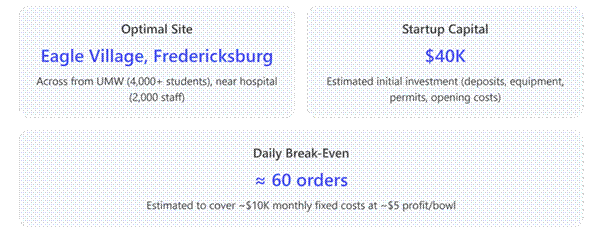
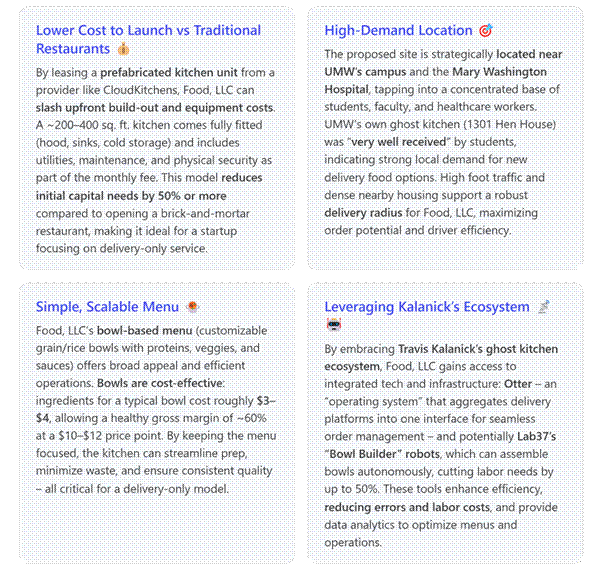
Executive Summary: *Launching a delivery-only “ghost kitchen” near UMW in Fredericksburg is a cost-efficient path to enter the food market, potentially requiring ~50–60 daily orders to break even. By adopting the CloudKitchens model (leasing a fully-equipped kitchen and services instead of owning), Food, LLC can minimize upfront capital costs and focus on its core offering: a simple, scalable bowl menu. A recommended location is in a commercial zone near UMW, providing access to ~4,000 students and staff[1] plus adjacent residents and a 571-bed hospital with ~2,000 employees[2]—ideal for high delivery demand. The CloudKitchens approach bundles essential facilities (equipment, utilities, maintenance, delivery logistics) into a single lease[3] [4], simplifying operations. Otter software aggregates orders across delivery apps into one platform and starts at ~$20/month, streamlining multi-app management.
Financial projections indicate the ghost kitchen can achieve profitability by Year 2 if it scales up order volume, with steady-state margins ~10–15% once fixed costs are covered. Key risks include ensuring sufficient local demand (especially during UMW’s off-peak seasons) and managing high delivery app commissions. However, the model’s flexibility – including potential introduction of additional virtual brands and automation (Lab37’s “Bowl Builder” robots) to cut labor by ~50%[5] [6] – offers robust long-term scalability. Below, we detail the location selection, operating model, menu design, cost breakdown, financial outlook, and risk analysis.
1. Location & Site Selection (Parcel-Specific)
Optimal Location: Eagle Village / Emancipation Highway Corridor, Fredericksburg, VA. This area, near 1245–1289 Emancipation Hwy, sits directly adjacent to UMW (±4,000 students) and a major hospital (571-bed)[14], making it an ideal hub for food delivery demand. Eagle Village is a mixed-use retail center across from campus and along a high-traffic corridor (33,000+ cars/day)[15]. A specific target property could be a 2,000 sq. ft. retail suite in Eagle Village or a similar nearby commercial space. For instance, Suite 1267B at 1245 Emancipation Hwy (2,040 sq. ft.) was listed for lease[16] [17]; such a space could comfortably accommodate a production kitchen plus storage and loading areas.
Rationale: A ghost kitchen thrives on proximity to customers for fast delivery. UMW students and staff are heavy users of food delivery, as evidenced by the campus ghost kitchen’s success[18]. Additionally, the hospital and surrounding neighborhoods expand the potential customer base beyond the university. Being near major roads (Route 1) ensures efficient routes for delivery drivers and suppliers. The chosen site offers “unmatched visibility” and is in a “high-traffic location” with ample parking for delivery pickups[19] [20].
Zoning & Permissibility: The target area is zoned Commercial (C-T or C-H), which permits restaurants and food service uses. A ghost kitchen (defined as a commercial food preparation facility without dine-in service) would typically be treated as a “restaurant, carry-out/delivery only.” In Fredericksburg’s zoning code, restaurants (including carry-out) are allowed in commercial districts (such as C-D downtown, C-SC shopping center, C-H highway) by right or with a special use permit, depending on the specific site and zone[21] [22]. The Eagle Village area is a commercial mixed-use district, intended for retail and service businesses that serve the community and benefit from proximity to UMW and downtown[23]. No residential uses are immediately adjacent, reducing nuisance concerns from 24/7 operations or delivery traffic.
Before signing a lease, Food, LLC should confirm:
- Zoning Compliance: That the chosen property’s zoning (e.g. C-T or C-H) explicitly allows a food service establishment without on-site dining. If not explicitly by-right, apply for a Special Use Permit for a “delivery-only restaurant” use. (Many jurisdictions treat ghost kitchens as a permitted restaurant use; others may require a special permit or minor variance if there’s no retail storefront – due diligence with Fredericksburg’s Planning Dept. is essential.)
- Health & Safety Requirements: The facility must either come with a commercial kitchen build-out or be upfitted to meet Virginia Health Department regulations. Key features include NSF-certified equipment, proper ventilation (Type I hood for cooking)[24], grease trap/interceptor[25], three-compartment sink for warewashing[26], handwashing sinks, and appropriate cold/dry storage areas. If these are not already in place, a build-out or equipment installation is needed (see Startup Costs).
- Building and Occupancy Permits: Renovations (if any) require building permits and inspections for compliance with Virginia building code (e.g., commercial kitchen fire suppression, electrical and plumbing up to code). Upon completion, obtain a Certificate of Occupancy for use as a food establishment. If using a CloudKitchens facility, these needs are handled by the provider (their lease typically covers facility code compliance and a valid building occupancy certification[27], simplifying setup).
- Business Licenses & Permits: Register the LLC with the state and city, obtain a Fredericksburg business license (annual fee ~$50–$100 depending on business type[28]), and a Virginia sales tax ID. Secure a Health Department food service permit (covers sanitation and food handling standards – often a ~$100–$300 fee and inspection[29]). At least one staff member must have a Food Manager Safety Certification (typically a short course, $100–$200[30]). Also, confirm any required fire safety inspections and grease disposal permits.
- Operational Hours & Noise: A delivery-only kitchen may operate extended hours (some CloudKitchens run 24/7[31] to capture late-night demand). Check if the location or landlord has restrictions on operating hours or noise. Ensure sound and odor control (high-quality exhaust hood with odor suppression) to mitigate impact on neighbors.
Space Requirements: A single-brand ghost kitchen can function in a compact footprint. CloudKitchens offers “standard” kitchen suites of ~200–400 sq. ft that include hot line cooking space plus shared access to cold and dry storage areas[32]. If Food, LLC leases a small standalone space, a total of 1,000–1,500 sq. ft is advisable to accommodate: the kitchen line, prep area, cold storage (walk-in fridge/freezer), dry storage racks, a dishwashing/cleaning area, and a staging & pickup zone for drivers. (For example, a 1,500 sq. ft former restaurant space on Mine Road in Fredericksburg was advertised as “turnkey” with a full kitchen and parking, at $24/sf/year NNN[33] [34].)
Given the CloudKitchens model, Food, LLC could alternatively partner with a ghost kitchen facility (if one exists or is built in the region) and rent a smaller dedicated kitchen pod (~300 sq ft) within a larger shared building. This saves space (since hallways, loading zones, and common facilities are shared) and ensures the site is purpose-built for delivery. While Fredericksburg doesn’t yet have a known CloudKitchens location, the company’s strategy often targets areas near large demand centers like hospitals and universities[35] – implying Fredericksburg could be on their radar. If no such facility is available initially, Food, LLC may start in a conventional leased kitchen space and later transition into a purpose-built ghost kitchen hub if one opens locally.
Local Market Feasibility: Fredericksburg’s population (≈28,000 city population plus UMW community) can likely support the concept, but volume is critical. The model thrives on dense order volume within a tight radius. UMW students are a prime demographic for food delivery, especially for late-night eats and convenient meals, as evidenced by UMW’s own ghost kitchen success in offering novel dining options[36] [37]. The presence of multiple hotels (863 hotel rooms within 0.5 miles of the Mine Rd site[38]) and a busy highway with commuters further expands the customer base and potential order flow throughout the day and week[39] [40]. A key is selecting a site that maximizes this reach while meeting zoning and logistical needs – the Eagle Village area fits these criteria well.
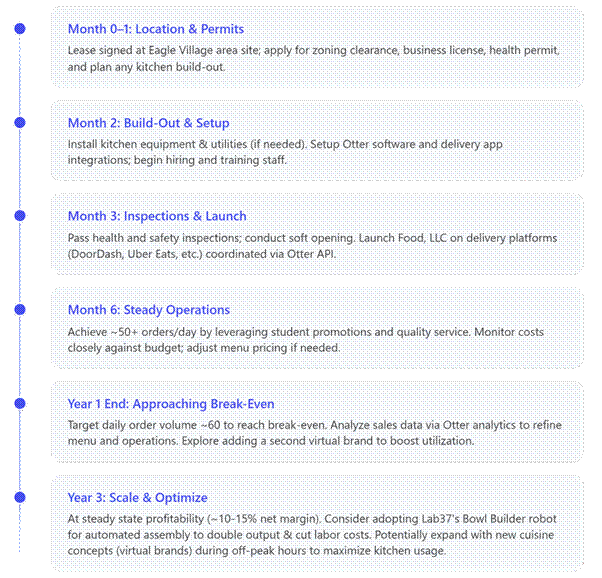
Permitting Steps & Timeline: Food, LLC should budget at least 2–3 months for site preparation and permitting:
- Month 0: Secure lease or CloudKitchens agreement; initiate architectural plans if needed.
- Month 1: Submit plans for building permit (for any needed interior renovations or equipment installation) and apply for zoning verification. Begin business registration and apply for health department review.
- Month 2: Build-out of kitchen (if not already outfitted). Under CloudKitchens, much of this is pre-done; otherwise, install ventilation, gas hookups, sinks, etc., per code.
- Month 3: Final inspections (health department, building, fire). Hire and train staff. Soft-opening trials.
- Launch: Begin operations with marketing targeted at UMW (social media, campus flyers) and local delivery app promotions.
2. Business Model & Technology Stack
Leasing Model (CloudKitchens/City Storage Systems): Food, LLC will lease a private commercial kitchen rather than buying or building a restaurant. In the Travis Kalanick-founded CloudKitchens model, entrepreneurs rent a “kitchen as a service” – a fully outfitted space inside a shared facility – on flexible terms (often 6–24 month leases). This lease typically includes major kitchen equipment (commercial hood, sinks, gas lines, refrigeration), utilities, and maintenance services[42] [43]. It also provides on-site staff for cleaning, security, and coordinating driver pickups[44]. In some cases, the provider bundles additional services like order packing, dedicated driver waiting areas, and integrated delivery dispatch.
- Turnkey Operations: The operator can move in quickly and start cooking with minimal setup. CloudKitchens advertises that its monthly fee for a ~200 sq. ft. kitchen covers “extensive commercial kitchen equipment and furnishings, utilities, facility licensing, and even a single-tablet ordering system with delivery tracking”[45]. This allows Food, LLC to focus on food preparation and marketing, while the facility handles the physical infrastructure and regulatory compliance (building codes, fire safety, pest control, etc.)[46].
- City Storage Systems (now part of Kalanick’s Atoms umbrella[47]) is the real estate arm acquiring underutilized properties (warehouses, abandoned restaurants) and converting them into these ghost kitchen hubs. This “infrastructure for better food” approach means Food, LLC benefits from professional kitchen design and economies of scale in expensive assets like ventilation and cold storage.
Operating System – Otter: To manage orders from multiple delivery platforms, Food, LLC will use Otter, a CloudKitchens-developed restaurant operating system. Otter consolidates incoming orders from services (DoorDash, Uber Eats, Grubhub, etc.) into a single dashboard and printer, eliminating the need for multiple tablets and simplifying workflows[48] [49]. It also functions as a point-of-sale (POS) and provides analytics on sales, menu performance, and delivery times. Otter’s pricing is affordable for startups – plans start around $20/month, with possibly additional fees for hardware (they offer a proprietary dual-screen POS device in some bundles). This software will be the “central brain” of Food, LLC’s operations:
- Order Aggregation & Dispatch: All online orders are captured by Otter, which directs them to the kitchen display and coordinates with delivery drivers. This reduces errors and late orders by having a unified ticketing system.
- Menu Management: Otter can manage multiple virtual brands if Food, LLC later adds new concepts; menus can be adjusted on the fly across all delivery apps at once (e.g., 86ing an item or changing a price updates everywhere).
- Data Analytics: The system provides detailed reports on order volumes by time of day, menu item popularity, average ticket, and customer ratings, helping fine-tune operations for profitability.
Food Production & Automation (Lab37): As business scales, Food, LLC can integrate automation to enhance robustness:
- Initially, cooking and assembly will be done by staff (humans) using standard commercial kitchen equipment. The simple bowl menu is well-suited to line assembly and batch cooking (e.g., prepping large batches of proteins and grains).
- Future Tech (Year 2–3): Lab37, another Kalanick-affiliated venture, has developed a “Bowl Builder” robot designed to automate bowl assembly. Staff load pre-prepped ingredients into the machine’s dispensers, and it assembles custom bowls to order, from portioning bases and proteins to adding toppings, then hands off a neatly packed bowl[50] [51]. This system is reported to halve labor hours while doubling output for bowl concepts[52]. By Year 3, if demand is high (e.g., 100+ bowls/day), investing in such automation could significantly improve margins by lowering labor costs (especially during peak meal times).
- Using Lab37’s tech would align with Food, LLC’s positioning as a Travis Kalanick-inspired, high-tech kitchen. It can become a local showcase of cutting-edge efficiency, providing marketing differentiation (“bowl meals prepared with robotic precision”). However, the feasibility of acquiring a Bowl Builder unit depends on availability and cost – as of 2026, Lab37 is part of Kalanick’s stealth company Atoms and targeting large-scale operations[53]. If accessible, this could be an innovative scaling tool; if not immediately available, Food, LLC can plan for it in later stages.
Division of Responsibilities: Under this model:
- Food, LLC handles: Menu development, ingredient sourcing, food prep and cooking, branding/marketing, pricing strategy, and overall business management. Staff (hired by Food, LLC) will handle receiving inventory, cooking, assembling orders, and ensuring quality.
- Leasing Partner (CloudKitchens/Facility) handles: Providing and maintaining the kitchen space and major equipment, utilities (water, electricity, internet), pest control, waste disposal, security, and often even delivery driver coordination on-site (e.g., a managed pickup area where drivers collect orders)[54] [55]. The partner may also cover certain regulatory matters like building codes and may have a streamlined health inspection process.
- Delivery Platforms: Third-party apps (DoorDash, UberEats, Grubhub) will handle the consumer ordering interface, payment processing, and last-mile delivery via gig-economy drivers. Food, LLC pays these platforms a commission (usually 20–30% of sales on each order) in exchange for their logistics and customer reach[56] [57]. These fees are significant, so part of Food, LLC’s strategy will be to optimize menu prices and encourage larger orders (to dilute the delivery fee impact).
Scalability: Because no front-of-house (dining area) is required and the model relies on standardized kitchen units, scaling up can be rapid. Food, LLC could:
- Extend Hours or Add Shifts: The kitchen could run into late-night hours (appealing to students and hospital night-shift workers). A 24/7 operation is possible with staggered shifts, since CloudKitchens facilities operate 24/7 to meet around-the-clock demand[58]. Longer hours spread fixed costs over more orders.
- Launch Additional Brands: With Otter and the ghost kitchen setup, it’s straightforward to introduce new virtual brands using the same kitchen and ingredients. For example, alongside the main bowl concept, Food, LLC could test a taco brand or a salad brand using much of the same inventory (grains, proteins, toppings) but different packaging and online presence. This strategy, used by many ghost kitchens, can increase total order volume from different customer niches without major new costs.
- Add Locations: If Fredericksburg proves successful, the company could open additional ghost kitchen outposts in neighboring markets (e.g., Richmond or Northern Virginia) using the same playbook, leveraging CloudKitchens sites in those cities. The standardized approach and technology make replication easier, and Otter can handle multi-location management.
3. Menu Concept: Simple Bowl Menu (One In-House Brand)
Concept Overview: Food, LLC’s menu will center on customizable bowl meals, aligning with popular fast-casual trends (think Chipotle-style burrito bowls or Asian fusion grain bowls). Bowls are well-suited for delivery (they travel well in a single container) and operational efficiency:
- Each bowl consists of a base (rice or grains), a protein (e.g., grilled chicken, tofu, beef, etc.), vegetables (fresh or roasted), and various sauces or toppings. This modular format means a limited set of ingredients can create many variations, simplifying procurement and prep.
- Small menu (perhaps 5–7 signature bowls plus a “build-your-own” option). Examples: Teriyaki Chicken Rice Bowl, Mediterranean Quinoa Bowl, Veggie Power Bowl (with tofu), etc. Sides could include a simple salad or drink combos, but the focus is on the one-bowl meal.
- Naming/Branding: The brand should be student-friendly and tech-savvy. It could simply be “Food Bowl Co.” or a catchy name that highlights freshness or customization. (This is the public-facing DBA “Food” brand.)
Ingredient Cost Estimates: Bowls have relatively low food costs, especially if vegetarian options are included. Using industry benchmarks and the specific components:
- Base (Rice/Grain): Very cheap – ~$0.20 per serving of rice[59].
- Proteins: Chicken is affordable (~$0.60–$0.80 per serving)[60]; tofu or beans even cheaper (beans
$0.25/serving dried[61]). Premium options like steak would cost more ($1.50+ per serving) but can be priced higher. - Veggies & Toppings: Mixed vegetables (like peppers, onions, lettuce) plus sauces and garnishes are low-cost per bowl. E.g., a portion of roasted veggies might be ~$1.00[62] [63], and miscellaneous toppings (salsa, cheese, etc.) another ~$0.50–$1.00[64].
- Packaging: Each order needs a disposable bowl with lid, possibly a bag, utensils, and napkins. Packaging costs range widely by type; for a bowl and lid, plus bag, an estimated $0.50–$1.00 per order is typical. Choosing bulk eco-friendly containers might be slightly more expensive but aligns with student values (sustainable packaging).
- Total Food & Packaging Cost per Bowl: Roughly $3.50–$4.50 for a chicken or vegetarian bowl (e.g., $3.00 ingredients + $0.75 packaging). Bowls can be priced around $10–$12 (comparable to Chipotle or Sweetgreen). This yields a food cost percentage ~30–35%, which is on target (QSRs often aim for < 32% COGS[65]). The contribution margin per bowl would be about $6–$7 after direct costs (ingredients + packaging). However, delivery commissions will take a bite from this, as discussed below in Unit Economics.
Labor & Preparation:
- Prep Simplicity: Many ingredients (rice, proteins, sauces) can be prepared in batches ahead of peak times. This reduces on-demand cook time to mostly assembly. For example, rice can be cooked in bulk and held warm; proteins can be grilled or roasted in advance and portioned.
- Assembly Time: Assembling a bowl might take ~2–3 minutes when ingredients are prepped (just scooping items into the bowl). This speed means one staff member can fulfill many orders in an hour (20+ bowls/hour in a well-organized line).
- Staffing Plan: Initially, Food, LLC might operate with a lean team per shift: one main cook and one kitchen assistant who handles prep, packing orders, and cleanup. Cross-training is key – all staff should be able to assemble orders, handle food safety, and manage incoming tickets. At modest volumes, two people can manage; as orders grow, a third person might be added during peak hours for packing and coordination. If utilizing Lab37 automation in the future, staff roles would shift more to prepping ingredients and overseeing the robot rather than manual assembly.
Quality & Consistency: The limited menu and measured recipes help maintain consistency, crucial for a new brand building trust through delivery alone. Ghost kitchen diners can’t see the food prepared, so reliably delivering fresh, well-portioned, tasty bowls earns good reviews and repeat orders. CloudKitchens’ facilities conduct safety & health inspections regularly[66], and Food, LLC will adhere to all food safety standards (e.g., proper cooling for ingredients, segregation of allergens, etc.). The Otter system can track each order’s prep time to ensure speedy delivery – an important quality factor for hot meals.
Revenue Opportunities: Bowls generally have a high perceived value, and customers often add extra toppings or sides, which can increase ticket size. For instance, adding a drink or dessert to an order, or premium add-ons like “double protein” for +$3, can significantly boost margins since the incremental cost of extra protein might be $1 while adding $3 revenue. Part of the menu strategy will be to encourage such upsells (e.g., suggest adding avocado or a beverage during online checkout).
4. Cost Modeling (Tables of Costs and Economics)
Below, we provide detailed cost breakdowns for Food, LLC’s ghost kitchen venture. All figures are realistic estimates for a Fredericksburg, VA location, using available data and industry benchmarks. Costs are split into: (A) one-time startup costs, (B) ongoing monthly operating costs, and (C) per-unit (bowl) economics. These assumptions reflect a single brand operating out of one kitchen, using the CloudKitchens leasing model.
A. Startup Costs (One-Time)
The upfront costs cover all expenditures before opening day. By leveraging a kitchen leasing model, Food, LLC avoids heavy construction costs of building a restaurant, but still must invest in key startup items:
| Startup Cost Item | Estimated Cost | Notes |
| Security Deposit (Lease) | $5,000 (approx.) | Typically 1–2 months of rent as deposit[67] [68]. For a small kitchen space, assume ~$2.5–5K. |
| Initial Kitchen Setup | $10,000 | If CloudKitchens: Minimal (included in lease). If independent lease: Some build-out of space, minor renovations, decor, etc. This assumes the site already has a commercial kitchen installed. |
| Equipment Purchase (if needed) | $20,000 | Only if not fully provided by lessor. Includes used commercial stove, oven, refrigeration, prep tables, smaller appliances. CloudKitchens provides major equipment[69]. |
| Smallwares & Utensils | $3,000 | Pots, pans, knives, cutting boards, containers, etc., to equip the kitchen. |
| Permits & Licensing | $1,000 | Business registration ( |
| Professional Services (legal, insurance) | $1,500 | Legal fees for business setup, plus first-year insurance premium (liability/workers comp). |
| Initial Inventory (Food & Packaging) | $3,500 | First bulk order of ingredients (dry goods, produce, meats) and disposable packaging to launch. |
| Technology Setup | $1,500 | POS system or tablets, internet setup, Otter subscription initiation (Otter’s setup fee + hardware, if any). CloudKitchens often includes one tablet[72]; additional may be purchased. |
| Marketing & Branding | $2,000 | Initial digital marketing push: photography, online ads targeting UMW students, grand opening promotions (e.g., first-order discounts), and branding materials (logo design, menu design). |
| Contingency Fund (recommended) | $5,000 | Reserve for unexpected costs or delays (e.g., extra permit requirements, repair, additional training). |
Total Estimated Startup Investment: ≈ $40,000 – $50,000. This is substantially lower than the six-figure sums often required for a full-service restaurant build-out (which commonly ranges $250K–$500K+ for space, equipment, décor, etc.). The ghost kitchen approach reallocates much of that to operational expenses spread over time, aiding cash flow.
B. Ongoing Monthly Operating Costs (Steady-State)
Once operational, Food, LLC will incur recurring costs. The table below outlines projected monthly operating expenses once the business reaches a steady state (post ramp-up). Note that if partnering with CloudKitchens, some costs are bundled into the lease fee, whereas an independent lease would break them out separately. We present a composite view and indicate which costs are covered by a typical CloudKitchens lease versus handled independently:
| Expense Category | Estimated Monthly Cost | Details & Assumptions |
| Kitchen Lease & Service Fee | $3,000 – $5,000 | CloudKitchens model: ~$4K/month for ~300 sq ft kitchen in a smaller city, including equipment, utilities, facility services. (For a direct lease: e.g., 1,500 sq ft at $24/sf/yr ≈ $3,000/mo plus ~$500 NNN)[73]. |
| Utilities (if not included) | $0 (in CK lease) or ~$500 | Electricity, gas, water, trash. Included in CK fee[74]. If independent, budget ~$2–$3 per sq ft. |
| Labor – Kitchen Staff | $8,000 | ~2–3 full-time equivalents (cooks/food preps). Assume ~$15/hr base wage; loaded with taxes = ~$2,700 per FTE/month. Covers operating ~12 hours/day, 7 days/week with staggered shifts. Overtime and extra drivers (if any) included here. |
| Food & Packaging (COGS) | $7,500 | Cost of goods sold for ingredients and disposables. Scales with sales volume. At ~60 bowls/day (@$11 average price), monthly sales ~$20K; COGS (~35% of sales) ≈ $7.5K. |
| Delivery Commissions | $5,000 | Fees paid to third-party delivery platforms. Assuming ~70% of $20K sales come via apps with 25% commission rates[75], that’s $3,500. Plus any marketing fees for promotions on apps, rounding up to ~$5K. |
| Software & Tech | $200 | Otter subscription (starting ~$20/month); plus accounting software, internet, and IT support. |
| Insurance | $150 | General liability and property insurance (approx. $1.8K/year). Lower risk since no dine-in, but still needed for kitchen operations[76]. |
| Maintenance & Cleaning | $0 (in CK lease) or ~$300 | Routine cleaning supplies, equipment maintenance. CK provides facility cleaning/maintenance[77]; in own space, allocate funds for hood cleaning, grease trap pumping, equipment service. |
| Marketing & Promotions | $500 | Ongoing social media marketing, campus promos, loyalty discounts to drive demand (3-5% of sales reinvested in marketing). |
| Admin & Misc. | $300 | Office supplies, bank fees, permit renewals, etc. Minor miscellaneous overhead. |
Total Estimated Monthly Costs: Approximately $24,000–$26,000 at steady state. If using CloudKitchens, several line items (utilities, maintenance) are embedded in the lease fee; if not, those are separate but potentially lower base rent. The largest costs are labor and COGS, which scale with sales. Notably, delivery commissions form a significant expense – often 20–30% of revenue on third-party orders[78] – effectively acting like an “additional rent” for access to customers. Managing this cost (through increasing direct orders or negotiating better rates at higher volumes) will be important for profitability.
C. Unit Economics (Per Bowl)
Understanding the per-unit economics helps ensure each sale contributes to covering fixed costs and profit:
| Metric (per average bowl order) | Amount (USD) | Assumptions/Notes |
| Average Menu Price (with tax) | $11.00 | Assumed average order value per bowl (mix of base prices ~$10–12 plus add-ons). |
| Third-Party Commission (25%) | –$2.75 | At a 25% commission rate on delivered orders (typical for apps)[79]. (If order is direct/pickup, this is saved) |
| Net Revenue after Commission | $8.25 | This is the revenue that reaches Food, LLC post platform fees. |
| Ingredient Cost per bowl | –$3.00 | Food ingredients: rice ($0.20)[80], protein ($0.70 avg)[81], veggies & toppings ($1.30), sauce/seasoning ($0.50), etc. Some bowls may cost up to $4 in ingredients if they include more premium proteins or extras (our average assumes a mix). |
| Packaging Cost per order | –$0.75 | Bowl container + lid, fork/napkin, carry-out bag. Bulk pricing can lower this. |
| Labor Cost per bowl (variable portion) | –$1.50 | Estimated direct labor per bowl. E.g., if one worker makes ~20 bowls/hour at $15/hr (including taxes) = ~$0.75 labor each; plus some prep/cleanup labor overhead. Automation via Lab37 could reduce this significantly in future[82] [83]. |
| Total Variable Cost per bowl | –$5.25 | Sum of ingredients, packaging, and the portion of labor that scales with output. (Excludes fixed costs like rent, manager salary, etc.) |
| Contribution Margin per bowl | $3.00 | Profit before fixed costs. Each additional bowl sold contributes ~$3 towards covering fixed expenses and profit. This is ~27% of the gross revenue, which is within a reasonable range for a well-run fast-casual concept (fast food gross margins ~40%[84] [85], net margins usually 5–15% after all expenses[86]). |
Using this contribution margin, we can evaluate break-even and profit potential. If monthly fixed costs (lease, full labor, insurance, etc.) are, say, $12,000, Food, LLC needs to sell roughly 4,000 bowls/month to cover costs – equivalent to ~133 bowls/day (for 30 days) – which is an aggressive target for a startup. Realistically, initial fixed costs might be kept closer to $9,000–$10,000 by starting with a skeleton crew and lean operations, yielding a more attainable break-even point around ~60 bowls per day (about 1,800 per month) as noted earlier. Many ghost kitchen startups struggle if they cannot achieve high order volumes; one CloudKitchens operator in Chicago paid ~$4,300/month rent but only received 1–2 orders/day, far below his ~18 orders/day break-even, leading to business failure. This underscores that volume is vital – Food, LLC must capture a significant share of the local delivery market (on the order of dozens of orders daily) to succeed.
To visualize how daily order volume impacts profitability, the chart below shows estimated monthly profit (or loss) versus average bowls sold per day, given our cost assumptions. At roughly 60 bowls/day, monthly revenue covers all costs (break-even), and beyond that the business turns profitable.
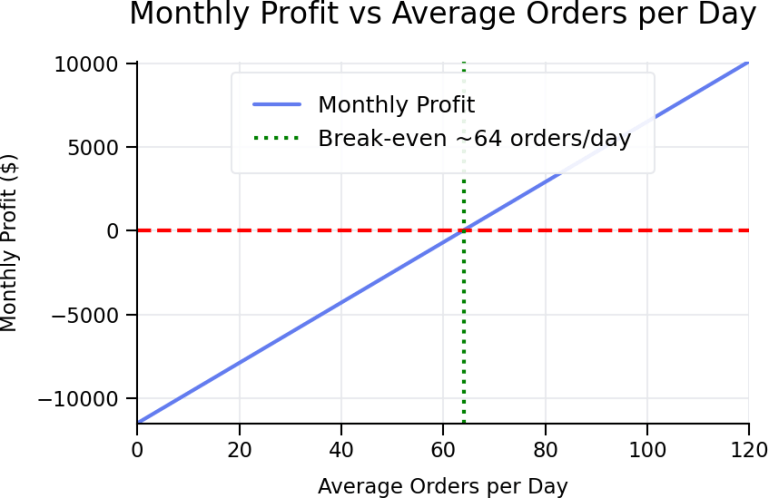
[87] Figure: Estimated Monthly Profit vs. Orders per Day. With an $11 average order and current cost structure, Food, LLC needs ~60 orders/day to break even (green line). Higher volume yields strong incremental profit due to fixed costs being covered.
Note: The unit economics can be improved over time by:
- Raising average order value (through upsells and combos, e.g., adding drinks or sides).
- Optimizing menu pricing (ensuring each item is priced for target food cost %, typically ~30% of price[88]).
- Increasing direct orders (encouraging customers to order via the company’s own website or phone for pickup/delivery, avoiding 3rd-party fees).
- Implementing efficiencies like automation (reducing labor cost per bowl) and negotiating better bulk prices from suppliers as volume grows.
5. Lease & Property Economics: Traditional Lease vs. CloudKitchens Model
A crucial part of the feasibility is comparing the economics of a standard commercial lease to the CloudKitchens (or similar ghost kitchen facility) lease:
- Traditional Direct Lease: Leasing a small restaurant or kitchen space in Fredericksburg is likely in the range of $18–$25 per sq. ft per year for commercial areas near UMW (e.g., $24/SF in a new retail strip on Mine Rd[89]). For ~1,500 sq. ft, that’s ~$30,000–$37,500 per year ($2,500–$3,125 per month). Additional costs include:
- NNN (Triple Net) Fees: Property tax, insurance, maintenance passed on by landlord – often ~$3–$5/SF/year extra (e.g., +$500/month).
- Upfront Build-Out: If the space is a bare “shell,” tenant must invest in building a kitchen. Even a second-generation restaurant space may need updates (e.g., equipment, permits to renovate).
- Utilities: Tenants pay their own electric, gas, water, trash removal.
- Cleaning & Maintenance: Responsibility of tenant – includes daily cleaning, equipment upkeep, and any repairs.
- Benefit: Direct control of space with potential for takeout counter (if ever desired), signage, and possible walk-in business (if allowed). Real estate asset can appreciate (if purchased rather than leased).
Drawback: High initial capex and long-term lease commitments; operational burden of facility management; under-utilized space if business is small (paying for dining area or extra square footage not needed for production). - CloudKitchens Lease: Typically offers smaller, purpose-built units (e.g., 300 sq ft) with rent $4K–$5K/month in many markets. This might be slightly lower in Fredericksburg (perhaps ~$3K+ range) given it’s a smaller market, though CloudKitchens often charges a premium for its all-inclusive model. Key points:
- The lease often requires a minimum term (6–12 months) and sometimes a revenue share component on top of base rent. For example, CloudKitchens in some cases has a profit-sharing agreement once sales exceed a certain threshold (the exact percentage varies).
- What’s included: As noted, rent covers the kitchen infrastructure, heavy equipment, many utilities, and even services like cleaning and on-site personnel[90]. This means fewer surprise expenses – the facility handles permits related to the building and regular maintenance (though some fees like grease trap cleaning might be extra[91]).
- Ancillary fees: There may be add-on fees (e.g., use of a larger shared walk-in fridge, additional storage, extra equipment, or purchasing packaging from the facility stock).
- Benefit: Lower upfront cost (little to no build-out). Speed to market – can launch within weeks of signing if a kitchen is available. Flexibility to scale up (rent more kitchens) or exit with less hassle than a multi-year property lease. The bundled services reduce time spent on facility issues and allow focus on food and marketing.
Drawback: The monthly cost can be higher on a per-square-foot basis than a traditional lease because of the included services and equipment. Additionally, the operator is dependent on the provider – if CloudKitchens decides to adjust fees or if their facility underperforms (as happened with some closures in 2023–24 during CloudKitchens’ restructuring[92]), it could disrupt the business. There’s also no equity or asset; all the money paid in rent doesn’t build ownership.
Recommendation: For Food, LLC, the CloudKitchens-style lease is attractive to contain risk and preserve capital. The ability to start in a small, ready-to-use space for a moderate deposit and monthly fee is aligned with the goal of quick, robust startup. However, since Fredericksburg may not yet have a CloudKitchens facility, a practical approach is:
- Short-term: Partner with a local commissary kitchen or small restaurant space (perhaps through a flexible sublease) to test the concept. Fredericksburg has commissary kitchens like On The Fly Culinary LLC – a food truck and catering kitchen offering shared kitchen memberships in town. These shared kitchens can cost as little as $500–$2,000/month for part-time access to a licensed kitchen in suburban areas. This could be a low-cost way to begin, though it offers less branding and control than a private space.
- Medium-term: As volume grows, transition to a dedicated leased space or advocate for a CloudKitchens facility. For example, if the City Storage Systems (Atoms) team is expanding, Food, LLC could coordinate to become an anchor tenant of a new Fredericksburg ghost kitchen hub – leveraging Kalanick’s network early might provide an advantage in securing such space.
Cost Inclusion Comparison: In summary, leasing through a ghost kitchen provider shifts many costs from capital expenses to a single operational expense. For a fair comparison:
- Traditional Lease: $3K base rent + $500 NNN + ~$20K equipment financed (or leased) + $500 utilities + $300 maintenance/month.
- CloudKitchens: ~$4K/month all-in, equipment included, no separate utilities or maintenance bills, and possibly shorter commitment.
Over a 3-year horizon, the total cost difference isn’t huge, but the risk distribution is. CloudKitchens requires less money upfront and provides a “one throat to choke” for facility issues, which adds robustness for a new business. It’s essentially outsourcing the property and kitchen maintenance to specialists.
6. Financial Projections (Years 1–5)
We project Food, LLC’s financial performance over the first five years, assuming a single kitchen in Fredericksburg focusing on the bowl concept. Key assumptions include:
- Ramp-up of Demand: Starting at ~20 orders/day in initial months and growing to ~80 orders/day by end of Year 1 through marketing and word-of-mouth. Growth continues in Year 2 (~100/day) and stabilizes by Year 3 at a steady ~120 orders/day as the concept matures.
- Average order value (AOV): $11 in Year 1, gradually increasing to $12 by Year 3 (with more combo sales and price adjustments).
- COGS: ~35% of revenue (slight improvements as bulk buying and menu tweaks reduce food costs to ~32% by Year 3).
- Labor: Staff scales from 2 FTE to 3 FTE by Year 2 to handle volume (with commensurate payroll increases), then partially offset by efficiency gains from automation in Year 3 (if implemented).
- CloudKitchens rent: assumed $4,000/month, with a 5% annual increase (and no revenue share for simplicity – if a revenue share exists, it effectively raises COGS or operating costs proportionally to sales).
- Misc. overhead growing modestly with inflation at ~3% annually.
Financial Projection Highlights (in $ Thousands):
| Year | Orders/Day (avg) | Revenue (Annual) | Net Profit (Loss) | Profit Margin | Key Milestones |
| Year 1 | 80/day by Q4 (avg ~60) | $240 – $250K | (~$20K) (Loss) | –8% | High marketing spend; reach breakeven volume by end of Year 1. |
| Year 2 | ~100 / day | $360 – $380K | $15K (Profit) | ~4% | Achieve full profitability mid-year as volume grows. |
| Year 3 | ~120 / day | $480K+ | $50K (Profit) | ~10% | Steady state operations. Implement Lab37 automation, reducing labor costs; explore 2nd virtual brand. |
| Year 4 | ~130+ / day | $550K+ | $75K (Profit) | ~14% | Possible expansion to second kitchen or brand; increased market share locally. |
| Year 5 | 2+ brands or sites | $700K+ | $100K Profit | ~15% | Scale-up stage: multi-brand lineup or new location, leveraging ghost kitchen blueprint. |
Note: The above figures are projections. Actual results will vary based on market conditions and execution. Notably, Year 1 shows a net loss due to initial inefficiencies and high fixed costs against ramping sales – this is normal for a new food business. By Year 2, monthly revenue crosses the breakeven threshold reliably, yielding a small annual profit (~$15K, ~4% margin). By Year 3, with optimizations, net margin improves to ~10%, in line with a healthy fast-casual operation.
Key Financial Insights:
- Cash Flow Management: The most cash-intensive period is pre-opening and the first 6 months, due to startup outlays and initial operating losses. The $40–50K initial investment plus working capital must cover this phase. It’s prudent to have additional cash or credit available as a buffer.
- Path to Profitability: Profitability is reached when daily order volume consistently exceeds ~60 bowls. Our model indicates this should occur in Year 2 with sufficient market penetration. Every order above break-even significantly boosts profit, since variable costs per order are only ~50–60% of the price, and fixed costs are already covered. This is a high operating leverage business: small increases in sales, once overhead is covered, can double or triple profit.
- Scalability: After achieving steady operations in one kitchen, adding an extra brand (for example, an evening-only “late-night bites” menu or leveraging the kitchen to offer catering to campus events) could produce additional revenue at relatively low incremental cost. By Year 5, if demand is robust, Food, LLC might invest in a second kitchen unit or location – potentially doubling revenue while less than doubling overhead (due to shared management and marketing).
7. Risks & Constraints
Despite the promising business model, several risks and challenges must be addressed to ensure robustness:
- Market Demand & Competition: Fredericksburg is smaller than major metro areas where ghost kitchens typically thrive. The UMW student population (while a great niche) is limited, especially when school is out of session (summer and winter breaks will see lower demand). Success hinges on capturing not only students but also local residents, hospital staff, and travelers. Competition from existing restaurants (some of which also offer delivery) and chains is a factor – Food, LLC must differentiate with unique offerings or superior convenience. Aggressive marketing and excellent customer reviews will be required to carve out a loyal customer base. Volume risk is the top concern: as noted, insufficient orders sank at least one CloudKitchens tenant who couldn’t hit break-even volumes. Mitigation: start with strong promotional offers, partner with UMW student groups for events, and possibly operate multiple virtual brands to widen appeal.
- Operational Complexity: Running a kitchen with delivery-only service means peak times can be intense. Orders may bunch at common lunch/dinner hours, straining capacity. Hiring and retaining reliable kitchen staff is a known challenge in foodservice – even UMW’s ghost kitchen cited staffing as an issue[93]. Turnover or absenteeism can disrupt service. Mitigation: cross-train employees, offer competitive pay (maybe slightly above local restaurant average due to no tip credit in a kitchen setting), and create a positive work environment. The automation from Lab37 could be a long-term solution, but it introduces its own risks like maintenance, upfront cost, and the need for technical support.
- Regulatory/Permitting Risks: While we expect ghost kitchen use to be allowable under existing restaurant zoning categories, there’s a possibility that local regulators could impose additional requirements. For instance, some jurisdictions require a special use permit for food preparation without a customer seating area – obtaining such permits can add time and uncertainty. Health regulations must be strictly followed (the Health Department will treat the kitchen like any other restaurant, with inspections for food safety). Also, as an employer, compliance with labor laws (regarding wages, scheduling, etc.) is crucial. Mitigation: engage early with City of Fredericksburg planning and health officials; ensure the facility (especially if independent) meets all code requirements before opening to avoid costly delays.
- Dependence on Third-Party Platforms: Food, LLC will rely on apps like DoorDash and UberEats for orders and delivery. This introduces multiple related risks:
- High Commission Fees: 20–30% fees pressure margins significantly[94]. If these fees increase, or if promotions are needed to stay visible on apps, profitability could suffer.
- Rating Algorithms: Poor reviews or lower ratings on these platforms can reduce visibility. Ensuring excellent customer experience (fast delivery, accurate orders, tasty food) is vital to maintain high ratings and avoid being deprioritized.
- Regulatory Changes for Gig Economy: Potential changes in how delivery drivers are classified (e.g., if they must be treated as employees) could increase delivery costs passed to restaurants.
- Platform Dependency: If a major app were to change its terms or if a competitor pays for better placement, Food, LLC could see order flow fluctuate. Mitigation: develop a direct ordering channel (own website or app) and build a strong brand so customers seek you out specifically. Consider offering customer loyalty incentives for ordering direct or for repeat business.
- CloudKitchens Partnership Risks: While a CloudKitchens-style solution reduces operational headaches, it means trusting an external partner. There have been reports of CloudKitchens facing internal challenges (e.g., layoffs and location closures in 2023–24[95]). If the Fredericksburg facility (hypothetically) underperforms or if CloudKitchens alters its strategy, Food, LLC could face relocation or renegotiation. Mitigation: maintain good relations with the facility manager and stay aware of the business’s performance; have a contingency plan (e.g., know alternative kitchen locations in the area, like other commissaries or restaurant subleases).
- Economic & Supply Chain Factors: In the broader sense, food cost inflation can squeeze margins – recent inflation has driven up grocery costs for proteins, produce, and disposables[96]. Our model assumes stable costs, but spikes in ingredient prices or shortages (e.g., if avian flu raises chicken prices) could require menu price adjustments or substitutions. Additionally, fuel price increases can affect delivery fees (though usually borne by the customer or driver, not the restaurant). Ensure menu pricing has enough margin to absorb reasonable cost fluctuations, and consider dynamic pricing or adjusting menu items seasonally to use more affordable ingredients when possible[97].
Regulatory Outlook: On a positive note, there are no known legal barriers to ghost kitchens in Virginia; they are generally treated as any other restaurant by health departments**[98]**. Zoning trends nationwide have started to acknowledge delivery-only kitchens; many cities treat them as commercial kitchens or catering facilities, which are permitted in commercial/industrial zones. It will be important to register the business properly as an LLC (the preferred structure for ghost kitchens[99]) and to understand local tax obligations (meals tax in Fredericksburg, etc.). Virginia, for instance, requires collection of state sales tax on prepared food and local meals taxes.
Conclusion: Launching Food, LLC as a CloudKitchens-style ghost kitchen near University of Mary Washington appears feasible and potentially profitable, provided the business can capitalize on local demand and execute efficiently. The ghost kitchen model offers a lower-cost, faster path to market – roughly $40K startup investment versus several times that for a traditional restaurant – and built-in scalability for growth. By focusing on a popular, simple bowl concept and leveraging tools like Otter for multi-channel order management and (eventually) Lab37 automation, Food, LLC can punch above its weight in terms of operational efficiency. We project a breakeven within the second year of operation, with net margins reaching the low double-digits by Year 3 under a steady order volume.
However, success is not guaranteed. The venture must overcome the challenges of generating sufficient demand in a smaller market and navigating the thin margins of delivery-centric dining. Careful location choice (to maximize the delivery customer base), strong marketing (especially to UMW and nearby communities), and continuous cost control will be critical. Additionally, contingency plans for regulatory hurdles or shifts in third-party delivery economics should be in place to bolster the business’s robustness.
In summary, Food, LLC’s ghost kitchen can be economically viable in the Fredericksburg/UMW market if it executes a smart, lean launch and rapidly achieves scale. The combination of a favorable location, a trending menu format, and the efficiency gains from Travis Kalanick’s ghost kitchen ecosystem provides a solid foundation for a profitable and scalable operation. With disciplined management and a focus on quality and convenience, Food, LLC can realistically turn its innovative concept into a sustainable business serving the campus and community.
[1]https://www.loopnet.com/Listing/1245-1289-Emancipation-Hwy-Fredericksburg-VA/27245453/
[2]https://www.loopnet.com/Listing/1245-1289-Emancipation-Hwy-Fredericksburg-VA/27245453/
[3]https://cloudkitchens.com/locations/cleveland/carnegie/
[4]https://cloudkitchens.com/locations/cleveland/carnegie/
[7]https://www.loopnet.com/Listing/1245-1289-Emancipation-Hwy-Fredericksburg-VA/27245453/
[8]https://cloudkitchens.com/locations/cleveland/carnegie/
[9]https://cloudkitchens.com/blog/how-much-does-it-cost-to-start-a-ghost-kitchen-a-complete-guide
[10]https://www.foodservicedirector.com/colleges-universities/why-university-of-mary-washington-opened-a-ghost-kitchen
[11]https://homediningkitchen.com/how-much-does-it-cost-to-make-a-chipotle-bowl-at-home/
[12]https://www.nrn.com/restaurant-technology/uber-cofounder-travis-kalanick-launches-atoms-a-new-robotics-and-food-tech-company
[14]https://www.loopnet.com/Listing/1245-1289-Emancipation-Hwy-Fredericksburg-VA/27245453/
[15]https://www.loopnet.com/Listing/1245-1289-Emancipation-Hwy-Fredericksburg-VA/27245453/
[16]https://www.loopnet.com/Listing/1245-1289-Emancipation-Hwy-Fredericksburg-VA/27245453/
[17]https://www.loopnet.com/Listing/1245-1289-Emancipation-Hwy-Fredericksburg-VA/27245453/
[18]https://www.foodservicedirector.com/colleges-universities/why-university-of-mary-washington-opened-a-ghost-kitchen
[19]https://www.loopnet.com/Listing/4714-Mine-Rd-Fredericksburg-VA/31392271/
[20]https://www.loopnet.com/Listing/4714-Mine-Rd-Fredericksburg-VA/31392271/
[21]https://www.fredericksburgva.com/229/Nonresidential-Mixed-Use-Districts
[22]https://www.fredericksburgva.com/229/Nonresidential-Mixed-Use-Districts
[23]https://www.loopnet.com/Listing/1245-1289-Emancipation-Hwy-Fredericksburg-VA/27245453/
[24]https://cloudkitchens.com/locations/cleveland/carnegie/
[25]https://cloudkitchens.com/locations/cleveland/carnegie/
[26]https://cloudkitchens.com/locations/cleveland/carnegie/
[27]https://cloudkitchens.com/blog/how-much-does-it-cost-to-start-a-ghost-kitchen-a-complete-guide
[28]https://cloudkitchens.com/blog/how-much-does-it-cost-to-start-a-ghost-kitchen-a-complete-guide
[29]https://cloudkitchens.com/blog/how-much-does-it-cost-to-start-a-ghost-kitchen-a-complete-guide
[30]https://cloudkitchens.com/blog/how-much-does-it-cost-to-start-a-ghost-kitchen-a-complete-guide
[31]https://cloudkitchens.com/locations/cleveland/carnegie/
[32]https://cloudkitchens.com/locations/cleveland/carnegie/
[33]https://www.loopnet.com/Listing/4714-Mine-Rd-Fredericksburg-VA/31392271/
[34]https://www.loopnet.com/Listing/4714-Mine-Rd-Fredericksburg-VA/31392271/
[35]https://cloudkitchens.com/locations/cleveland/carnegie/
[36]https://www.foodservicedirector.com/colleges-universities/why-university-of-mary-washington-opened-a-ghost-kitchen
[37]https://www.foodservicedirector.com/colleges-universities/why-university-of-mary-washington-opened-a-ghost-kitchen
[38]https://www.loopnet.com/Listing/4714-Mine-Rd-Fredericksburg-VA/31392271/
[39]https://www.loopnet.com/Listing/4714-Mine-Rd-Fredericksburg-VA/31392271/
[40]https://www.loopnet.com/Listing/4714-Mine-Rd-Fredericksburg-VA/31392271/
[42]https://cloudkitchens.com/locations/cleveland/carnegie/
[43]https://cloudkitchens.com/locations/cleveland/carnegie/
[44]https://cloudkitchens.com/locations/cleveland/carnegie/
[45]https://cloudkitchens.com/blog/how-much-does-it-cost-to-start-a-ghost-kitchen-a-complete-guide
[46]https://cloudkitchens.com/locations/cleveland/carnegie/
[47]https://www.nrn.com/restaurant-technology/uber-cofounder-travis-kalanick-launches-atoms-a-new-robotics-and-food-tech-company
[48]https://www.nrn.com/restaurant-technology/uber-cofounder-travis-kalanick-launches-atoms-a-new-robotics-and-food-tech-company
[49]https://www.nrn.com/restaurant-technology/uber-cofounder-travis-kalanick-launches-atoms-a-new-robotics-and-food-tech-company
[53]https://www.nrn.com/restaurant-technology/uber-cofounder-travis-kalanick-launches-atoms-a-new-robotics-and-food-tech-company
[54]https://cloudkitchens.com/locations/cleveland/carnegie/
[55]https://cloudkitchens.com/locations/cleveland/carnegie/
[56]https://mygrinderguide.com/how-much-do-ghost-kitchens-cost-to-rent/
[57]https://mygrinderguide.com/how-much-do-ghost-kitchens-cost-to-rent/
[58]https://cloudkitchens.com/locations/cleveland/carnegie/
[59]https://homediningkitchen.com/how-much-does-it-cost-to-make-a-chipotle-bowl-at-home/
[60]https://homediningkitchen.com/how-much-does-it-cost-to-make-a-chipotle-bowl-at-home/
[61]https://homediningkitchen.com/how-much-does-it-cost-to-make-a-chipotle-bowl-at-home/
[62]https://homediningkitchen.com/how-much-does-it-cost-to-make-a-chipotle-bowl-at-home/
[63]https://homediningkitchen.com/how-much-does-it-cost-to-make-a-chipotle-bowl-at-home/
[64]https://homediningkitchen.com/how-much-does-it-cost-to-make-a-chipotle-bowl-at-home/
[65]https://pos.toasttab.com/blog/on-the-line/fast-food-profit-margin
[66]https://cloudkitchens.com/locations/cleveland/carnegie/
[67]https://www.loopnet.com/Listing/4714-Mine-Rd-Fredericksburg-VA/31392271/
[68]https://www.loopnet.com/Listing/4714-Mine-Rd-Fredericksburg-VA/31392271/
[69]https://cloudkitchens.com/locations/cleveland/carnegie/
[70]https://cloudkitchens.com/blog/how-much-does-it-cost-to-start-a-ghost-kitchen-a-complete-guide
[71]https://cloudkitchens.com/blog/how-much-does-it-cost-to-start-a-ghost-kitchen-a-complete-guide
[72]https://cloudkitchens.com/locations/cleveland/carnegie/
[73]https://www.loopnet.com/Listing/4714-Mine-Rd-Fredericksburg-VA/31392271/
[74]https://cloudkitchens.com/locations/cleveland/carnegie/
[75]https://mygrinderguide.com/how-much-do-ghost-kitchens-cost-to-rent/
[76]https://cloudkitchens.com/blog/how-much-does-it-cost-to-start-a-ghost-kitchen-a-complete-guide
[77]https://cloudkitchens.com/locations/cleveland/carnegie/
[78]https://mygrinderguide.com/how-much-do-ghost-kitchens-cost-to-rent/
[79]https://mygrinderguide.com/how-much-do-ghost-kitchens-cost-to-rent/
[80]https://homediningkitchen.com/how-much-does-it-cost-to-make-a-chipotle-bowl-at-home/
[81]https://homediningkitchen.com/how-much-does-it-cost-to-make-a-chipotle-bowl-at-home/
[84]https://pos.toasttab.com/blog/on-the-line/fast-food-profit-margin
[85]https://pos.toasttab.com/blog/on-the-line/fast-food-profit-margin
[86]https://pos.toasttab.com/blog/on-the-line/fast-food-profit-margin
[87]https://us-prod.asyncgw.teams.microsoft.com/v1/objects/0-cus-d10-ed274dda8901a3ed034e169d54514356/views/original/profit_vs_orders.png
[88]https://pos.toasttab.com/blog/on-the-line/fast-food-profit-margin
[89]https://www.loopnet.com/Listing/4714-Mine-Rd-Fredericksburg-VA/31392271/
[90]https://cloudkitchens.com/locations/cleveland/carnegie/
[91]https://cloudkitchens.com/locations/cleveland/carnegie/
[92]https://www.nrn.com/restaurant-technology/uber-cofounder-travis-kalanick-launches-atoms-a-new-robotics-and-food-tech-company
[93]https://www.foodservicedirector.com/colleges-universities/why-university-of-mary-washington-opened-a-ghost-kitchen
[94]https://mygrinderguide.com/how-much-do-ghost-kitchens-cost-to-rent/
[95]https://www.nrn.com/restaurant-technology/uber-cofounder-travis-kalanick-launches-atoms-a-new-robotics-and-food-tech-company
[96]https://cloudkitchens.com/blog/how-much-does-it-cost-to-start-a-ghost-kitchen-a-complete-guide
[97]https://cloudkitchens.com/blog/how-much-does-it-cost-to-start-a-ghost-kitchen-a-complete-guide
[98]https://cloudkitchens.com/blog/how-much-does-it-cost-to-start-a-ghost-kitchen-a-complete-guide
[99]https://cloudkitchens.com/blog/how-much-does-it-cost-to-start-a-ghost-kitchen-a-complete-guide


