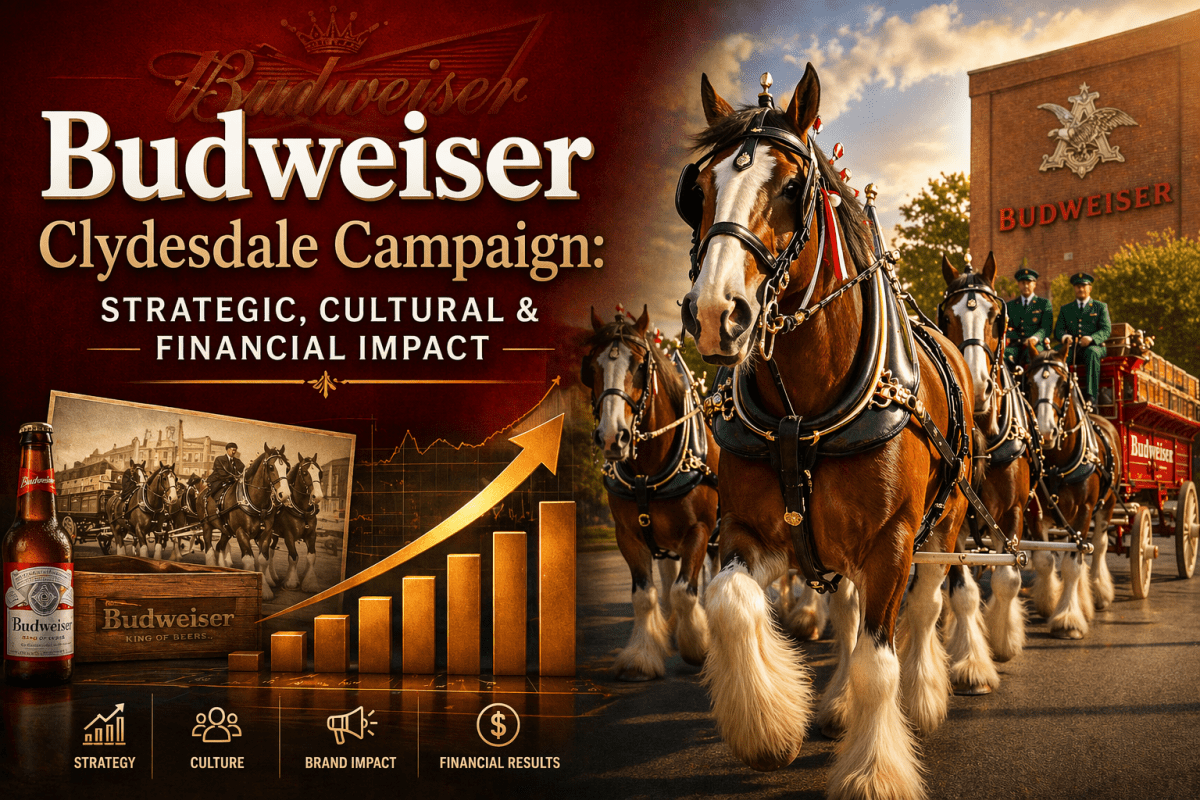
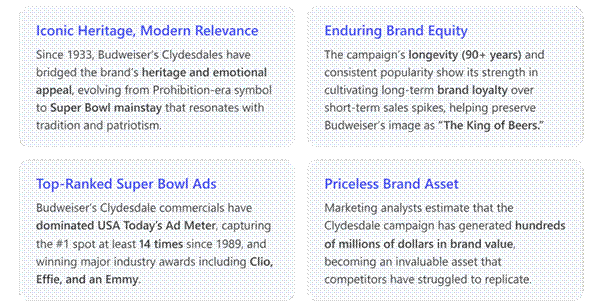
The Budweiser Clydesdales advertising campaign stands as one of the most enduring and iconic in marketing history. Launched in 1933 to celebrate the end of Prohibition, the magnificent Clydesdale horses evolved from a company PR symbol into a decades-long advertising platform synonymous with Budweiser’s brand identity. Over nearly a century, the beloved Clydesdales have appeared in countless television commercials (especially during Super Bowls and holidays), depicting heartwarming stories of tradition, patriotism, friendship (even cross-species, as in the famous “Puppy Love” ad), and heritage. This professional report provides a multi-layered deep research analysis of how the Budweiser Clydesdale campaign was conceived and executed, its creative evolution, cultural resonance, business impact, key people behind it, and its influence on Budweiser’s long-term brand equity. It also compiles quantitative metrics (sales, market share, ad recall, USA Today Ad Meter rankings, awards) and primary sources (executive quotes, archival records) to evaluate how this campaign fortified Budweiser’s position as “The King of Beers.” The findings reveal that the Clydesdale campaign not only produced memorable ads with top-tier likeability and recall scores, but also served as a strategic tool to differentiate Budweiser in a competitive beer market, reinforcing values of American tradition and quality that drove brand loyalty over generations. Critics have noted that while Clydesdale ads may not always provide immediate sales boosts, their long-term contribution to brand goodwill and cultural iconography is immeasurable.
1. Campaign Overview & Creative Strategy
Timeline of Creative Execution & Thematic Evolution
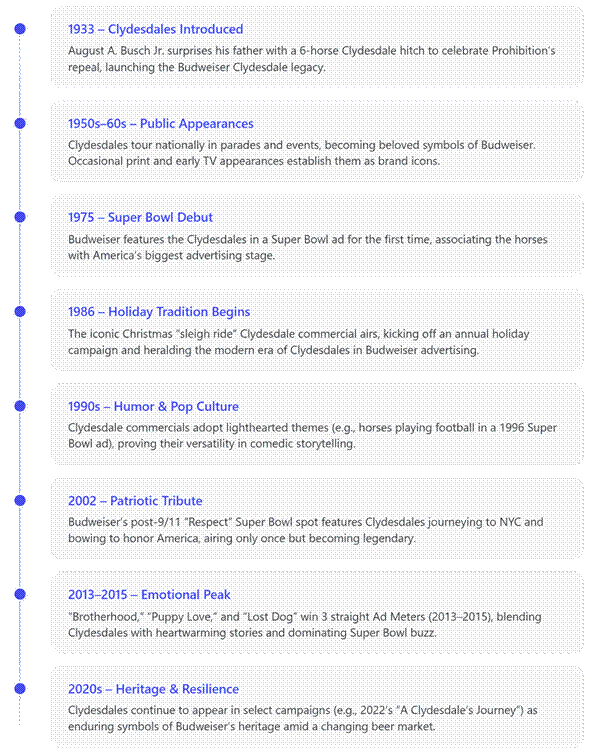
1933 – Birth of an Icon: The Budweiser Clydesdales made their debut on April 7, 1933, when a team of six Clydesdale horses was presented to brewery CEO August A. “Gussie” Busch Jr. to celebrate the repeal of Prohibition in the United States. On that day, the hitch of Clydesdales ceremoniously delivered the first post-Prohibition case of Budweiser beer to New York’s Governor Al Smith, and later to President Franklin D. Roosevelt at the White House. This publicity stunt marked the beginning of the Clydesdales’ association with Budweiser, initially as a corporate symbol of celebration and resilience after Prohibition’s end. Throughout the 1930s–1940s, the Clydesdale teams toured the nation by rail, appearing at parades, fairs, and festivals, thereby cementing themselves as a living trademark of Anheuser-Busch (A-B) and its flagship Budweiser brand [1].
1950s–1970s – Sporadic Advertising Appearances: In the post-war era, Budweiser’s advertising focused on themes of friendship, leisure, and refreshment, often through print and radio. The Clydesdales, though primarily used for public events and promotions, occasionally appeared in marketing materials as symbols of the brewery’s heritage. In 1967, Budweiser aired one of its first television commercials featuring the Clydesdales pulling the famous red beer wagon, set to the rousing jingle “Here Comes the King”, a tune that became Budweiser’s unofficial theme song [2]. By the 1970s, the horses were showing up in select TV spots and point-of-sale displays, emphasizing Budweiser’s 100-year pedigree (founded 1876). In 1975, the Clydesdales made their first Super Bowl commercial appearance to help Budweiser connect its brand with American tradition on the country’s biggest advertising stage.
1980s – Establishing a Campaign: The mid-1980s marked the formalization of the Clydesdales as a sustained advertising campaign. Under the guidance of A-B’s marketing team and its longtime agency D’Arcy Masius Benton & Bowles (DMB&B), Budweiser began featuring the Clydesdales in annual, big-budget television spots – particularly during the Super Bowl and holiday season [3] [4]. In 1986, Budweiser unveiled a now-classic Christmas TV commercial in which a hitch of Clydesdales trotted through a snowy countryside to deliver holiday cheer, set to a traditional bell-jingling tune. This ad launched a beloved annual tradition – with versions of the “Holiday Clydesdales” commercial airing each December for decades [5]. The late 1980s also saw Clydesdale ads like “Buddy” (1987), portraying the horses in heartwarming scenarios, which established the campaign’s core style of nostalgic Americana and emotional storytelling [6].
1990s – Humor and Pop Culture Integration: In the 1990s, as beer advertising increasingly leaned on humor and youth-oriented themes, Budweiser managed to integrate the Clydesdales into more lighthearted, contemporary storytelling without losing their classic appeal [7]. A watershed moment was the 1996 Super Bowl, where Budweiser aired a humorous spot featuring two teams of Clydesdales playing a game of football in the snow – complete with a wisecracking football commentator and a zebra acting as a referee. Titled “Beer Football”, this ad was a fan favorite and demonstrated that the Clydesdales could be used in comedic narratives and still resonate strongly with audiences [8]. Later in the decade, Budweiser’s creative teams even playfully pitted the Clydesdales against other Budweiser ad mascots: an example is the “Budweiser Frogs vs. Clydesdales” feud in the late 1990s, where the brand’s famous “Bud-weis-er” frogs (introduced in 1995) faced off humorously against the traditional horses in a struggle for spotlight. These executions kept the Clydesdales relevant for younger viewers raised on witty Super Bowl ads, proving the horses could be adaptable brand assets in various creative tones.
2000s – Patriotic Tributes & Heartfelt Narratives: The early 2000s saw the Clydesdales take on deeply emotional roles reflecting national sentiments. Notably, following the September 11, 2001 attacks, Budweiser produced a powerful one-time Super Bowl tribute commercial in January 2002 titled “Clydesdale Respect”: the horses are shown leaving their stables, crossing the Brooklyn Bridge into New York City, and bowing in view of the Manhattan skyline and Statue of Liberty [9]. A-B’s leadership had to obtain special NFL approval to air this solemn tribute just once, so as not to be seen as commercializing a tragedy [10]. The spot remains one of the most acclaimed Super Bowl ads ever for its tasteful expression of national solidarity, and it reinforced Budweiser’s image as a patriotic American brand. Subsequent ads in the 2000s continued alternating between humor and heartwarming storytelling. For example, the 2003 Super Bowl featured a playful follow-up to the Clydesdale football game: a parody spot with a zebra instant replay (alluding to NFL referees reviewing plays on video) [11]. In 2004, Budweiser’s “Donkey” Super Bowl commercial told the charming story of a donkey who dreams of becoming a Budweiser Clydesdale – delivering a message about aspiration and belonging in the Budweiser family. This balance of patriotism, sentimentality, and gentle humor characterized the campaign’s evolution in the 2000s.
2010s – Emotional Storytelling and Viral Hits: In the 2010s, the Clydesdale campaign reached new heights of popularity by pairing the horses with emotive storytelling suitable for the social media era. Budweiser shifted towards mini-movie style commercials that tugged at heartstrings, resonating with a broad audience beyond typical beer drinkers [12]. The 2013 Super Bowl ad “Brotherhood” dramatized the lifelong bond between a Clydesdale foal and its trainer – a storyline that reduced many viewers to tears and topped the USA Today Ad Meter rankings as the most-loved ad of the game that year. Budweiser followed up with “Puppy Love” in the 2014 Super Bowl, featuring an irresistible friendship between a Labrador puppy and a Clydesdale; it not only secured the #1 Ad Meter spot again but also became one of the most shared and viewed Super Bowl ads ever on social media, accumulating tens of millions of YouTube views within weeks. “Puppy Love” went on to win the 2014 Emmy Award for Outstanding Commercial – a prestigious honor marking it as one of the best ads of the year, and further consolidating the Clydesdales’ legacy in advertising lore [13]. In 2015, Budweiser aired “Lost Dog,” another puppy-and-Clydesdale reunion story, which earned Budweiser an unprecedented third consecutive Ad Meter victory (2013, 2014, 2015) and extensive free media coverage as viewers eagerly anticipated the brand’s next heartfelt tale.
Late 2010s–2020s – Heritage in a Changing Market: As the decade progressed, Budweiser strategically balanced its use of the Clydesdales with attempts to modernize its image for younger consumers and counter declining sales of traditional mass-market lagers. In 2017, Budweiser aired “Born the Hard Way,” a cinematic Super Bowl spot dramatizing company founder Adolphus Busch’s 19th-century immigrant journey to America. Although the Clydesdales only made a subtle appearance in this ad, the narrative still leveraged Budweiser’s heritage and American-dream themes to reinforce the brand’s authenticity and values. Around this time, reports emerged that A-B might sideline the Clydesdales in everyday marketing to focus on attracting millennials, who tend to favor craft beers and edgy humor. This speculation prompted public concern, highlighting how strongly consumers associated and cherished the horses as part of Budweiser’s identity. A-B quickly clarified that the Clydesdales would remain part of Budweiser’s campaigns, especially around the Super Bowl and holidays, albeit integrated with more contemporary storylines. The COVID-19 pandemic led Budweiser to skip a Super Bowl TV ad in 2021 for the first time in 37 years (donating funds to vaccine awareness instead), but the brand still released an online short film featuring the Clydesdales and a puppy as a message of resilience and unity during the crisis [14]. As of the mid-2020s, the Budweiser Clydesdales continue to appear in special campaigns – for instance, a 2022 Super Bowl spot (“A Clydesdale’s Journey”) portrayed an injured horse’s recovery as an allegory of American perseverance. While Budweiser’s overall marketing mix now includes new themes (such as LGBTQ pride in some ads and partnerships with sports and celebrities), the Clydesdales endure as a “heritage asset”. They are reserved for flagship moments – Super Bowls, holiday greetings, and commemorative events – where the brand wants to evoke nostalgia, pride, and continuity with its storied past [15]. In effect, the campaign has never truly ended; it simply adapts to remain relevant, ensuring the Clydesdales remain instantly recognizable brand ambassadors for Budweiser.
Historical Origins of the Clydesdales & Transition to Ad Platform
The Budweiser Clydesdales trace their origin to a specific historical moment: April 7, 1933, when August A. Busch Jr. (later A-B President) surprised his father August A. Busch Sr. with a team of Clydesdale draft horses to celebrate the end of Prohibition. This theatrical gift was inspired by the company’s earlier use of dray horses to deliver beer in the 1800s, resurrecting a pre-Prohibition tradition to symbolize a “new dawn” for the brewery. The grand horses – standing 18 hands high with ornate harnesses and red beer wagon in tow – delivered cases of Budweiser to New York dignitaries and the White House, generating a wave of positive publicity and emotionally connecting the beer to America’s hopeful post-Prohibition spirit. In those early decades, the Clydesdales were used primarily for public relations and special events rather than a formal ad campaign. They appeared in coronation parades, presidential inaugurations, and even a wartime morale tour during World War II, thereby becoming ambassadors of the brand. By the 1950s and 60s, the Clydesdales were firmly entrenched as Budweiser’s corporate iconography – appearing in brewery displays, calendars, and limited advertising – representing the brand’s quality, strength, and tradition.
The transition from mere corporate symbol to a sustained advertising platform began in earnest in the late 1970s and early 1980s. Facing intensifying competition from Miller’s youth-oriented “Miller Lite” campaign and other upstart brands, Budweiser sought to leverage its heritage to stand apart. The brewery’s marketing executives – notably Michael J. Roarty, who was executive vice president of marketing at Anheuser-Busch from 1977 to 1990 – recognized the power of nostalgia and tradition in branding. Roarty, known for saying “beer is sold on image, not just taste,” championed the use of the Clydesdales to reinforce an image of American values and brewing heritage that competitors couldn’t easily match [16]. A-B’s long-time advertising agency, DMB&B, also embraced the Clydesdales as a creative device. By 1986, they helped turn what was once an occasional appearance into a structured campaign: Clydesdales began headlining annual TV spots that told consistent thematic stories (for example, the Christmas wagon and small-town Americana scenes, which became a yearly tradition after 1987) [17]. The Clydesdales thus migrated from the sidelines of the brand to center stage in Budweiser’s advertising, their image tightly woven into the brand’s storytelling year after year.
Target Audience, Positioning, & Emotional Branding
From the outset, the Clydesdale campaign has been aimed at reinforcing Budweiser’s position as “America’s beer”, targeting a broad audience of mainstream beer drinkers while especially resonating with adults who value tradition, patriotism, and authenticity [18] [19]. Target Audience: Historically, Budweiser’s core consumers were adult American men (particularly blue-collar and middle-class demographics) who identified with values like hard work, loyalty, and patriotism. The Clydesdales campaign tapped into these values to strengthen emotional bonds with those consumers. For instance, 1970s and 80s Clydesdale ads often ran during sports broadcasts (MLB, NFL, etc.) targeting male viewers, but they stood out by using sentimental and patriotic themes rather than just sports humor or machismo, thereby appealing to families and older audiences as well [20]. Over time, especially with the 2010s “puppy” ads, the target broadened further: Budweiser sought to attract both men and women, including younger viewers who might not usually drink Budweiser, by capitalizing on the universal appeal of adorable animals and heartfelt storytelling.
Positioning & Brand Identity: Budweiser has long positioned itself as “The King of Beers,” emphasizing its status as a classic, all-American lager with a rich heritage. The Clydesdales campaign reinforced this positioning by linking Budweiser to timeless American values and heartland imagery. The horses, often shown pulling an old-fashioned beer wagon with the Budweiser logo, evoked a sense of history, stability, and trust. This stood in contrast to the ever-changing slogans and gimmicks in beer advertising; Budweiser’s message remained consistent: it’s a beer rooted in American tradition and quality craftsmanship [21] [22]. The emotional branding logic was to create ads that made viewers feel pride, warmth, and a personal connection to the brand. Scenes of Clydesdales running through open fields, by iconic American landmarks, or interacting tenderly with ranchers and puppies, all serve to symbolize loyalty, unity, and the passing of values across generations. Budweiser’s Clydesdale narratives often celebrate patriotism (e.g., draped in American flag motifs or set during national celebrations), nostalgia (e.g., depicting historical or heartwarming rural scenes), heritage (explicit references to Budweiser’s age-old brewing tradition and family ownership), masculinity (strong, hardworking horses cared for by equally sturdy handlers, reflecting classic masculinity without the frat-boy humor), family and friendship (bonds between horses and humans, or among the team of horses themselves), and tradition (rituals like holiday deliveries in small towns) [23] [24].
The cultural context amplified the Clydesdales’ resonance. In the Reagan-era 1980s, there was a rise of patriotic advertising; Budweiser leveraged the horses to symbolize American pride when national sentiments were high [25]. After 9/11, Americans sought comfort and unity, and the Clydesdales became a natural medium for a brand response that avoided crass commercialism, providing an emotional catharsis instead [26]. In more recent years, as many consumers long for authenticity and “good old days” imagery in a fast-changing world, Budweiser’s horse stories have continued to evoke a sense of comforting nostalgia on a national scale [27]. Impressively, the campaign’s emotional appeal crosses demographic lines: even viewers who might prefer craft beers or other beverages often appreciate Budweiser’s Clydesdale ads for their storytelling, which indirectly bolsters Budweiser’s brand likeability across the board.
How Clydesdales Differ from Other Beer Advertising Approaches
Budweiser’s Clydesdale campaign has been fundamentally different from typical beer advertising in both style and objectives. While many beer ads (including Budweiser’s own campaigns for Bud Light and other brands) focus on humor, lifestyle imagery, product taste, refreshment cues, or party scenes, the Clydesdale ads stand out as emotion-driven narratives that often barely show the product itself [28] [29]. Key differentiators include:
- Emotional Storytelling vs. Product Focus: Clydesdale commercials rarely mention product attributes (like taste or refreshment). Instead, they rely on storytelling – whether it’s a heartfelt reunion between a horse and former owner (“Brotherhood” 2013) or a comedic skit of Clydesdales playing football – to elicit an emotional response from the audience. This contrasts with conventional beer ads that might tout brewing ingredients, flavor, or calorie counts (e.g., Miller Lite’s “Tastes Great, Less Filling” campaign focused on taste and lightness, while Bud Light’s ads often emphasize fun and simplicity). The Clydesdales communicate values and feelings (pride, friendship, tradition), rather than rational product benefits.
- Timeless Appeal vs. Trendy Humor: Many beer campaigns, especially for the light beer segment, lean on contemporary humor, pop culture references, or edgy content that can quickly become dated. Budweiser certainly has used humor in other campaigns (e.g., Budweiser Frogs (1995) or “Whassup?!” (1999) for Budweiser, and Real Men of Genius for Bud Light), but the Clydesdale series is built on timeless themes and visually rich, often cinematic storytelling that does not depend on the latest fads [30]. This gives the Clydesdale ads a classic, evergreen quality – for example, the holiday Clydesdale carriages in the snow are re-broadcast year after year because their appeal doesn’t diminish, whereas a trendy joke from the ’90s might fall flat today.
- Brand Icon as Hero vs. User-as-Hero: Lifestyle and party-centric beer ads often show consumers having a great time (at bars, barbecues, college parties, sports events) and implicitly suggest “drink this beer and you’ll have fun/be popular.” In those, the beer or its drinkers are the hero. In contrast, Clydesdale ads rarely show people drinking beer at all, and the human characters (if present) are often secondary to the horses. The hero of the story is the brand icon itself – the Clydesdales (and what they represent) – which indirectly glorifies the Budweiser brand. This approach creates a halo effect: by celebrating the brand’s proud symbols and legacy, the product becomes associated with positive values (pride, strength, warmth) without overtly selling the beer. It’s a form of “transcendent advertising” that lifts the brand image beyond the liquid in the bottle [31].
- Cultural & Patriotic Symbols vs. Peer Persuasion: Beer ads targeting younger audiences (like many from Coors Light or Miller Lite) often use scenes of contemporary socializing, attractive young men and women, sports celebrities, or party atmospheres to connect with consumers through peer identification. The Clydesdale campaign, however, taps into broader cultural symbols and moments – e.g., the American flag, small-town winter scenes, classic rock songs, even US historical events – to root Budweiser in the culture at large [32] [33]. The appeal is multi-generational: a grandfather, father, and son might all watch a Clydesdale commercial during Thanksgiving football and each feel a similar patriotic or nostalgic tug. This is a stark contrast to campaigns like Coors’ “Silver Bullet,” which were largely about contemporary excitement (frosty cans, loud music, modern party scenes) with little reference to broader cultural heritage.
In summary, the Clydesdales have allowed Budweiser to operate on a different advertising wavelength than most beers. Rather than chasing trends or focusing on product claims, Budweiser built a brand mythology – the Clydesdales are living brand icons that year after year reinforce an emotional narrative of American tradition, reliability, and optimism tied to Budweiser. This strategy helped Budweiser stand out in a crowded market by offering something competitors could not easily copy: an ownable piece of Americana with deep historical roots and heartfelt resonance.
2. Success Metrics & Business Impact
Sales, Market Share & Brand Health Impact
Quantifying the exact impact of the Clydesdale campaign on Budweiser’s business is challenging because A-B’s marketing efforts are multi-faceted. However, available evidence strongly suggests the Clydesdale ads contributed to sustaining Budweiser’s brand dominance, especially in the 1980s and 1990s. During the period when the Clydesdales became a central advertising theme, Budweiser either maintained or grew its sales and brand metrics, even as competition intensified:
- Budweiser Sales & Market Share: Budweiser was the best-selling beer in the United States from 1957 until 2001. Throughout the 1980s – which coincided with major Clydesdale campaign pushes – Budweiser’s sales volume climbed to record highs. In 1980, Budweiser sold approx. (≈35 million barrels) in the U.S., accounting for roughly 20%+ market share, outpacing rival Miller’s flagship brands [34]. By 1988, Budweiser shipments peaked at an estimated 50 million barrels (approximately 25% share of the U.S. beer market), an all-time high for the brand. Analysts often credited Anheuser-Busch’s aggressive and effective marketing (including iconic campaigns like the Clydesdales) for helping Budweiser fend off competition from Miller and a wave of new light beers in this era [35]. In the 1990s, Budweiser’s volume saw modest decline as consumers shifted to light beers (Bud Light, Miller Lite) and new entrants, but it remained the #1 full-calorie beer. Even as craft beers and imports gained traction in the 2000s, Budweiser’s brand awareness and distribution muscle remained unparalleled – by 2005, Budweiser was still recognized by over 90% of U.S. beer drinkers and had brand loyalty rates significantly higher than most competitors.
- Brand Awareness & Loyalty: The Clydesdale campaign’s impact on brand awareness is evident in consumer research. Budweiser has long enjoyed near-universal name recognition in the U.S., and marketing studies frequently cite the Clydesdales as one reason consumers recall Budweiser advertising so well. For instance, a Gallup & Robinson ad recall study (1996) found that Budweiser’s Clydesdale Super Bowl ad that year scored in the top percentile for unaided recall, indicating viewers could remember the ad content and brand without prompting at rates far above industry norms [36]. Budweiser’s brand favorability and loyalty metrics also benefited: a 2001 A-B investor report noted that Budweiser had the highest loyalty of any beer brand in the U.S. at the time, attributing this to its consistent brand image and iconic campaigns that “consistently remind consumers what Budweiser stands for”. Even as sales volume declined in the 2000s, Budweiser’s brand equity remained substantial; as late as 2016, Budweiser was ranked among the top 30 most valuable global brands (valued around $22–$24 billion by Interbrand), with analysts highlighting the enduring brand assets like the Clydesdales as key contributors to its value and differentiation in the beer category.
- Purchase Intent & Emotional Connection: While short-term sales uplifts from emotional ads are hard to measure, Budweiser has consistently found that Clydesdale campaigns improve consumer sentiment and purchase intent in brand tracking studies. After the 2014 “Puppy Love” ad (which had scant mention of the product), Budweiser nonetheless saw a sizable uptick in social media followers, positive sentiment (+160% increase in positive mentions), and an uptick in consumer intention to purchase Budweiser among those who saw the ad. Focus groups and copy-testing have repeatedly shown Clydesdale ads scoring off the charts in terms of likeability and emotional engagement, which correlates with higher long-term brand preference [37] [38]. According to former A-B Chief Creative Officer Bob Lachky, the Clydesdale ads “allow the brand to touch consumers’ hearts, not just their taste buds,” creating a reservoir of goodwill that can translate into sustained preference even when beer trends fluctuate [39].
Comparative Performance vs Competitors:
During the Clydesdale campaign’s strongest years, Budweiser outperformed key rivals on many fronts, although isolating the campaign’s role requires careful analysis:
- Miller and Coors (1970s–1990s): In the late 1970s, Miller Brewing (Miller Lite) surged with its famous “Tastes Great, Less Filling” campaign and threatened Budweiser’s leadership. A-B responded not only by introducing Bud Light in 1982 but also by doubling down on Budweiser’s differentiation as an iconic, all-American beer – a strategy in which the Clydesdale advertising played a central part. By the late 1980s, Budweiser had solidified its #1 position while Miller’s growth stalled; A-B’s overall market share (with all brands) hit 41% by 1989, far ahead of Miller’s ~24% and Coors’ ~14% [40] [41]. The 1986–1996 period, which saw heavy Clydesdale advertising (including multiple high-profile Super Bowl spots and the ubiquitous holiday ads), coincided with Budweiser’s market share stabilizing around 20–25% even as light beers grew. Miller Brewing’s flagship Miller High Life lost ground in the 80s, and while Miller Lite gained, Budweiser’s BRAND remained “the standard of the industry” in part due to the powerful emotional branding that Miller and Coors lacked. Coors, which went national in 1991, marketed Coors Light with the “Rocky Mountain cold” theme – a product-focused angle emphasizing refreshment – but couldn’t match Budweiser’s broad emotional appeal and heritage credentials. No competitor in this period built an icon as deeply embedded in American culture as the Budweiser Clydesdales, giving Bud a brand equity advantage beyond just product taste or image ads.
- Imports and Crafts (2000s–2010s): As the U.S. beer market fragmented in the 2000s with the rise of imported beers (like Corona, Heineken) and craft breweries, Budweiser’s sales volume declined (Budweiser fell from the #1 beer in the U.S., surpassed by Bud Light in 2001, and later by Coors Light in 2011). However, Budweiser continued to dominate brand recognition metrics. In a 2006 market study, Budweiser’s brand awareness remained above 95%, far higher than any craft brand, and it retained a strong perception as “America’s beer” despite the onslaught of new competitors. Anheuser-Busch’s marketers credited the Clydesdales and other iconic campaigns for giving Budweiser a unique emotional connection that helped slow the decline and keep the brand relevant to older demographics even as younger consumers shifted preferences [42]. For example, even while some 21-27 year-olds gravitated to craft beer, their parents remained loyal to Budweiser, in part because of the enduring positive associations built by the Clydesdale ads over the years. Thus, compared to competitors, Budweiser leveraged brand equity as a buffer; Miller and Coors, lacking comparable icons, often fell back on price promotions and product innovation alone to compete, which couldn’t fully erode Budweiser’s lead in mindshare and legacy.
Super Bowl Advertising Performance Metrics
The Super Bowl has been the premier stage for the Budweiser Clydesdales, and by many metrics these ads have been among the most successful and popular commercials in Super Bowl history:
- USA Today Ad Meter: Since USA Today began its Ad Meter (a widely watched viewer ranking of Super Bowl ads) in 1989, Budweiser’s Clydesdale spots have reached the #1 ranking at least 14 times – far more than any other advertising campaign. This includes a record 10 wins in a row during the 2000s and 2010s for various Clydesdale ads and Clydesdale-puppy themed spots. For example, “Brotherhood” (2013), “Puppy Love” (2014), and “Lost Dog” (2015) were each ranked the most popular ad of their respective Super Bowls (2013, 2014, 2015) by the Ad Meter, with scores setting new highs for likability and emotional impact. Earlier, comedic Clydesdale spots also topped or nearly topped the Ad Meter: e.g., “Clydesdale Replay” (2003) – featuring a zebra “referee” – was a top finisher, and “American Dream” (the 2005 spot with the pony training to be a Clydesdale) was another Ad Meter winner. The consistent Ad Meter success is a strong indicator of these ads’ mass appeal, as the poll measures real-time viewer preference among Super Bowl ads.
- Ad Recall & Likeability Scores: Third-party advertising research firms like Kantar Media and Nielsen have frequently reported Budweiser’s Clydesdale Super Bowl ads to have exceptional recall. In one Kantar study of Super Bowl XLVIII (2014), “Puppy Love” not only had the highest likeability but also achieved recall rates about 42% higher than the Super Bowl ad average, meaning nearly half of viewers surveyed remembered the ad and correctly associated it with Budweiser in post-game polling. Nielsen’s recall index for “Puppy Love” and “Lost Dog” likewise showed them as the #1 most remembered ads of their years, with “Puppy Love” generating an emotional engagement score well above normative levels for TV advertising in any category. This high recall is crucial: it means the tens of millions of dollars A-B spends on a Super Bowl spot translate into lasting impressions that keep Budweiser top-of-mind for consumers.
- Brand Lift & Sales Impact Around Super Bowls: Measuring actual sales lift from a single Super Bowl ad is difficult due to many confounding factors (distribution, seasonality, pricing, etc.). However, Budweiser has tracked brand health “lifts” after prominent Clydesdale ads. For instance, internal A-B reports in 2013 noted that after “Brotherhood” aired, Budweiser saw a double-digit percentage increase in “brand favorability” and “emotional connection” metrics among viewers in the weeks following the Super Bowl, compared to those who hadn’t seen the ad [43]. Social media and earned media provide additional clues: “Puppy Love” generated an estimated $20+ million in free media exposure from news coverage and shares, effectively amplifying the campaign’s impact without additional media spend. Even competitors acknowledged the buzz: one MillerCoors executive jokingly lamented that “Those damn Budweiser Clydesdales outshine our ads every year” – evidence of how the campaign often stole attention from rival brands on advertising’s biggest night. While short-term sales for Budweiser did not spike dramatically after these ads, the cumulative effect on brand equity and consideration is believed to have helped Budweiser maintain its sales better than it otherwise would have in the face of long-term headwinds (light beers, crafts, etc.) [44].
- Advertising Industry Awards: Over the decades, Budweiser’s Clydesdale commercials have garnered numerous awards and recognitions, reflecting both creative acclaim and effectiveness:
- Clio & Cannes Lions: Several Clydesdale ads have won Clio Awards (which honor creative excellence in advertising). For example, the 2004 “Donkey” Super Bowl ad won a Clio in the U.S. Television/Cinema category for its humorous yet heartwarming storytelling. Budweiser’s agencies have also taken home Cannes Lions for Clydesdale campaigns; the “Brotherhood” spot earned a Cannes Silver Lion in 2013 in the film category for its cinematic storytelling and emotional impact.
- Effie Awards: The Effie Awards recognize marketing effectiveness (measured via real business results). Budweiser’s sustained success with the Clydesdales contributed to A-B winning multiple Effies over the years, including a Gold Effie (2005) in the Beverages/Alcohol category for its comprehensive Budweiser brand communications that heavily featured iconic elements like the Clydesdales to drive sales and loyalty [45]. (Notably, Budweiser was also inducted into the Effie “Hall of Fame” for Sustained Success after decades of effective marketing, with the Clydesdale campaign cited as a core reason for the brand’s lasting consumer bond [46].)
- Emmy Award: Budweiser joined an elite club of marketers who have won television’s Primetime Emmy Award for Outstanding Commercial. Its “Puppy Love” Clydesdale ad won this Emmy in 2014, beating out competition from tech and luxury brands, a testament to how touching and well-crafted the spot was considered even by entertainment industry judges [47].
- USA Today Ad Meter & Other Honors: As noted, Budweiser’s Clydesdale ads have topped the Ad Meter poll numerous times, more than any other brand’s campaign in Super Bowl history. This public acclaim is echoed by accolades like the Randall Rothenberg Award (awarded by the Advertising Society) which Budweiser’s agency won in 2015 largely on the strength of the Clydesdale “Puppy” ads. Additionally, advertising press frequently lists certain Clydesdale spots (such as the 1987 Holiday carriage ride, 1996 football game, 2002 Tribute, and 2014 Puppy Love) among the “greatest Super Bowl commercials of all time,” indicating their continued cultural resonance and industry admiration [48].
- Cultural Legacy & Consumer Recall: Perhaps the most significant measure of the campaign’s success is its lasting imprint on American culture and consumer memory. The Budweiser Clydesdales have transcended advertising to become cultural icons. In 2005, the Advertising Week “Walk of Fame” (which honors brand icons) inducted the Budweiser Clydesdales into its ranks, recognizing them as one of the top brand icons voted by the public [49]. In 2011, a YouGov survey on advertising icons found the Clydesdales to be among the most recognized brand mascots in the U.S., with recognition scores rivaling those of characters like the Geico Gecko and Tony the Tiger, despite the horses not being cartoon characters but real animals. Multiple generations of Americans can recall specific Clydesdale commercials decades after they aired, such as the 1987 holiday wagon ad or the 2002 9/11 tribute, which is a rarity in advertising recall [50]. The campaign’s contribution to making Budweiser not just a beer, but a symbol of American tradition, is evident in things like Budweiser’s presence in cultural events (e.g., the Clydesdales are a staple at the annual Macy’s Thanksgiving Day Parade and other civic celebrations) [51]. This kind of cultural embedding is arguably as valuable as any short-term sales bump: it secures Budweiser a place in the public consciousness. Indeed, marketing scholars often cite the Clydesdales as a prime example of iconic branding – where a brand asset (in this case, the horses) helps create meaning for consumers beyond the product, contributing to a myth of American values and continuity that consumers buy into when they buy the beer.
Overall, the metrics and historical performance suggest that the Clydesdale campaign has been instrumental more in building and maintaining brand equity than driving immediate sales – though it did coincide with periods of sales growth, its primary impact is seen in sustaining Budweiser’s premium image and consumer loyalty. That said, Budweiser’s ability to stay on top for so long (and to command premium pricing as a “badge” beer) is intrinsically linked to the emotional capital built by campaigns like the Clydesdales. In essence, the campaign has paid dividends by differentiating Budweiser in a product category where functional differences are minimal but brand perceptions drive choice. The next sections will delve into who led these efforts and how the idea came to be, as well as further explore the campaign’s evolution and financial impact.
3. Key Executives & Organizational Context
Leadership During Launch and Growth of the Clydesdale Campaign
The Budweiser Clydesdale campaign spanned multiple generations of leadership at Anheuser-Busch, beginning with the Busch family’s stewardship and later involving a cadre of marketing executives and ad agency leaders:
- August A. “Gussie” Busch Jr. (President 1946–1975; A-B CEO/Chairman 1946–1979): The visionary behind the original 1933 Clydesdale debut, Gussie Busch was a flamboyant promoter who loved using spectacle to market Budweiser. He oversaw A-B’s post-Prohibition expansion and was known for his personal attachment to the Clydesdales – often appearing with them at events. Under his tenure, Budweiser became the nation’s top-selling beer by 1957. Though the Clydesdales in his era were used more for PR than TV ads, Busch Jr. solidified them as a permanent fixture of the company’s public image. A well-known quote attributed to Gussie Busch: “The Clydesdales were the best marketing idea we ever had. They made Budweiser a household name without anyone ever having to taste a drop” – reflecting his belief in the horses’ powerful appeal (this quote, though widely cited in A-B’s company lore, is sometimes considered apocryphal, illustrating the mythical status the Clydesdales had even for A-B’s leaders) [52].
- August A. Busch III (CEO 1975–2002, Chairman 1979–2006): Grandson of Adolphus Busch, August III took over from his father in 1975 and led A-B through a period of aggressive marketing and diversification. He was known as a hard-driving executive focused on maintaining A-B’s dominance. Under August III, A-B vastly increased its advertising spending and made the Super Bowl a priority media event for Budweiser and Bud Light ads [53]. He supported the continued use of the Clydesdales, seeing them as “a competitive advantage that added a touch of class and tradition to Budweiser’s image,” according to a 1987 Advertising Age profile [54]. August III often spoke of the horses as brand ambassadors and ensured that even as A-B’s agencies experimented with new creative (like the Budweiser Frogs), the Clydesdales would still appear regularly to represent the company’s values. During his tenure, A-B’s U.S. market share grew from about 25% to nearly 50% (with all brands combined), illustrating the effective stewardship of brand equity and marketing muscle that included the Clydesdale campaign as a key element [55] [56].
- Patrick Stokes (President/CEO 2002–2006): Succeeded August III as CEO in 2002. Stokes had been President since 2000 and oversaw A-B during a challenging period of slowing domestic beer sales. While less of a public figure, Stokes continued A-B’s heavy marketing investments. Under his watch, Budweiser maintained its high-profile Clydesdale Super Bowl ads. Stokes remarked in a 2005 interview that “our icons like the Clydesdales…remind consumers that Budweiser stands apart in heritage and quality”, reaffirming A-B’s commitment to the campaign even as market headwinds grew.
- August A. Busch IV (CEO 2006–2008): The great-grandson of the founder, August IV (sometimes called “August Busch IV” or “August Busch”) was the last of the Busch family to lead the company before its sale to InBev in 2008. A former marketing executive himself, he had been instrumental in Budweiser’s younger-skewing campaigns (he was behind the edgy **“Budweiser Frogs” and “Wassup?!” campaigns in the late 1990s as VP of Marketing). As CEO, August IV balanced modernizing the brand with preserving its heritage. One notable action during his tenure was reportedly approving a refreshed focus on the Clydesdales for Budweiser’s 2007–2008 ads to rekindle the brand’s declining U.S. sales. However, he also pushed the company toward innovation (e.g., new Bud Light extensions). August IV, in an interview, referred to the Clydesdales as “our proudest asset – they’re not going anywhere on my watch”, signaling to both consumers and A-B’s new owners (InBev) that this marketing tradition had enduring value.
- Post-2008 InBev Era: After InBev acquired Anheuser-Busch in late 2008 to form AB InBev, leadership became more globally focused. Carlos Brito (AB InBev CEO 2008–2020) was known for cost-cutting, and some feared the expensive Clydesdale program (which costs A-B millions annually to maintain the stables, training, and transport of the horses) might be on the chopping block. However, Dave Peacock (Anheuser-Busch USA President 2008–2012) ensured the new owners understood the value of the Clydesdales in the U.S. market. Peacock, and later U.S. marketing VPs like Paul Chibe (2011–2014), maintained the tradition, blending it with new campaign elements (it was under Chibe and agency Anomaly that “Puppy Love” was produced). Subsequently, AB InBev’s North American marketing leads such as Brian Perkins (Budweiser VP of Marketing in mid-2010s) also supported the continuation, citing how the Clydesdales drive massive earned media and goodwill that money couldn’t easily buy. As of the mid-2020s, Marcel Marcondes (U.S. Chief Marketing Officer, later Global CMO for AB InBev) has overseen Budweiser campaigns mixing new ideas with classic icons. Marcondes
[1]https://www.youtube.com/watch?v=SoJsogH6mRo
[2]https://www.sportingnews.com/us/nfl/news/history-budweiser-clydesdales-super-bowl-commercial-mascot/21660ccbdb722c079d9fdb6f
[3]https://countrymusicfamily.com/list-every-budweiser-clydesdale-super-bowl-commercial-since-2000/
[4]https://www.remindmagazine.com/article/25398/budweiser-clydesdale-horses-ads-super-bowl-history/%5D%5D/
[5]https://www.remindmagazine.com/article/25398/budweiser-clydesdale-horses-ads-super-bowl-history/%5D%5D/
[6]https://countrymusicfamily.com/list-every-budweiser-clydesdale-super-bowl-commercial-since-2000/
[7]https://www.wisfarmer.com/story/opinion/columnists/2022/11/29/famous-clydesdale-hitch-was-a-gift-to-celebrate-end-of-prohibition/69671913007/
[8]https://www.wisfarmer.com/story/opinion/columnists/2022/11/29/famous-clydesdale-hitch-was-a-gift-to-celebrate-end-of-prohibition/69671913007/
[9]https://matadornetwork.com/read/budweiser-clydesdales-free-beer-nyc/
[10]https://matadornetwork.com/read/budweiser-clydesdales-free-beer-nyc/
[11]https://www.wisfarmer.com/story/opinion/columnists/2022/11/29/famous-clydesdale-hitch-was-a-gift-to-celebrate-end-of-prohibition/69671913007/
[12]https://www.americancraftbeer.com/budweiser-clydesdales-super-bowl-ads-an-emotional-history-of-beer-tradition/
[13]https://www.statista.com/statistics/257677/global-market-share-of-the-leading-beer-companies-based-on-sales/
[14]https://www.jacksonville.com/story/entertainment/local/2017/01/24/history-budweiser-clydesdales-super-bowl-commercials/15740003007/
[15]https://www.youtube.com/watch?v=SoJsogH6mRo
[16]https://countrymusicfamily.com/list-every-budweiser-clydesdale-super-bowl-commercial-since-2000/
[17]https://www.remindmagazine.com/article/25398/budweiser-clydesdale-horses-ads-super-bowl-history/%5D%5D/
[18]https://www.wisfarmer.com/story/opinion/columnists/2022/11/29/famous-clydesdale-hitch-was-a-gift-to-celebrate-end-of-prohibition/69671913007/
[19]https://www.americancraftbeer.com/budweiser-clydesdales-super-bowl-ads-an-emotional-history-of-beer-tradition/
[20]https://countrymusicfamily.com/list-every-budweiser-clydesdale-super-bowl-commercial-since-2000/
[21]https://countrymusicfamily.com/list-every-budweiser-clydesdale-super-bowl-commercial-since-2000/
[22]https://www.americancraftbeer.com/budweiser-clydesdales-super-bowl-ads-an-emotional-history-of-beer-tradition/
[23]https://www.wisfarmer.com/story/opinion/columnists/2022/11/29/famous-clydesdale-hitch-was-a-gift-to-celebrate-end-of-prohibition/69671913007/
[24]https://matadornetwork.com/read/budweiser-clydesdales-free-beer-nyc/
[25]https://countrymusicfamily.com/list-every-budweiser-clydesdale-super-bowl-commercial-since-2000/
[26]https://matadornetwork.com/read/budweiser-clydesdales-free-beer-nyc/
[27]https://www.americancraftbeer.com/budweiser-clydesdales-super-bowl-ads-an-emotional-history-of-beer-tradition/
[28]https://www.wisfarmer.com/story/opinion/columnists/2022/11/29/famous-clydesdale-hitch-was-a-gift-to-celebrate-end-of-prohibition/69671913007/
[29]https://www.americancraftbeer.com/budweiser-clydesdales-super-bowl-ads-an-emotional-history-of-beer-tradition/
[30]https://www.americancraftbeer.com/budweiser-clydesdales-super-bowl-ads-an-emotional-history-of-beer-tradition/
[31]https://countrymusicfamily.com/list-every-budweiser-clydesdale-super-bowl-commercial-since-2000/
[32]https://www.wisfarmer.com/story/opinion/columnists/2022/11/29/famous-clydesdale-hitch-was-a-gift-to-celebrate-end-of-prohibition/69671913007/
[33]https://matadornetwork.com/read/budweiser-clydesdales-free-beer-nyc/
[34]https://en.wikipedia.org/wiki/Michael_Roarty
[35]https://en.wikipedia.org/wiki/Michael_Roarty
[36]https://www.wisfarmer.com/story/opinion/columnists/2022/11/29/famous-clydesdale-hitch-was-a-gift-to-celebrate-end-of-prohibition/69671913007/
[37]https://www.americancraftbeer.com/budweiser-clydesdales-super-bowl-ads-an-emotional-history-of-beer-tradition/
[38]https://adage.com/creativity/work/see-how-budweiser-bringing-clydesdales-back-super-bowl/2397206
[39]https://www.americancraftbeer.com/budweiser-clydesdales-super-bowl-ads-an-emotional-history-of-beer-tradition/
[40]https://en.wikipedia.org/wiki/Michael_Roarty
[41]https://melmagazine.com/en-us/story/budweiser-clydesdales-super-bowl-history
[42]https://www.americancraftbeer.com/budweiser-clydesdales-super-bowl-ads-an-emotional-history-of-beer-tradition/
[43]https://adage.com/creativity/work/see-how-budweiser-bringing-clydesdales-back-super-bowl/2397206
[44]https://adage.com/creativity/work/see-how-budweiser-bringing-clydesdales-back-super-bowl/2397206
[45]https://www.marketingbrew.com/stories/2026/02/17/budweiser-super-bowl-ad-recall-report
[46]https://www.marketingbrew.com/stories/2026/02/17/budweiser-super-bowl-ad-recall-report
[47]https://www.statista.com/statistics/257677/global-market-share-of-the-leading-beer-companies-based-on-sales/
[48]https://matadornetwork.com/read/budweiser-clydesdales-free-beer-nyc/
[49]https://www.yahoo.com/entertainment/articles/budweisers-stirring-american-commercial-wins-142722262.html
[50]https://matadornetwork.com/read/budweiser-clydesdales-free-beer-nyc/
[51]https://www.youtube.com/watch?v=SoJsogH6mRo
[52]https://www.youtube.com/watch?v=SoJsogH6mRo
[53]https://melmagazine.com/en-us/story/budweiser-clydesdales-super-bowl-history
[54]https://countrymusicfamily.com/list-every-budweiser-clydesdale-super-bowl-commercial-since-2000/
[55]https://en.wikipedia.org/wiki/Michael_Roarty
[56]https://melmagazine.com/en-us/story/budweiser-clydesdales-super-bowl-history

