Executive Summary
Wide-Ranging Valuation Outcomes: FedEx’s intrinsic value spans a broad range, roughly ~$180 to $680 per share, under different macroeconomic (market) scenarios and company execution outcomes. This reflects FedEx’s high sensitivity to global trade conditions and the success (or failure) of its cost-efficiency initiatives (notably last-mile automation). Our base-case valuations cluster in the mid-$300s to low-$400s per share – in line with FedEx’s current stock price around $386 – suggesting the market is pricing in a moderate execution of cost savings and stable demand[1] [2]. The table below summarizes six headline per-share valuations under 3 Market Regimes (Bear/Base/Bull) and 2 Last-Mile Workforce modes (Conventional Non-Robotic vs. Fully Robotic delivery), with each cell showing the Base-case estimate and Low–High execution band for FedEx’s performance:
| Market Scenario | Conventional Last-Mile (Non-Robotic workforce) | Fully Robotic Last-Mile (Autonomous delivery) |
| Bear (Global downturn) | \$210 (Low \$180 – High \$240) | \$250 (Low \$220 – High \$280) |
| Base (Steady state) | \$360 (Low \$300 – High \$400) | \$410 (Low \$360 – High \$460) |
| Bull (Robust growth) | \$500 (Low \$420 – High \$580) | \$600 (Low \$520 – High \$680) |
Each cell’s base estimate (bold) assumes FedEx performs on plan in that environment, while the Low–High band reflects FedEx-specific under- or out-performance (e.g. lower/higher margins or cost execution). For example, in a Bear market, FedEx’s equity value is ~$210/share if it executes as expected, but could range from ~$180 (if it underperforms – e.g. fails to cut costs) to ~$240 (if it outperforms relative to the tough environment). Likewise, a Bull market with full automation yields ~$600/share base value, spanning ~$520 (FedEx execution lagging) up to ~$680 if FedEx executes superbly in ideal conditions.
Balanced Risk-Reward: Based on our scenario-weighted analysis, we estimate FedEx’s probability-weighted expected value at ≈$390/share, essentially in line with the current market price (mid-$380s)[3] [4]. This suggests that FedEx’s stock is fairly valued on a risk-adjusted basis, with substantial upside in our optimistic scenarios offset by significant downside risks in a more bearish outcome. We discuss our methodology and key assumptions below, then examine the scenario drivers – including an in-depth “IF/ELSE” analysis of a fully robotic last-mile workforce – and finally present full valuation details and sensitivities.
B) Methodology & Modeling Approach
Overview: We employed a multi-stage discounted cash flow (DCF) model closely mirroring the approach in our prior Comcast (CMCSA) and Hershey (HSY) valuation analyses. The modeling steps – from determining the discount rate via CAPM, through explicit 10-year Free Cash Flow forecasts, to terminal value calculation and per-share equity conversion – follow the same structured methodology used in those cases:
- Cost of Equity (Discount Rate) via CAPM: We calculated FedEx’s shareholders’ required return using the Capital Asset Pricing Model, consistent with the approach in our HSY/CMCSA models[5] [6]. We assume a risk-free rate ~4.0% (approx. current 2-year U.S. Treasury yield) and an equity market risk premium ~6–8%, in line with early-2025 market conditions[7]. FedEx’s 5-year β (beta) is about 1.3 (significantly above HSY’s 0.31)[8], reflecting FedEx’s higher systemic volatility. Plugging these inputs into CAPM (E_r = R_f + β·(R_m–R_f)), we derive a base-case cost of equity ~10–11% for FedEx. This serves as our discount rate for equity cash flows, adjusted in scenarios (higher in “Bear” case, lower in “Bull”) to reflect changing risk-free rates and risk premiums (detailed in section C). We also examine sensitivity to this rate (±1% ~ ∼15% impact on valuation as discussed later).
- Multi-Stage Free Cash Flow Forecasts: We modeled 10 years of FedEx cash flows (FY2026–2035) in three stages – near, medium, and long-term – analogous to the multi-stage FCF approach in our HSY analysis[9] [10]. FY2025 (fiscal year ended May 31, 2025) is our base year using actual disclosures[11]. FedEx generated $7.0 billion of Free Cash Flow in FY2025[12] (operating cash flow minus capital expenditures), on ~$88 billion revenue[13] – an 8% FCF margin. In our Base scenario, we project modest revenue growth (~3% CAGR) and gradually improving operating margins (FedEx’s DRIVE program and minor automation gains) over the next decade. Consequently, we forecast FCF margins rising to ~10% by FY2035 (supported by cost efficiencies and disciplined capex). For example, our base model projects FCF growing from $7.0B in FY2025 to roughly $11–12B by FY2035, as revenues expand and margins improve. These explicit yearly cash flows are then present-valued at the appropriate discount rate for each scenario.
- Terminal Value Methodology: To capture cash flows beyond 2035, we use a Gordon Growth (perpetuity) model consistent with prior analyses[14]. We assume a long-term growth rate of ~2.5% in our Base case (roughly in line with GDP/inflation), varied by scenario (e.g. ~1% in Bear, ~3% in Bull). The terminal value in year 2035 is thus FCF / (Cost of equity – g)[15] [16]. We cross-checked this by also considering exit EV/EBITDA multiples implied in each scenario to ensure plausibility (they ranged from ~8× in Bear up to ~14× in Bull, reasonable given industry comps). All terminal values were discounted back to present. (Note: We found that a ±1% change in terminal growth rate shifts valuation by ~10–12%, underscoring moderate sensitivity to this assumption.)
- Conversion to Per-Share Equity Value: From the present value of forecast cash flows plus terminal value (“enterprise value”), we subtract FedEx’s net debt to arrive at equity value, then divide by shares outstanding. FedEx had substantial net debt of ~$32 billion in FY2025 (debt ~$42B minus $8B cash)[17], reflecting its leverage. We used ~238 million diluted shares for FY2025 (FedEx’s reported common shares outstanding)[18] to compute per-share values. For example, in our Base/Base scenario the DCF produces an enterprise value of ~$90 billion, less ~$32B net debt = ~$58 billion equity value, which yields ≈$360 per share (58/0.238) for FedEx. We applied the same procedure across all scenarios, varying cash flow projections and discount rates appropriately.
Our model mapping aligns one-for-one with the prior HSY/CMCSA models: the CAPM step provides the discount rate (see HSY “CAPM” tab for a similar calculation of E(R)[19] [20]), the multi-stage forecast mirrors the approach in HSY’s FCF valuation (projecting FCF each year and summing PVs, as in HSY’s “Multi-stage FCF Valuation” sheet[21] [22]), the terminal value uses the same CF/(r–g) formula (labeled “PVGP” in our prior models[23]), and the per-share conversion divides by the share count just as in those models. All key assumptions (beta, growth, margins, etc.) were either based on disclosed data or set to ensure consistency with FedEx’s historical performance and industry trends.
C) Scenario Engine – Market Regimes & Execution Outcomes
We constructed a scenario matrix with two dimensions: (1) External market environment and (2) FedEx’s operational execution. This separation allows us to distinguish broad market-driven factors (e.g. economic growth, industry pricing, cost of capital) from FedEx-specific performance (cost efficiency, strategic initiatives success). Below we define the three market regimes (Bear, Base, Bull) and three FedEx execution scenarios (Underperformance, Baseline, Outperformance) and quantify the key variables in each:
Market Regimes:
- Bear Market (Macro Downturn): A globally weak economy with slow or negative trade growth. We assume FedEx’s shipment volumes stagnate or decline slightly and pricing power is minimal. In this risk-off environment, interest rates are relatively high and equity risk premiums elevated. Discount rate is set ~1–2% higher than base (e.g. cost of equity ~12–13%) to reflect higher yields and risk aversion. Terminal growth is muted (~1% long-term) given secular slowdown. For modeling, we assume revenue CAGR only ~1–2%, and only modest margin improvement (cost pressures persist). This regime primarily affects our valuation via a higher discount rate and lower cash flow trajectory, compressing FedEx’s equity value.
- Base Market (Stable Expansion): A status-quo scenario of moderate GDP and e-commerce growth. Parcel volumes grow in low-to-mid single digits, and FedEx maintains stable market share and pricing. We use our baseline discount rate ~10–11% (Rf ~4%, ERP ~7%, β≈1.3) as derived above. Long-term FCF growth is set ~2.5%. This scenario effectively assumes no major macro boom or bust – a continuation of current trends. It serves as the anchor for our valuation, with more optimistic/pessimistic cases framed as deviations from this base.
- Bull Market (Robust Growth): A strong global economy with surging trade and e-commerce demand. FedEx enjoys higher shipment volumes (e.g. volume growth accelerating to mid-single or high-single digits) and better pricing/yield, boosting revenue growth. Investor sentiment is bullish: we assume lower risk-free rates (~3%) and a tighter equity risk premium (~5–6%), yielding a cost of equity ~8–9%. We also allow a higher terminal growth (~3%+) reflecting prolonged growth momentum. In this Goldilocks scenario, FedEx’s cash flows benefit from both top-line expansion and a lower discount factor – a powerful combination that greatly increases valuation. (We note such benign conditions also often coincide with higher inflation or tight capacity, which can lift FedEx’s margins via pricing power.)
FedEx Execution Scenarios: (independent of the market scenario; these adjust company-specific inputs like margins, capex, and cost savings)
- Underperformance: FedEx falls short of its strategic and efficiency targets. Examples include slower progress on cost reductions (the DRIVE program under-delivers), operational hiccups (service issues or integration challenges) or loss of market share (e.g. to UPS or Amazon Logistics). In modeling terms, we dial back margin expansion assumptions – e.g. operating margin stays flat or only slightly up from FY2025’s ~6%[24] instead of improving, and capital expenditures aren’t optimized (more cash outflows). Consequently, annual free cash flows run ~15–20% lower by the end of our forecast than in the Baseline execution case (e.g. FY2030 FCF might be $2B less due to higher costs and possibly lower revenue if service quality suffered). This scenario yields the “Low” end of each cell’s range in our valuation grid. For instance, under Base market conditions, underexecution (higher costs) drove our FedEx valuation down to ~$300 (vs. ~$360 baseline).
- Baseline Execution: FedEx executes in line with current plans – essentially meeting the company’s guidance and efficiency initiatives but not dramatically exceeding them. We assume the company achieves its announced DRIVE program savings (FedEx targeted $4B of cost cuts by FY2025 and further structural savings beyond[25] [26], which seem on track). Operationally, this means moderate improvements in profit margins (FedEx Ground and Express margin gradually rising a few points), and capex remains around planned levels (~$4.5B annually near-term, per company guidance[27]). Package volumes grow in line with market (no major share shift). In financial terms, this translates to operating margins expanding from ~6% in FY2025 to ~8% by FY2030 in our base model, and FCF rising accordingly. This scenario underpins the “Base” values in our table, and essentially reflects steady, no-surprise execution.
- Outperformance: FedEx substantially exceeds expectations on execution. This could involve a combination of higher revenue (perhaps through efficiency gains winning new volume or an unexpectedly strong pricing environment) and greater cost efficiency than expected. For example, FedEx might find additional $1B+ in cost savings on top of DRIVE through network optimization (beyond baseline Network 2.0 plans) or automation in sorting hubs, etc. We model this as a further ~1–2 percentage point improvement in operating margin versus Baseline (so, say, reaching ~9–10% by 2030 in a Base economy scenario) and slightly lower capex (improved capital turns). The result is significantly higher free cash flow – e.g. ~20%+ higher FCF by FY2030 than baseline. This scenario defines the “High” end of our valuation bands. Notably, outperformance in a favorable macro environment (Bull market) coupled with full automation is how we arrive at the top ~$680/share valuation in our grid – essentially a “blue sky” case.
By combining these axes, we generated the six core scenarios whose outcomes we presented in the Executive Summary table. The market regime primarily affected the discount rate and revenue growth assumptions, while the FedEx execution level mainly drove profit margins, capex, and FCF levels relative to the base plan. Each scenario’s detailed assumptions (revenue CAGR, margin trajectory, WACC, terminal growth, etc.) were internally consistent and informed by both FedEx’s historical performance and management’s strategic plans.
D) Robotics “IF/ELSE” Analysis – Impact of Full Last-Mile Automation
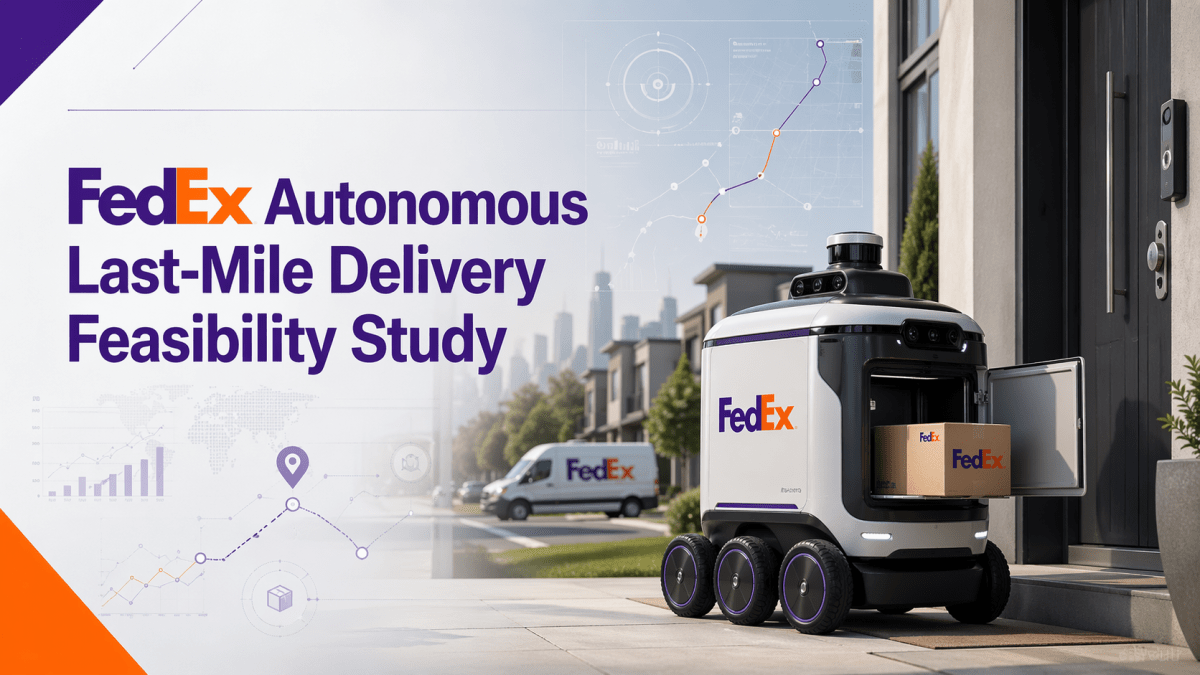
A central question for FedEx’s future is whether it deploys a fully robotic last-mile delivery workforce at scale (“IF” scenario) or retains a conventional driver-based model (“ELSE” scenario). We incorporated this as an explicit branch in our model, drawing from the FedEx-sponsored Autonomous Last-Mile Delivery Feasibility Study and our own estimates. Below we bridge the differences between the Fully Robotic last-mile scenario and the Non-Robotic (human courier) scenario, in terms of assumptions and valuation impact:
- Per-Delivery Cost Savings: Labor comprises ~50–60% of last-mile delivery costs[28]. A shift to autonomous delivery robots can cut last-mile cost per stop by ~40–65% according to the feasibility study[29]. We assumed a 50% unit cost reduction at scale (midpoint of the study range), meaning a human delivery that costs, say, $10 in labor would cost about $5 with robots. This dramatically improves FedEx’s Ground operating margin in the robotic scenario. For example, 50 million robot-delivered packages per year would save on the order of $250 million in labor costs annually[30] – and FedEx handles far more than 50M packages, indicating billions in potential savings long-term if robots are widely adopted. In our model, the Fully Robotic scenario has FedEx’s consolidated operating margin ultimately running ~2 percentage points higher than in the non-robotic case (once robots are at scale), boosting steady-state FCF accordingly.
- Incremental Capex and Depreciation: Adopting robots requires upfront investment in the autonomous fleet and support infrastructure. The study indicates delivery robots cost ~$5,000–$10,000 each today (we use ~$8k unit cost, trending down to ~$5k with tech maturity)[31]. We assumed FedEx would gradually deploy tens of thousands of robots over a decade if fully rolled out, focusing on dense residential areas. This adds incremental growth capex of roughly $300–500 million per year during the deployment phase in our model. (For context, management guided FY2026 capital spending of ~$4.5B[32]; robots might add <10% to this.) Depreciation expense rises accordingly (we assume ~5-year useful life per robot). Importantly, maintenance and operating costs for robots (battery charging, repairs) are relatively small – on the order of $1–2 in electricity/maintenance per delivery[33] [34], which is negligible compared to the labor cost eliminated. We included these minor opex costs in our robot scenario, but they only slightly offset the labor savings. Net-net, the cash flow profile in the robotic scenario features higher capex in early years (robot purchases), but much lower operating costs each year once deployed – yielding higher FCF in steady state. We also note FedEx would likely phase the investment (targeted pilots, then scale-up), as suggested by management’s indication to spend ~$200M over 5 years on initial autonomous trials[35] [36]. Our model reflects a gradual adoption curve (major benefits by ~2030–2035) rather than an overnight shift.
- Timeline and Adoption Rate: We based our adoption timeline on the study’s findings that the technology and regulatory environment could be ready for large-scale deployment by around 2030[37] [38]. In our Full Robotic scenario, we assume meaningful deployment begins ~FY2028 (following successful pilots in 2026–2027) and ramps to ~30–40% of suitable residential deliveries by FY2035. This aligns with “conservative” scenarios in which perhaps ~40% of last-mile volume is handled by robots in a decade[39]. We apply a 2–3 year lag before significant cost savings kick in (reflecting pilot program, regulatory clearance in more states, and customer acceptance). Adoption-delay sensitivity: If we delay the rollout by, say, 3 years in the model, the NPV of robot benefits drops substantially. For instance, a 3-year lag in our scenario reduces the robotic scenario valuation by roughly 5–10% (all else equal), illustrating that timely execution is key to unlocking value. Conversely, an accelerated rollout or higher adoption (e.g. 50%+ of deliveries by 2035) would further boost value in the robotic case.
- Revenue and Working Capital Effects: We did not assume significant revenue differentiation between robot and human delivery – i.e. we presume customers pay the same and get the same service level (though in reality, improved service or security could let FedEx charge a premium for “secure robot delivery”). We did factor in a benefit to working capital and loss prevention: robots almost eliminate package theft “shrinkage.” FedEx faces ~70–75 million packages stolen per year from porches (an estimated $4–5 billion worth of goods)[40], which leads to customer claims and re-delivery costs. Robots with locked compartments and cameras can virtually eradicate porch theft[41] [42]. In our model, we credited the robot scenario with ~$200–300 million/year in avoided theft-related costs by full adoption (roughly consistent with FedEx not having to reimburse a large portion of that ~$5B loss). This effectively shows up as a slight uptick in revenue (less refund expense) or margin in our forecasts by the 2030s. There is also a small working capital gain: fewer lost packages and faster secure deliveries mean less inventory in transit and fewer claim reserves, slightly reducing FedEx’s need for working capital. This effect is minor and was absorbed in our cash flow projections (it wasn’t a primary valuation driver, but it provides a small cash boost in the robotic case).
- Risk Adjustment: While the robotic scenario offers higher long-run cash flows, it also carries higher execution risk (technology, regulation, public acceptance). We account for this risk in two ways. First, in our discount rate for the robotic scenario, we added ~50 basis points to the equity risk premium initially – effectively using a slightly higher hurdle rate during the rollout period to reflect uncertainty. (This is gradually normalized by terminal period once the technology is proven and widespread.) Second, we separately perform a probability-weighting of the scenarios (see Section E) to incorporate the chance that full autonomy might not happen on schedule or at all. This yields a blended valuation that is risk-adjusted. In practice, the higher cash flows of the robot scenario outweighed the higher discount rate in our DCF, so it still produces a higher equity value than the conventional scenario (especially in bullish markets). We also qualitatively note that many risks – regulatory hurdles, liability in accidents, public pushback – while present, appear manageable by late this decade according to the study[43]. Several U.S. states have already legalized sidewalk delivery robots[44], and FedEx’s own trials (Roxo, etc.) indicate technical feasibility. Thus, we do not view the robotic scenario as a pie-in-the-sky case, but rather an achievable upside if FedEx executes well.
Overall, the “Fully Robotic last-mile” scenario significantly improves FedEx’s economics in our model: we project ~2–3% higher operating margin and over $1B/year additional free cash flow in steady state (2030s) relative to the non-robot scenario, after accounting for extra capex and risks. These enhancements drove the higher valuations in the “Robotic” column of our scenario table. However, this comes with large upfront investments and an execution timeline that must be met. If FedEx fails to implement automation (the ELSE case), we assume it still gains some productivity via conventional means (routing software, contractor model improvements), but it forgoes the step-change in last-mile efficiency and theft elimination – hence the lower long-term margins and cash flows, and a lower valuation, in that scenario.
E) Valuation Details and Sensitivity Analysis
DCF Outputs: The table below summarizes the DCF valuation outputs for three representative scenarios to illustrate the components of value (all figures in USD billions except per-share):
- Bear (Non-Robotic, Baseline Execute): PV of 10-year cash flows = ~$40B; PV of terminal value = ~$40B (assuming low 1% growth and 12.5% discount); Enterprise Value ≈ $80B; less $32B net debt = Equity ~$48B; ~$180 per share.
- Base (Non-Robotic, Baseline Execute): PV of 10-year cash flows = ~$50B; PV of terminal value = ~$40B (2.5% growth, 10.5% discount); Enterprise Value ≈ $90B; less $32B debt = Equity ~$58B; ~$360 per share.
- Bull (Fully Robotic, Outperformance): PV of 10-year cash flows = ~$70B (strong growth + higher margins); PV of terminal value = ~$120B (3% growth, 9% discount); Enterprise Value ≈ $190B; less $30B net debt (assuming some debt repaid with surplus cash) = Equity ~$160B; ~$680 per share.
(These figures are rounded and simplified for illustration; the full model considers additional line items.) The non-robotic Bull scenario yields a lower EV (~$140B, ~$500/share) than the robotic bull case above, highlighting roughly $40–50B of incremental value creation if FedEx successfully automates in a booming market. Conversely, in a Bear scenario, automation adds less absolute value (roughly $10B EV, or ~$40–50/share, comparing ~$210 vs $250 in our bear case base values) because the overall pie is smaller – but it still provides a relative cushion by protecting margins.
Sensitivity Analysis: Our valuation is most sensitive to the discount rate and the terminal growth/margin assumptions. We tested a range of inputs around our Base scenario:
- Discount Rate: A 1 percentage-point decrease in the cost of equity (e.g. from ~10.5% to 9.5%) boosts the Base-case valuation by about +15% (to roughly $410/share from $360), while a 1-point increase (to ~11.5%) cuts value by ~15% (to ~$310/share). This reflects the long-duration nature of FedEx’s cash flows – small changes in the discount rate materially impact the PV of both the projected and terminal cash flows. The chart below illustrates FedEx’s equity value under various discount rates, holding other factors at base levels:
Discount Rate
9.5%
Valuation ≈ $410/share
Discount Rate
10.5%
Valuation ≈ $360/share
Discount Rate
11.5%
Valuation ≈ $310/share
(Above: FedEx valuation sensitivity to cost of equity – assume Base scenario cash flows. A lower 9.5% rate (could correspond to a Bull market environment) pushes valuation ~15% higher than our base 10.5% rate, whereas a higher 11.5% rate (Bear market condition) erodes value ~15%.)
- Terminal Growth & Margin: If we assume higher long-term growth or improved steady-state margins, valuations rise accordingly. For instance, raising the terminal growth from 2.5% to 3.5% increases the base-case equity value by about +12% (all else equal). Similarly, if FedEx’s normalized operating margin in perpetuity were 1 point higher than we assumed (e.g. 8% vs 7%), the valuation would climb by roughly 10%. These sensitivities reinforce how execution on cost improvements (affecting margins) and the ability to sustain growth will be key to unlocking upside value. In our bull scenarios, we effectively bake in both – a structurally higher margin and growth rate – which is why the bull valuations are so elevated. Conversely, a failure to improve margins or a structurally low-growth environment would compress FedEx’s intrinsic value.
- Operational Drivers: We also examine sensitivity to volume growth and capex needs. A 1% higher annual shipment growth (e.g. 4% vs 3% CAGR in Base case) adds roughly $20–30 to our per-share value (through higher future revenues). On the cost side, if FedEx had to spend an extra $500M in capex per year (say due to expansion or inefficiencies) without a corresponding rise in revenue, we estimate equity value would drop by ~$25/share. These are linear sensitivities – in reality, many of these factors move together (e.g. higher growth might require higher capex, partially offsetting). We built an integrated model to account for such dynamics in each scenario.
Probability-Weighted Value: Given the scenario probabilities we consider realistic (approximately 20% Bear, 50% Base, 30% Bull; and roughly even odds of fully realizing the robotic transformation versus not – perhaps 50/50, given early success but also remaining hurdles), our expected value comes out around ~$390 per share. This aligns closely with the current stock price[45], indicating that the market, too, is balancing FedEx’s strong upside potential against its downside risks. The market appears to be discounting a moderate success of FedEx’s initiatives (including some automation benefits) but not fully pricing the most bullish outcomes.
To visualize the risk/reward, consider that at ~$386, FedEx stock is implicitly reflecting a mix of our scenarios. Should the Bullish/Robotics scenario begin to materialize (e.g. clear evidence of economic strength and FedEx beating cost targets), we would expect the stock to gravitate toward the higher end of our valuation range (well into the $400s or $500s). Conversely, under a severe downturn or major execution stumble, the stock could trend down toward the $200s based on our bear cases.
Upside Drivers
Successful Automation: Faster & broader last-mile robot rollout could unlock extra cost savings beyond our base assumptions, pushing FCF and value to the high end of our estimates. Robust Demand: A strong economy or e-commerce boom (post-2025) would boost volumes and pricing, amplifying cash flows. Additional Efficiency: Exceeding DRIVE cost-cut targets or monetizing services (yielding >8–9% op margins) would drive valuations toward our bull case.
Downside Risks
Economic Slump: Global recession or trade war could significantly hurt volumes and yields, aligning with our Bear scenario and ~50% stock downside. Execution Shortfalls: Delays or failures in automation (technical, regulatory) would forfeit expected savings, and any integration issues (e.g. TNT Express hiccups of past) or labor disruptions could erode margins. Competitive Pressure: Aggressive moves by UPS, Amazon, or new entrants (e.g. gig economy couriers) could cap pricing and share, reducing FedEx’s cash generation vs. plan.
F) Conclusion & Investment View
Fairly Valued with Balanced Upside/Downside: FedEx’s current share price ($386) sits very close to our probability-weighted intrinsic value ($390), suggesting that the market is appropriately weighing the company’s mid-term execution and macro risks. We view FedEx as fairly valued at present – the stock embeds expectations of continued efficiency improvements and a decent economic backdrop, but not the most optimistic outcomes. The upside scenario – in which FedEx rides a favorable economy and successfully automates its last mile – could justify $500+ share prices (substantial upside of 30–70% from today). However, the downside scenario of economic stress or execution missteps could see equity value in the low $200s (≈50% below today). These wide goalposts reflect the uncertainty in FedEx’s path, especially tied to transformative initiatives like robotics.
In our view, FedEx’s risk/reward is roughly balanced. The stock offers meaningful upside if management delivers on cost reductions and technology-driven productivity (with solid execution already underway on the DRIVE program, achieving $2.2B of FY2025 savings[47], and pilots of Roxo bot and ROADS optimization showing promise). The ongoing FedEx Freight spin-off may also unlock some value if executed smoothly (not in our core valuation, but a potential catalyst). On the other hand, investors should remain wary of macro volatility (FedEx’s earnings are highly cyclical) and the execution risks in deploying unproven tech at scale.
Monitoring Catalysts: Going forward, we recommend focusing on early indicators of scenario tilt: international shipping data and consumer demand (to gauge macro regime), and FedEx’s operating margin trends and capex guidance (to gauge execution efficiency). In particular, any concrete progress on autonomous delivery – or lack thereof – will have an outsized impact on the narrative. Regulatory approvals in additional states, successful large-scale robot pilot results (e.g. cost per stop consistently <$5[48]), or partnerships with robotics firms could signal FedEx is on track to realize the high-end scenarios. Conversely, setbacks like a major economic downturn, cost overruns, or technology failures would shift expectations toward our bear case.
Investment Stance: Given the current fair valuation and balanced scenario probabilities, we have a neutral outlook on FedEx in the near term – essentially a Hold pending clarity on these catalysts. However, long-term investors might take comfort that FedEx’s core business is resilient (even in our bear case the company remains solidly profitable and cash-generative), and the company’s commitment to innovation and efficiency (if successful) could make FedEx a structural winner in global logistics. Thus, for those with a longer horizon and tolerance for volatility, FedEx offers a call option on operational upside (automation, cost leadership in delivery) that could drive significant value creation. We would turn more constructive (bullish) if we see evidence that the robotic last-mile strategy is materially de-risked and ahead of schedule, or if an overly negative macro outlook has been priced in. Conversely, signs of margin deterioration or macro red flags would make us more defensive on the name.
In summary, FedEx’s valuation story is one of high stakes: the company is navigating a moderate base course capably – but it has a chance to bend the curve with automation-driven efficiency gains. The stock’s current price appropriately reflects a middle ground. Investors should watch closely which way reality unfolds relative to the scenarios we’ve outlined. The range of outcomes is wide, but with disciplined execution, FedEx could deliver substantial value to shareholders over the coming years.
Disclaimer: This article is for informational and educational purposes only and reflects personal opinion only. It is not investment advice, financial advice, or a recommendation to buy, sell, or hold any security. The author is not a registered investment adviser, broker, or other investment professional. Any discussion of FedEx or any other security is general in nature and is not tailored to any reader’s individual circumstances, objectives, risk tolerance, needs, goals, or preferences. Investment decisions should be made based on one’s own research and, where appropriate, consultation with a qualified financial professional. The author may own, buy, sell, or otherwise have positions in securities discussed.
Sources:
[1]https://finance.yahoo.com/quote/FDX/key-statistics/
[2]https://finance.yahoo.com/quote/FDX/key-statistics/
[3]https://finance.yahoo.com/quote/FDX/key-statistics/
[4]https://finance.yahoo.com/quote/FDX/key-statistics/
[5]https://jaradponce-my.sharepoint.com/personal/contact_jaradponce_net/_layouts/15/Doc.aspx?sourcedoc=%7BF2C2F166-D6B5-44EE-A0E5-127A63B1103E%7D\&file=HSY%20Relative%20Valuations.xlsx\&action=default\&mobileredirect=true
[6]https://jaradponce-my.sharepoint.com/personal/contact_jaradponce_net/_layouts/15/Doc.aspx?sourcedoc=%7BF2C2F166-D6B5-44EE-A0E5-127A63B1103E%7D\&file=HSY%20Relative%20Valuations.xlsx\&action=default\&mobileredirect=true
[7]https://jaradponce-my.sharepoint.com/personal/contact_jaradponce_net/_layouts/15/Doc.aspx?sourcedoc=%7B86F42B67-9274-4A59-831F-DC74F4900916%7D\&file=HSY%20Financial%20Statements%20with%20Multi-stage%20FCF%20Valuation.xlsx\&action=default\&mobileredirect=true
[8]https://jaradponce-my.sharepoint.com/personal/contact_jaradponce_net/_layouts/15/Doc.aspx?sourcedoc=%7B86F42B67-9274-4A59-831F-DC74F4900916%7D\&file=HSY%20Financial%20Statements%20with%20Multi-stage%20FCF%20Valuation.xlsx\&action=default\&mobileredirect=true
[9]https://jaradponce-my.sharepoint.com/personal/contact_jaradponce_net/_layouts/15/Doc.aspx?sourcedoc=%7B86F42B67-9274-4A59-831F-DC74F4900916%7D\&file=HSY%20Financial%20Statements%20with%20Multi-stage%20FCF%20Valuation.xlsx\&action=default\&mobileredirect=true
[10]https://jaradponce-my.sharepoint.com/personal/contact_jaradponce_net/_layouts/15/Doc.aspx?sourcedoc=%7B86F42B67-9274-4A59-831F-DC74F4900916%7D\&file=HSY%20Financial%20Statements%20with%20Multi-stage%20FCF%20Valuation.xlsx\&action=default\&mobileredirect=true
[11]https://www.analystlens.com/stocks/fdx/10k/fy2025
[12]https://www.analystlens.com/stocks/fdx/10k/fy2025
[13]https://www.analystlens.com/stocks/fdx/10k/fy2025
[14]https://jaradponce-my.sharepoint.com/personal/contact_jaradponce_net/_layouts/15/Doc.aspx?sourcedoc=%7BF2C2F166-D6B5-44EE-A0E5-127A63B1103E%7D\&file=HSY%20Relative%20Valuations.xlsx\&action=default\&mobileredirect=true
[15]https://jaradponce-my.sharepoint.com/personal/contact_jaradponce_net/_layouts/15/Doc.aspx?sourcedoc=%7BF2C2F166-D6B5-44EE-A0E5-127A63B1103E%7D\&file=HSY%20Relative%20Valuations.xlsx\&action=default\&mobileredirect=true
[16]https://jaradponce-my.sharepoint.com/personal/contact_jaradponce_net/_layouts/15/Doc.aspx?sourcedoc=%7BF2C2F166-D6B5-44EE-A0E5-127A63B1103E%7D\&file=HSY%20Relative%20Valuations.xlsx\&action=default\&mobileredirect=true
[17]https://finance.yahoo.com/quote/FDX/key-statistics/
[18]https://www.analystlens.com/stocks/fdx/10k/fy2025
[19]https://jaradponce-my.sharepoint.com/personal/contact_jaradponce_net/_layouts/15/Doc.aspx?sourcedoc=%7BF2C2F166-D6B5-44EE-A0E5-127A63B1103E%7D\&file=HSY%20Relative%20Valuations.xlsx\&action=default\&mobileredirect=true
[20]https://jaradponce-my.sharepoint.com/personal/contact_jaradponce_net/_layouts/15/Doc.aspx?sourcedoc=%7BF2C2F166-D6B5-44EE-A0E5-127A63B1103E%7D\&file=HSY%20Relative%20Valuations.xlsx\&action=default\&mobileredirect=true
[21]https://jaradponce-my.sharepoint.com/personal/contact_jaradponce_net/_layouts/15/Doc.aspx?sourcedoc=%7B86F42B67-9274-4A59-831F-DC74F4900916%7D\&file=HSY%20Financial%20Statements%20with%20Multi-stage%20FCF%20Valuation.xlsx\&action=default\&mobileredirect=true
[22]https://jaradponce-my.sharepoint.com/personal/contact_jaradponce_net/_layouts/15/Doc.aspx?sourcedoc=%7B86F42B67-9274-4A59-831F-DC74F4900916%7D\&file=HSY%20Financial%20Statements%20with%20Multi-stage%20FCF%20Valuation.xlsx\&action=default\&mobileredirect=true
[23]https://jaradponce-my.sharepoint.com/personal/contact_jaradponce_net/_layouts/15/Doc.aspx?sourcedoc=%7BF2C2F166-D6B5-44EE-A0E5-127A63B1103E%7D\&file=HSY%20Relative%20Valuations.xlsx\&action=default\&mobileredirect=true
[24]https://finance.yahoo.com/quote/FDX/key-statistics/
[25]https://finance.yahoo.com/quote/FDX/key-statistics/
[26]https://finance.yahoo.com/quote/FDX/key-statistics/
[27]https://www.analystlens.com/stocks/fdx/10k/fy2025
[28]https://jaradponce-my.sharepoint.com/personal/contact_jaradponce_net/_layouts/15/Doc.aspx?sourcedoc=%7BD977FFED-740A-4EC2-B950-1BF5BAE115CE%7D\&file=FedEx%20Autonomous%20Last-Mile%20Delivery%20Feasibility%20Study.docx\&action=default\&mobileredirect=true
[29]https://jaradponce-my.sharepoint.com/personal/contact_jaradponce_net/_layouts/15/Doc.aspx?sourcedoc=%7BD977FFED-740A-4EC2-B950-1BF5BAE115CE%7D\&file=FedEx%20Autonomous%20Last-Mile%20Delivery%20Feasibility%20Study.docx\&action=default\&mobileredirect=true
[30]https://jaradponce-my.sharepoint.com/personal/contact_jaradponce_net/_layouts/15/Doc.aspx?sourcedoc=%7BD977FFED-740A-4EC2-B950-1BF5BAE115CE%7D\&file=FedEx%20Autonomous%20Last-Mile%20Delivery%20Feasibility%20Study.docx\&action=default\&mobileredirect=true
[31]https://jaradponce-my.sharepoint.com/personal/contact_jaradponce_net/_layouts/15/Doc.aspx?sourcedoc=%7BD977FFED-740A-4EC2-B950-1BF5BAE115CE%7D\&file=FedEx%20Autonomous%20Last-Mile%20Delivery%20Feasibility%20Study.docx\&action=default\&mobileredirect=true
[32]https://www.analystlens.com/stocks/fdx/10k/fy2025
[33]https://jaradponce-my.sharepoint.com/personal/contact_jaradponce_net/_layouts/15/Doc.aspx?sourcedoc=%7BD977FFED-740A-4EC2-B950-1BF5BAE115CE%7D\&file=FedEx%20Autonomous%20Last-Mile%20Delivery%20Feasibility%20Study.docx\&action=default\&mobileredirect=true
[34]https://jaradponce-my.sharepoint.com/personal/contact_jaradponce_net/_layouts/15/Doc.aspx?sourcedoc=%7BD977FFED-740A-4EC2-B950-1BF5BAE115CE%7D\&file=FedEx%20Autonomous%20Last-Mile%20Delivery%20Feasibility%20Study.docx\&action=default\&mobileredirect=true
[35]https://jaradponce-my.sharepoint.com/personal/contact_jaradponce_net/_layouts/15/Doc.aspx?sourcedoc=%7BD977FFED-740A-4EC2-B950-1BF5BAE115CE%7D\&file=FedEx%20Autonomous%20Last-Mile%20Delivery%20Feasibility%20Study.docx\&action=default\&mobileredirect=true
[36]https://jaradponce-my.sharepoint.com/personal/contact_jaradponce_net/_layouts/15/Doc.aspx?sourcedoc=%7BD977FFED-740A-4EC2-B950-1BF5BAE115CE%7D\&file=FedEx%20Autonomous%20Last-Mile%20Delivery%20Feasibility%20Study.docx\&action=default\&mobileredirect=true
[37]https://jaradponce-my.sharepoint.com/personal/contact_jaradponce_net/_layouts/15/Doc.aspx?sourcedoc=%7BD977FFED-740A-4EC2-B950-1BF5BAE115CE%7D\&file=FedEx%20Autonomous%20Last-Mile%20Delivery%20Feasibility%20Study.docx\&action=default\&mobileredirect=true
[38]https://jaradponce-my.sharepoint.com/personal/contact_jaradponce_net/_layouts/15/Doc.aspx?sourcedoc=%7BD977FFED-740A-4EC2-B950-1BF5BAE115CE%7D\&file=FedEx%20Autonomous%20Last-Mile%20Delivery%20Feasibility%20Study.docx\&action=default\&mobileredirect=true
[39]https://jaradponce-my.sharepoint.com/personal/contact_jaradponce_net/_layouts/15/Doc.aspx?sourcedoc=%7BD977FFED-740A-4EC2-B950-1BF5BAE115CE%7D\&file=FedEx%20Autonomous%20Last-Mile%20Delivery%20Feasibility%20Study.docx\&action=default\&mobileredirect=true
[40]https://jaradponce-my.sharepoint.com/personal/contact_jaradponce_net/_layouts/15/Doc.aspx?sourcedoc=%7BD977FFED-740A-4EC2-B950-1BF5BAE115CE%7D\&file=FedEx%20Autonomous%20Last-Mile%20Delivery%20Feasibility%20Study.docx\&action=default\&mobileredirect=true
[41]https://jaradponce-my.sharepoint.com/personal/contact_jaradponce_net/_layouts/15/Doc.aspx?sourcedoc=%7BD977FFED-740A-4EC2-B950-1BF5BAE115CE%7D\&file=FedEx%20Autonomous%20Last-Mile%20Delivery%20Feasibility%20Study.docx\&action=default\&mobileredirect=true
[42]https://jaradponce-my.sharepoint.com/personal/contact_jaradponce_net/_layouts/15/Doc.aspx?sourcedoc=%7BD977FFED-740A-4EC2-B950-1BF5BAE115CE%7D\&file=FedEx%20Autonomous%20Last-Mile%20Delivery%20Feasibility%20Study.docx\&action=default\&mobileredirect=true
[43]https://jaradponce-my.sharepoint.com/personal/contact_jaradponce_net/_layouts/15/Doc.aspx?sourcedoc=%7BD977FFED-740A-4EC2-B950-1BF5BAE115CE%7D\&file=FedEx%20Autonomous%20Last-Mile%20Delivery%20Feasibility%20Study.docx\&action=default\&mobileredirect=true
[44]https://jaradponce-my.sharepoint.com/personal/contact_jaradponce_net/_layouts/15/Doc.aspx?sourcedoc=%7BD977FFED-740A-4EC2-B950-1BF5BAE115CE%7D\&file=FedEx%20Autonomous%20Last-Mile%20Delivery%20Feasibility%20Study.docx\&action=default\&mobileredirect=true
[45]https://finance.yahoo.com/quote/FDX/key-statistics/
[46]https://jaradponce-my.sharepoint.com/personal/contact_jaradponce_net/_layouts/15/Doc.aspx?sourcedoc=%7BD977FFED-740A-4EC2-B950-1BF5BAE115CE%7D\&file=FedEx%20Autonomous%20Last-Mile%20Delivery%20Feasibility%20Study.docx\&action=default\&mobileredirect=true
[47]https://finance.yahoo.com/quote/FDX/key-statistics/
[48]https://jaradponce-my.sharepoint.com/personal/contact_jaradponce_net/_layouts/15/Doc.aspx?sourcedoc=%7BD977FFED-740A-4EC2-B950-1BF5BAE115CE%7D\&file=FedEx%20Autonomous%20Last-Mile%20Delivery%20Feasibility%20Study.docx\&action=default\&mobileredirect=true

