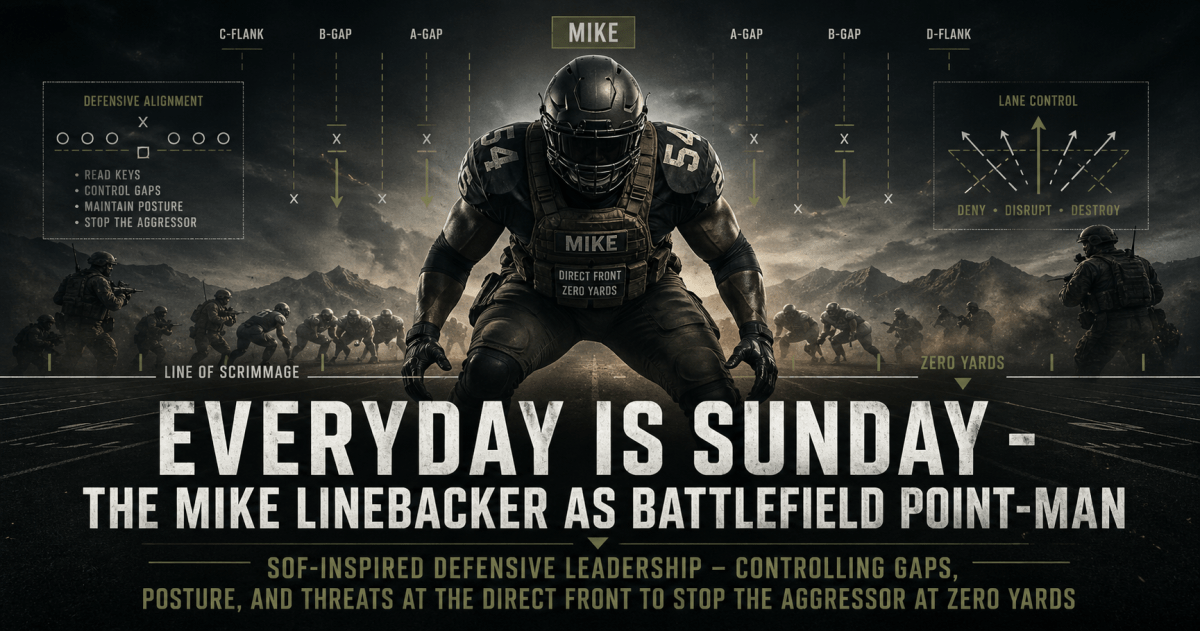
SOF-inspired defensive leadership
Everyday is Sunday
The Mike linebacker operates as the defense’s battlefield point-man: controlling gaps, projecting posture, fusing intelligence, and stopping the aggressor at zero yards.
Gap control
Own every avenue of approach at the line.
Posture
Project confidence, violence, and control pre-snap.
Layered intel
Fuse ground truth with elevated oversight.
Zero yards
Stop the play at the point of first contact.
Executive Summary
The middle linebacker – traditionally called the “Mike” – is the defensive unit’s on-field point-man and tactical commander, akin to a Special Operations Forces (SOF) team leader orchestrating an ambush. The Mike linebacker’s core mission is simple but uncompromising: dominate the line of scrimmage – control every gap, project an overwhelming defensive posture, and stop the offensive “aggressor” at zero yards gained. By halting plays at the point of contact instead of allowing penetration into the secondary, a defense denies the offense any momentum, much as elite military units seek to neutralize threats at the initial point of friction rather than fighting a running battle deeper in the battlespace. Key insights include:
- The Mike as Field General: Renowned as the “quarterback of the defense,” the Mike linebacker calls defensive plays, aligns teammates, and adjusts formations pre-snap based on offensive cues. This central leadership role directly parallels the small-unit commander or point man in combat who leads his patrol, reads the enemy’s moves, and directs rapid tactical adjustments under fire. The Mike’s ability to analyze the offense and communicate in real time makes the difference between a cohesive defense and chaos. [underarmour.com], [footballad…antage.com]
- Gap Control – Owning the Avenues of Approach: Just as military strategists define and defend key avenues of approach against an enemy attack, a Mike linebacker must obsess over “gaps” – the spaces between offensive linemen (A-gap, B-gap, C-gap, etc.) – as potential breach points in the defensive front. Effective defenses assign each player gap responsibilities, denying creases for the offense to exploit. By controlling these gaps at the line of scrimmage, the Mike ensures no enemy runner can burst through unchecked – akin to infantry securing a chokepoint to prevent hostile breakthroughs. [viqtorysports.com], [viqtorysports.com]
- Posture and Psychological Dominance: A Mike linebacker’s role isn’t only physical; it’s profoundly psychological. The defense’s alignment, stance, and aggressive presence at the direct front constitute a form of posturing and presentation that can intimidate and unnerve the offense before the play even begins. Great Mikes cultivate a command presence, using vocal calls, confident body language, and explosive hits to project dominance. This is analogous to military units using show-of-force tactics and decisive posturing to erode an enemy’s will. The result is a defense that “projects an overwhelming presence” and causes opponents to hesitate or make mistakes under pressure. Legendary NFL defenses like the 2000 Baltimore Ravens exemplified this: they prided themselves not just on shutting down offenses, but on punishing them with ferocious, swarm-tackling at or behind the line on every play. Such relentless front-line intensity had a cascading psychological effect, as star players like Ray Lewis and his unit instilled palpable fear in opposing offenses, often causing ball carriers to outright quit after being hit repeatedly for no gain. [espn.com]
- Layered Intelligence and the “Green-Dot” Leader: Modern defenses harness a layered “eyes-on/ears-on fusion” similar to a military operation’s use of ground observers and overwatch. The Mike linebacker is the only defensive player typically equipped with a coach-to-player radio (the green-dot helmet), making the Mike the crucial conduit between the defensive coordinator (often viewing from the “eye in the sky” press-box vantage) and the troops on the field. From aloft, a coordinator recognizes macro-level patterns – down-and-distance tendencies, offensive formations, and developing gap vulnerabilities – effectively serving as a drone or aerial recon overwatch for the point-man on the ground. The Mike receives this real-time intel (e.g. a quick alert that “B-gap is open!” or a new offensive personnel package) through the helmet radio, analogous to a SOF team leader getting updates from a joint tactical air controller (JTAC) or forward observer with a drone feed overhead. Armed with both firsthand ground truth and an integrated “common operating picture” of the whole field, the Mike can rapidly adjust the defense – shifting a lineman, calling an audible, or re-directing a blitz – within seconds. This seamless fusion of elevated intelligence and ground-level instinct compresses the decision-making cycle, effectively “closing the OODA loop” (Observe–Orient–Decide–Act) at the point of friction so the defense can outcycle the offense and respond to threats almost as they unfold. In sum, the Mike linebacker and his coaches create a multi-layered sensor-shooter network, much like a military combat team leveraging both a frontline squad leader’s situational awareness and a higher headquarters’ surveillance to achieve total battlefield awareness and decisive control at the point of attack. [footballad…antage.com] [thefreelibrary.com], [magaero.com]
- Stopping the Aggressor at Zero Yards: A consistent theme in both defensive football strategy and combat doctrine is that preventing enemy breakthrough at the front line is infinitely preferable to a protracted fight in one’s defensible depth. The Mike linebacker’s mandate to “stop the aggressor at zero yards” means exactly that – meet the ball carrier in the hole and drive them back or stop the play cold. In tactical terms, this is the principle of denying enemy momentum and initiative. If an offense is allowed to penetrate 40–50 yards downfield into the secondary (akin to an enemy force pushing through to rear layers of a battlefield), the defense is on its heels and the results are operationally catastrophic. Statistics bear out that giving up “explosive plays” (gains of 20+ yards) correlates directly with points allowed – as one NFL coach explained, “X (explosive) plays equal points. If we don’t give up any X plays, we can be a really good defense. But if we do, then we’re not going to be worth anything.” Therefore, the Mike’s fierce leadership in plugging gaps and making tackles for no gain is not just about one stop – it prevents the “dam break” of big plays that lead to scoring drives. This concept mirrors the military axiom that the strongest defense succeeds at the line of contact, whereas yielding ground invites disorder and heavy losses. Whether in football or war, victory is decided at the line: by standing your ground, denying the adversary even an inch, and forcing them into a futile, demoralizing fight. The best Mikes internalize this imperative, often exhorting their units that “we don’t give up a blade of grass” – comparable to an infantry squad leader rallying troops to hold the line at all costs. [si.com]
- Case Studies – From Gridiron to Battlefield: History and real-world examples underscore the impact of strong point-man leadership and decisive action at first contact. In the NFL, legendary Mike linebackers like Ray Lewis, Dick Butkus, Mike Singletary, and Luke Kuechly became iconic precisely because they embodied these principles. They combined the physical ability to deliver bone-jarring hits with a general’s mind for strategy and the inspirational presence of a battlefield commander. Ray Lewis, for instance, was famed not only for his tackling prowess but for his fiery leadership that set the mental tone for the Baltimore Ravens’ record-setting defense. His unit overwhelmed offenses with intensity and preparation – studying opponents like enemy insurgents, calling out plays before they happened, and celebrating every hit as a psychological victory. The effect was akin to a well-led special forces ambush: by the time the ball was snapped (or the enemy patrol entered the kill zone), the outcome was almost pre-ordained in the defenders’ favor due to superior preparation, unity, and ferocity. In one notable example, Lewis and the Ravens so smothered and intimidated star running back Corey Dillon that after being repeatedly blasted behind the line for minimal or negative yards, Dillon simply refused to re-enter the game – a testament to breaking an opponent’s will in the same spirit as an overwhelming first strike in combat. [espn.com] Military history provides parallel cases of the costs of failing to stop an attack early – and the advantages when you do. The Battle of New Orleans (1815) is a classic illustration: lacking effective point-men and quick adjustments at the front, a British attack faltered and turned into a rout when American defenders, using high ground and prepared barricades, halted the assault at the line with withering fire. Analysts have speculated that if British leaders had better utilized their equivalent of “field generals” (in this case, senior noncommissioned officers) at the decisive points of friction, they might have reorganized and pushed through – but instead the attack broke apart, suffering catastrophic losses. In contrast, consider modern special operations direct action raids: small teams led by NCOs or junior officers move with a clear objective to strike a high-value target swiftly and prevent any protracted gunfight. The raid on Osama bin Laden’s compound in 2011 (Operation Neptune Spear) is an example of owning the point of contact: by achieving total surprise and speed, the SEAL team denied the enemy any opportunity to mount a coordinated defense or escape. Similar principles apply on the defensive side – e.g., in countless platoon-level engagements in Iraq and Afghanistan, NCOs serving as squad leaders or platoon sergeants have saved lives by immediately countering ambushes and halting enemy advances at the initial point of attack, rather than falling back and ceding the initiative. These real-world scenarios mirror what a great Mike linebacker does on the field every Sunday: relentlessly attack the attack, prevent the opponent from gaining an inch, and keep your team’s internal cohesion and morale intact under fire. [army.mil], [army.mil]
- From Pre-Snap to After-Action – Leadership in Chaos: A hallmark of elite Mike linebackers is their ability to maintain unit cohesion and clarity amid chaos, much like a combat leader under fire. Pre-snap, the Mike is barking out commands, adjusting the front, and ensuring every defender is mentally locked on – akin to a platoon leader issuing final directives before an enemy assault. As the play unfolds, the Mike reacts instantaneously to the offense’s moves, directing teammates on the fly. This is comparable to a squad leader in battle shouting new cover positions or target indications as the fight evolves. In both arenas, this demands supreme situational awareness, trust, and communication. Great Mikes cultivate that trust off the field – poring over film (their intelligence preparation of the battlefield), drilling with teammates so everyone understands their role, and often serving as an on-field coach. Former Carolina Panthers All-Pro Luke Kuechly, for example, was renowned for his exhaustive film study and uncanny talent for diagnosing plays, allowing him to line up his defense in exactly the right spots and seemingly anticipate the offense’s moves—a product of both preparation and battlefield-like intuition. In critical moments, teammates look to the Mike for steady confidence: “whether it’s the final drive or a goal-line stand in the trenches, the Mike’s voice stays calm and assertive, resetting the defense and giving direction when things get tight,” as one football analysis describes. This leadership under pressure – the ability to find clarity in chaos – is directly analogous to how a seasoned SOF team sergeant or platoon sergeant performs under fire, keeping his soldiers focused, informed, and aggressive even when a situation seems to be unraveling. It is no accident that many coaching staffs refer to the Mike as the “coach on the field”; like a tactical commander, the Mike must think two steps ahead and make life-or-death (or game-on-the-line) decisions in seconds, all while inspiring those around him through sheer will and example. [gamedayculture.com]
Mike Linebacker Decision Cycle
Layered intelligence compresses the Observe–Orient–Decide–Act loop at the point of friction.
1
Observe
Read stance, motion, spacing, cadence, and backfield tells.
2
Orient
Combine film study, front structure, and coach intel from above.
3
Decide
Reset fits, shift leverage, call pressure, or tighten the front.
4
Act
Meet the threat at first contact and prevent momentum.
Operational effect: faster diagnosis, tighter alignment, fewer explosive plays.
Layered Observation: Ground Truth vs. Elevated Intel
One of the most powerful weapons in a Mike linebacker’s arsenal is information – specifically, the pairing of ground-level observation with high-level intelligence to create a layered view of the battlefield. In military operations, this is often achieved by combining the “muddy-boots” perspective of troops in contact with the enemy and the high-ground surveillance of a headquarters or overwatch element (think: a platoon leader in a firefight communicating with a drone operator or a higher commander watching from a hill). Together, they form a comprehensive common operating picture (COP) that allows faster, smarter decisions. A similar dynamic is at play every time a middle linebacker takes the field in today’s NFL. [magaero.com]
At ground level, the Mike is like the tip-of-the-spear operator – reading the body language of the opposing linemen, hearing the quarterback’s cadence, detecting subtle “tells” in the offensive formation, and even sensing shifts in momentum or hesitation in the opponent. This first-hand “feel” for the situation – the ground truth – is invaluable. Great linebackers develop almost a sixth sense for plays; they can sniff out a screen pass or a draw play through experience and acute observation. As the “eyes and ears of the defense,” the Mike processes this immediate battlefield data and relays urgent alerts to his unit (e.g. yelling “watch the trap!” or “check outside run!” based on a motion or lineman’s stance). [gamedayculture.com]
Simultaneously, the Mike receives elevated intelligence from the coaching staff, particularly when the defensive coordinator or linebackers coach is stationed up in the press box (the football equivalent of a command post on the high ground). From that vantage, a coach sees the overall pattern – perhaps noticing an offensive tendency (e.g., a certain formation that signals a pass to the slot receiver, or an offensive tackle’s alignment indicating a power run). This is relayed in seconds via the helmet radio in the Mike’s headgear. In essence, the Mike is functioning like a forward-deployed squad leader with a direct line to higher command, who provides a macro view of the enemy’s disposition. Military professionals would liken it to an SF team leader in a firefight getting real-time updates from a recon drone or a Joint Tactical Air Controller (JTAC) observing from above – “overwatch providing SA (situational awareness)” – such as identifying an incoming threat or an exploitable gap in the enemy line. The Mike takes this in, combines it with his own vision on the field, and immediately issues orders or adjusts his tactics. If the press-box coach shouts that the offense is showing an overloaded strong side formation, the Mike can shift the defensive front or call a run blitz into that strong side before the ball is snapped. This rapid cycle of observe–orient–decide–act is a direct application of Col. John Boyd’s OODA Loop principle, which in combat is used to out-cycle the enemy’s decision-making. By fusing multi-level observations, the Mike compresses the OODA loop at the point of contact, making the defense dramatically more responsive than the offense can anticipate. [footballad…antage.com]
A tangible example of this fusion was seen with teams that utilized legendary linebackers like Ray Lewis or Brian Urlacher. They often spoke later about how their coaches in the booth would feed them keys – “Run coming right, watch the tight end motion” – which they trusted and acted on instantly, sometimes changing the play call or shifting the entire defense in a split second. In one playoff game, film study shows Ray Lewis adjusting his alignment and signaling a blitz the moment before the snap because his coaches had identified a tell in the offense’s formation – resulting in a blindsiding tackle in the backfield as soon as the play began. In military terms, that’s akin to a patrol’s point man getting a radio call from a scout helicopter about an enemy hiding around the next bend – and then immediately tossing a grenade and flanking that position to neutralize the ambush. Without the radio link, the patrol might have walked into the ambush and taken casualties deeper down the trail; without his helmet receiver, the Mike’s unit might have been gashed by that play for a big gain. Instead, intelligence and ground action merged to thwart the threat at first contact.
This layered approach also helps the Mike craft the holistic strategy series by series. Through constant feedback with the “intel support” upstairs, the Mike builds a mental map of the opponent’s intentions as the game progresses – much like how a combat leader refines his understanding of the enemy’s movements with each report from reconnaissance elements. The concept of a unified COP means that everyone – the Mike, his teammates, and his coaches – share the same real-time picture of the battle, just as a military command post and its forward units share a synchronized map of friendly and enemy positions. When executed well, this gives the defense a tremendous edge in anticipation and coordination. A famous contemporary example is how San Francisco 49ers’ All-Pro linebacker Fred Warner operates: he is known to drop into exactly the right passing lane or fill the perfect run gap before a play fully develops, largely because he and his coaches have meticulously studied opponent tendencies and communicate constantly. By the time the ball is snapped, Warner (like a point-man with a live feed from a surveillance drone) has essentially “seen” the play in his mind already and is one step ahead. His anticipation compresses the offense’s options – effectively denying the offense any surprise or strategic depth, just as a well-networked defense force can deny an enemy any chance to maneuver beyond the kill zone. [thefreelibrary.com]
In combining ground truth and elevated intel, the Mike linebacker serves as the critical node of command and control (C2) on the field. He embodies the SOF principle of sharing a “common operating picture” – every defensive teammate plays with the same understanding of the situation because the Mike, like a battlefield commander, has disseminated the key information rapidly and clearly. The result is a defense that acts in unison, much like a trained military unit executing a battle drill, with the Mike ensuring that the first contact with the enemy (the offense’s play) is met with maximum force and flawless coordination.
Layered Observation
The Mike becomes the command-and-control node by merging first-hand field awareness with elevated oversight.
Ground truth
On-field eyes and ears
- Linemen leverage and pad level
- Backfield depth and motion tells
- Cadence, tempo, and formation stress
- Immediate feel for pressure points
Mike = C2 node
Elevated intel
Press-box / coach overwatch
- Formation pattern recognition
- Tendency alerts and personnel cues
- Weak-gap or overload identification
- Real-time strategic adjustment input
Shared awareness lets the defense close the decision cycle faster than the offense can exploit space.
The Mike as Point-Man: Tactical Command at the Direct Front
The term “point-man” in military parlance refers to the lead individual or unit at the forefront of a patrol or assault, who is first to encounter the enemy and often carries the heaviest burden of awareness and decision-making. In an infantry squad moving through hostile territory, the point-man’s alertness and choices can spell the difference between a successful mission or an ambush. In much the same way, the Mike linebacker is the point-man of the defense, leading from the middle of the formation – right at the direct front of the defensive battle line. From this central position, the Mike can see and respond to both sides, make calls for the entire unit, and physically insert himself wherever the threat is greatest. His leadership and tactical command at the line of scrimmage ensure that the defense moves as a single, cohesive unit to meet the offense.
Crucially, the Mike’s point-man duties begin before the snap. As the defensive captain, he is typically responsible for receiving the play call from coaches (via hand signal or headset) and echoing it in the defensive huddle. Once the team breaks the huddle and lines up, the Mike must rapidly survey the offensive formation and adjust his unit’s alignment or call audibles (like shifting the defensive line, changing a coverage, or bringing a safety down) to counter what he sees. NFL middle linebackers are trained to identify the offense’s strong side (e.g. where the tight end and fullback have lined up), recognize formation patterns (trips, bunch sets, etc.), and anticipate likely plays. This role is directly comparable to a small-unit leader conducting a leader’s reconnaissance of the battlefield: noting where the enemy’s “weapons” are massed (tight ends, running back depth, wide receiver stacks) and then positioning his forces to negate those threats. [footballad…antage.com]
Because of this responsibility, the Mike is often described as having to play with “his head on a swivel” – constantly scanning for immediate dangers such as motioning receivers, shifts in the offensive line, or changes by the quarterback. He shouts out any alerts: “Watch the inside draw! Check out, check out!” – ensuring every defender is refocused on the right hazard. In essence, the Mike owns the “point of friction” where offense meets defense, actively managing it just as a frontline commander directs his troops at the contact point with an enemy. An Army Command Sergeant Major recently noted that leaders must deliberately position themselves at points of maximum friction to influence the fight – “like a Pro Bowl free safety, senior NCOs should roam to where the chaos is fiercest, freeing the commander to orchestrate”. The Mike linebacker fills exactly this function for the defense: by taking charge in the most contested gaps and making split-second tactical decisions, he allows the coaches (the “commanders” on the sideline) to focus on the broader game plan. [army.mil]
Additionally, just as a military point-man puts himself in danger for the sake of the unit, the Mike linebacker’s job description requires a rare blend of toughness, agility, and intellect. Physically, he must take on blockers and ball-carriers head-on play after play; this is the player who often leads the team in tackles and absorbs punishing contact from 300-pound linemen. The Mike is typically one of the bigger, stronger linebackers – as one coaching guide puts it, they need the “size, strength and toughness” to take on lead blockers in the A-gap and still make the tackle. Yet he also cannot be so large that he loses mobility: the Mike must move sideline-to-sideline quickly, pursuing running backs on outside plays, dropping into pass coverage, or even blitzing the quarterback. In tactical terms, he is both a frontline fighter and a mobile reserve force in one. [footballad…antage.com], [footballad…antage.com]
Mentally, the Mike is the brain of the defense. The best at this position exhibit extraordinary “field IQ” – knowing the playbook inside-out, recognizing opponent tendencies, and making rapid risk assessments like a seasoned officer under fire. Many teams test and cultivate this by giving the Mike extensive film study duties and expect him to practically memorize opposing playbooks. During games, you’ll often see Mikes like Luke Kuechly or Kansas City’s star linebacker Nick Bolton shouting and gesturing frantically before the snap – they have detected a certain formation or a change in the offensive protection and are aligning their teammates in response. This ability to Diagnose–Decide–Direct under extreme time pressure is exactly what a platoon leader must do when, say, encountering an unexpected enemy flank attack: quickly size up the threat, decide on a counter, and direct his unit to respond before the enemy can exploit the situation. A Mike’s decisiveness and command at the line can thwart plays before they begin, much like a well-placed point-man can thwart an ambush by shouting “Contact front!” and opening fire the instant he perceives movement. In both cases, the first seconds of engagement are pivotal, and the leader at the front must seize the initiative.
Posture, Presentation, and Psychological Intimidation
“The most effective defense not only defeats an opponent’s body, but breaks their will.” This adage holds as true on a football field as it does on a battlefield. A critical but less tangible duty of the Mike linebacker is to orchestrate the psychological warfare aspect of defense – using posture, presentation, and sheer intimidation to gain an edge before the play begins. The line of scrimmage, like the line separating two armies, is as much a moral battleground as a physical one. By setting a dominant posture at the line, a defense can make an opposing offense doubt its plan or even fear its opponent; such hesitation can be as deadly as any tactical error.
Posture and Presentation:
In military terms, posture refers to the stance and disposition of a force – whether aggressive, defensive, deceptive, etc. On the gridiron, posture is conveyed through how the defense presents itself pre-snap. The Mike linebacker takes the lead in this; from his central position he can influence the demeanor of the entire front seven. A classic example is the goal-line stand – the defense will crowd the line, low in their stances, feet churning, hands in the dirt, exuding readiness to surge. The Mike might position himself like a coiled spring, creeping toward the A-gap with chest puffed out and eyes boring into the backfield. This physical display of confidence and menace is no accident; it’s engineered to send a message: we own this line; you shall not pass. It parallels the command presence that an army leader and his soldiers show on a defensive perimeter – standing tall (or crouched in fighting positions) with weapons trained forward, undaunted by the enemy’s approach.
Vocal intimidation and control:
The Mike’s voice is another weapon. The best Mikes are extremely vocal pre-snap, decisively barking out checks and motivating battle cries. By doing so, they accomplish two things: they ensure perfect communication among teammates, and they signal to the offense that the defense is confident and ready. There’s a documented phenomenon in sports psychology where a unit that communicates loudly and clearly can unnerve an opponent, creating the impression that “they know something we don’t” or simply demonstrating unity and resolve. Offenses may rush a play or make a poor audible if they sense the defense is one step ahead. Former Chicago Bears great Mike Singletary was famous for his intense stare and constant pre-snap directives – so much so that opposing quarterbacks remarked it was like having a second coach on the field, one that they could feel just as much as his own team could. This echoes the psychological impact of a well-disciplined military unit using battle cries, coordinated movements, or even loudspeaker announcements to mentally dominate an adversary. [footballad…antage.com]
The Fear Factor:
A truly commanding Mike linebacker can instill what can only be called fear in an offense – a fear of running certain plays, of entering certain spaces on the field, or of individual matchups. In the early 2000s, for example, offenses facing Ray Lewis’s Ravens often avoided calling runs up the middle by the second half of games, because Lewis had hit their running backs so hard in the A-gaps in the first half. As one analysis noted, that 2000 Ravens defense approached each snap with the attitude of “punish the opponent with every tackle and gang hit”, effectively intimidating offenses into submission. In a like manner, many historically formidable military units – from ancient Roman legions to modern special forces – have leveraged their reputation and ferocity to discourage enemy aggression. SOF doctrine often discusses “commanding the environment” – using overwhelming speed, surprise, and aggression to make the enemy feel helpless and overmatched at the initial point of contact. The Mike linebacker embodies this by launching into each play with explosive intent, whether blitzing, filling a gap, or leveling a ball carrier, and by encouraging his teammates to do the same. The cumulative effect is a form of psychological attrition: offenses start to play tentatively, linemen come out of their stances a half-step slow (wondering who’s about to hit them), and running backs start looking for a safe place to fall down rather than fighting for extra yards. The goal is to have the opponent mentally defeated and anticipating failure even before the ball is snapped – just as a cornered enemy, confronted with an intimidating defensive line or a daunting ambush, might lose the will to fight. [espn.com]
In practical terms, this psychological dominance often leads to unforced errors by the offense: false start penalties as linemen flinch under the threat of a blitz, hurried throws by quarterbacks sensing pressure that isn’t there (the “ghosts” that come from being hit too many times), or receivers running wrong routes due to confusion from defensive shifts. Every one of those outcomes is a minor victory for the defense. A famous documentary about the 1985 Chicago Bears – one of the NFL’s most fearsome defenses – highlighted how their aggressive posture and constant pressure caused opposing quarterbacks to make ill-advised throws or avoid certain areas of the field entirely. Similarly, during the 2013 season, the Seattle Seahawks’ defense (nicknamed the “Legion of Boom”) was so physical with receivers and so loud in their communication that many offenses struggled with basic execution, leading to delay-of-game flags, dropped passes from footsteps they heard, and an avalanche of turnovers. The lesson: intimidation can be weaponized. A Mike linebacker operates in this realm of mental combat, rallying his men while eroding the opponent’s confidence – much like a battlefield leader uses morale as a weapon, bolstering friendly fighting spirit and sapping the enemy’s resolve.
Stopping the Aggressor at Zero Yards
In both football and war, preventing enemy penetration through your front lines is imperative. The phrase “stop the aggressor at zero yards” encapsulates the defensive philosophy of denying any forward progress – to tackle the ball carrier at the line of scrimmage (or behind it) so that the offense gains nothing. The Mike linebacker, as field general, is charged with ensuring this happens consistently. When he succeeds, the results are akin to a successful ambush or fixed defense: the offensive drive stalls, and the enemy is forced to recoil or resort to desperate measures.
One can draw a direct parallel to military strategy here. In defensive warfare, commanders establish a forward line of troops (FLOT) and strive to stop enemy assaults right at that line. If attackers break through and penetrate deeply, the battle often turns into a chaotic melee, ceding the initiative to the enemy and making it far harder to regain control. For example, Clausewitz’s concept of friction in war highlights how unexpected resistance at the point of contact can throw off even a well-planned attack. A defender that yields space and allows an attacker to gain momentum often finds the subsequent fight to be exponentially more difficult, akin to a snowball rolling downhill.
Statistics from the NFL illustrate why denying any yardage is so critical: A recent analysis showed that in games where a defense allowed a significant number of “explosive plays” (generally, gains of 20+ yards), those big plays accounted for over 40% of the total yards given up and led directly to almost all the points scored against them. In contrast, when those same defenses eliminated big plays, keeping everything in front of them, points allowed plummeted. As one defensive coach put it, “If we don’t give up any X-plays, we’re a really good defense. But if we do, we’re not worth anything.” Offenses thrive on breaking into the open – a running back who squirts through the line can turn a modest 5-yard run into a 50-yard gain if the second level is breached, just as an enemy platoon that outflanks your front can run rampant in your rear area if not immediately contained. The Mike linebacker’s unwavering mission is to prevent such breaches. By plugging the gaps with authority and “building a wall” at the line of scrimmage, the Mike forces the offense to fight “in the trenches” on every down – exactly where the defense has the advantage. As a coaching maxim goes, games are won in the trenches, since the team that controls the line of scrimmage usually controls the game. [si.com], [si.com] [viqtorysports.com]
Beyond the physical aspect, there’s a strategic benefit to consistently stopping an offense for little or no gain: you dictate the terms of engagement. If the enemy knows that every attempt to run up the middle meets a stone wall, they are forced to alter their strategy – perhaps becoming one-dimensional (only passing, for instance) or attempting riskier trick plays. This is similar to how a military force that cannot break through a well-fortified direct defense might try to maneuver to the flanks or delay and call for fire support – options which may be less ideal or more dangerous. By removing the “easy option” of straightforward gains, the Mike linebacker is compelling the offense into riskier, slower-developing plays that the defense can then exploit. In effect, the defense is dictating the battle, which is always the goal of a strong defensive leader. Coaches often emphasize that if you knock an offense off schedule – for example, putting them in second-and-10 or third-and-long consistently – you dramatically raise the odds of ending that drive. This is analogous to forcing an attacker into an unfavorable position or channeling them into a well-prepared kill zone, making it far more likely you’ll halt the attack.
The consequences of failing to stop the offense early can be dire. Consider a scenario where a Mike linebacker misses a tackle in the hole and a running back bursts free into the secondary: the entire defense must suddenly transition from attack to pursuit mode, angles of support can break down, and just as importantly, the offense gains confidence and tempo. The psychological momentum swings to the offense – much like a breach in a defensive line can energize an attacker to press harder. This is why the Mike’s mindset, echoed to the whole defense, is often “First man hits, first man stops.” A well-coached unit practices run fits and tackling relentlessly to make sure that the first defender at the point of contact (often the Mike himself) brings down the ball carrier or at least slows them until help arrives. Elite defenses also preach a concept of “population to the ball” – every defender swarms to ensure that even if the point-man misses, there is a second and third wave immediately behind to finish the job, limiting the damage to just a few yards. This is reminiscent of a defense-in-depth in military science: even if the enemy pierces the first layer, successive layers close in to contain the breach before it widens. And just as a failed first contact in war can be redeemed by quick action of reserve forces, a missed tackle at the line can be saved by disciplined pursuit if the defense reacts instantly. However, in both cases, the preference is clear – do not let the enemy through in the first place.
Operational takeaway
Stop the Aggressor at Zero Yards
The defense wins at the line by denying momentum, preventing penetration, and refusing to surrender depth.
If the front holds
The offense stalls, loses rhythm, and is forced into predictable, higher-risk decisions.
If the front gives ground
Penetration creates explosive-play risk, transfers initiative, and forces the defense into recovery mode.
Control the point of attack, own the first collision, and prevent the dam break.
Case Studies and Historical Parallels
To illustrate these principles, one can look at celebrated examples of defensive leadership and tactical decisiveness in both football history and military history.
Football Case Study – 2000 Baltimore Ravens:
Widely regarded as one of the greatest defenses in NFL lore, the 2000 Ravens epitomized the “stop them at zero yards” philosophy under the leadership of middle linebacker Ray Lewis. Lewis, a two-time NFL Defensive Player of the Year, was the vocal and emotional leader of that unit. He ensured every player knew their assignment on each play and held them to the standard of absolute toughness. The Ravens focused intently on gap control, with massive defensive tackles (Tony Siragusa and Sam Adams) plugging the middle and freeing their linebackers – led by Lewis – to attack ball carriers freely. The result was historic: Baltimore allowed the fewest rushing yards ever in a 16-game season (970 yards, an average of just 60.6 per game). Opponents found no cracks in the front line; every attempted run was met with immediate violent contact. On many occasions, Lewis and his cohorts stopped runs for no gain or negative yardage, inducing a psychological state of desperation in offenses. A famous anecdote from that season recounts how, after being repeatedly hammered by the Ravens’ front seven and limited to 9 yards on 12 carries, Pro Bowl running back Corey Dillon effectively surrendered – removing himself from the game rather than face any more hits. The Ravens’ insistence on dominating the line (“owning the immediate threat at the point of contact,” as their coaches described it) meant they rarely needed to rely on last-ditch tackles downfield; the fight was won where it started. In the Super Bowl that year, they overwhelmed the New York Giants by consistently hitting the quarterback and ball carriers in the backfield, forcing four turnovers and holding the Giants offense to zero touchdowns. The Ravens defense was so dominant that, as one player recalled, by midseason they barely discussed game plans anymore – only how they would celebrate big plays – because they had preemptively broken the spirit and predictability of opposing offenses through preparation and intimidation. Ray Lewis’s role in this mirrors a SOF team leader’s: he was the first to diagnose the threat, the first to engage the enemy (often literally the first to make contact on a running play), and the one to direct his unit’s every move. The Ravens’ success validated the notion that a singular, unifying leader at the core of the defense, embodying both physical ferocity and tactical acumen, can elevate an entire unit to dominance. [espn.com]
Football Case Study – Modern Mike Linebackers:
In more recent times, players like Luke Kuechly (Carolina Panthers) and Fred Warner (San Francisco 49ers) have carried the torch of the Mike as battlefield commander. Kuechly was so adept at reading offenses that rival quarterbacks often remarked it was like he was reading their mail – he would frequently adjust his defense to exactly counter the play that was coming, leading to frustration and confusion on the offensive side. This level of anticipation is a textbook example of the Mike linebacker operating inside the opponent’s decision cycle (OODA loop), leaving offenses a step behind and prone to mistakes. Fred Warner, meanwhile, showcases how a Mike can be a destabilizing force through communication and versatility. He seamlessly coordinates with the 49ers’ coaches (some in the booth, some on the sideline) and translates the weekly game plan into on-field execution. Warner’s 49ers exemplify defense as a proactive strike force – their linebackers and linemen are often seen shifting right up to the snap, following Warner’s directives as he reacts to the offense’s formation. This has led to countless instances of the 49ers seeming to have “the perfect call” on defense; it’s not luck, but a result of their Mike’s steady hand in commanding the direct front. The ripple effect of such leadership is evident: teammates play faster and with more confidence, knowing that their point-man will put them in the best position and that he has their backs. It’s akin to how a well-led military unit, confident in its leader, will execute complex maneuvers under fire with alacrity because everyone trusts the plan and knows their role in it.
Military Parallels:
Combat history is rich with episodes that echo these football lessons. We already touched on the Battle of New Orleans as an example of failing to have the right leaders at the point of friction. On the flip side, consider a small-unit defensive action like the Battle of Kamdesh (2009) in Afghanistan, where a remote US outpost (COP Keating) was almost overrun by insurgents. Amid chaos, Staff Sergeant Clinton Romesha and other junior leaders acted as de facto “Mikes” – rallying soldiers to hold key gaps in the perimeter and counterattack at critical points of enemy penetration. Romesha moved through heavy fire to reinforce weak spots (much like a linebacker filling whichever gap the offense attacks), directed friendly fires onto enemy positions (analogous to calling audibles and adjustments), and continually motivated his outnumbered troops to stand fast. His leadership helped prevent a total collapse of the defense and eventually repel the assault – essentially stopping the aggressors as close to “zero yards” as the situation allowed. This valor earned him the Medal of Honor. The incident underscores that even when an enemy manages some penetration (just as an offense will occasionally get a first down), the presence of determined point-men leaders to plug the leak can snatch victory from the jaws of disaster.
From ancient history, one can draw parallels to the Roman Legion’s centurions, who fought in the front ranks of their units and were known for enforcing discipline and holding the line. A Roman centurion’s job was to project courage and keep his soldiers fighting in formation, even when barbarian hordes charged with ferocity. They literally fought shoulder-to-shoulder with the front-line troops. This is precisely what the Mike linebacker does – setting the example with his personal courage and commitment to stopping the enemy head-on, inspiring those around him to do the same. In football terms, when a Mike meets a lead blocker in the hole with a thundering collision, fellow defenders feed off that energy and flow to the ball, while offensive players feel the shock – just as an ancient phalanx’s solidity could psychologically and physically break a charging foe.
Across contexts, the consistent theme is that leadership at the decisive point – whether a gap on the 50-yard line or a breach in the defensive perimeter – can turn the tide. The Mike linebacker, like the battlefield point-man, is the leader who thrives in that crucible, making lightning-fast decisions, mastering the interplay of intelligence and instinct, and motivating his unit to dominate the opposition in the moment of truth.
Conclusion and Operational Takeaway
In both elite defensive football and high-stakes military operations, victory is decided at the line. The Mike linebacker, serving as a battlefield point-man, epitomizes this principle. By controlling gaps, maintaining an unshakeable posture, and fusing on-the-ground perception with elevated intelligence, the Mike ensures that the defense always strikes the opponent first and hardest at the point of contact. This SOF-inspired defensive leadership philosophy – hitting the offense “before they can hit us” – results in denying the opposing team any gain of ground (or yards), thereby robbing them of momentum and initiative.
The broader lesson for leaders in any domain is clear: don’t cede the initiative. Whether you’re leading a defensive unit on a football field, a squad on a battlefield, or even a corporate team in a high-pressure project, the keys to success are striking decisively at the crucial moment, leveraging all available information to make quick decisions, and creating an environment of confidence that intimidates your adversaries. A well-led unit becomes a psychologically dominant force – loud, synchronized, and unyielding – causing the opponent to doubt their plan and respond to your moves, rather than the other way around. The Mike linebacker’s example shows how preparation, communication, and bold leadership at the critical juncture can stop threats in their tracks. In the words of one NFL defensive coach addressing his linebackers, “If they come into our house, meet ’em at the door and knock ’em flat. Not one step further.” The same could easily be said by a platoon sergeant to his squad before holding a line against a charging enemy.
From the gridiron to the battlefield, the message resonates: the first clash often decides the contest. The Mike linebacker – the battlefield point-man of defense – embodies the credo that every day is “Sunday,” every down is a battle, and every inch must be earned. By living that mindset, and leading others to do the same, the Mike ensures that the aggressor is stopped at zero. This synthesis of tactics and leadership, drawn from both playbooks and military doctrine, reminds us that no matter the arena, the fundamentals of strong defense – communication, courage, and controlling the point of attack – are universal constants in achieving victory.
References
- Under Armour – “The Ultimate Guide to the Linebacker Position.” UnderArmour.com. (Describes the linebacker as the “quarterback of the defense” who calls plays and ensures teammates are aligned in the right spots.) Link: https://www.underarmour.com/en-us/t/playbooks/football/guide-to-the-linebacker-position/ [underarmour.com]
- Coach Martin – “What is a Mike Linebacker in Football? (Full Explanation)” on FootballAdvantage.com. (Overview of the middle linebacker’s role calling defensive plays, wearing the headset, scanning the offense, and being vocal pre-snap.) Link: https://footballadvantage.com/mike-linebacker/ [footballad…antage.com], [footballad…antage.com]
- GameDay Culture – “What Is the MIKE in Football: Understanding the Heart and Soul of the Defensive Huddle.” GameDayCulture.com. (Highlights the MIKE linebacker’s leadership under pressure – acting as the defense’s eyes and ears, keeping a steady voice, and providing clarity in chaos.) Link: https://gamedayculture.com/what-is-the-mike-in-football/ [gamedayculture.com]
- vIQtory Sports (Chris Haddad) – “Defensive Line Techniques & Alignments in Football.” Updated Apr 9, 2026. (Explains gap control and how teams that control the line of scrimmage by defending gaps typically win, emphasizing that the A-gaps – the quickest path to the end zone – must be protected to stop the run.) Link: https://www.viqtorysports.com/understanding-defensive-techniques/ [viqtorysports.com], [viqtorysports.com]
- Jamison Hensley – “How the Ravens’ historic defense fueled their first Super Bowl win.” ESPN.com, Feb 3, 2023. (Details the intimidation and dominance of the 2000 Ravens defense, which aimed not only to shut down offenses but to physically and psychologically punish them with gang tackles behind the line of scrimmage.) Link: https://www.espn.com/nfl/story/_/id/30776361 [espn.com]
- “Senior NCOs at Points of Friction.” Article on Army.mil by CSM Nema Mobarakzadeh, July 17, 2024. (Discusses how seasoned NCOs, like free safeties on a football field, position themselves at points of maximum friction to manage chaos and allow commanders to oversee the broader battle.) Link: https://www.army.mil/article/278130 [army.mil]
- Edwin McIntyre – “That Eye in the Sky: Coaching from the Press Box.” Coach & Athletic Director Magazine (via TheFreeLibrary), 2006. (Describes the role of the press-box coach as an indispensable “eye in the sky,” a strategic link between the sideline and what’s happening on the field – observing every facet of the game to provide real-time intelligence to field leaders.) Link: https://www.thefreelibrary.com/That+Eye+in+the+Sky%3a+coaching+from+the+press+box.-a0147205228 [thefreelibrary.com]
- David Boclair – “Big Plays a Big Part of Defense’s Struggles.” Sports Illustrated/Titans News, Sept 2022. (Analyzes how a majority of yards and points allowed by a struggling defense came from a few big plays, quoting Titans coaches on the importance of eliminating “X plays” (20+ yard gains) and keeping everything in front to force opponents to march methodically.) Link: https://www.si.com/nfl/titans/onsi/news/tennessee-titans-defense-nfl-big-plays-allowed [si.com]
- MAG Aerospace – “Unlocking the Benefits of a Common Operating Picture (COP).” MAGAero.com, Mar 10, 2026. (Defines the Common Operating Picture as a continuously updated, centralized display of tactical information enabling shared real-time situational awareness and faster decision-making in defense and security operations.) Link: https://www.magaero.com/unlocking-the-benefits-of-a-common-operating-picture/ [magaero.com]

