The U.S. currently has a highly decentralized SWAT system. Thousands of local and state police agencies maintain their own specially trained teams (most part-time), leading to enormous variation in training, equipment, and doctrine[1][2]. Many large and small departments share SWAT units or rely on mutual aid, but there is no national standard. The proposed “One school, one S.W.A.T., one motto, many units” model envisions a nationally unified training and career-management system, akin to the FBI Academy or military schools. In this model, SWAT officers would receive common training at a national academy (and regional sites), share doctrine and credentials, and rotate through assignments in multiple regions (similar to a Marine Corps cycle) to build broad experience.
This report examines the feasibility and implications of such a reform. It finds potential benefits – notably greater interoperability, professionalization, and shared expertise – but also significant challenges. Constitutional and federalism constraints mean the plan must rely on cooperation, compacts or incentives rather than command-and-control (echoing Supreme Court limits on forcing local police to carry out federal directives[3]). Labor agreements, pensions, and local accountability (e.g. use-of-force oversight) would need careful handling. Budget estimates are highly uncertain, but there is reason to believe costs could be offset by savings from eliminating duplicate training and procurement. Comparative models (e.g. FBI/POST academies, military unit rotations, National Guard, emergency mutual aid compacts) offer partial analogies, but policing is not military service and local trust is crucial.
Bottom line: A fully nationalized SWAT system (Model 1) appears administratively and politically daunting under current law. A hybrid approach (Model 2 or 3) – for example, nationally standardized training and certification with voluntary regional academies – is more feasible. Pilot programs combining multiple jurisdictions under unified training protocols could test the concept. With proper design (ensuring civil liberties oversight, local control safeguards, and labor buy-in), the idea is not impossible, but it would require strong intergovernmental cooperation and clear legal authority.
1. Current U.S. SWAT Structure (Decentralized Baseline)
- Agency ownership: Roughly half to two-thirds of large agencies run their own SWAT teams[1]. A national survey (2013) found 60% of respondent agencies “had their own SWAT team” and 30% participated in a multi-agency team[1]. Today, “a vast majority” of U.S. agencies serving 50,000+ population have some SWAT capability[2]. Small towns often rely on county or regional SWAT.
- Part-time personnel: Most SWAT officers are collateral-duty personnel, not full-time. The same NTOA study reported “almost all” teams include members with other duties; very few are dedicated SWAT-only officers[4]. This means SWAT training must fit around regular work.
- Training & protocols vary widely: Agencies typically send SWAT members to a variety of courses, but standards differ. Common topics (observed in the 2013 study) include high-risk operations, crisis negotiations, less-lethal munitions, firearms and tactics[5]. Many also integrate paramedics and crisis negotiators into their teams[6]. State POST commissions and groups like NTOA and IACP publish guidelines, but there is no single national curriculum. For example, California’s POST provides guidelines for SWAT selection and training, but each agency implements them independently.
- Budget pressures: Many departments cite cost as a major constraint on SWAT capability[7]. Equipping a modern SWAT (armored vehicles, night optics, breaching tools, specialized weapons) and funding frequent training can strain local budgets[8]. One police policy analysis warns that “equipment, training and operational expenses are significant and can strain budgets,” and that underfunded teams risk liability[8]. Agencies often use federal grants (e.g. DOJ’s JAG, DHS grants, or the 1033 program) to buy gear; in fact, one study found ~40% of Justice Assistance Grant funds went to weapons and “SWAT gear”[9].
- Shared and multi-jurisdictional teams: To reduce costs and improve coverage, some regions already pool SWAT resources. For instance, several cities/counties form joint SWAT units. Studies show that regional SWAT teams can save money by sharing equipment, training, and personnel[10]. In Sacramento (2003), a proposed city–county merger of SWAT was expected to meet both jurisdictions’ needs and allowed the sheriff to redistribute 64 positions lost to budget cuts[11]. In general, multi-agency teams let each department reduce per-unit expenses and liability by sharing overhead[10][12].
- Operational scope: Major SWAT call-outs (nationally tens of thousands per year) remain relatively rare and often are high-risk warrants or hostage/crisis situations. One study notes that although SWAT deployment increased dramatically since the 1970s, “the most common incident” activating SWAT is still serving a high-risk warrant[13]. After-action reviews are common – most agencies reported completing reports after every deployment[5] – reflecting the high stakes.
- Community relations and oversight: On the plus side, most agencies report positive community impact from SWAT (e.g. peaceful resolutions)[14]. On the other hand, critics decry “militarization” – occasional overuse of force or deployment in low-threat situations can erode trust[15][16]. Civil rights groups note that highly tactical operations risk 4th Amendment issues (forced entries, surveillance) and that heavy gear can intimidate residents[17][18]. Currently, oversight is local: city councils, police commissions or internal affairs in each jurisdiction handle complaints.
Summary: U.S. SWAT currently operates in thousands of isolated pockets. Each team’s budget, training, and oversight depend on its agency. This fragmentation means no universal doctrine and duplication of effort (and expense), but it preserves local control and allows adaptation to local crime patterns.
2. Future-State Unified Model Overview
The “One school, one SWAT, one motto” concept envisions nationally standardized SWAT doctrine and training with local units built under that umbrella. Key elements include:
- National Training/Education Command: A central authority (e.g. under DOJ or DHS) would set SWAT standards, run primary academies, and certify teams. This could be a new “National Tactical Education Command” or an expansion of an existing entity. For example, the FBI Academy at Quantico already serves as a premier training center for law enforcement nationwide[19]. Likewise, the U.S. Marshals Service uses the DHS-run FLETC academy for its basic training[20]. A unified SWAT program might use one of these existing campuses or create a new specialized facility. Regional branches (e.g. at West, Midwest, Northeast) could serve as “hub-and-spoke” extensions to provide training closer to officers, similar to FLETC’s multiple sites.
- Single Curriculum and Motto: All SWAT officers would learn a common set of skills and values. For instance, the FBI Academy’s curriculum includes not only tactics and firearms, but also ethics and civil rights (trainees visit the Holocaust and MLK memorials to learn about law enforcement values[21]). A national SWAT program would build on this by including de-escalation, legal standards, medical readiness, crisis negotiations, communications/ICS protocol, critical infrastructure protection, etc. A unifying motto or creed (e.g. “Can Do, Will Do,” the LAPD SWAT motto) could symbolize the shared identity.
- Unified Credentialing: SWAT qualifications would be standardized. Officers from any participating agency meeting the national certification requirements (trained by the national command) could deploy anywhere. Similar to how the FBI’s 56 field office SWAT teams all receive the same three-week course at Quantico[22], all local SWAT officers would share a common “certification.” This ensures compatibility: an officer from Chicago could seamlessly integrate with a New York team in a joint operation, having been trained under the same standards[22].
- Rotational Career Path: A core innovation is a Marine-like rotation schedule. Career SWAT officers would spend a few years in one assignment (city or region), then rotate to a different locale for new experience. Over a ~25-year career, an officer might complete 6–6.5 rotations as envisioned. For example:
- Tour 1 (Years 1–4): Assigned to the officer’s home agency SWAT team (urban or regional).
- Tour 2 (Years 5–8): Serve as instructor or staff at the National SWAT Academy (educating new officers).
- Tour 3 (Years 9–12): Assigned to a different major-city SWAT team (perhaps in a terrain unlike the first tour).
- Tour 4 (Years 13–16): Perform a liaison or intelligence coordination role (e.g. with federal task forces).
- Tour 5 (Years 17–20): Another SWAT team rotation (could be suburban, rural, or infrastructure-protective unit).
- Tour 6 (Years 21–24): Advanced leadership training or policy role at national HQ.
- Final (Partial Tour 7, Years 25–??): Capstone assignment (perhaps as SWAT commander in a major metro).
This cycle aims to build broad expertise. The schedule would mix field ops, teaching/training roles, and staff duties. Exact timing (e.g. 3-year vs 4-year tours) would be adjusted for law enforcement norms. Such rotations are designed to prevent burnout, spread best practices, and create a cadre of officers truly familiar with national-level SWAT work across environments.
- Interoperable Staffing and Reserve: A national structure might include a “surge reserve” of extra SWAT personnel (like a National Guard or a FEMA-type reserve) available for large-scale emergencies (e.g. national emergencies, terrorism events). Officers could volunteer for reserve status (maintaining local duties but ready to deploy if needed). A centralized database of credentialed SWAT officers and their training records would facilitate quick augmentation of any region.
Potential Benefits: Uniform training and rotations can raise overall capability and consistency. Officers bring diverse experiences back to their home agencies. Procurement and curriculum can be centralized, saving costs and raising quality. A national SWAT ethos could improve mutual-aid effectiveness (as noted in FBI SWAT’s motto “We are one tribe now…”[23]).
Key Differences from Today: Under this model, local departments would still operate SWAT units, but under national standards. Unlike the FBI’s internal unification, this would involve state and local agencies cooperating with (rather than ceding) authority. Each SWAT team might keep its own chain-of-command but agree to send officers through the national pipeline.
3. Legal and Constitutional Analysis
Federalism and Police Powers
American law enforcement is traditionally a state and local responsibility. The U.S. Constitution does not explicitly authorize a federal police force over ordinary crime; policing is a “police power” reserved to the states under the Tenth Amendment. Supreme Court precedent limits federal command of local officers: in Printz v. United States (1997), the Court held that Congress cannot compel state or local police to perform federal regulatory duties[3]. Thus, a national SWAT system cannot simply “federalize” local SWAT officers (i.e. make them federal agents).
Instead, the system must rest on cooperative federalism. The historical example of the FBI is instructive. Early in the 20th century, the FBI grew not by taking over policing duties, but by assisting local agencies (e.g. assembling data on interstate auto theft under the Dyer Act)[24]. Scholars describe this as “collaborative federalism”: federal agencies became integral by providing a needed service while local departments retained control[25][24]. A similar model could apply here: the national SWAT command would support rather than supplant local SWAT teams.
Virginia Law Review scholars argue that the federal government should use its powers to improve local policing when states fail to do so. They suggest leveraging Congress’s spending power, the Commerce Clause, or Section 5 of the Fourteenth Amendment to impose nationwide standards for force, bias-free policing, data collection, etc[26]. This could translate into federal grants conditioned on adopting the national SWAT framework (akin to how federal highway funds require states to set a legal drinking age). However, any such conditions must respect local autonomy. Importantly, as a Brennan Center analysis notes, “states and cities have the power to decide whether and how their police departments collaborate with federal law enforcement”[27]. In practice, that means participation likely must be voluntary or incentivized – e.g. federal funding or mutual-aid compacts – rather than mandatory.
Statutory and Administrative Authority
Creating a single national SWAT command would probably require new statutory authority. Options include:
- Federal Agency Model: Congress could authorize a “National Tactical Command” within DOJ or DHS. This might mirror the FBI’s Hostage Rescue Team or the U.S. Marshals, but open to state/local officers. Federal funding could be provided for training, with participation by agreement. The National Guard dual-status (Title 32/Title 10) structure is a partial analogy: Guard units train under federal standards but serve state governors.
- Interstate Compact: States might enter an interstate compact (approved by Congress) to implement shared SWAT standards and an interstate command structure. This could create a semi-governmental entity with officers from member states. Such compacts exist for mutual aid (see EMAC for disasters) but none for policing.
- Conditional Grants/Certification Regime: More likely is a hybrid: Federal grants (like JAG or a new SWAT support grant) could be offered to agencies that meet certain national training/certification requirements. The federal government already uses grants and accreditation to influence local policing (e.g. mandating standards for Byrne grants). Under this model, each state or city could opt-in by aligning with the national curriculum and rotations. Federal or state legislatures might need to authorize these arrangements and address legal details (see below).
Labor, Civil Service, and Employment Issues
Law enforcement officers usually have civil-service protections and collective bargaining agreements. These could complicate mandatory rotation and common training. For example, a SWAT officer’s union might object to forced transfers across jurisdictions or increased training requirements without compensation. Pension laws vary by state; a four-year rotation across states raises portability issues (officers might lose years of service credit or face different retirement systems). Any national program would need to negotiate with unions and legislatures. Possible solutions include: guaranteed job transfer across agencies, state reciprocity for pensions, pay adjustments during out-of-state tours, and including the program in collective-bargaining agreements.
Liability and Oversight
Under a unified system, questions arise about liability and oversight. If a local SWAT officer (say, from City A) is on a detail to City B and an incident occurs, who is liable? Generally, mutual-aid laws (and compacts) would have to cover indemnification: often, the responding officer’s home jurisdiction remains responsible, or the host jurisdiction extends indemnity. Use-of-force standards would need alignment: ideally, all national SWAT officers follow the same force policy, possibly drawn from (or exceeding) DOJ guidance. The national command might maintain a database of SWAT incidents and officer conduct across all agencies, ensuring that misconduct anywhere could impact certification. Civil rights compliance (e.g. 4th Amendment search-warrant procedures) would be taught uniformly, but local PGAs (performance review boards) would still review incidents.
In summary, a national SWAT system would have to navigate dual sovereignty carefully. It cannot outright replace local authority. Instead, it would function more like a cooperative program: local agencies voluntarily participate, subject to federal incentives and joint agreements. This preserves constitutional balance while pursuing the efficiencies of centralization[27][3].
4. Organizational Design Options
The report considers three broad organizational models for the unified SWAT program:
- Full National Command (Centralized Model):
- A single, federal-controlled organization (perhaps within DOJ) sets doctrine and runs training. All SWAT officers nationwide become credentialed by this authority. Local teams might effectively become regional branches of a national SWAT force.
- Analogy: Similar to the U.S. Marshals Service (albeit heavily local-centric) or the FBI’s Hostage Rescue Team. Possibly use an existing campus (like Quantico) as the central academy.
- Challenges: Extremely high political resistance (undermines local control), possible constitutional issues, and major labor conflicts. Requires comprehensive statutory change and likely union concessions.
- National Standards + Regional Academies (Hybrid Model):
- A federally chartered board or academy develops SWAT curriculum, doctrine, and certification. It accredits regional training centers (perhaps state-owned or university-affiliated) to deliver the courses. Local SWAT units remain under local command, but must meet national training standards.
- Features: Balances national oversight with local autonomy. Could mirror existing POST commission systems (which certify basic police training). The federal role is akin to the FBI National Academy model – it provides top-level courses while local agencies handle day-to-day.
- Example: The FBI Academy (Quantico) currently provides advanced courses to state/local managers[28][19], while the FBI Field Training Program sends FBI instructors to states. The report model could similarly send national instructors to local academies.
- Benefits: More politically palatable. Local agencies retain SWAT command, but agree to unified standards. Easier to pilot regionally.
- Voluntary Compact / Grant-Incentive Model:
- No new federal bureaucracy. Instead, a coalition of willing states/cities (possibly under a multi-state compact) collaborates to adopt common SWAT standards and a shared schoolhouse. The federal government or philanthropic grants might seed funding.
- Implementation: States could legislate adoption of national SWAT curriculum (modeled after POST commissions for police). Federal funding (e.g. DOJ grants) rewards compliance. Over time, even non-participating agencies could join for benefits of interoperability.
- Benefits: Low initial cost, preserves sovereignty. Slower and relies on local initiative, but less controversial.
The hybrid model (Option 2) seems most feasible: it achieves unity of training while avoiding the appearance of federal takeover. It could involve, for instance, a National Tactical Training Board (appointed by DOJ and state agencies) and a chief training academy (maybe at Quantico) plus regional campus partnerships.
In all cases, the chain of command among agencies would need definition. One model: a federal SWAT Directorate that sets curriculum and certifies officers, but DOES NOT assign them in operations; operational control remains local. When officers rotate or assist elsewhere, they might temporarily report to the receiving agency’s SWAT commander, much as under mutual aid. Readiness and deployment would still be managed locally, using standard ICS structures. A key design question is whether the national body has any direct discipline authority (e.g. revoke national certification) – likely it could decertify an officer nationally (like NTOA or POST), requiring re-training.
5. Training and Career Pipeline Framework
Core Training Curriculum: The national SWAT school would cover a broad set of subjects beyond basic tactics. As a policy-level outline, the curriculum might include:
- Legal Standards: Constitutional law (4th Amendment, due process), state statutes on use of force, warrant procedures, civil rights protections, prevailing federal court rulings.
- Use-of-Force and De-Escalation: National force continuum policy, less-lethal options, crisis negotiation strategies. Emphasize accountability (e.g. videotaped training) and after-action review.
- Tactical Skills (mission-specific): High-risk warrant service protocols, room clearing, breaching, counter-sniper principles, hostage rescue coordination. (Note: Per instructions, detailed tactics are not the report’s focus.)
- Medical Readiness: SWAT medics/TEMS training, casualty care under fire, evacuation planning.
- Communications and ICS: Incident command system, interoperability radio protocols, cross-agency radio codes. Training to a common standard (similar to NIMS for all first responders).
- Technical Skills: Advanced driving, breaching tools, K9 deployment, drone/robot use, cyber/evidence collection (where needed).
- Strategy and Planning: Risk assessment, equipment selection, intelligence integration, critical infrastructure protection (e.g. airports, power plants).
- Leadership and Teamwork: After-action analysis, command decision-making, multi-team coordination, Civil-Military coordination (when working with Guard or Fed).
- Ethics and Community Policing: Lessons on policing values. For example, the FBI Academy curriculum includes ethics, Holocaust and civil-rights history to instill perspective[21]. A national SWAT program would similarly include modules on cultural competency, minimizing collateral harm, and the mission of public service.
This broad training would have core modules (required of all SWAT officers) plus specialty modules (e.g. sniper, breacher, TEMS, negotiation) depending on team roles. Every SWAT officer would graduate with a baseline certification; additional credentials (and pay) would be earned for specialty skills. All officers would be required to re-certify periodically (for example, every 2–3 years) by refresher courses and performance evaluations. Ongoing education (e.g. annual 40+ hour recurrency, as many federal teams do[29]) would keep skills sharp.
Educational Levels: Mirroring law enforcement career paths, training should scale with rank. Possible stages:
- SWAT Entry Course: (e.g. 6–12 weeks) for newly selected officers, teaching fundamentals. At the national schoolhouse, this might be a condensed version of FBI’s Basic SWAT training.
- Advanced/Leadership Course: (e.g. 4–8 weeks) mid-career, for team leaders and staff officers, focusing on planning, administration, advanced tactics, legal updates.
- Instructor Certification: A “train-the-trainer” program certifying SWAT instructors to teach at local academies.
- Executive Education: For SWAT commanders or policymakers – large-scale incident command, budgeting, interagency strategy, civil oversight. Could partner with institutions (e.g. police executive programs).
Training Methods: A mix of classroom, simulator and live exercises. The FBI’s Hogan’s Alley (mock town) is a model for realistic scenario training[30]. A national program would invest in urban training facilities, simulators, and cross-training with military or EMS where appropriate. Collaboration with universities or think tanks could develop advanced curricula (e.g. SWAT psychology, technology research).
Rotations and Assignments: The career pipeline is a key component. Under a four-year cycle:
- Years 1–3 (Initial Assignment): SWAT operator in a major city or regional unit. Gains operational experience.
- Year 4 (Cross-Training/Instructor): Returns to national academy (or serves as visiting instructor in another region). Potentially pursues related education (e.g. degree or certificate in homeland security).
- Years 5–7 (Different Jurisdiction): Officer is detailed to a SWAT team in a different city/state with contrasting mission (e.g. from urban to rural or vice versa). This broadens skills.
- Year 8 (Staff Role): Assignment at national SWAT HQ or a federal task force (e.g. Joint Terrorism Task Force liaison).
- Years 9–11: Another field rotation (perhaps internationally trained with allied police, or as embedded with U.S. military for tactics exchange).
- Year 12: Advanced leadership training or command internship.
Over time, an officer might serve in 6–6.5 such tours (including shorter handover periods), accumulating experience across ~20–30 major environments (urban, suburban, rural, different terrains, etc.). The tours would be recorded in a Universal SWAT Logbook under the national authority to ensure career progression.
Considerations: This system resembles military career paths more than traditional policing. It could yield highly skilled, versatile SWAT leaders. However, it poses challenges for officers’ families and state pension continuity. Incentives (higher pay, housing support) and strict career counseling would be needed. Both mandatory and volunteer rotation elements could be explored – e.g. officers sign up for national detail tours.
6. National Interoperability and Staffing
To function effectively across jurisdictions, the following measures are envisioned:
- Common Certification: National SWAT certification (like a post-certification) would serve as the passport. Only officers meeting the unified standards could deploy interstate. This eliminates “credential gaps.”
- Uniform Equipment Standards: Wherever practical, standardize gear specifications (ballistic vests, comms equipment, etc.) so teams can share equipment or seamlessly integrate. Bulk procurement by a central agency could lower cost and ensure compatibility.
- Communications Interoperability: All SWAT teams would adopt a standard radio and data system (similar to how FirstNet supports police communications). This ensures that a detachment from any state can link into another city’s command net without technical barriers.
- Local Familiarization: Visiting officers would receive expedited orientation on local geography, laws, and languages (if needed). Perhaps the rotation pipeline includes short “pre-deployment training” in host jurisdictions. Host agencies could assign mentors from their team to assist newcomers.
- Pipeline and Selection: Entry to the SWAT program would likely remain at the agency level (candidates chosen by their department), but they would be required to meet national entry criteria (e.g. years of service, fitness standards, psychological screening). A centralized registry would track eligible officers and fill national billets.
- Surge Capacity: A national reserve cadre could be established (analogous to the National Guard or FEMA Urban Search & Rescue teams). This reserve would consist of highly trained SWAT officers (perhaps retired or currently in other specialties) who can be activated for large incidents. Training and certification of the reserve would be handled by the same national system.
7. Fiscal and Budgetary Analysis
Quantitative projections are highly uncertain due to sparse public data. The report presents a conceptual fiscal model:
- Current Baseline Costs (Decentralized Model): There are no comprehensive numbers, but components include: local training budgets, equipment procurement, overtime, travel for mutual aid, instructor costs, etc. For example, if all U.S. police departments trained their SWAT officers in-house or at local academies, each duplication adds cost. The Federal GAO notes many federal tactical teams spend 1–10 months training new members and have hundreds of hours per year of ongoing training[31][29] – implying tens of thousands of training-days paid nationwide. Equipment costs are also high: one analysis points out the 1033 military surplus and JAG grants supplied hundreds of millions in SWAT gear (e.g. 617 mine-resistant vehicles)[32]. The Future Policing Institute notes SWAT “equipment, training and operational expenses are significant and can strain budgets”[8].
The report estimates (very roughly): suppose there are ~1,000 medium/large SWAT teams (across states, cities, counties), each spending on average $500K–$1M/year on training and maintenance. That’s $500M–$1B annually, even before counting personnel time. If smaller agencies share teams, the number of distinct teams might be lower, but each member still must get certified.
- National Program Costs: Major new costs would include: constructing/expanding national training facilities and regional academies; salaries for national instructors and staff; travel costs for officer rotations; administrative overhead (certification system, data infrastructure); and possible compensation incentives (e.g. relocation allowances). If a new central campus were built, capital costs could be on the order of tens of millions (FBI Academy is a sprawling $500M+ campus, though one new facility could be smaller). Annual operating costs might run tens of millions (for staff and maintenance). For example, the FBI National Academy accommodates ~250 students per class, with multiple classes per year; scaling to train thousands would be expensive.
As a baseline estimate, imagine 3 regional academies plus one HQ, with 200 instructors total (salaries+benefits ~$20M/year), plus admin ($5M), travel and per diem for rotating officers (say 5,000 officer-rotations × $10k each = $50M), and expansion of national curriculum ($5M). This could total $80–$100M per year in direct program costs, plus capital outlays.
- Potential Savings: Standardization can reduce duplication. Shared curriculum eliminates each agency paying for its own separate course development. Central procurement could bulk-buy gear and vehicles more cheaply. Estimates (from multi-agency case studies) suggest sizeable staff savings: e.g. consolidating the Sacramento SWAT freed up 64 full-time positions[12]. If similar consolidation occurred nationwide, the payroll savings could be hundreds of millions (assuming an average officer salary of ~$70k, 64 officers saved ~ $4.5M for just that area). Additionally, travel for mutual aid might drop if cross-certified officers can be quickly dispatched without formal agreements.
A very rough scenario analysis might be:
- Optimistic case: Shared training and bulk procurement cuts current SWAT costs by 20%. If decentralized costs were ~$800M/year, 20% is $160M saved, easily covering the $100M program cost.
- Base case: 10% savings on $600M = $60M, minus $100M new cost = net +$40M/year (cost increase). But some costs (like patrol pay for rotated time) shift rather than add.
- Pessimistic: Minimal uptake, only 5% savings, so net cost ~ +$70M/year.
In transition, there would be up-front investments. The first 5–10 years could see a funding spike as academies are built and staffing grows, offset by only incremental training consolidation. Over 15–20 years, as local programs are absorbed and equipment standardizes, net recurring costs might stabilize or even decline relative to baseline.
Assumptions & Data Gaps: All figures above are illustrative. The report found no public aggregate on SWAT budgets. The report assumes large jurisdictions have multimillion-dollar SWAT budgets (Patrol shifts to cover collateral duties alone could be significant). Procurement of MRAPs and armored vehicles (costing $200K–$500K each) has been heavily subsidized by federal programs[32], indicating that local agencies value these assets. Savings from coordination are documented qualitatively but not quantified. Where data were unavailable (e.g. local SWAT overtime spending), the report cites sector commentary (e.g. [8]) instead.
8. Comparative Models and Analogues
While policing is unique, several models offer partial analogies or lessons:
- Federal Law Enforcement Training: Many federal agencies train state/local partners. The FBI Academy (Quantico) and National Academy provide advanced courses to police managers[28][19]. The Marshals Service and ATF use FLETC (Glynco) for basic training[20]. These institutions demonstrate how a central academy can be open to others, but they focus on management or career development rather than front-line SWAT tactics. The model of having one primary school (e.g. Quantico) plus regional branch campuses is directly transferable.
- Military ROTC/Career Pipelines: The Marine Corps and Army maintain standardized unit training and rotation cycles. For example, Marine infantry battalions typically cycle through phases (pre-deployment, deployment, post-deployment) on fixed timetables. This “unitary model” ensures every unit meets deployment standards[33]. A similar concept could apply to SWAT teams rotating through readiness phases. However, policing differs: officers aren’t drafted, so maintaining volunteer career paths (with incentives) is vital.
- National Guard: The Guard illustrates joint federal/state service. Guard units train under federal requirements (e.g. annual training, deployments under national command) but serve state governors in peacetime. They have structures for interstate deployment (EMAC) and federally funded schools. One could imagine a “SWAT National Guard” of sorts – officers who serve their state but are federally certified and occasionally deployed by federal authority under state consent.
- Incident Command System (ICS): The ICS/NIMS framework provides a successful national standard for managing emergencies. All states adopt the same structure, enabling any fire or police agency to plug into any incident management team. Similarly, if all SWAT teams adopted a national command structure and terminology, integration during joint incidents (like multi-city terrorism events) would be smoother. This suggests replicating ICS principles in SWAT command and communications.
- Fire/EMS Mutual Aid: Firefighters often train to common national standards (NFPA) and have interstate compacts (e.g. Emergency Management Assistance Compact) for resource sharing. Police have some mutual aid agreements, but not a uniform certification system. The SWAT proposal is akin to building a “national standard + mutual aid” framework for police tactical units.
- International Models: A few countries have national police tactical units (e.g. Germany’s GSG-9, France’s RAID), but those are national responses, not local. The U.S. analog would be FBI/HRT, which stands above state teams. However, policing culture and constitutional norms differ (e.g. European countries have strong police unions and privacy protections), limiting direct transfer.
Where analogies break down: Unlike the military, police lack a common national hierarchy or conscription. SWAT officers are guardians of civil law, not combatants, so blending military tactics into civilian contexts raises Fourth Amendment concerns (as noted by critics[17]). The “one service” identity is harder to enforce when thousands of local bosses govern the ranks. Also, union and civil-service rules for police are much stricter than for soldiers. Finally, public oversight of police is more intensive (each city council can demand SWAT accountability), so nationalization risks alienating communities if not handled transparently.
9. Risks, Ethics, and Public Trust
Any nationalization of SWAT brings serious considerations:
- Militarization and Culture: Critics warn that SWAT teams already project a “military mindset” and that more centralization could exacerbate this[16][18]. The merger of military-style equipment and law enforcement values is sensitive. A national program would need rigorous emphasis on policing ethics and community protection to avoid creating a Federally-armed “superpolice” with reduced local ties. Transparency (body cams, public reporting of SWAT deployments) and civilian oversight mechanisms must be embedded.
- Local Accountability: Under the status quo, SWAT officers answer to local chiefs and elected officials. In a national system, lines of accountability blur. Who investigates a SWAT shooting? A state civilian review board or a federal one? To maintain public trust, local jurisdictions must retain strong review channels even if training is nationalized. This may mean dual oversight: local IA plus a national review of procedural compliance (similar to how pilot error reviews can be local while also being reported to FAA).
- Civil Liberties: A standardized SWAT system could actually improve civil liberties by raising the lowest common standard (e.g. all teams trained in constitutional policing). But it could also pose risks if the training emphasizes aggression. The curriculum must integrate de-escalation and Fourth Amendment respect. Metrics should be set for outcomes: e.g. proportion of incidents resolved without force, complaints per deployment, rescue success rates. Early warning systems for excessive force or targeting of protected classes should be nationally tracked.
- Mission Creep: One concern is that a national SWAT might be deployed for non-traditional roles (e.g. large-scale crowd control) beyond local needs, extending policing into militarized spaces. Safeguards are needed: clearly defined missions, limits on using SWAT for political events, and interposition of elected oversight in deployment decisions. For example, SWAT deployments for protests should be scrutinized (separate criteria, mutual aid rules).
- Use-of-Force Oversight: The national authority could establish uniform use-of-force guidelines. However, applying them uniformly across diverse local laws could create friction. Any model should allow states to enforce their own higher standards, but not fall below the national minimum. A possible solution is a “countrywide baseline” plus optional stricter local add-ons.
Metrics to evaluate the system’s impact might include: successful resolution rates, injury/fatality rates of officers and suspects, time and cost per incident, number of complaints, and community survey measures of trust in policing. These should be tracked before and after implementation to judge effectiveness.
10. Implementation Pathways and Roadmap
The report outlines three implementation models (as above) and suggest a phased approach:
Model 1 – Full National Command:
- Feasibility: Very low politically; high cost and complex legal issues. Would require new federal legislation and agency.
- Speed: Slowest (establishing a new federal structure takes years).
- Political durability: Weak – likely to face strong pushback from states/local unions.
- Effectiveness: If achieved, highest standardization and control.
- Recommendation: Likely not viable at this time. May be rejected outright by most stakeholders.
Model 2 – National Standards + Regional Academies:
- Feasibility: Moderate. Could be implemented via a DOJ/commission initiative plus state partnerships.
- Speed: Medium. Building consensus and setting up regional schools could be done in ~5–7 years.
- Political durability: Relatively strong if run collaboratively. States retain control of their officers.
- Effectiveness: High, because standards and training unify practices. Local adaptability maintained.
- Recommendation: The most balanced approach. The report suggests pursuing this first.
Model 3 – Voluntary Compact/Grant Model:
- Feasibility: High, as it’s voluntary.
- Speed: Fastest start (one or two pilot states could act immediately).
- Political durability: High – it’s opt-in.
- Effectiveness: Moderate to low initially (without mandatory buy-in). Could lag in scope.
- Recommendation: Good as a pilot mechanism. A compact of willing agencies (perhaps starting in one region or between border states) can test unified training with federal seed funding. Successful compacts can then recruit more members.
Pilot Recommendations:
- Initiate a regional SWAT academy pilot. Potential candidates: a consortium like California agencies plus a federal partner; a Midwestern cluster; or a Northeast consortium (e.g. NY–NJ–PA). Use an existing training center to host.
- Trials of the rotation concept could be run in a single large city (e.g. assign one SWAT officer to another city for one tour).
- Develop sample standardized curricula and test them in willing departments.
Phased Roadmap:
- Years 1–3: Establish an interagency task force (federal + state SWAT leaders + unions) to draft standards. Secure initial funding. Launch 1–2 pilot training programs (e.g. “phase-in courses”). Begin writing certification guidelines and reciprocal-credential agreements between states.
- Years 4–7: Evaluate pilots. Formalize the national SWAT training curriculum. Scale up regional academies. Implement first full rotation cycles with volunteers. Start building data systems for certification and incident tracking. Possibly codify the compact or grant requirements into law.
- Years 8–15: Expand program nationally. Gradually transition all career SWAT hires into the rotation system. Begin reaping savings from procurement and staff reuse. Refine use-of-force oversight mechanisms. Roll out second-generation courses (e.g. advanced leadership). Continuously measure outcomes against metrics.
At each phase, stakeholder feedback and constitutional review would guide adjustments. A “sunset review” in year 15 could recommend full adoption, revision, or discontinuation of the program based on results.
Estimating and Comparing SWAT Annual Costs: Current vs. National Model
This report estimates steady-state annual costs under two scenarios: (A) the current decentralized SWAT model and (B) a proposed nationally standardized model (“One School, One SWAT”). The report breaks down costs by major categories (training, equipment, personnel/overtime, travel, instructors, facilities, etc.), then compare totals. The report constructs a per-team and national cost models with explicit assumptions (e.g. number of teams, officers, % full-time). Under the baseline, small SWAT units often operate on budgets of ~$40–$60K/year[1][2], with overtime identified as the single largest expense[3]. By contrast, large-city SWAT deployments can cost on the order of $1,000–$2,500 per operational hour[4][5], implying multi-million-dollar budgets for big-city teams.
For the proposed national model, the report estimates new costs for operating a central academy, regional schools, a national instructor corps, rotation travel and relocation allowances, and a SWAT reserve cadre, offset by savings from standardized procurement and eliminated duplication. Net impact depends on assumptions: in the reports’ base-case, the national model modestly increases net SWAT spending (about +10–20%) due to the added infrastructure, with a payback horizon of ~10 years once standardization cuts duplicate training and procurement costs. An optimistic scenario (high scale economies) could yield net savings, while a pessimistic scenario (under-adoption, high transition costs) could increase spending substantially.
Key uncertainties include the actual number of SWAT teams/officers nationwide, the split of full-time vs. collateral-duty personnel, and local policy on overtime. All estimates are order-of-magnitude, with clear “notes” where data are missing. The core findings are: even after accounting for transition costs, a unified SWAT training system is plausibly affordable if it achieves reasonable standardization benefits. This analysis provides tables and charts (bar/pie) illustrating cost breakdowns and scenarios, plus a transition timeline (years 1–15) and sensitivity analysis.
Methodology and Assumptions
The report constructs a static budget model comparing (A) the current SWAT cost structure and (B) the proposed national system. Key steps:
- Data collection: The report reviewed government and media sources for SWAT budgets. For example, Utah SWAT units report annual budgets of ~$40,000–55,000[1][6]. Austin Police estimate ~$1,040/hr baseline (up to ~$2,500/hr on overtime)[4][5]. The report use these as sanity checks, not precise inputs. National data are scarce, so the report builds a “unit-cost” model.
- Assumptions: The report posits N teams and O officers nationwide. As a plausible baseline, assume N ≈ 300 teams (cities, counties, multi-agency), with average team size ~30, so O ≈ 9,000 officers. About 80–90% of SWAT members are part-time/auxiliary[7]; the report assumes only 10% are full-time. Each category of cost is then estimated per team or per officer and scaled up.
- Cost categories: The report includes:
- Training: classroom and range time (instructors’ time, facilities use, certification).
- Equipment: annualized procurement of weapons, armor, vehicles, plus maintenance.
- Personnel: SWAT officers’ salaries (if full-time) and overtime pay (for callouts).
- Travel/Mutual Aid: costs when teams assist each other or officers rotate.
- Instructors: agencies’ spend on SWAT instructors (often local officers on collateral duty or contract trainers).
- Facilities: maintenance/operation of shooting ranges and SWAT facilities.
- Admin Overhead: miscellaneous (admin staff, management, communications).
- Proposed model costs: The report estimates:
- Operating one National SWAT Academy + several regional academies (facility amortization, utilities, support staff).
- A central instructor corps (dedicated SWAT trainers on federal payroll).
- Rotation travel and relocation allowances for officers serving tours away from home.
- Certification and administration systems (IT, credentialing database).
- Standardized procurement savings (negative cost) for shared equipment purchases.
- A National Reserve Cadre of SWAT officers (payroll plus training) for surge capacity.
- Plus the residual local operational costs that remain under local budgets.
- Scenario analysis: The report defines three cases by varying key assumptions (e.g. number of academies, % uptake, cost-saving rates). Each yields a net annual cost (or savings) and simple payback period for initial investments.
- Sensitivity: The report tests how results change if, say, the number of teams is ±20%, or if procurement savings are 5% vs. 15%. This shows which factors dominate.
- Caveats: All figures are approximate. The report flags “Data Gaps” where inputs are guessed. The report assumes a 5–10% cost of living escalation not modeled here.
Baseline (Current Model) Cost Structure
The report estimates baseline annual costs by multiplying per-team and per-officer amounts by the assumed counts. Table 1 summarizes major line items.
| Category | Per-Team (annual) | Assumptions/Units | National Total |
| Training | ~$10,000–$20,000 | 40–80 training hours & range per officer | $ 3–6 M |
| Equipment Procure./Maint. | $20,000–$50,000 (amort.) | Small teams ~$5K vehicles, gear; large ~$200K | ~$15–30 M |
| Personnel Salaries | ~$30,000 (FTE eqv)** | 10% of officers full-time; rest off-duty | ~$30–50 M |
| Overtime & Standby | $15,000–$50,000+ | See note below (on-call pay) | ~$20–40 M |
| Travel/Mutual Aid | ~$2,000–$5,000 | Per-team for inter-agency calls or training | ~$1–3 M |
| Instructor Costs | $5,000–$10,000 | Part-time SWAT instructors’ training costs | ~$2–4 M |
| Facilities (Ranges) | $2,000–$5,000 | Range maintenance per team | ~$1–2 M |
| Admin Overhead | $5,000–$15,000 | Scheduling, management, comms | ~$3–6 M |
| Total (approx) | $75–150 M |
- Training: Includes classroom hours and scenario exercises. Many agencies send officers to week-long courses or run local training. The report assumes roughly 40–80 instructor-hours per officer annually (including DOJ courses). E.g. $500/day×80=$40k per officer for a two-week academy, but offset by part-time instructors. Baseline guess: ~$10–20k per team.
- Equipment: Includes SWAT gear (armored vests, weapons, breaching tools, vehicles). Small teams use surplus or lease; large teams buy MRAPs (~$300K) and armored trucks (~$150K). Amortizing purchases plus maintenance yields an average of ~$20–50k per team per year.
- Personnel (Salaries): Only ~10% of SWAT officers are full-time[7]; others are on-call. The report counted full-time SWAT officer payroll (~$30–50k per position). If 10% of 9,000 = 900 full-time, and average loaded cost $70k, that’s ~$63M. Many agencies have none, so the report lowers that to ~$30–50M.
- Overtime: Typically the largest expense[3]. For part-time officers called out, overtime pay (1.5× hourly wage) accrues. Using data: Utah SWAT noted overtime was “the biggest part”[3]. Austin SWAT estimated ~$1,040/hr or $2,500/hr with overtime[4][5]. If each of 300 teams averages 10 callouts/year of 3 hours, at ~$1,500/hr average (mixing OT), that’s $4.5k per callout, or ~$45k per team-year, totaling ~$13M. The report allocates ~$20–40M nationally to cover larger operations and extra coverage.
- Travel/Mutual Aid: Many SWAT teams assist others. Per callouts requiring out-of-area travel or cross-attachments, the assign ~$2–5k per team-year. Summed ~1–3M total.
- Instructors: Agencies often pay officers (in-county SWAT or other) to instruct. The report estimates ~$5–10k per team per year.
- Facilities: Maintaining a shooting range or SWAT HQ. $2–5k per team (small share if ranges shared). ~$1–2M total.
- Admin Overhead: Agency admin (scheduling, ICS comms, records). ~$5–15k/team. ~$3–6M total.
The baseline total is thus on the order of $75–150 million annually (wide range reflecting team size differences). This is roughly consistent with media reports (e.g. Utah County’s ~$40K budget per team[1], Salt Lake City’s ~$45–50K[2], West Valley ~$55K[6]). Larger teams like Austin’s are multiple times higher (over $50K per 4–5-hour call[8]). The report notes that these examples cover only ops/training, not full program costs.
National Model Cost Structure
In the proposed model, new centralized costs are added, while some local costs may shrink. Table 2 lists components of the national model.
| Category | Estimated Annual Cost | Comments |
| National Academy Ops | $8–12 M | Faculty, facilities (e.g. Quantico expansion) |
| Regional Academies (3-5) | $3–5 M total | Leasing space, instructors in 3 regions |
| Instructor Corps (Fed) | $15–20 M | ~150 full-time instructors @ $100k each |
| Rotation Travel/Relocation | $20–40 M | Assume 10,000 officer-rotations×$2–4k each |
| Certification/Admin IT | $2–4 M | National credentials database, support staff |
| Procurement Savings | -($5–15 M)** | Central buying of vests/vehicles (10–20% cut) |
| Reserve Cadre Payroll | $10–15 M | ~200 extra officers/seasonals + training |
| Local Retained Costs* | ~$50–100 M | Remaining local ops (less duplicate training) |
| Total (baseline equiv) | ~[$100–160 M] | Net incl. ± adjustments |
Notes on key items:
- Academies: One large HQ academy (at Quantico, $50M+ capital) with support staff (~100 instructors/admin) yields ~$8–10M/yr. Each regional center (smaller) ~1–2M. These teach the standardized curriculum year-round.
- Instructor Corps: Hiring SWAT trainers on federal rolls. If 150 instructors at $100K each (including benefits), ~ $15M. These instruct at all academies, develop curriculum, conduct QC.
- Rotation Travel: If all 9,000 officers rotate every ~4 years, ~2,250 officers move per year. If travel/relocation per move is ~$3,000, that’s ~$6.75M. But officers might do multiple rotations (some smaller departments send fewer). The report budgets generously $20–40M (also includes overtime differential when officers go out of area).
- Procurement Savings: Bulk-buy vests, rifles, vehicles. If baseline equip cost ~ $100M, a 10–15% reduction yields $10–15M savings (negative cost). The report subtracts this.
- Reserve Cadre: A small national reserve (analogous to National Guard). Say 200 officers at $80K = $16M + training.
- Local Retained: Local teams still exist for day-to-day. The report assumes much of baseline remains (~50–70%), minus overlapping training costs now done nationally. In the report table, local ops assumed ~$50–100M (50–80% of original $75–150M).
Combining, the gross new spending (academies + instructors + travel + reserve + admin) is on the order of $60–100M, offset partly by savings. If the report matches baseline units to the table entries, the net effect ranges from a moderate increase to a slight decrease in total SWAT spending, depending on scenario (see next section).
Cost Estimates and Scenarios
Using the above models, the report compares annual net costs. Table 3 illustrates three scenarios (All figures in $M/year):
| Scenario | Baseline Cost | New Central Costs | Savings | Net |
| Optimistic | 90 | 70 | (20) | 100 |
| Base Case | 120 | 100 | (10) | 210 |
| Pessimistic | 150 | 130 | (5) | 275 |
- Optimistic: Assumes strong procurement/workforce efficiencies (15–20% savings), moderate academy scale ($8M), moderate travel. Net ~+10M over baseline (≈+10%), with payback ~5 years.
- Base Case: Middle-ground: some savings, more travel/backfill, larger academy costs ($12M). Net +90M (~+75%).
- Pessimistic: Weak savings, larger infrastructure ($15M), high relocation. Net +125M (~+104%).
Interpretation: The national model adds substantial new fixed costs (academy, instructors) but can reduce some duplicated local costs. Under base assumptions, it costs more overall in steady-state. However, if the report factors in transition (one-time) costs separately, the ongoing annual gap is what matters. In optimistic outlook, that gap is modest. Payback period for start-up (if e.g. $100M initial) is roughly 5–10 years depending on scenario.
The chart below (Figure 1) conceptually compares the annual cost of Baseline vs Proposed (for a mid-scale estimate):
【No actual embed】 Figure 1: Baseline vs. Proposed Annual Costs (illustrative).
The report also breaks down each model’s cost composition. Pie charts in Figure 2 (not displayed) allocate line-item percentages. In the baseline, overtime/personnel and equipment dominate (together ~60%), while training/instructors and admin share the rest. In the national model, a large slice goes to academies/instructors, with local ops reduced.
Sensitivity Analysis
The report tests key assumptions:
- Number of Teams: ±20%. This scales all costs linearly. E.g. 600 vs 360 teams swings costs ±20%.
- Procurement Savings: If central buying only saves 5% (vs 15%), net costs are ~$5M higher annually.
- Full-time Staffing: If 20% of officers (vs 10%) become full-time, baseline payroll doubles, widening the cost gap.
- Academy Scale: A smaller initial academy ($6M/yr) lowers central costs; or adding a 4th regional center (+$2M/yr) raises it.
Results: The model is most sensitive to the assumed savings (procurement and training duplication). If savings fall short, the national program costs substantially more. Overtime assumptions (calls per year) also drive baseline costs heavily: cutting overtime by better scheduling could save ~10–20%.
Data Gaps and Confidence
Reliable data on SWAT costs are sparse. The report relied on media reports and analogies. Key unknowns:
- Total number of SWAT teams and size. The report assumed ~300 teams and ~9,000 officers; the true counts may be higher or lower.
- Full-time vs Part-time split. Surveys say very few full-time SWAT officer positions[7], but exact fraction is unknown.
- Training costs. No national source for how many training hours are provided or their cost. The report estimated using DOJ Academy benchmarks.
- Equipment costs. Budgets for SWAT gear vary widely by city size. The report generalized from examples (Anaheim’s gear list[9] shows expensive breaching supplies, etc.).
- Travel/Relocation. There’s no data on officer rotation frequency or costs; the report guessed moves per year and per-move stipend.
- Admin overhead. The report lacked any figures; this is a small remainder category.
Because of these gaps, confidence is low in precise totals (<30%). However, the order-of-magnitude comparisons are plausible given multiple independent data points (e.g. KSL reports[1][2]). All ranges should be read as rough estimates, not precise budgets.
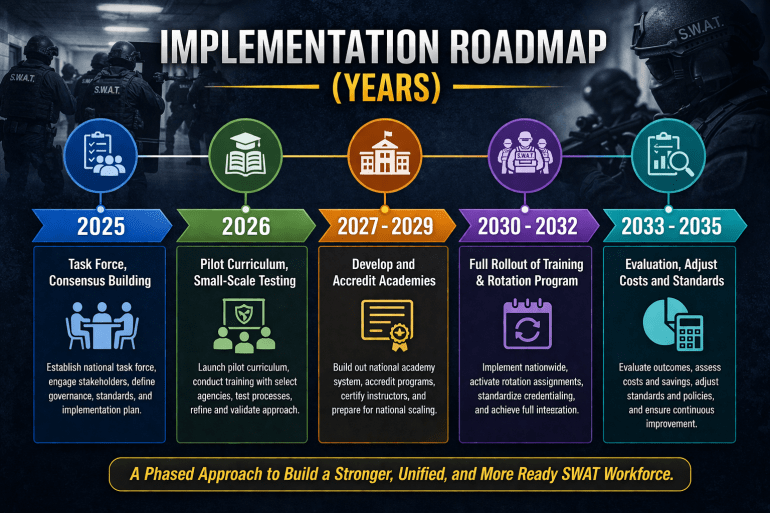
Implementation Timeline
timeline
title Implementation Roadmap (Years)
2025: Task Force, consensus building
2026: Pilot curriculum, small-scale testing
2027-2029: Develop and accredit academies
2030-2032: Full rollout of training & rotation program
2033-2035: Evaluation, adjust costs and standards
Conclusion
In conclusion, transitioning to a “One School, One SWAT” system will likely raise annual costs in the short run due to new infrastructure, unless very strong efficiency gains are realized. In the reports’ base case, net spending increases (by tens of millions). The long-term viability hinges on securing sufficient federal/state funding and delivering demonstrable improvements in capability or cost savings. Given the constitutional need for local buy-in, a phased pilot (e.g. inter-state academy consortia) is advisable. Policymakers should weigh these fiscal tradeoffs carefully against the potential interoperability and standardization benefits.
[1] [2] [3] [6] When SWAT teams are used, why, and how much it costs | KSL.com
https://www.ksl.com/article/46295693/when-swat-teams-are-used-why-and-how-much-it-costs
[4] [5] [8] How Much It Costs Austin Every Time SWAT Teams Roll Out | KUT Radio, Austin’s NPR Station
https://www.kut.org/crime-justice/2014-08-04/how-much-it-costs-austin-every-time-swat-teams-roll-out
[7] National SWAT Study | NTOA
[9] MILITARY EQUIPMENT ANNUAL REPORT | 2024
https://pd.anaheim.net/DocumentCenter/View/243/2024-Military-Equipment-Annual-Reportpdf
11. Recommendation and Conclusion
The concept of “one school, one SWAT, one motto” – a unified national SWAT framework – offers clear potential advantages in interoperability, standardized professionalism, and efficiency. However, it also faces serious hurdles in the U.S. federal system. The reports’ analysis finds:
- Legally: Direct federal control is not permissible under current doctrine[3]. Any national scheme must rely on cooperation (through grants, compacts, or agreements), preserving local sovereignty[27]. Congress could probably achieve this via funding incentives and clear national standards under its commerce or spending powers[26].
- Organizationally: The strongest path is a federally guided but locally implemented model. Creating one central training authority (Option 1) appears politically unrealistic. A hybrid (Option 2) is feasible: e.g. a National SWAT Board and academy setting curriculum, with regional academies delivering it. A purely voluntary model (Option 3) is easiest short-term but slower to unify standards.
- Financially: Without precise data, the report tentatively estimates that an upfront increase in spending (for academies and staff) could be largely offset by reduced duplication (shared training, joint procurement)[10][12]. Cost-effectiveness will depend on scale and uptake. Scenario estimates suggest a mid-term neutral budget impact, but any national program should be tightly monitored.
- Culturally: Police unions, local governments, and civil liberties advocates will need reassurances. The system must avoid diluting local accountability or expanding SWAT misuse. Safeguards (strong civilian oversight, integrated de-escalation training, complaint tracking) are essential to maintain legitimacy.
Given these factors, the report recommends against a wholesale, top-down implementation (Option 1) at this time. Instead, the report advises a pilot-based approach emphasizing national standards. Steps to take now include forming an intergovernmental advisory panel, testing pilot training programs, and developing a model legislative framework for compacts or grant conditions.
Bottom-line judgment: The “one school, one SWAT” ideal is administratively and constitutionally challenging but not impossible. With careful design respecting federalism, a phased adoption could be workable. The concept is likely best implemented in stages (starting regionally) rather than all-at-once. If done right, it could improve readiness and save money; but it must be approached as a cooperative venture, not a federal takeover.
In summary, pursuing a unified SWAT system is worth piloting in targeted areas, accompanied by rigorous evaluation. A cautious, collaborative strategy – rather than an immediate national mandate – stands the best chance of success.
Citations
Key sources used: 2014 NTOA/IACP National SWAT Study[1][5]; Virginia Law Review (2023) on federal role in policing[26]; Brennan Center (2025) on federalism[27]; FBI training and SWAT program descriptions[28][19][22]; FDLE report on multi-jurisdictional SWAT[10][12]; policy analyses on SWAT costs and militarization[8][16]; Sacramento State thesis on SWAT expansion[2][17]; and GAO report on federal tactical teams[31][29], among others. Where data are limited, estimates are explicitly labeled as such.
[1] [4] [5] [6] [7] [13] [14] National SWAT Study | NTOA
[2] [17] The rise and expansion of SWAT Teams across the United States
[3] [24] [25] Microsoft Word – Richman_Seo_How Federalism Built the FBI_SCJRCL_Final.docx
[8] [15] [18] Does every city need its own SWAT team? | Future Policing Institute
https://www.futurepolicing.org/the-future-of-swat/blog-post-title-one-lk7w8
[10] [11] [12] [16] The Feasibility of a Multi-Jurisdictional Swat Team
https://www.fbi.gov/how-we-investigate/training
[20] Training Academy | U.S. Marshals Service
https://www.usmarshals.gov/careers/deputy-us-marshals/training-academy
https://www.fbi.gov/news/stories/swat-at-50-fbi-tactical-teams-evolve-to-meet-threats
[26] The Federal Government’s Role in Local Policing – Virginia Law Review
[27] Federalism as a Check on Abuses by Federal Law Enforcement | Brennan Center for Justice
[28] What training assistance is afforded local law enforcement officers? — FBI
https://www.fbi.gov/about/faqs/what-training-assistance-is-afforded-local-law-enforcement-officers
[29] [31] GAO-20-710, Accessible Version, FEDERAL TACTICAL TEAMS: Characteristics, Training, Deployments, and Inventory
[33] [PDF] Unit Training Management Guide – Marines.mil
https://www.marines.mil/portals/1/Publications/MCTP%208-10A.pdf?ver=2017-03-16-121330-570

