Hosting a Formula One[1] street-circuit Grand Prix in Tysons Corner[2] is economically plausible only if the event is designed as (a) an FIA-compliant circuit footprint primarily within Tysons and (b) a week-long, luxury-first business-and-hospitality platform that converts national-security/tech/finance density into sponsorship demand and high-margin hospitality. Tysons has the right “inputs” for that thesis—large employment density, premium retail, high household income, and rail/airport connectivity—but also one of the biggest U.S. “friction costs” for a street race: transportation network disruption and the special legal/regulatory status of the airport access roadway system. [3]
Using a benchmark-and-multiplier approach anchored to the published 2024 economic impact analysis for the Las Vegas Grand Prix (Applied Analysis) and standard BEA input-output concepts, a Tysons Grand Prix can reasonably be modeled as:
- Steady-state annual incremental economic output: ~$307M to ~$942M
- Steady-state annual incremental GDP (value added) estimate: ~$169M to ~$518M
- Inaugural-year (with one-time infrastructure/capex) economic output: ~$572M to ~$1.65B
- Inaugural-year GDP (value added) estimate: ~$315M to ~$907M
These are regional impacts (Tysons + adjacent nodes that actually capture visitor nights/spend), not a promise of net fiscal benefit after public costs. The “GDP impact” is expressed as value added (a closer GDP analog than gross sales/output), consistent with BEA’s framing of impact measures. [4]
For scale: Fairfax + Fairfax City + Falls Church 2023 GDP is about $167.8B, so the base steady-state GDP increment (~$338M) is roughly 0.20% of that county-level GDP in a typical year; the inaugural year could be higher if the project includes large one-time construction and year-round race operations. [5]
Tysons–Dulles corridor baseline that matters for an F1 bid
A credible F1 economic-impact case starts with the host submarket’s capacity to absorb and monetize visitor inflows (rooms, restaurants, premium retail, corporate hospitality inventory, and transit connectivity). In the “Tysons area profile” published by the Fairfax County Economic Development Authority[6]:
Tysons is presented as the largest business district in Fairfax County with 35.6M square feet of office space and 149,095 total jobs, and it explicitly emphasizes (i) four Washington Metro Silver Line[7] stations and (ii) rail access to Washington Dulles International Airport[8] as part of the district’s economic proposition. [9]
Two other baseline indicators shape the “airport-to-luxury-district” narrative you want:
- The Metropolitan Washington Airports Authority[10] reported a system-wide passenger record in 2024, driven largely by record performance at Dulles. [11]
- Dulles specifically reached ~27.25M passengers in 2024, an all-time high since 2005 (as reported by regional aviation coverage citing MWAA). [12]
This matters because F1’s premium hospitality demand is strongly correlated with: (1) the ease of routing international and C-suite travelers and (2) the presence of high-income corporate customers who can buy packages as relationship capital.
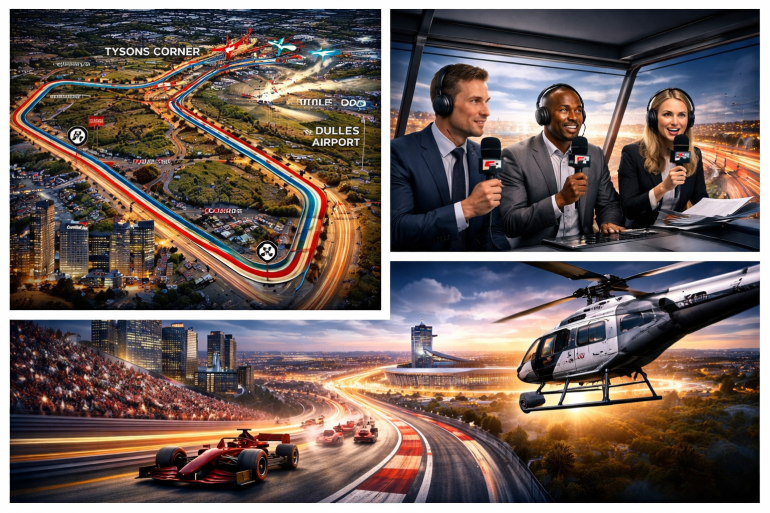
Benchmarks from comparable races and what they imply for Tysons
The most useful benchmarks are the U.S. “destination-premium” races (Las Vegas, Miami) and the archetype luxury street race (Monaco). Their headline impact numbers are not directly portable—but they provide spend-per-visitor, attendance density, operations spend, and media exposure reference points.
The 2024 Las Vegas Grand Prix[13] economic impact analysis prepared by Applied Analysis[14] reports:
- 306,000 total attendance during race week, translating to ~175,000 unique travelers. [15]
- Aggregate economic impacts exceeding $934M in year two (net visitor spending + operations/infrastructure). [16]
- Visitor behavior: 3.7 nights average stay and >$2,400 in non-ticket spending per visitor, with explicit clarification that this does not include ticket prices. [17]
- A reported visitor-spend multiplier framing: “for every dollar spent… roughly $1.65 of economic activity was generated.” [17]
- Media reach claims including publicity value >$6B, over 706B impressions, and 56.1M television viewership during race weekend (methodology-dependent and not directly comparable to standard ad buys, but it signals the scale of global exposure). [18]
For Miami Grand Prix[19], multiple reports cite a local economic impact around $449M (2023) and ~$350M (2022), with 2023 frequently described as an increase over 2022. [20]
This places Miami—an event designed around premium hospitality and celebrity programming—closer to what a “Tysons luxury” positioning would pursue than a traditional civic festival model.
For Monaco Grand Prix[21], Monaco’s own statistical institute analysis (as reported by Monaco-focused outlets summarizing IMSEE results) attributes approximately €90M of economic benefit to the 2017 edition, including €21.7M direct and €68.3M indirect, measured over the four-day event window and tied to Grand Prix-specific visitors/spend. [22]
Two caution flags should be explicitly built into any Tysons model:
- The U.S. Bureau of Economic Analysis[23] RIMS II user guide warns that impact studies can be inflated if analysts misuse Type II multipliers or include spending that is already embedded in the multiplier structure (a common “double counting” failure mode). [24]
- Peer-reviewed research on F1’s broader regional economic effects is mixed; some econometric work finds limited or neutral long-run effects depending on region and measure, and at least one 1990–2023 European-region study framework emphasizes that claims should be tested rather than assumed. [25]
In practice: Tysons should not pitch “Vegas numbers.” It should pitch a Miami-like visitor-and-hospitality profile plus a differentiated “global business corridor showcase” narrative tied to the airport and corporate concentration.
Circuit concept feasibility for a Tysons street race with a Dulles high-speed identity
The vision of a “Tysons-to-Dulles Airport turnaround” is compelling for broadcast storytelling—but the physical roadway geometry and FIA constraints create a hard design boundary:
- FIA Appendix O sets a maximum permitted straight length of 2 km and recommends that the length of any new circuit should not exceed 7 km (for FIA Championship/Trophy/Cup contexts). It also notes typical planning widths (e.g., 12 m track width for new permanent circuits, and 15 m starting grid width). [26]
- The Dulles Airport Access Highway[27] is restricted to airport users “by federal law and Authority regulation” (MWAA), and the operator’s own traveler guidance emphasizes that once you enter the westbound access highway “there will be no opportunity to exit until you reach the Airport.” [28]
- The access highway is enforced: Virginia code explicitly provides for enforcement mechanisms and civil penalties related to improper use of the Dulles Access Highway. [29]
A realistic FIA-compliant “Tysons–Dulles Corridor” race narrative
A workable concept is therefore two-layered:
Layer one is the FIA-compliant race circuit (lap length in the ~5.6–7.0 km range), which can include a high-speed segment up to 2 km to create the “corridor speed” signature. Layer two is the broadcast and digital content plan that turns the event into a rolling advertisement for the airport-corridor-finance narrative—even if the lap itself doesn’t travel to the airport perimeter.
Concept circuit geometry (investment-grade concept, not engineering)
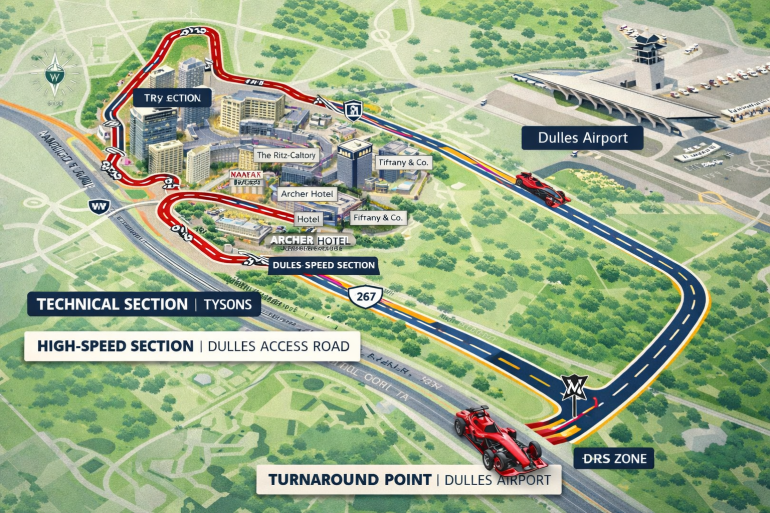
A plausible target is a ~6.3–6.9 km (3.9–4.3 mile) layout anchored on Tysons arterials and controlled-access segments that can be converted into an FIA Grade 1 street circuit configuration. The core deliverable is three sectors:
- Technical / “urban luxury” sector in Tysons: tighter corners around the high-density mixed-use core, designed for camera sightlines to skyline assets and premium viewing decks. (This is where the brand story is richest: malls, hotels, corporate towers.) [30]
- High-speed “corridor” sector (≤ 2 km straight): designed explicitly to comply with FIA Appendix O’s straight-length envelope while still delivering a “Monza/Baku-like” visual identity. [31]
- Return/braking sector: heavy braking zones engineered for overtaking, plus a second DRS opportunity where feasible (street circuits need deliberate passing design due to limited runoff and narrow rights-of-way).
Speed and time modeling for the high-speed segment
The most defensible speed benchmark is to anchor to an F1 public simulation reference: Formula1.com[32] reported pre-event simulations for the Las Vegas circuit suggesting top speeds around 342 km/h (212 mph). [33]
If Tysons uses a 2.0 km max straight (FIA limit): [34]
– At an average straight-segment speed of 240–300 km/h (accounting for acceleration and braking), traversal time is roughly 24–30 seconds (2.0 km / speed).
– That is consistent with your goal of a visibly “high-speed” portion without exceeding FIA’s straight constraint.
By contrast, if you attempted to incorporate the full Dulles Access Highway to the airport as a race segment, you run directly into the FIA length envelope. A 13.65-mile one-way run (cited in legal description of the access road) at racing speeds would take roughly 3.7–5.5 minutes one way at 150–220 mph—and a round-trip would create lap times on the order of 8–11 minutes, far outside modern F1 circuit norms and the recommended new-circuit length guidance. [35]
Spectator luxury design, co-events, and transport monetization
A Tysons Grand Prix should be structured less like a municipal “festival” and more like an integrated corporate hospitality and retail conversion engine. Tysons already has the building blocks:
High-margin hospitality inventory that already exists
- The Ritz-Carlton, Tysons Corner[36] positions itself as a luxury hotel connected to premium retail (Tysons Galleria). Independent hotel listing sources cite 398 rooms. [37]
- Archer Hotel Tysons[38] is a boutique property that publicly lists 178 rooms (including 43 suites) and positions itself at the foot of the McLean Silver Line station. [39]
- The Perch at Capital One Center[40] is explicitly described as a sky-park “more than 10 stories above” the street level—a natural “rooftop deck” asset for premium race viewing packages if sightlines can be engineered. [41]
- Capital One Hall[42] provides an on-site anchor for concert programming, VIP receptions, and brand launches, strengthening the week-long economic ecosystem concept. [43]
Luxury retail ecosystem as an activation platform
Tysons’ premium retail is not hypothetical. Tysons Galleria[44] directory listings and brand store pages show flagship luxury presence (examples include Gucci[45] and Louis Vuitton[46], with CHANEL[47] also publicly listing a Tysons boutique). [48]
The local EDA profile also explicitly names Tiffany & Co., among selected Tysons retail employers, reinforcing sponsor fit. [49]
Luxury automotive as both sponsor and “mobility product”
High-end dealership density in the corridor is real and close to the airport side of the narrative:
- The same Sterling node hosts Lamborghini Washington[52], Ferrari of Washington[53], and Rolls-Royce Motor Cars Washington[54]. [55]
This supports a monetization plan where “ground fleet” is not a vendor cost center but a co-branded activation (chauffeured VIP transfers, dealer-hosted owner lounges, curated test-drive experiences on non-race days).
Transportation reality and the airport story
The “opulence corridor” storyline is strengthened by the fact that the Dulles rail extension is operational. MWAA describes the Dulles Corridor Metrorail as a 23.1-mile extension that opened in November 2022, connecting the corridor and Dulles into the regional rail system. [56]
However, the road network constraint must be front-and-center in feasibility messaging:
- The Dulles Access Highway is restricted to airport users (law/regulation); this is not a normal urban arterial you can casually close and repurpose. [57]
- As designed, once drivers enter westbound airport access lanes there is no general exit before the airport, which has implications for emergency access design, VIP convoy routing, and event-day traffic reconfiguration. [58]
Sponsorship, paid placement, and a defensible media valuation approach
Sponsor demand logic in Tysons is unusually strong for a U.S. street race
A Tysons Grand Prix is effectively selling (1) a premium audience with high household income and (2) a concentrated corporate cluster. The local EDA profile explicitly frames Tysons employment mix with major shares in professional/scientific/technical services and finance/insurance, alongside a large job base. [59]
The corridor also has identifiable corporate anchor candidates:
- Blue Origin[64] has been reported opening a Reston facility “just off the Dulles Access Road,” reinforcing the corridor storyline. [65]
Together, that’s a sponsor pipeline spanning: luxury retail, luxury automotive, finance, defense, and tech—aligned with F1’s global sponsor categories.
Paid placement: what is realistic
A Tysons race can monetize visibility via three channels:
1) Event-controlled branding (trackside signage, bridges, temporary structures)
2) Venue-adjacent real estate branding (building wraps, LED boards, rooftop decks)
3) Content packaging (produced segments, aerials, “corridor stories,” sponsor-backed features)
But two credibility rules apply:
- F1 rights and the “world feed” control much of the broadcast ecosystem; a sponsor inventory plan must be structured around what is actually sellable locally vs centrally. (This is a deal-structure constraint, not just a creative constraint.)
- AVE (Advertising Value Equivalency) is widely criticized in the communications measurement field. AMEC[72] has a longstanding “Say No to AVEs” position, documenting why AVEs are considered invalid as a true measure of PR value. [73]
A better approach than AVE, while still speaking “CFO language”
A finance-grade media valuation framework for this project should separate:
- Measured audience reach (viewers, impressions, digital views)
- Sponsor exposure (duration, on-screen area, frequency, placement context)
- Conversion proxies (web lift, brand search lift, lead-gen, event attendance, partner pipeline)
For global reach context, Reuters (citing Nielsen Sports) reports that F1 achieved a 1.83B cumulative audience in 2025 and an average of 76.1M viewers per Grand Prix—a meaningful baseline for the potential “showcase” value of a U.S. race if it makes the calendar. [74]
For event-specific illustration, the Las Vegas impact report claims very large publicity value and impressions around race week (again, methodology-dependent), but it demonstrates how an F1 host city can position the event as a “global media moment.” [75]
GDP impact model for Tysons with low, base, and high cases
How the model is structured
Economic impact is frequently reported as economic output (“sales”), but “GDP impact” is better approximated by value added (wages + profits + taxes on production, net of intermediate inputs). The BEA’s RIMS II user guide explicitly describes that impacts can be expressed as output, value added (GDP), earnings, and employment. [76]
This model intentionally:
- Anchors multipliers and visitor behavior to a published F1 race impact report (Las Vegas 2024) to avoid arbitrary multipliers. [16]
- Uses a net visitor spending concept (adjusting for displacement/leakage) consistent with how the Las Vegas report frames net impacts. [77]
- Incorporates BEA guidance that mis-specified final demand (or double-counting household spending under Type II multipliers) can inflate results. [24]
Key assumptions (transparent, stress-testable)
The modeled cases depend primarily on four levers:
1) Unique out-of-town visitors (not total turnstile attendance)
2) Average non-ticket spend per visitor (hotels, F&B, local transport, shopping, entertainment)
3) Net-adjustment factor for displacement/leakage (how much spend is truly incremental)
4) Local operations spend (what the promoter and vendors purchase locally for staging the race)
The Las Vegas 2024 report provides a strong reference point that average visitors spent >$2,400 outside the race itself over 3.7 nights, excluding ticket costs. Tysons may be able to reach similar spend levels in the luxury tiers, but “destination gambling” behavior is not as structurally embedded as in Las Vegas, so the base case is set modestly below the most aggressive Vegas-style upside. [17]
Modeled impact ranges
The table below reports both economic output (gross activity) and an estimated GDP value-added slice (modeled here as ~55% of output; in a full implementation, this would be replaced with county/region-specific value-added multipliers from RIMS II or IMPLAN).
The visitor-spend and operations multipliers are benchmarked to the Las Vegas 2024 report’s internal “ripple effect” framing (visitor spending multiplier ~1.65; operations/infrastructure spending also generates large indirect/induced effects). [16]
| Scenario | Net visitor spend ($M) | Recurring local ops spend ($M) | Steady-state economic output ($M) | Steady-state GDP value added ($M, est.) | Steady-state jobs (approx.) | Inaugural economic output ($M) | Inaugural GDP value added ($M, est.) |
| Conservative | 121.5 | 60 | 306.7 | 168.7 | 1,380 | 572.2 | 314.7 |
| Base | 276.0 | 90 | 614.7 | 338.1 | 2,459 | 1,057.2 | 581.5 |
| Upside | 442.0 | 120 | 941.7 | 517.9 | 3,296 | 1,649.7 | 907.3 |
Interpreting the table for “Tysons GDP impact”: if you benchmark against the ~$167.8B GDP level for Fairfax + Fairfax City + Falls Church (2023), the base steady-state GDP impact (~$338M) equates to about 0.20% of that county-level GDP, while the upside case approaches ~0.31%. [78]
What would shift the estimate up or down
The dominant sensitivities in a Tysons context are:
- Hotel room capture and pricing power (Tysons vs Arlington/DC capture): Tysons’ luxury hotels exist (e.g., 398 rooms at the Ritz-Carlton property and 178 rooms at Archer), but the region-wide room supply and rate surge will determine whether spend concentrates in Tysons or diffuses. [79]
- Road-closure friction: the more disruptive the circuit to commuter flows, the higher the risk of displacement (locals leaving, non-race visitors avoiding the region), reducing net spending—an effect the Las Vegas impact report explicitly accounts for through displacement adjustments. [75]
- Governance and “who keeps the money”: ticket revenue and certain sponsorship flows can leak out of the local economy depending on promoter structure; the model therefore emphasizes non-ticket local spend and local procurement.

AVE and the “Flutie Effect” as long-term economic uplift
Why “Flutie Effect” logic is relevant—but must be disciplined
Your framing is: the race is a long, expensive commercial for the Tysons–Dulles luxury/finance corridor.
That is directionally consistent with a well-studied idea in economics of attention: high-visibility events can create measurable downstream demand shifts.
In higher education, the “Flutie effect” literature documents how sports success increases applications. The peer-reviewed paper by Devin G. Pope[80] and Jaren C. Pope[81] reports, for example:
- Ending a football season ranked in the top 20 yields about a 2.5% increase in applications the following year (in their results discussion). [82]
- For private schools, advancing to the Sweet 16 can correspond to an 8–14% increase in applications for multiple subsequent years (their discussion contrasts persistence). [82]
For Tysons, the analog is not “applications”—it is: business travel preference, meeting/conference site selection, investor attention, relocation pipeline velocity, and luxury retail conversion. The lesson is not that the effect will be huge; it’s that high-profile visibility shocks can have multi-year persistence when the product (here: Tysons as a premium business district) is already credible.
A defensible “brand uplift” projection range
Because academic evidence on mega-events and GDP is mixed and depends on the region and counterfactual, a disciplined Tysons forecast should treat long-term uplift as a range, not a point estimate. [25]
A practical long-term model would estimate:
- A baseline steady-state annual GDP impact (from the event itself; table above), plus
- A leveraged uplift from incremental tourism, conferences, and corporate-site selection, modeled as a percentage of the steady-state impact rather than an independent giant number.
A conservative approach is to model long-term uplift as 10%–30% of steady-state annual value-added impact, sustained while the race remains on the calendar and while the corridor story is actively produced (airport-to-district aerials, corporate campus showcases, luxury retail/venue tie-ins). This keeps the model within the scale of what’s defensible under uncertain causality and avoids “marketing-number inflation.”
The media engine: what “one long commercial” actually means in production terms
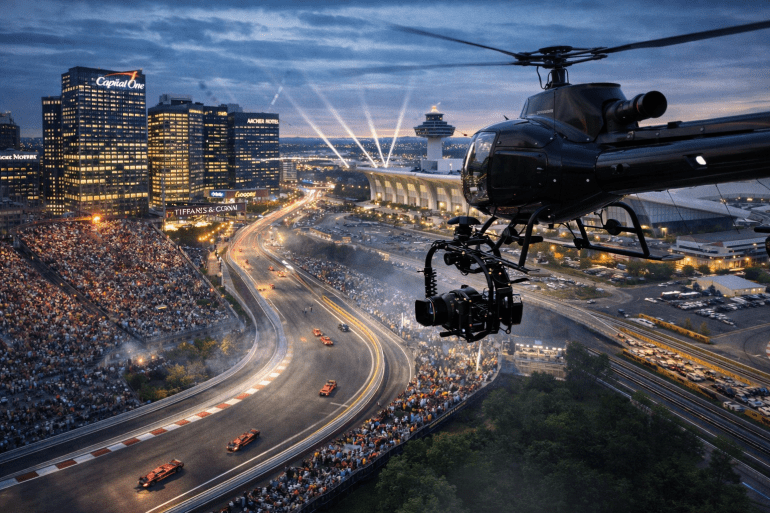
If the goal is to showcase “everything between the airport and Tysons,” the most feasible approach is broadcast packaging, not lap geometry:
- Pre-produced aerial sequences (IAD terminal, Silver Line stations, skyline, major corporate campuses)
- Sponsor-funded corridor segments (e.g., “arrival to boardroom” narratives)
- Event-week content in hotels, malls, and venues that actually monetizes viewer attention into bookings, retail sales, and business development
This approach also avoids colliding head-on with the legal restrictions and practical constraints of converting the Dulles Access Highway into a racing surface. [83]
[1] [7] [13] [15] [16] [17] [18] [32] [45] [60] [66] [75] [77] https://ewscripps.brightspotcdn.com/ba/a8/ad3094094f42a32b81fd94057456/lvgp-2024-economic-impact-final.pdf
[2] [27] [61] https://www.capitalone.com/about/corporate-information/corporate-offices/
https://www.capitalone.com/about/corporate-information/corporate-offices/
[3] [9] [30] [40] [44] [49] [59] [70] https://fairfaxcountyeda.org/wp-content/uploads/2024/11/Tysons-area-profile.pdf
[4] [24] [47] [54] [76] [81] https://www.bea.gov/sites/default/files/methodologies/RIMSII_User_Guide.pdf
[5] [10] [78] https://fred.stlouisfed.org/series/GDPALL51919
https://fred.stlouisfed.org/series/GDPALL51919
[6] [26] [31] [34] [53] https://api.fia.com/system/files/documents/appendix_o_2025_published_23122025_0.pdf
[8] [21] [48] [68] https://www.tysonsgalleria.com/en/directory/
https://www.tysonsgalleria.com/en/directory/
[11] [23] https://www.flydulles.com/editorial-section/about-airport-0
https://www.flydulles.com/editorial-section/about-airport-0
[12] https://wtop.com/business-finance/2025/02/dulles-reagan-national-set-new-records/
[14] [69] https://www.gd.com/about-gd/faqs
https://www.gd.com/about-gd/faqs
[19] [55] https://www.lamborghiniwashington.com/hours.aspx
https://www.lamborghiniwashington.com/hours.aspx
[20] https://www.nbcmiami.com/news/local/businesses-expect-big-boost-during-formula-1-miami-grand-prix-weekend/3301756/?utm_source=chatgpt.com
[22] https://monacolife.net/grand-prix-has-e90m-impact-on-economy-says-report/
[25] [62] https://erbe.autonoma.pt/articles/ERBE04102-The-economic-impact-of-Formula-1-Portuguese-Grand-Prix.pdf
[28] [57] [83] https://www.mwaa.com/policefireems/mwaa-police-department/safety-service-patrol-dulles-toll-road
https://www.mwaa.com/policefireems/mwaa-police-department/safety-service-patrol-dulles-toll-road
[29] https://law.lis.virginia.gov/vacode/title46.2/chapter8/section46.2-819.5/
https://law.lis.virginia.gov/vacode/title46.2/chapter8/section46.2-819.5/
[33] https://www.formula1.com/en/latest/article/in-numbers-the-facts-and-figures-behind-the-new-las-vegas-grand-prix.614g1kuZTz5VhwmGEcLcid
[35] [52] [64] https://case-law.vlex.com/vid/corr-v-metro-washington-892456213
https://case-law.vlex.com/vid/corr-v-metro-washington-892456213
[36] [56] https://www.mwaa.com/business/construction/dulles-corridor-metrorail/dullesmetro
https://www.mwaa.com/business/construction/dulles-corridor-metrorail/dullesmetro
[37] [80] https://www.ritzcarlton.com/en/hotels/wasty-the-ritz-carlton-tysons-corner/overview/
https://www.ritzcarlton.com/en/hotels/wasty-the-ritz-carlton-tysons-corner/overview/
[38] [43] https://www.capitalonehall.com/
https://www.capitalonehall.com/
[39] https://archerhotel.com/tysons
https://archerhotel.com/tysons
[41] [42] https://www.capitalonecenter.com/the-perch
https://www.capitalonecenter.com/the-perch
[46] [63] https://bigbear.ai/contact/
[50] [51] [72] https://tysonscorner.porsche.com/en/about-us/hours
https://tysonscorner.porsche.com/en/about-us/hours
[58] https://www.dullestollroad.com/traveler-information
https://www.dullestollroad.com/traveler-information
[65] https://www.ffxnow.com/2022/07/08/jeff-bezos-space-flight-company-blue-origin-has-its-reston-landing-spot/
[67] https://about.google/company-info/locations/
https://about.google/company-info/locations/
[71] https://www.northropgrumman.com/who-we-are/contact-us-northrop-grumman
https://www.northropgrumman.com/who-we-are/contact-us-northrop-grumman
[73] https://amecorg.com/2017/06/the-definitive-guide-why-aves-are-invalid/
[74] https://www.reuters.com/sports/formula1/live-viewing-powers-formula-one-biggest-total-audience-five-years-2026-03-04/
[79] https://www.fivestaralliance.com/luxury-hotels/washington-dc/ritz-carlton-tysons-corner
https://www.fivestaralliance.com/luxury-hotels/washington-dc/ritz-carlton-tysons-corner
[82] https://jarenpope.weebly.com/uploads/2/9/7/3/29731963/2009_pope_pope_sej.pdf

