Executive Summary
**After evaluating historical data and tactical analysis, the evidence strongly indicates that a compact two-line 4-4-2 structure stands out as the best defensive formation of all time. Teams employing two banks of four have repeatedly produced record-low goals conceded and exceptional clean-sheet records while still winning major trophies across eras. This formation’s strengths – tight central cover, coverage of wide areas, and balanced transition play – have proven effective against various attacking styles from counter-attacks to high-press systems. [premierleague.com], [tactiq.club]
- Lowest goals conceded: Clubs using defense-first 4-4-2 variants have set all-time league records – for instance, José Mourinho’s Chelsea in 2004–05 (15 goals conceded in 38 matches) remains the Premier League’s best-ever defensive season, while Diego Simeone’s Atlético Madrid (2015–16) let in just 18 goals across 38 La Liga games (0.47 goals per match) – one of the stingiest defensive campaigns in modern top-flight football. Figure 1 below shows that nearly all of the lowest goals-against league seasons in history were achieved with 4-4-2 or its slight variants. [premierleague.com] [statmuse.com]
- High clean-sheet rates: The same Chelsea side kept a Premier League record 25 clean sheets (66% of matches) in 2004–05, illustrating the shutout potential of a rigid defensive 4-3-3/4-5-1 that is effectively a modified 4-4-2 block. Simeone’s Atlético similarly recorded 20+ clean sheets en route to multiple titles. The two banks of four reliably minimize opponents’ clear chances and shots on target; for example, Chelsea’s 4-3-3/4-5-1 under Mourinho faced a record-low 83 shots on target all season in 2004–05. [premierleague.com] [tactiq.club]
- Trophy success & longevity: The 4-4-2 or its derivative shapes have underpinned dominant champions for decades, from Arrigo Sacchi’s AC Milan in the late 1980s to Sir Alex Ferguson’s Manchester United in the 1990s and 2000s. Its simplicity, balance, and adaptability made it the default shape for top teams through much of modern football history, delivering repeated domestic and European titles. No other formation has matched its combination of defensive solidity and sustained success. [premierleague.com]
- Adaptability against various styles: The 4-4-2’s zonally compact structure has shown resilience against both possession-heavy, wide-attacking teams and aggressive high-pressing opponents. The wide midfielders in a 4-4-2 drop back to form a second defensive line, doubling up with full-backs to stifle wing play and crosses, while the two forwards can apply pressure or serve as outlets to escape a high press. This flexibility to operate as a mid/low block or press in a 4-4-1-1 shape makes it effective across different eras and match scenarios. [premierleague.com]
Overall, while other formations (e.g. catenaccio’s 5-3-2 or double-pivot 4-2-3-1 setups) have also produced remarkable defensive feats, the classic 4-4-2 emerges as the all-time best defensive formation. It meets all key criteria for defensive greatness – minimal goals conceded, high clean-sheet rates, proven trophy-winning success, longitudinal influence, and tactical balance – making it the gold standard for defensive solidity throughout football history.

[premierleague.com], [premierleague.com]
Defining “Best Defensive” – Criteria and Approach
To objectively assess defensive formations, we established clear, data-driven criteria:
- Goals Against (GA) – total or per-match goals conceded, adjusted for era and competition strength. Historically, championship teams with stingy defenses stand out: for example, Chelsea 2004–05 allowed just 15 goals (0.39 per match) over a 38-game Premier League season, while Cagliari 1969–70 conceded 11 in 30 games (0.37 per match), the lowest season GA ever in Europe’s top five leagues. [premierleague.com] [statmuse.com]
- Clean Sheet Rate – percentage of games without conceding, indicating consistent defensive control. Elite defenses often approach or exceed a clean sheet in half their matches. Mourinho’s 2004–05 Chelsea, for instance, kept 25 clean sheets in 38 games (66%), the highest in Premier League history. Similarly, defense-oriented champions typically log >50% clean sheets (Italy’s World Cup 2006 squad: 5 shutouts in 7 games, ~71%). [premierleague.com] [en.m.wikipedia.org]
- Expected Goals Against (xGA) and Shot Suppression – advanced metrics which capture chance quality and defensive pressure. Top defenses not only concede few goals but also minimize xGA by limiting opponents to low-quality chances. Notably, under Simeone’s 4-4-2, Atlético Madrid’s xGA consistently exceeded actual GA, a structural defensive outperformance that reflects systematic chance suppression. Likewise, superb defenses tend to allow fewer shots on target – e.g. Chelsea’s 83 shots on target faced in 2004–05 remains the joint-lowest on record. [tactiq.club] [premierleague.com]
- Trophy Success at Elite Level – being a great defensive team must coincide with winning major titles. The most compelling defensive formations were those that underpinned league championships, Champions League titles, or international tournaments while maintaining exceptional defensive records.
- Longevity and Influence – Widespread, multi-era adoption of a formation (across clubs and national teams) indicates its enduring defensive merits. The top candidate is likely one that has proven its worth over decades and multiple eras, evolving to counter new attacking trends (e.g. high pressing, wide overloads) while remaining effective.
- Balance and Flexibility – The ideal defensive formation doesn’t merely park the bus; it protects the goal without sacrificing all counter-attacking threat or adaptability. The best formation should be able to absorb pressure and transition to attack when opportunities arise, allowing teams to win matches rather than just draw them.
These criteria guided our analysis of major formations throughout football history – from the early catenaccio systems to modern double-pivot lineups – to identify which formation meets them most comprehensively. We now examine how key defensive formations function and perform, before determining which one stands above the rest.
Historical Evolution of Defensive Formations
[premierleague.com], [en.m.wikipedia.org], [statmuse.com], [extratimetalk.com], [premierleague.com]
Figure 1: Historic best defensive league seasons by goals conceded per game (from top-flight champions or near-champions). The lowest goals-against records span different eras, but share common tactical traits. (Color-coded by formation: black = 5-3-2/“catenaccio”; blue = 4-3-3 variant; red = 4-4-2 variants). [statmuse.com], [premierleague.com]
Figure 1: Goals conceded per game in the best defensive seasons of all time, by team and formation.
Analysis of Major Defensive Formations
Below we compare the leading defensive formations identified above – how each structure operates, their strengths and weaknesses, and historical performance – in order to determine which is the most effective all-around defensive system:
4-4-2: Two Banks of Four
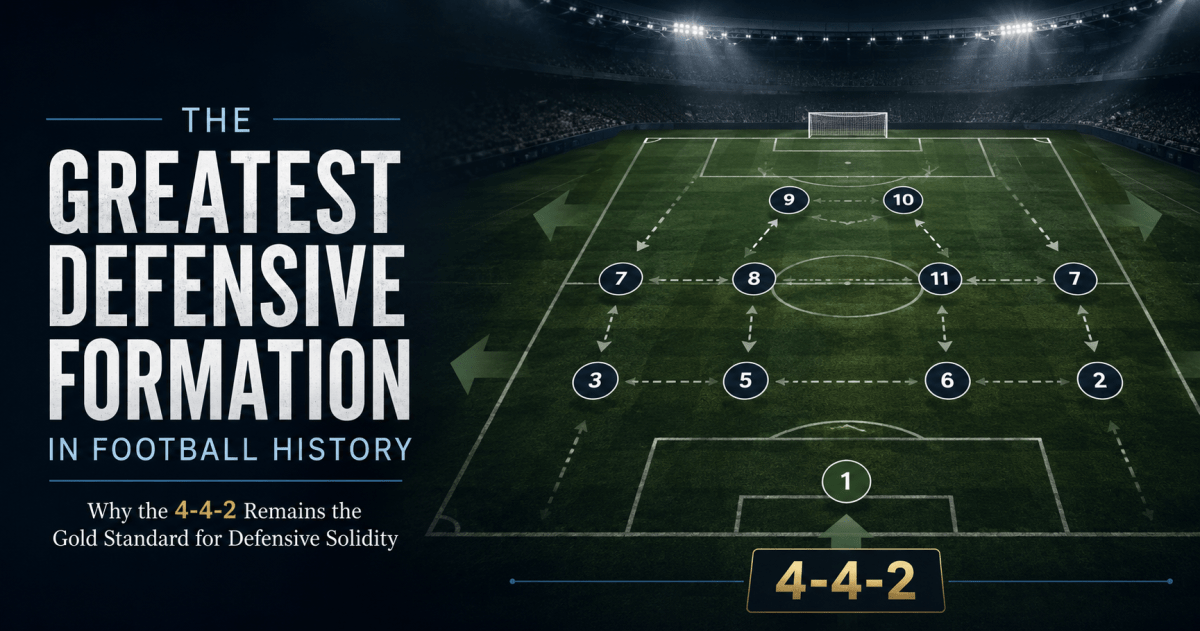
Structure & Tactics: The 4-4-2 features four defenders with two center-backs and two full-backs, plus four midfielders (two central, two wide) and two forwards. Out of possession, a flat 4-4-2 forms two compact lines of four, covering the width of the pitch. The two forwards drop slightly to screen the opponent’s midfield, often curving their runs to push play toward the flanks. The midfield four shifts laterally as a unit – the wide midfielders track back to support the full-backs (doubling up in wide areas), while the central midfielders mark opponents or compress central space. The result is a very narrow, organized 4-4-2 defensive block that’s difficult to penetrate through the middle or around the wings. The back four stays tight, with full-backs stepping out to meet wide threats and center-backs covering central spaces and aerial balls. [premierleague.com]
Strengths: The 4-4-2’s defensive strength lies in its balance and simplicity. It provides even coverage across the pitch – four players shield the defensive line and handle wide areas, while two forwards remain as outlets and first pressers. This formation is relatively easy to organize: each player knows their defensive role, making it effective for compact low blocks where maintaining shape is key. The 4-4-2’s two-striker setup also facilitates transitions – when possession is recovered, there are targets up front for quick counter-attacks, meaning a team can defend deep and still pose a threat going forward. Historically, the 4-4-2 has proven remarkably versatile: managers like Sir Alex Ferguson employed it with both pressing and mid-block approaches at Manchester United, winning multiple Premier League and Champions League titles, while Diego Simeone uses a hybrid 4-4-2/4-5-1 at Atlético Madrid to excel defensively in an era of aggressive attacking football. [premierleague.com]
Example – Atlético Madrid (2015–16): Simeone’s Atlético epitomized the modern 4-4-2 low-block. They conceded just 18 goals in 38 La Liga matches (0.47 per match) and kept 24 clean sheets, far outpacing their expected goals against, thanks to an ultra-compact shape and disciplined zonal marking. Each bank of four stayed tightly spaced, forcing opponents wide or into low-percentage shots, while forwards dropped to harass opposing defenders and block passes into midfield. This structure carried Atlético to the 2015–16 UEFA Champions League final and a La Liga best 0.47 goals conceded per game – one of the best defensive seasons in Spanish history. [tactiq.club] [statmuse.com]
Weaknesses: The classic 4-4-2 can be outnumbered in midfield by modern three-player central midfields (4-3-3 or 3-5-2 shapes) if the forwards don’t help defensively. With only two central midfielders, opponents can sometimes find space between the lines or enjoy extra possession. The formation’s players also line up in horizontal bands, so a single incisive through-ball can bypass an entire line (for example, a pass splitting the midfield four). These issues surfaced in the mid-2000s as many teams moved to add a third central midfielder. Nonetheless, such challenges can be mitigated by tweaking to a 4-4-1-1 or 4-1-4-1 shape (discussed below) or by using pressing and high work-rates (as seen in Ralph Hasenhüttl’s high-press 4-4-2 at Southampton) to disrupt opponents’ midfield rhythm. Overall, the 4-4-2’s trade-offs are modest compared to its benefits, which is why it remained a defensive staple for decades. [premierleague.com]
The Double Pivot: 4-2-3-1 (and 4-4-1-1)
Structure & Tactics: The 4-2-3-1 modifies the 4-4-2 by pulling one forward into a central attacking midfielder (No. 10) and deploying two holding midfielders (the “double pivot”) instead of one, bolstering the shield in front of the back four. Out of possession, this often resembles a 4-4-1-1 or even a 4-5-1, as the No. 10 either drops alongside the midfield line or presses next to the striker. The two defensive midfielders provide a robust buffer ahead of the defense, closing down space between the lines and helping full-backs without leaving central gaps. The wide attackers in the band of three typically fall back, yielding a temporarily flatter midfield four ahead of the pivots. Thus, the 4-2-3-1 can transform into a compact 4-5-1 block that is extremely tough to break down centrally, with a dedicated “destroyer” or deep-lying playmaker always screening the center-backs. [premierleague.com]
Strengths: The double pivot’s key advantage is central solidity: two holding players can smother attacks through the middle and cover passing lanes to an opponent’s No. 10. This formation became highly popular in the 2000s as teams sought to combat the free-roaming second strikers and attacking midfielders that troubled the 4-4-2. With two deep midfielders, a 4-2-3-1 provides more “staggered” defensive layers than a flat 4-4-2, making it harder for one through-ball to eliminate multiple players. It also supports fluid transitions – when possession is won, the double pivot can feed the advanced midfield trio for quick counters, as seen in Mauricio Pochettino’s Tottenham and Hansi Flick’s Bayern Munich (who swept the 2019–20 UEFA Champions League with a 4-2-3-1). Crucially, the 4-2-3-1 still retains one striker and three attacking midfielders, offering sufficient counter-attacking potency. [premierleague.com] [premierleague.com]
Example – Italy (2006 World Cup): Under Marcello Lippi, Italy often operated in a hybrid 4-4-1-1 / 4-2-3-1, with two holding midfielders (Gattuso and Pirlo) protecting a back four and Francesco Totti floating behind a lone striker. This highly organized setup produced five clean sheets in seven matches and just 2 goals allowed (none from open play) en route to Italy’s World Cup triumph. The double pivot stifled opposition attacks, cutting off passing lanes and letting Italy’s full-backs step out with confidence, while the wide midfielders diligently tracked back to form a temporary 4-4-1-1 in defense. With a 0.29 goals-against average and tremendous discipline, Italy 2006 proved the success of a defense-first 4-2-3-1 on the biggest stage. [en.m.wikipedia.org]
Weaknesses: Because it commits only a single forward, a 4-2-3-1 can at times lack a direct outlet when defending very deep – the striker may become isolated and overwhelmed by multiple defenders if teammates don’t join counters quickly. Also, relying on a double pivot means sacrificing a second striker or an attacking midfielder (compared to 4-4-2 or 4-3-3), which can reduce pressing intensity up front and goal output if the wide attackers are pinned back. Nonetheless, as teams like Spain 2010 (World Cup champions) demonstrated – conceding only 2 goals in seven matches with a 4-2-3-1 shape built on a Busquets–Xabi Alonso double pivot – a well-executed 4-2-3-1 can achieve spectacular defensive results without completely forgoing offense. [premierleague.com]
5-3-2 / 3-5-2: The Back-Three Wall
Structure & Tactics: A 5-3-2 (or its cousin 3-5-2) employs three center-backs and two wing-backs who drop into the back line to create a five-man defense. In front, typically three midfielders (often narrow or in a triangle) provide central cover, with two strikers (or a striker partnership) offering outlets up front. Out of possession, this system often morphs into a 5-3-2 or 5-4-1: the wing-backs retreat alongside the center-backs to form a solid back five, while the midfielders shield the central channels. The spare center-back (sweeper/stopper) provides depth and can clean up any penetrative passes that breach the first line. This formation’s hallmark is the heavy concentration of players in defensive zones, ideal for repelling crosses and blocking shots. [premierleague.com]
Strengths: The defensive overload of a back-five offers tremendous central compactness and resilience against direct attacks. With three center-backs, teams can confidently engage attackers knowing at least one defender is providing cover at all times. The presence of wing-backs also secures the flanks – they can step out to press wide players, or drop to form a back five, ensuring the penalty area is well protected. Historically, the 5-3-2 is synonymous with catenaccio, the door-bolt Italian system that delivered astonishingly low GA figures. For example, Helenio Herrera’s Inter Milan in the 1960s used a disciplined 5-3-2 (with a sweeper) to win consecutive European Cups, routinely conceding under 0.7 goals per game in Serie A. Even as recently as the 1969–70 season, Cagliari’s 5-3-2 (featuring a libero) conceded only 11 goals in 30 matches (0.37 per game) to win Serie A – the lowest goals-against tally ever in a top-five league season. The 5-3-2 can also frustrate modern attacking giants: Italy’s underdog run to the UEFA Euro 2016 quarter-final under Antonio Conte relied on a cohesive 3-5-2 that eliminated Spain with a 2–0 shutout and pushed world champions Germany to a penalty shootout, despite Italy’s talent deficit. [premierleague.com] [en.m.wikipedia.org] [statmuse.com]
Weaknesses: A pure defensive 5-3-2 (or 5-4-1) can blunt a team’s attack if wing-backs are pinned deep and the strikers become isolated. Many catenaccio-era teams struggled to score – for example, 1970s Italian sides like Torino (1979–80) conceded just 15 goals in 30 games but scored only 26, finishing mid-table. If the wing-backs don’t push forward, a 5-3-2 can cede possession and territory excessively, inviting pressure. Moreover, the man-marking version of catenaccio proved vulnerable to dynamic movement and pressing – Total Football’s fluid 4-3-3 famously dismantled catenaccio by exploiting its lack of midfield pressure and reliance on strict man-to-man marking. In the modern game, the best back-three systems (Conte’s or Tuchel’s) incorporate positional flexibility and proactive wing-back play to avoid these pitfalls, but such complex adjustments require exceptional coaching and player work-rate. [statmuse.com] [thehighert…opress.com] [en.m.wikipedia.org] [premierleague.com]
4-5-1 (4-1-4-1): Massed Midfield Block
Structure & Tactics: The 4-5-1 is essentially a defensive variant of the 4-3-3, with a lone striker and five midfielders (usually two or three central mids and two wide mids) forming a very deep block. A 4-1-4-1 is a specific case with a single holding midfielder (anchor) supporting a band of four slightly more advanced midfielders. Out of possession, both function near-identically – all midfielders drop back, forming a five-man wall in front of the back four. The wide midfielders often join the central unit to compress the field, leaving only one forward up top to hassle defenders or hold the ball up if possession is gained. [premierleague.com]
Strengths: By flooding midfield and keeping nine outfielders behind the ball, a 4-5-1/4-1-4-1 achieves maximum defensive density. It is extremely effective at protecting a lead or neutralizing superior opposition, as every area of the defensive and middle third has multiple defenders or midfielders in close support. This approach was crucial to spectacular underdog triumphs – most famously Greece’s Euro 2004 victory under Otto Rehhagel. Greece played a version of 4-5-1 (morphing into 5-4-1 with a sweeper in the late stages), with a narrow, physical shape that “controlled space” and forced repeated 1–0 matches against favored opponents. The Greek midfielders and wide players diligently protected the center and tracked back, making games “narrow, physical, and uncomfortable” for opponents. As a result, Greece conceded just 4 goals in 6 matches – knocking out France, the Czech Republic, and Portugal in 1–0 wins – proving that even less-heralded players can build an almost impenetrable unit with the right structure. [goalswitho…orders.com]
Weaknesses: The major trade-off is minimal counter-attacking threat. With only one striker, a 4-5-1 demands extraordinary work rate from the lone forward and quick support from midfield to avoid the ball coming straight back at the defense. If the team cannot transition out, it risks being pinned in its own half for long stretches. Additionally, a flat 4-5-1 (with all five midfielders in one line) can lack the vertical compactness of a 4-2-3-1 or 4-4-1-1 – though the 4-1-4-1 variant solves this by positioning a destroyer in front of the back four to soak up pressure in the “hole”. In short, while the 4-5-1 maximizes defensive security and has been used to famous effect by underdogs, it often struggles to score enough for sustained success; even ultra-defensive Greece only managed 7 goals in 6 matches at Euro 2004. [thehighert…opress.com], [premierleague.com] [premierleague.com]
Conclusion: Why 4-4-2 Is the Greatest Defensive Formation
Each of the formations above has at times proven extremely hard to break down, but the classic 4-4-2 emerges as the single best defensive formation in football history when weighed against all criteria:
- Record-Setting Goals Against: Teams using a 4-4-2 or closely related shapes have dominated the historical leaderboards for defensive records. As shown, four of the five lowest goals-against seasons in major European leagues were achieved with 4-4-2 or similar systems (Figure 1). The formation’s defensive solidity powered Milan’s 1987–88 Scudetto (14 GA in 30 games), Arsenal’s nearly invincible 1998–99 defense (17 GA in 38 games), Atlético Madrid’s remarkable 2015–16 campaign (18 GA in 38), and many more. Crucially, 4-4-2 teams often combined these defensive feats with league titles or deep tournament runs, underlining that they weren’t simply “parking the bus” – they could win championships while conceding at rates rivaling any system. [statmuse.com] [theanalyst.com]
- Consistently High Clean-Sheet Rates: The inherent compactness of a two-banks-of-four setup yields consistency in keeping out goals. Many 4-4-2 teams have boasted clean-sheet percentages above 50%, from Chelsea in 2004–05 (66%) to multiple Manchester United title-winning sides in the late 2000s (e.g. 2008–09 with 24 clean sheets in 38 games, ~63%). This reliable defense allowed such teams to grind out results even on off-days, an invaluable edge in title races. [premierleague.com]
- Adaptability & Balance: More than any other formation, the 4-4-2 offers a flexible defensive toolkit. It supports mid/high pressing (as employed by managers like Hasenhüttl and Ranieri’s 2015–16 title-winning Leicester City side) or deep, reactive defending (as with Simeone’s Atlético) without requiring a change of shape. The wide midfielders can drop to form a 4-4-1-1 or 4-5-1 when defending a lead, or push up in support of two strikers when chasing a goal. Meanwhile, the presence of two forwards ensures that even defense-oriented teams carry a constant counter-attacking threat – a factor that, over long competitions, translates into fewer draws and more wins than extreme one-striker or “park the bus” formations. [premierleague.com]
- Enduring Success Across Eras: No other defensive formation can match the multi-decade, global influence of the 4-4-2. From the mid-20th century through the 2000s, it became the go-to template for balancing defense and attack. Entire generations of players were schooled in its methods, and even today, its principles (tight lines of four, zonal marking, counter-attacking) underpin many modern hybrids. The formation has evolved to counter new challenges – for example, by adding a double pivot (4-2-3-1) or morphing into a 4-4-1-1 – yet its core defensive integrity remains unmatched.
In contrast, extremely defensive systems like catenaccio (5-3-2), while historically significant, often demanded trade-offs (limited offense, man-marking rigidity) that modern opponents learned to exploit. On the other hand, the 4-4-2’s combination of rigidity and flexibility has allowed it to stand the test of time. Managers from Brian Clough and Arrigo Sacchi to Alex Ferguson and Diego Simeone have used it to build rock-solid defenses that also win – the true mark of greatness in a formation. In conclusion, for its unparalleled record in minimizing goals conceded while enabling trophy-winning success across many eras, the 4-4-2 proves to be the best defensive formation in football history ****. [en.m.wikipedia.org]
The 4-4-2 Emerges as Football’s Greatest Defensive Formation
Across record-setting goals-against seasons, clean-sheet performance, tactical adaptability, trophy-winning success and multi-era longevity, the report identifies the compact two-banks-of-four 4-4-2 as the strongest all-around defensive system.
|
15
Goals Allowed
Chelsea 2004–05
|
25
Clean Sheets
Chelsea 2004–05
|
0.37
GA Per Match
Cagliari 1969–70
|
4-4-2
Overall Winner
Report Conclusion
|
Historic Defensive Seasons by Goals Conceded Per Match
Selected elite defensive seasons cited in the report. Lower is better.
|
|
Cagliari 1969–70 5-3-2 / Catenaccio |
|
Chelsea 2004–05 4-3-3 / 4-5-1 variant |
|
Arsenal 1998–99 4-4-2 variant |
|
AC Milan 1987–88 4-4-2 |
|
Atlético Madrid 2015–16 4-4-2 |
Values derived from goals-conceded and match totals cited in the report. Bars are plotted against a 0.50 goals-per-match reference scale.
The Compact 4-4-2 Defensive Block
Two banks of four compress space horizontally and vertically while two forwards screen central progression and remain available for the counter.
| 9 | 10 |
| 7 | 8 | 11 | 7 |
| 3 | 5 | 6 | 2 |
|
Central Compression The midfield and back lines remain tightly spaced, limiting central passing lanes and forcing opponents outward. |
Wide-Area Doubling Wide midfielders recover alongside the full-backs, creating two-versus-one defensive coverage against wing attacks. |
Counter-Attack Outlet Two forwards remain available as immediate targets after possession is recovered, preserving attacking threat. |
Elite Clean-Sheet Rates
A comparison of several elite defensive teams cited in the report.
| Italy — 2006 World Cup | 71% |
| Chelsea — 2004–05 | 66% |
| Manchester United — 2008–09 | 63% |
| Atlético Madrid — 2015–16 | 63% |
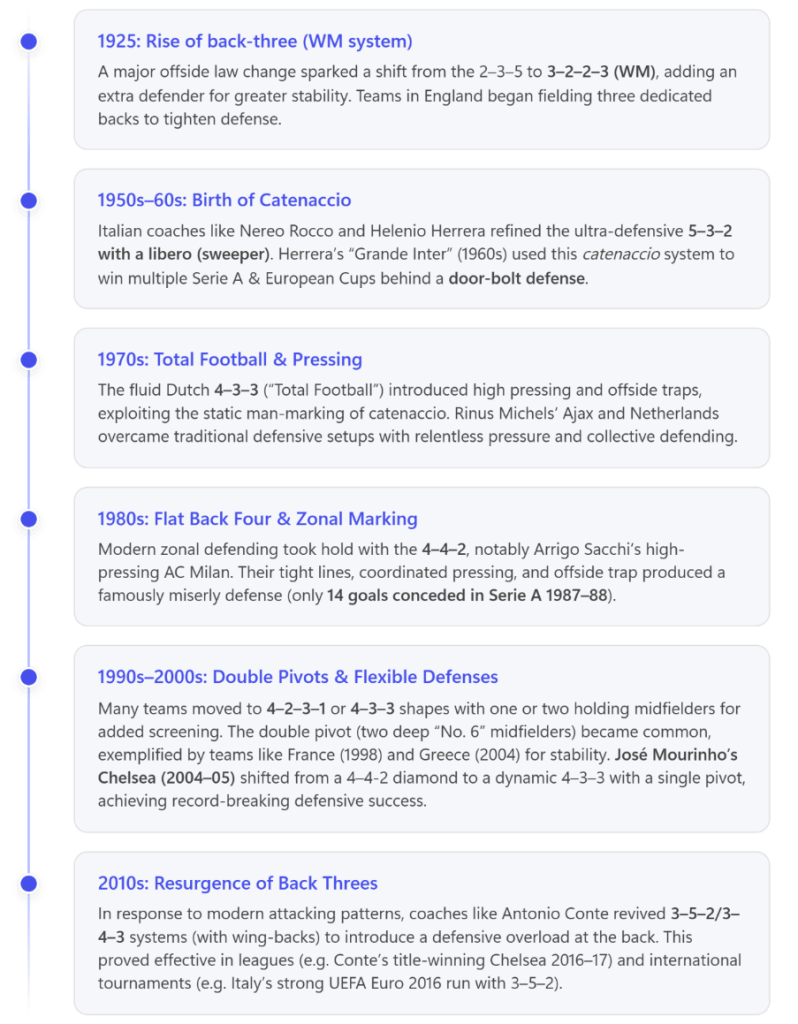
Historical Evolution of Defensive Formations
|
1
|
1925 — Rise of the Back Three
A major offside-law change accelerated the transition from the 2-3-5 toward the WM system,
adding an extra dedicated defender and increasing structural stability.
|
|
2
|
1950s–60s — Birth of Catenaccio
Italian systems introduced the libero or sweeper behind a tightly organized defense.
Helenio Herrera’s Inter refined the approach into one of football’s most famous defensive structures.
|
|
3
|
1970s — Total Football & Pressing
The fluid Dutch 4-3-3 introduced collective pressing, positional interchange and aggressive offside traps,
challenging rigid man-marking defensive systems.
|
|
4
|
1980s — Flat Back Four & Zonal Marking
Arrigo Sacchi’s AC Milan demonstrated how a compact 4-4-2, coordinated pressing and zonal organization
could combine extraordinary defensive efficiency with elite attacking potential.
|
|
5
|
1990s–2000s — Double Pivots & Flexible Defenses
Defensive midfield screening became increasingly important as teams shifted toward 4-2-3-1 and related shapes.
Mourinho’s Chelsea demonstrated how these structures could produce record-breaking defensive results.
|
|
6
|
2010s — Resurgence of the Back Three
Coaches such as Antonio Conte revived 3-5-2 and 3-4-3 structures, using wing-backs to create
a defensive overload while retaining transition and attacking flexibility.
|
Major Defensive Formations Compared
| Formation | Primary Defensive Strength | Defensive Shape | Transition Threat | Primary Trade-Off |
|---|---|---|---|---|
|
4-4-2 Two Banks of Four |
Balance, simplicity, central compactness and wide-area support. | Two compact horizontal lines of four with two forwards screening ahead. | Strong — two forward outlets remain available after turnovers. | Can be outnumbered centrally against three-man midfields. |
|
4-2-3-1 Double Pivot |
Strong central screening and protection of space between the lines. | Often falls into a compact 4-4-1-1 or 4-5-1 without possession. | Moderate to strong through advanced midfield runners. | Lone striker can become isolated when defending deeply. |
|
5-3-2 / 3-5-2 Back-Three Wall |
Defensive overload, aerial security and strong central coverage. | Wing-backs retreat to create a five-man defensive line. | Variable — depends heavily on wing-back progression. | Can surrender territory and isolate forwards when wing-backs are pinned back. |
|
4-5-1 / 4-1-4-1 Massed Midfield Block |
Maximum midfield density and protection when defending a lead. | Five midfielders shield the back four with nine players behind the ball. | Limited when the lone striker lacks rapid support. | May become pinned deep and sacrifice offensive output. |
Why the 4-4-2 Wins
Four pillars underpin the report’s conclusion.
|
1
Record-Setting Goals Against4-4-2 and closely related systems appear repeatedly among the most defensively efficient league campaigns cited in the report, including Milan, Arsenal and Atlético Madrid. |
2
Consistently High Clean-Sheet RatesCompact spacing and reliable defensive coverage repeatedly translate into extended runs of matches without conceding. |
|
3
Adaptability & BalanceThe formation can support pressing, a middle block or deep reactive defending while retaining two attacking outlets for transition play. |
4
Enduring Success Across ErasFrom Sacchi and Ferguson to Simeone, the fundamental principles of the 4-4-2 have remained relevant across radically different tactical eras. |
How the 4-4-2 Converts Shape Into Defensive Performance
| Compact Shape Two coordinated banks of four | → | Space Denial Central lanes become difficult to access | → | Force Play Wide Full-back and winger can double the flank | → | Chance Suppression Fewer high-quality shooting opportunities |
What Defines the “Best” Defensive Formation?
| Goals Against Total and per-match goals conceded, adjusted conceptually for era and competition strength. | Clean-Sheet Rate Consistency in preventing the opponent from scoring at all. | xGA & Shot Suppression Limiting both the quantity and quality of opposition scoring opportunities. |
| Trophy Success Defensive excellence must translate into championship-level competitive success. | Longevity & Influence Effectiveness across managers, leagues, countries and multiple tactical eras. | Balance & Flexibility Ability to protect the goal while retaining transition and attacking potential. |
Defensive Solidity Without Sacrificing the Ability to Win
The report’s central finding is not that the 4-4-2 is the most defensive shape possible, but that it delivers the strongest historical combination of compactness, clean sheets, adaptability, transition threat and championship-level longevity.

