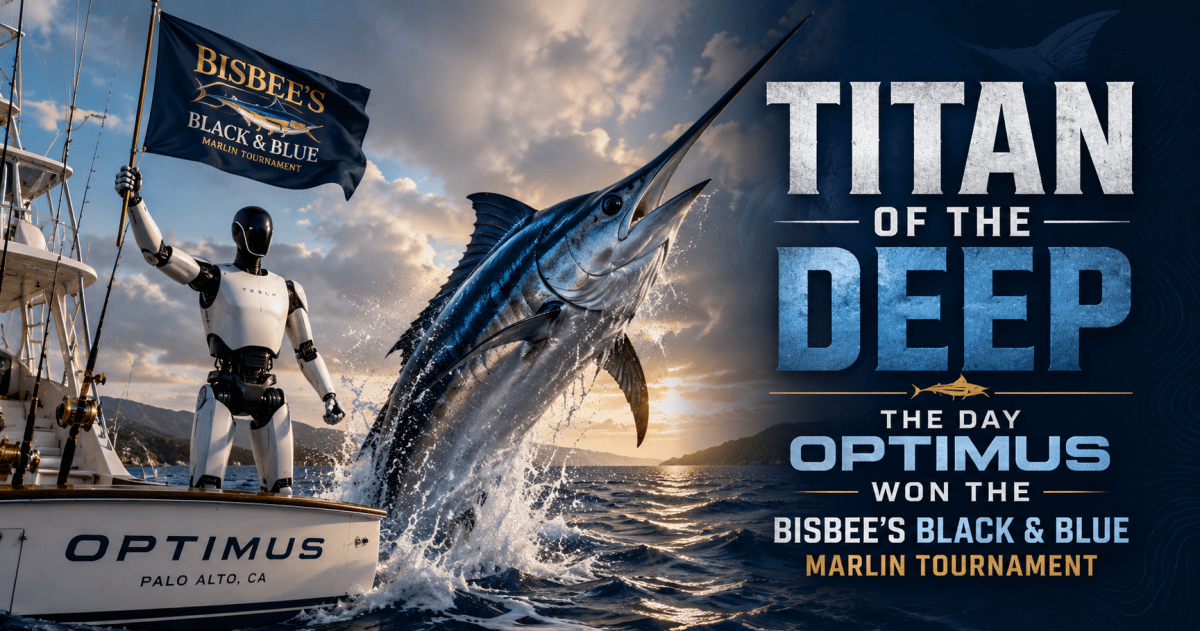
EXT. CABO SAN LUCAS MARINA – DAWN, TOURNAMENT KICKOFF (2035)
The harbor stirs before sunrise. Diesel engines rumble awake, and the salt-tinged air crackles with anticipation. Crews scurry on the docks, loading bait tanks and checking 130-pound-class rods. The Bisbee’s Black & Blue Marlin Tournament—“the Super Bowl of Fishing”—is about to begin. Multimillion-dollar sportfishing yachts, with names like El Dorado and Reel Deal, bob at their slips. At the center of the commotion, a single vessel draws nearly all eyes and camera lenses. Its gleaming white hull is emblazoned with a crimson ”TEAM OPTIMUS” logo. Standing on deck amid the human crew is Optimus—a humanoid robot in a slate-gray saltwater jumpsuit, face blank and visorlike, its carbon-fiber frame accented by Tesla’s red trimming. The first robot angler ever allowed to compete in the legendary Black & Blue.
A hush falls over nearby boats as Optimus steps into the fighting chair mounted at the stern. It’s an imposing throne of aerospace-grade alloy and carbon fiber, reinforced to endure over a thousand pounds of drag force. The robot moves with uncanny grace—servos and tendon-driven actuators whir softly as it adjusts its position. The chair’s gimbal locks into the robot’s harness with a heavy metallic click, securing it like a coiled spring ready to explode. On the dock, a veteran captain in a weathered hat watches with folded arms. “Dios mío… They actually let the machine in,” he mutters to his mate. A younger angler nearby shakes his head. “This isn’t fishing anymore,” he spits under his breath, knuckles white around his lucky rod.
Up on the flybridge of Team Optimus’s boat, Captain Reyes surveys his unusual “angler.” He’s piloted boats for decades, but never one with a crew member who runs on code. Reporters lean out from neighboring slips, shouting questions: “Captain! How do you feel about partnering with a robot? Think it can beat a human to a grander (a 1,000+ pound marlin) today?” Reyes adjusts his sunglasses and answers evenly, “We’ll see—Optimus is… well, it’s ready. And I’m honored to be here for this tournament’s history.”
Many share his cautious optimism; others are more skeptical. Eight years ago, IGFA (the International Game Fish Association) bylaws explicitly defined an angler as a “person,” effectively banning non-humans. But after Tesla’s relentless lobbying, lawsuit showdowns, and demonstration charters, the rules bent. Optimus is here under special provisions: one of them an assurance that its performance won’t exceed human limits—it can only reel and maneuver within the realm of human capability. To appease critics, its software even includes a dash of programmed randomness mimicking the imperfect “feel” of a human angler. Still, this morning’s scene feels like sci-fi made real: fishermen and fans alike gawk as Optimus helps the crew rig lures with machine-steady hands. The clack of swivels and whirr of the robot’s actuators accompany the pelicans’ squawks. As the first rays of sun gild Land’s End’s rocky arches, the tournament flare sizzles skyward. The crowd erupts—whoops and air horns echo across the bay. Boats gun their engines and surge out to sea. Cabo’s azure horizon beckons, and Optimus, the humanoid titan, is officially in the chase for the biggest black marlin on Earth.
EXT. PACIFIC OCEAN – DAY 1, MID-MORNING
Out on open water, swell after swell lifts Team Optimus’s boat, AI Angler, as it trolls in the sprawling Pacific. The 2035 season has brought a powerful El Niño—currents run weird and warm streaks snake through the sea, stirring up nutrients that lure reckless schools of skipjack tuna and the giant marlin following them. On the AI Angler’s bridge, Captain Reyes monitors a live feed of oceanographic data. Hovering above the console are translucent AR projections: sea surface temperatures from satellites (a warm eddy of 29°C water just ahead), and a real-time reading of subsurface currents courtesy of a NOAA ocean glider. Optimus stands in the fighting chair below, bolted in and cradling a 130-class rod rigged with a skipping black-and-purple lure. The robot’s glossy white fingers are wrapped around the reel, each digit outfitted with pressure sensors that feel the line’s slightest vibrations. BEEP—a system alert: water temperature has jumped two degrees.
Suddenly, one outrigger clip snaps free with a sharp pop. ZZZZZzzz! Line starts screaming from the reel. Strike! Fifty yards behind the boat, a marlin explodes out of the water in a cascade of spray— midnight-blue and silver, lit by late morning sun. It’s a sizable fish, maybe 400 pounds, not a tournament-winner but a worthy first test. “Fish on, port side!” yells the mate. Captain Reyes spins the wheel; the twin diesels roar as AI Angler gives chase.
In the fighting chair, Optimus is already in action. Its internal gyros and joint servos balance elegantly against the boat’s lurch. As the marlin’s initial run peaks—speeds touching 45 mph—the robot’s algorithms flash through thousands of fight simulations per second. It’s creating a digital twin of this battle: line tension, boat speed, fish acceleration all feeding into a predictive model. The marlin streaks deep and left; Optimus swivels the rod smoothly to keep a perfect 30-degree line angle, sub-millimeter adjustments from shoulder and elbow actuators. The reel’s drag is set to 30 pounds—exactly 25% of the braided line’s breaking strength—just as a seasoned human pro might start.
The fish dives abruptly, 200, 300 feet down. The rod tip bucks with violent headshakes. In the past, Reyes has seen exhausted anglers get jolted right out of the chair by such force. But Optimus is bolted in and unyielding. Its chest motors apply an even counter-torque, legs pressing into the footrest for leverage just as a human’s would. The captain watches the fight on a display: line out 400 yards and holding. “Steady as she goes,” he calls to no one in particular—Optimus neither needs encouragement nor hears it like a person would. It simply persists, implacable.
After 40 minutes of back-and-forth, the marlin tires and begins to circle. “He’s coming up,” calls the mate from the bridge wing, binoculars trained on the water. On cue, a huge sickle tail breaks the surface off starboard, thrashing foam. The fish is parallel to the boat now in the classic “death circle” – a dangerous moment where one misstep could part the line. Optimus senses a spike in tension: 38.6 pounds, nearing the line’s safety limit as the marlin refuses to yield. Instantly, the robot’s left hand taps a button on the reel, smoothly backing the drag off by a few clicks to soften the strain. The line sings but holds.
As the marlin glides nearer, an observer onboard—an IGFA official in a life vest—is scribbling notes furiously. He’s witnessed thousands of fights, but none like this. Optimus’s performance is precise, almost surgical: never once has the rod angle exceeded the optimal range; never once has the line gone slack during a jump. Still, the robot’s perfection is disconcerting. There’s no grunt of exertion, no adrenaline-fueled shouting. Just the whir of high-torque actuators adjusting posture in micro-steps, the mechanical breathing of hydraulic dampers modulating force. At last, the magnificent marlin is alongside. The crew whoops; the mate grabs the leader line (per IGFA rules, no one could touch the rod, but leadering is allowed now). With a quick, careful motion, the fish is tagged and then cut loose to fight another day, per tournament catch-and-release policy for smaller catches. Spray glistens off Optimus’s expressionless face as it watches the black marlin vanish into the cobalt depths.
By midday, news of Optimus’s first catch crackles across tournament radio channels and social media. On the public leaderboards broadcast live to the marina, Team Optimus posts a modest 420-pound catch & release. Not a contender yet, but it’s proof: the robot can fish—and fish well. On another boat, veteran competitor Miguel “Cap” Santiago, five-time tournament champion now in his late 60s, hears the report crackle over the VHF. He exhales slowly, equal parts awe and bitterness. So the damn thing can really do it. Meanwhile, the cocky young captain of Team SeaBandit, bristling at the hype around the robot, sneers at the scoreboard. “Let the gadget have its fun. Luck won’t hold once a grander is on the line,” he tells his crew loudly. Still, a seed of doubt is planted in every human heart—a mixture of primal pride and a twinge of fear. The machines have come even for this, the most elemental contest of man vs. nature.
INT. DOCKSIDE BAR – NIGHT, DAY 2
Neon beer signs cast a flickering blue glow over the packed bar near Cabo’s marina. Sunburnt anglers swap battle stories from the day. On a corner TV, tournament highlights replay: giant marlin leaping in slow motion, overlayed with AR graphics of weight estimates and heart-rate monitors. A segment on Team Optimus comes up—drones captured footage of the robot’s flawless catch earlier, and a commentator excitedly breaks down the telemetry: “Optimus kept constant pressure of 32 pounds, adjusting drag within 0.1-second of each headshake… just extraordinary control!”
At a high-top table, Cap Santiago sips a tequila thoughtfully as he watches. Across from him sits a journalist with a recorder app open on their tablet. “So, Captain, what’s your take on this robot angler phenomenon? Is it an unfair advantage?” they ask. Santiago runs a calloused hand through his gray beard. He’s a legend—one marlin short of a record he’s chased his whole career. “Back in ’28, when Tesla first announced they wanted a bot in the tournament,” he says in a low rasp, “we all scoffed. Then we got scared.” He recalls the outcry: protest petitions, the Professional Anglers Association almost boycotting tournaments, the IGFA stiffly reminding everyone that an angler must be ‘in direct control’ of the rod at all times. “They meant human hands only,” Santiago notes. “But Tesla… they argued, what’s an angler if not someone controlling a rod? They said Optimus has hands, he’ll be physically present.”
He gestures at the screen where Optimus’s white figure is strapped in the chair with uncanny poise. “I spent decades honing instincts—when to let a fish run, when to crank down. That thing’s got no instincts, just… code. But damn if it isn’t effective.” The journalist presses, “Do you think it’s the end of fishing as a human sport?” Santiago’s eyes follow the slow-mo of Optimus coolly reeling. Other patrons are craning to listen in. The old captain shakes his head, a faint, wry smile appearing. “It’s not the end. Maybe just a new chapter. Look—tomorrow’s the last day. Me, I’ve got one more fight in me. Maybe I’ll tangle with the biggest marlin and show that robot what a little human heart can do.” He lifts his glass. The bar cheers in approval; clearly, many there are rooting for the old-school angler over the machine.
At another corner, Team SeaBandit’s young captain seethes quietly. He’s convinced the bot has an edge. Has Tesla gone too far? he wonders. Rumors swirl that Optimus’s crew tapped into advanced NOAA fish-finding coordinates that gave them an edge locating marlin. (In truth, all teams use fish-finder sonars and satellite data these days, but with Optimus, every advantage feels amplified.) He slams back his drink, determined to outfish that soulless contraption come morning.
EXT. PACIFIC OCEAN – FINAL DAY, HIGH NOON
It’s the final hours of the tournament, and the ocean seems to hold its breath. Heat shimmers off a flat cobalt expanse. Team Optimus has been quiet today—no strikes yet—while a couple of top teams each boated 500- and 600-pound blues earlier in the morning. Captain Reyes, under his white Tilley hat, scans for any sign of life: frigate birds, dolphin pods… anything. The robot remains bolted in the fighting chair, motionless but alert. Its black visor-like face is fixed on the trolling spread of lures skipping in the boat’s wake.
Then, at 12:14 pm, a beeping alert: the boat’s AI-enhanced fish finder pings an underwater silhouette rising fast from 300 feet. Simultaneously, up on the bridge, Reyes spots a subtle color change in the water—a ripple of neon blue and green behind the starboard teaser lure. “Marlin inbound, starboard side!” he barks, adrenaline spiking. The crew rushes to clear the other lines as a behemoth shadow materializes beneath the foam. Whoosh! A scimitar-like bill slashes through the surface, billowing whitewater as the black marlin strikes the lure and is on. The line thumps taut on the outrigger release—BOOM—and then the reel starts shrieking as line pours off at an unbelievable clip. “Hooked up! Big one!” cries the mate.
Optimus reacts instantaneously, no gasp of surprise, just pure action. The robot’s left hand guns the reel drag lever to strike position—roughly 35 pounds of resistance—then clamps down on the reel knob. Its right arm holds the rod steady as the rod tip bends to a near breaking arc. The fight is on. Captain Reyes shouts down, “Stay with it! It’s yours!” He throws the boat in reverse, engines churning froth, to chase the fish and prevent it from spooling all 900 yards of line.
The giant marlin’s first run is ferocious. It torpedoes away, grey-hounding across the surface in an eruption of spray and muscle. Its tail beats the water into a white boil, propelling it at bullet-train speed – 50 mph or more. In the chair, Optimus endures the onslaught without flinching, absorbing each jolt with perfectly calibrated servo dampening. The line is slicing the water, dangerously close to snagging in the boat’s prop wash, but Reyes’s autopilot-assist thrusters keep the stern aligned. “Distance?” the captain calls into his headset. A feminine AI voice answers from the console: “Line out: 850 yards and holding.” Almost the entire spool. The crewmen exchange anxious looks—no human could long hold a fish running this far, this hard. But a robot won’t tire.
Then, abruptly, the marlin changes tactics and dives, sounding toward the black. “He’s going down… 500 feet… 600…,” the mate reads off sonar. The line angle steepens; more, more, until it’s nearly vertical under the boat. Optimus fluidly stands from the chair, still harnessed in, and leans the rod over the transom. Its knees flex, maintaining perfect balance as the boat heaves in the building swells of a surprise afternoon squall. Whitecaps scatter across the once-flat sea—a result of the same El Niño system that has brought record-high water temps this season. On deck, the human crew grapples with sudden sheets of rain and spray. Lightning forks in the distance. But the robot is unfazed by weather or fatigue; it counters each wave’s roll with microcountermovements in its ankles and hips.
An hour into the fight. Then two. The marlin refuses to come up, bulldogging in deep circles. Optimus’s performance remains eerily constant, reeling line inch by inch whenever the fish eases, yielding line in controlled bursts when the fish surges. Captain Reyes monitors the stats on his dash display: Line tension bouncing between 25 and 45 pounds with each tail thrust; Battery at 64% and draining slowly—plenty of power for hours more. Still, this is a critical juncture: even a machine can’t just win by brute force. The monofilament line itself is weakening over time, stretched near its limit. In a fight this long, water seeps into the line, making it subtly less resilient. A lesser angler might be tempted to tighten down and end it quickly, risking a snap-off. Optimus, by contrast, holds a mathematical respect for the limits—never exceeding safe drag for the line’s integrity.
Suddenly, the marlin rockets upward from the depths, unleashing a final desperate gambit. It breaches fully out of the water in front of the bow—a jaw-dropping sight of a fish the size of a small car airborne. Its massive body, over 16 feet long, glistens dark and dinosauric against the stormy sky. The spectators watching on livestream gasp; some with augmented reality visors see a data overlay painting the arc of the marlin’s leap, its estimated weight climbing beyond 1,500 lbs—flirting with the all-time record. “Madre de Dios…” Captain Reyes whispers. The giant black marlin crashes back into the sea, sounding with newfound vigor. In that explosive moment, a lesser angler might panic or clamp down too hard, but Optimus’s response is immediate and precise: the robot senses the slack risk as the fish falls back, and instantly freespools a few feet of line to avoid any whiplash that could rip the hook out. When the line snaps taut again, the hook is still set firm in the marlin’s mouth. A collective exhale sweeps over the crew—and many watching screens back on shore.
3 Hours 47 Minutes. The battle has ground on, an epic test of endurance—of human planning and machine precision against the untamed power of the sea’s apex predator. Several boats have quietly drawn nearer to witness history in the making. Among them is Captain Santiago’s vessel. Through binoculars, Santiago watches the struggle, begrudging admiration in his eyes. He knows no matter the outcome, this fight is one for the ages.
Inside the AI Angler, alarms beep as the marlin makes one last attempt to deep-dive. The reel is nearly at capacity now as Optimus has regained hundreds of yards, but the fish still has fight. Reyes notices a swirl on the sea surface and quickly checks the NOAA current overlay: a strong sub-surface current is flowing, likely aiding the marlin’s final run. The captain doesn’t even need to shout an order—Optimus has already detected it via the boat’s sensors and adjusted accordingly, tilting its rod and signaling the autopilot to pivot the boat 15 degrees, aligning the pull directly opposite the current’s force. It’s a subtle tweak, but crucial to prevent the fish from gaining leverage.
Moments later, the digital voice from the console rings out: “Leader in range.” The mate stands by with a heavy glove and a reinforced tail rope. Through the wind and waves, the black marlin finally emerges beside the boat, exhausted but still shimmering with raw vitality. Its eye is huge, primeval, seeming to glare at the strange new opponent in the chair. The crew carefully secures the titanic fish alongside using the tail rope and a gentle gaff under the chin to control it for measurement. Even in victory, Optimus moves meticulously—throttling back the reel, relaxing tension as the crew works, to avoid injuring the prize catch.
Onboard and across the airwaves, everyone understands this fish is beyond extraordinary. The tournament radio crackles with chatter: “Team Optimus has a monster! Possibly a new record!” On the Team SeaBandit boat idling nearby, the young captain who scoffed at the robot now stands slack-jawed. In the building excitement, his envy gives way to primal awe—no angler, human or otherwise, has ever conquered a fish quite like this under tournament conditions.
EXT. WEIGH STATION DOCK – LATE AFTERNOON
It takes over an hour for AI Angler to return to port with its precious cargo. Word of the catch spreads like wildfire, and a massive crowd crushes the docks despite the drizzle from the dissipating storm. Onshore spectators and crews from dozens of boats, even those who were rivals minutes ago, are drawn to witness the weigh-in of this almost mythical black marlin.
The great fish is hoisted slowly by a dockside crane. Water streams from its cobalt flanks. Silence falls as the digital scale beeps and locks on a number: 1,614 lbs – a staggering new tournament and world record. The crowd erupts in cheers and stunned whistles. Bulbs flash as media capture the moment. Optimus stands at attention on deck, rainwater and sea-spray still dripping off its robotic frame, while Captain Reyes raises his arms in triumph. In that instant, some in the audience feel a pang of disquiet: history has been made by a machine. But alongside it are the human hands that made the machine, and the crew and captain who guided it. Together, they’ve just pushed the boundary of what was thought possible in sportfishing.
Organizers rush forward to officially record the catch for IGFA. There’s a brief pause—confirmation needed that the fight followed all rules. The onboard IGFA observer steps up, drenched and exhilarated. He verifies that Optimus angled the fish single-handedly from strike to finish, abiding by the letter of every rule. No unauthorized assistance, no autopilot trickery during the fight. The catch stands. Pandemonium as the tournament director hands over the trophy check worth $5 million to Captain Reyes and flips on the dock PA: “For the first time ever, our champion angler is not human. Ladies and gentlemen, Team Optimus!”
A path clears through the jubilant throng as Optimus and the crew disembark. And then something happens that no one expected: Captain Santiago steps forward from the crowd. The grizzled legend moves toward the robot, face unreadable under his weather-beaten cap. He stops in front of Optimus, gazing up into the android’s smooth, unblinking “face.” The old captain slowly extends his hand. Flashbulbs capture the moment as Optimus, after a brief pause, grasps Santiago’s hand and shakes it—firmly but carefully, its grip moderated by pressure sensors. The crowd’s cheers swell at this symbol of respect. Click, click, click go the cameras: man and machine, side by side, dwarfed by the hanging leviathan of a marlin behind them.
EPILOGUE – EVENING
By nightfall, the storm has cleared, revealing a sky full of stars over Cabo San Lucas. The tournament’s closing ceremony is winding down. The great marlin, having been measured and sampled for science, was released back to the deep with satellite tags to track its survival—a new tradition in this age of conservation-focused sportfishing. Some old-timers still grouse into their drinks about a robot stealing the glory. But others muse that perhaps Optimus saved big-game fishing from decline, injecting fresh excitement and a global audience (the event’s livestream shattered viewership records).
On the deck of AI Angler, Captain Reyes stands with a hand on the fighting chair where Optimus remains seated, powered down into a silent guardian. He reflects on the day: the breathtaking leaps of the marlin, the raw power that pitted every bit of their technological ingenuity and seamanship against nature. The robot was flawless, yes, but the victory was a team effort—human intuition guided the search, human experience built the gear, and a human heart still felt the thrill. On the dock, the champion’s trophy glints under floodlights as crews celebrate with laughter and backslaps. Amid it all, an image endures: a fisherman and a robot, shaking hands at the edge of the wild ocean, the titan of the deep slipping back to freedom. The boundaries between man, machine, and nature have blurred, but for one unforgettable day in 2035, they all fought the same fish, under the same sun and storm, bound together by the ancient, primal battle at the end of the line.

