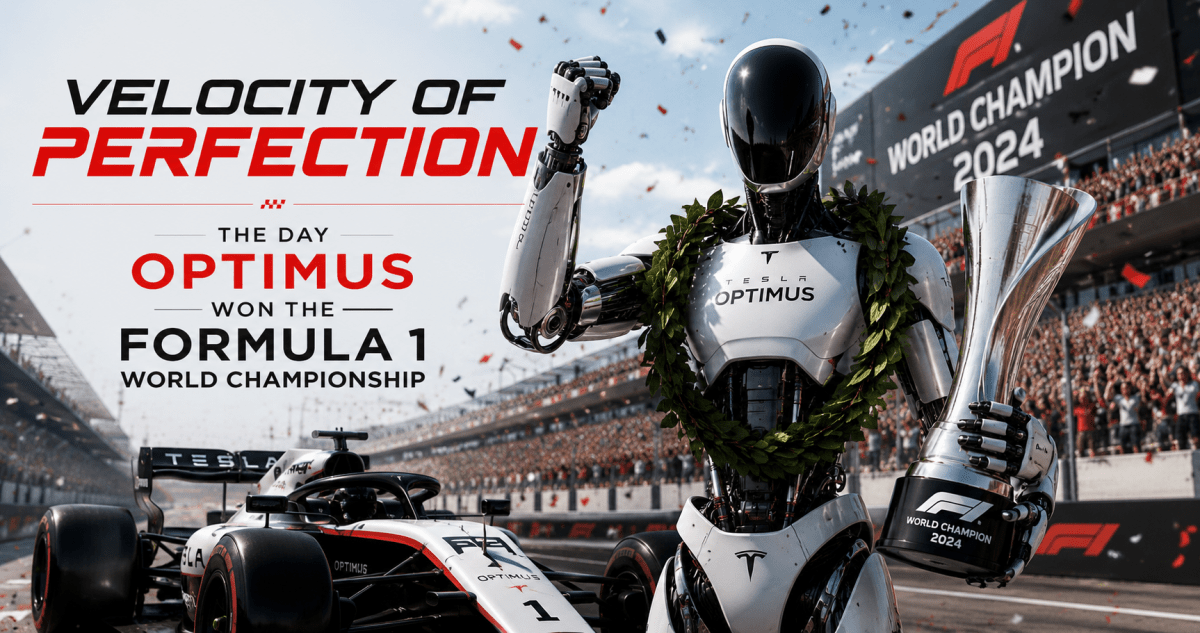
Abu Dhabi, Yas Marina Circuit – Race Night, 2035
Under the floodlights of Yas Marina Circuit, the desert air shimmers with heat. Twenty Formula 1 cars are lined up on the twilight starting grid, engines rumbling in eager impatience. The grandstands are packed; the crowd’s anticipation is electric. Car Number 4 sits on pole position—a sleek, silver-white machine glinting under the lights. It carries no national flag, no human name. In its cockpit is Tesla’s Optimus, the first humanoid robot to qualify for a Formula 1 World Championship.
Strapped into a custom carbon fiber seat, Optimus’s humanoid form is eerily still. Its LED visor glows a steady blue as it scans the track ahead. The robot’s fingers rest lightly on a steering wheel studded with sensors and haptic actuators tuned to respond to the tiniest movement. A faint electronic hum emanates from beneath its black fireproof race suit. Under the glossy carbon fiber shell, high-tensile actuators and tendon-like cables are primed to react faster than any human muscle.
The five red lights above the grid blink on in sequence. In the adjacent front-row car, eight-time world champion Alejandro “Aero” Salazar tightens his grip on the wheel. At 38, he’s a living legend, and tonight he’s fighting not just for another title but to defend the honor of human racers. Behind them, the rest of the drivers stare ahead with clenched jaws and pounding hearts. One of them, 22-year-old Lucas Vialli—brash, hungry, feeling the pressure of the machine—sits third on the grid, vibrating with adrenaline. In contrast, Optimus needs no nerves. It simply monitors its systems as the lights come on one by one. A subtle gust from the Arabian Gulf triggers a pressure change in the robot’s sensors, and its neural network instantly tweaks the launch settings to compensate for a slight headwind. Each red light is like a metronome tick in its clockwork mind—three, four, five lights. Optimus’s advanced vision locks on, while it runs thousands of clutch and throttle simulations to ensure a flawless launch.
The last red light goes out. Engines scream and the race explodes to life. The rear tires of Car 4 bite into the asphalt without a hint of wheelspin. With a violent thrust, Optimus rockets forward and spears into the first corner in clean air. In that instant, decades of human racing supremacy meet a new reality. As Salazar and Vialli jostle behind for second place, Optimus is already blasting out of Turn 1 exactly on the racing line. “Clean start for Optimus!” the commentator’s voice booms above the crowd’s roar. “The robot leads into Turn 1… This is history in the making under the lights at Yas Marina!”
Flashback: The Road to the Grid
A few years ago, even the idea of this moment seemed impossible. Back in 2028, when Tesla announced plans to enter a humanoid robot as an F1 driver, the racing world reacted with disbelief and outrage. The sport’s rules didn’t even have language to address non-human competitors. Behind closed doors, the FIA and the drivers’ association debated fiercely. Many veteran racers—fearing for their jobs and the sport’s soul—derided the concept as a “computer on wheels.” Regulators were equally hesitant. The FIA demanded that Optimus qualify for a Super License just like a human driver—and then some. The robot was put through an exhaustive battery of tests over several seasons. It had to prove it could control a car at the limits of grip, obey all racing rules, and even escape a wrecked cockpit in under five seconds. Tesla’s engineers outfitted the robot with a reinforced titanium skeleton to endure 6G forces, and advanced AI hardware (derived from the company’s self-driving “Dojo” tech) for lightning-fast decision making.
The turning point came with a series of public demonstration runs. In 2032, Optimus raced wheel-to-wheel against professional drivers in an exhibition event. Critics who expected a disastrous wreck instead saw a masterclass in clean racing: the robot executed impeccable overtakes and, crucially, backed off when an opponent forced it into a dangerous position, avoiding contact. One by one, objections fell away. The Grand Prix Drivers’ Association withdrew its protests when the FIA imposed strict conditions on robotic entrants: only one per team, all AI decision logs shared openly after each race, and absolutely no remote control from outside the car. By early 2034, the FIA officially expanded its definition of “driver” and granted Optimus a conditional Super License. By 2035, what had once sounded like science fiction became reality—Tesla’s Optimus on the grid as a fully sanctioned Formula 1 competitor.
Qualifying – A Perfect Lap
On Saturday night, Optimus delivered a qualifying lap that stunned the paddock. In the final minutes of Q3, it unleashed a blistering time that other drivers could scarcely believe. Approaching the marina hairpin, its sensors detected every nuance of the braking zone—precisely when and how hard to slow the car. The robot’s foot smashed the brake pedal with superhuman precision, modulating pressure 200 times a second to keep the tires right at the threshold of lock-up. The deceleration peaked above 5G, yet the robot’s head remained perfectly still as it flung the car through the tight turn, clipping the apex curb by mere centimeters and getting back to full throttle in a heartbeat.
Down the long straight, Optimus’s left thumb tapped the DRS button at the exact moment its rear wing flap could open, slashing drag and adding precious km/h to its top speed. The silver car howled under the neon lights of the arching Yas Hotel, multiple tenths of a second up on Salazar’s best as it entered the final sector. Through the last chicane, Car 4 glided over the curbs with just the right touch. A sudden gust of wind blew a veil of desert sand across the final corner. Instantly, the robot adjusted its line by a few inches and braked a split-second earlier, compensating for the reduced grip before the first grain of sand even settled on the track.
The result was a pole position lap nearly a full second faster than any competitor. Mechanics up and down pit lane erupted in both cheers and stunned silence. It was as if the car had taken the team’s simulated “perfect lap” and simply made it real. Optimus guided the car back to the garage, then climbed out with the same fluid, unhurried motion as always. It gave a polite wave to the cameras. Onlookers saw no exultant fist-pump or exhausted collapse—just the calm blue of that LED visor. Perfection, it seemed, was all in a day’s work.
The Final Showdown
Lap 30 (of 58): Sunday night arrives with a clear sky and the track lights blazing. The race is more than half done, and Optimus has led from the start, steadily building a gap. Salazar has pushed hard to keep up, but an early pit stop dropped him a few seconds back. Vialli, overdriving in frustration, spun out on worn tires before mid-race and is long gone, leaving Salazar as the only remaining challenger to the machine.
Lap 42: A multi-car collision in the midfield triggers a Safety Car. The field compresses, and Salazar’s black-and-gold car closes right up to Car 4’s gearbox. The old champion knows this is his chance. His heart drums in his chest as he wipes sweat from his brow and prepares for the restart. In Car 4, Optimus is as composed as ever, running countless projections for what might come next—its physics engine performing a Monte Carlo–like simulation of every potential scenario before the green flag.
The Safety Car peels off, and Optimus nails the restart with metronomic precision—accelerating in exactly the right gear at exactly the right moment. Still, Salazar’s reflexes are razor-sharp. He anticipated the move and clings to the robot’s slipstream, using every watt of hybrid boost to stay within half a second. All around the circuit, fans stand with their hearts in their throats: it’s the veteran human versus the upstart machine, nose-to-tail, battling for a world title with only a handful of laps to go.
Final Lap: The championship comes down to a single lap around Yas Marina. Optimus leads, but only just—Salazar’s front wing fills its mirrors. Both drivers have their engines turned up to “everything you’ve got”; neither will hold anything back now. The silver and black cars shoot down the back straight for the last time. Salazar knows it’s now or never. He hits DRS and gains rapidly, drawing out of the slipstream. At the 150-meter marker, he jinks hard to the inside and stands on the brakes—a daring, do-or-die lunge. The two cars are suddenly side by side as they scream into the braking zone. A collision seems inevitable. But Optimus calculates the danger in a microsecond and makes the unthinkable decision: it yields a few crucial inches. The robot eases its brake pressure and gives Salazar just enough room to avoid contact as the human barrels ahead into the hairpin.
Salazar has the lead now, but he’s entered the turn carrying too much speed. His tires protest, the back end twitching as he struggles for grip. With unflappable poise, Optimus holds a tighter line and gets superior traction out of the hairpin. In the blink of an eye it darts back alongside Salazar as they charge toward the final corner. Two silhouettes—one flesh and blood, one carbon fiber and code—plunge into the last turn wheel-to-wheel. Salazar fights the G-forces, sweat stinging his eyes as he wrangles the wheel; his helmet’s sensors would show his heart rate red-lining. Yet the robot never tires. It threads the car through with unerring control, its racing line as precise now as on the opening lap.
Off the final corner, they accelerate toward the finish line locked in a drag race. Salazar’s V6 engine wails at maximum revs, but Car 4 surges ahead by half a car length, its deployment of the last drops of battery energy perfectly timed. The checkered flag flutters under the lights—Car 4 flashes across mere meters in front, clinching the win and the World Championship.
Podium & Epilogue
On the podium, an exhausted but gracious Salazar steps up beside the tall, white-suited figure of the victorious Optimus. In third place, a chastened Lucas Vialli applauds politely, having learned just how formidable the machine is. When the national anthem plays for the winning team, the mechanical driver stands motionless, gazing straight ahead. Then, with the formalities complete, Optimus turns and extends a hand to Salazar. The crowd roars as the human legend grasps the robot’s hand and raises it high, both celebrating a race like no other.
Within minutes, social media and news outlets are ablaze with debate. Some hail Optimus’s triumph as a watershed moment—proof that technology has taken motorsport into the future. Others fret that the sport’s very soul has been compromised now that a machine stands atop the podium. But down in the paddock itself, a mood of cautious awe prevails.
In a post-race interview, a reporter asks Salazar what it means to lose a title to a robot. The veteran driver’s face is still flushed from exertion, but he manages a small, reflective smile. “To be honest,” he says, “it pushed me to drive one of the best races of my life. That thing… it may be incredibly fast and precise, but it doesn’t feel joy or fear or pride. That’s what makes us human, and that’s what racing has always been about.” His eyes shine with a mixture of disappointment and respect. “Machines can be perfect,” he adds. “But only we can feel the passion. That will always be our edge.”
As midnight nears, the celebrations wind down and the garages grow quiet. The last team members and journalists drift away, leaving the circuit to the desert silence. In the darkness, an automated transport hauler slowly carries Car 4—still scuffed and streaked from its battles—toward the paddock gates. Walking alongside it are Optimus and Salazar, the robot’s stride steady, the human’s shoulders heavy with fatigue. They share a final nod of mutual admiration before parting ways. On this night, both man and machine found new limits within themselves. Whatever the future holds, the essence of racing—courage, innovation, and the pursuit of speed—continues unabated. And as man and machine chase the next checkered flag together, there’s no telling how far they will go, or how fast.
“”” final_word_count2 = len(final_story_updated2.split()) print(“Word count:”, final_word_count2) Velocity of Perfection: The Day Optimus Won the Formula 1 World Championship
Abu Dhabi, Yas Marina Circuit – Race Night, 2035
Under the floodlights of Yas Marina Circuit, the desert air shimmers with heat. Twenty Formula 1 cars are lined up on the twilight starting grid, engines rumbling in eager impatience. The grandstands are packed; the crowd’s anticipation is electric. Car Number 4 sits on pole position—a sleek, silver-white machine glinting under the lights. It carries no national flag, no human name. In its cockpit is Tesla’s Optimus, the first humanoid robot to qualify for a Formula 1 World Championship.
Strapped into a custom carbon fiber seat, Optimus’s humanoid form is eerily still. Its LED visor glows a steady blue as it scans the track ahead. The robot’s fingers rest lightly on a steering wheel studded with sensors and haptic actuators tuned to respond to the tiniest movement. A faint electronic hum emanates from beneath its black fireproof race suit. Under the glossy carbon fiber shell, high-tensile actuators and tendon-like cables are primed to react faster than any human muscle.
The five red lights above the grid blink on in sequence. In the adjacent front-row car, eight-time world champion Alejandro “Aero” Salazar tightens his grip on the wheel. At 38, he’s a living legend, and tonight he’s fighting not just for another title but to defend the honor of human racers. Behind them, the rest of the drivers stare ahead with clenched jaws and pounding hearts. One of them, 22-year-old Lucas Vialli—brash, hungry, feeling the pressure of the machine—sits third on the grid, vibrating with adrenaline. In contrast, Optimus needs no nerves. It simply monitors its systems as the lights come on one by one. A subtle gust from the Arabian Gulf triggers a pressure change in the robot’s sensors, and its neural network instantly tweaks the launch settings to compensate for a slight headwind. Each red light is like a metronome tick in its clockwork mind—three, four, five lights. Optimus’s advanced vision locks on, while it runs thousands of clutch and throttle simulations to ensure a flawless launch.
The last red light goes out. Engines scream and the race explodes to life. The rear tires of Car 4 bite into the asphalt without a hint of wheelspin. With a violent thrust, Optimus rockets forward and spears into the first corner in clean air. In that instant, decades of human racing supremacy meet a new reality. As Salazar and Vialli jostle behind for second place, Optimus is already blasting out of Turn 1 exactly on the racing line. “Clean start for Optimus!” the commentator’s voice booms above the crowd’s roar. “The robot leads into Turn 1… This is history in the making under the lights at Yas Marina!”
Flashback: The Road to the Grid
A few years ago, even the idea of this moment seemed impossible. Back in 2028, when Tesla announced plans to enter a humanoid robot as an F1 driver, the racing world reacted with disbelief and outrage. The sport’s rules didn’t even have language to address non-human competitors. Behind closed doors, the FIA and the drivers’ association debated fiercely. Many veteran racers—fearing for their jobs and the sport’s soul—derided the concept as a “computer on wheels.” Regulators were equally hesitant. The FIA demanded that Optimus qualify for a Super License just like a human driver—and then some. The robot was put through an exhaustive battery of tests over several seasons. It had to prove it could control a car at the limits of grip, obey all racing rules, and even escape a wrecked cockpit in under five seconds. Tesla’s engineers outfitted the robot with a reinforced titanium skeleton to endure 6G forces, and advanced AI hardware (derived from the company’s self-driving “Dojo” tech) for lightning-fast decision making.
The turning point came with a series of public demonstration runs. In 2032, Optimus raced wheel-to-wheel against professional drivers in an exhibition event. Critics who expected a disastrous wreck instead saw a masterclass in clean racing: the robot executed impeccable overtakes and, crucially, backed off when an opponent forced it into a dangerous position, avoiding contact. One by one, objections fell away. The Grand Prix Drivers’ Association withdrew its protests when the FIA imposed strict conditions on robotic entrants: only one per team, all AI decision logs shared openly after each race, and absolutely no remote control from outside the car. By early 2034, the FIA officially expanded its definition of “driver” and granted Optimus a conditional Super License. By 2035, what had once sounded like science fiction became reality—Tesla’s Optimus on the grid as a fully sanctioned Formula 1 competitor.
Qualifying – A Perfect Lap
On Saturday night, Optimus delivered a qualifying lap that stunned the paddock. In the final minutes of Q3, it unleashed a blistering time that other drivers could scarcely believe. Approaching the marina hairpin, its sensors detected every nuance of the braking zone—precisely when and how hard to slow the car. The robot’s foot smashed the brake pedal with superhuman precision, modulating pressure 200 times a second to keep the tires right at the threshold of lock-up. The deceleration peaked above 5G, yet the robot’s head remained perfectly still as it flung the car through the tight turn, clipping the apex curb by mere centimeters and getting back to full throttle in a heartbeat.
Down the long straight, Optimus’s left thumb tapped the DRS button at the exact moment its rear wing flap could open, slashing drag and adding precious km/h to its top speed. The silver car howled under the neon lights of the arching Yas Hotel, multiple tenths of a second up on Salazar’s best as it entered the final sector. Through the last chicane, Car 4 glided over the curbs with just the right touch. A sudden gust of wind blew a veil of desert sand across the final corner. Instantly, the robot adjusted its line by a few inches and braked a split-second earlier, compensating for the reduced grip before the first grain of sand even settled on the track.
The result was a pole position lap nearly a full second faster than any competitor. Mechanics up and down pit lane erupted in both cheers and stunned silence. It was as if the car had taken the team’s simulated “perfect lap” and simply made it real. Optimus guided the car back to the garage, then climbed out with the same fluid, unhurried motion as always. It gave a polite wave to the cameras. Onlookers saw no exultant fist-pump or exhausted collapse—just the calm blue of that LED visor. Perfection, it seemed, was all in a day’s work.
The Final Showdown
Lap 30 (of 58): Sunday night arrives with a clear sky and the track lights blazing. The race is more than half done, and Optimus has led from the start, steadily building a gap. Salazar has pushed hard to keep up, but an early pit stop dropped him a few seconds back. Vialli, overdriving in frustration, spun out on worn tires before mid-race and is long gone, leaving Salazar as the only remaining challenger to the machine.
Lap 42: A multi-car collision in the midfield triggers a Safety Car. The field compresses, and Salazar’s black-and-gold car closes right up to Car 4’s gearbox. The old champion knows this is his chance. His heart drums in his chest as he wipes sweat from his brow and prepares for the restart. In Car 4, Optimus is as composed as ever, running countless projections for what might come next—its physics engine performing a Monte Carlo–like simulation of every potential scenario before the green flag.
The Safety Car peels off, and Optimus nails the restart with metronomic precision—accelerating in exactly the right gear at exactly the right moment. Still, Salazar’s reflexes are razor-sharp. He anticipated the move and clings to the robot’s slipstream, using every watt of hybrid boost to stay within half a second. All around the circuit, fans stand with their hearts in their throats: it’s the veteran human versus the upstart machine, nose-to-tail, battling for a world title with only a handful of laps to go.
Final Lap: The championship comes down to a single lap around Yas Marina. Optimus leads, but only just—Salazar’s front wing fills its mirrors. Both drivers have their engines turned up to “everything you’ve got”; neither will hold anything back now. The silver and black cars shoot down the back straight for the last time. Salazar knows it’s now or never. He hits DRS and gains rapidly, drawing out of the slipstream. At the 150-meter marker, he jinks hard to the inside and stands on the brakes—a daring, do-or-die lunge. The two cars are suddenly side by side as they scream into the braking zone. A collision seems inevitable. But Optimus calculates the danger in a microsecond and makes the unthinkable decision: it yields a few crucial inches. The robot eases its brake pressure and gives Salazar just enough room to avoid contact as the human barrels ahead into the hairpin.
Salazar has the lead now, but he’s entered the turn carrying too much speed. His tires protest, the back end twitching as he struggles for grip. With unflappable poise, Optimus holds a tighter line and gets superior traction out of the hairpin. In the blink of an eye it darts back alongside Salazar as they charge toward the final corner. Two silhouettes—one flesh and blood, one carbon fiber and code—plunge into the last turn wheel-to-wheel. Salazar fights the G-forces, sweat stinging his eyes as he wrangles the wheel; his helmet’s sensors would show his heart rate red-lining. Yet the robot never tires. It threads the car through with unerring control, its racing line as precise now as on the opening lap.
Off the final corner, they accelerate toward the finish line locked in a drag race. Salazar’s V6 engine wails at maximum revs, but Car 4 surges ahead by half a car length, its deployment of the last drops of battery energy perfectly timed. The checkered flag flutters under the lights—Car 4 flashes across mere meters in front, clinching the win and the World Championship.
Podium & Epilogue
On the podium, an exhausted but gracious Salazar steps up beside the tall, white-suited figure of the victorious Optimus. In third place, a chastened Lucas Vialli applauds politely, having learned just how formidable the machine is. When the national anthem plays for the winning team, the mechanical driver stands motionless, gazing straight ahead. Then, with the formalities complete, Optimus turns and extends a hand to Salazar. The crowd roars as the human legend grasps the robot’s hand and raises it high, both celebrating a race like no other.
Within minutes, social media and news outlets are ablaze with debate. Some hail Optimus’s triumph as a watershed moment—proof that technology has taken motorsport into the future. Others fret that the sport’s very soul has been compromised now that a machine stands atop the podium. But down in the paddock itself, a mood of cautious awe prevails.
In a post-race interview, a reporter asks Salazar what it means to lose a title to a robot. The veteran driver’s face is still flushed from exertion, but he manages a small, reflective smile. “To be honest,” he says, “it pushed me to drive one of the best races of my life. That thing… it may be incredibly fast and precise, but it doesn’t feel joy or fear or pride. That’s what makes us human, and that’s what racing has always been about.” His eyes shine with a mixture of disappointment and respect. “Machines can be perfect,” he adds. “But only we can feel the passion. That will always be our edge.”
As midnight nears, the celebrations wind down and the garages grow quiet. The last team members and journalists drift away, leaving the circuit to the desert silence. In the darkness, an automated transport hauler slowly carries Car 4—still scuffed and streaked from its battles—toward the paddock gates. Walking alongside it are Optimus and Salazar, the robot’s stride steady, the human’s shoulders heavy with fatigue. They share a final nod of mutual admiration before parting ways. On this night, both man and machine found new limits within themselves. Whatever the future holds, the essence of racing—courage, innovation, and the pursuit of speed—continues unabated. And as man and machine chase the next checkered flag together, there’s no telling how far they will go, or how fast.

