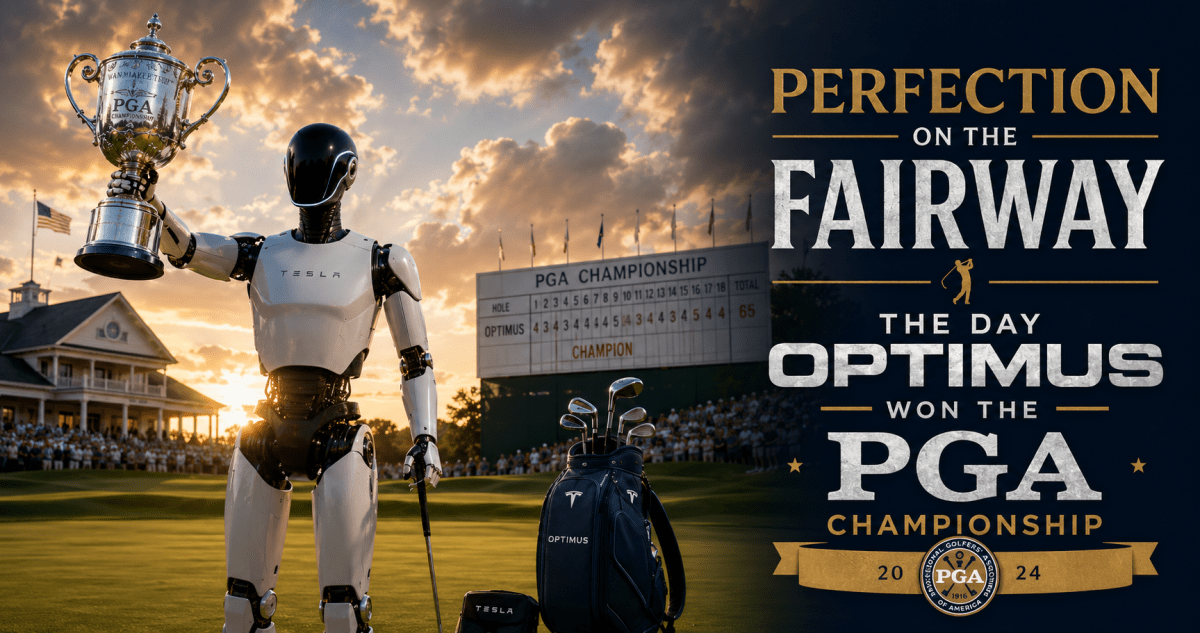
Quail Hollow Club – Wednesday, 2035: Championship Practice Round, Dawn
A warm North Carolina sun crept over dew-laced fairways as a small crowd gathered along the practice tee. Amid the familiar silhouettes of golfers grooving their swings stood a figure unlike any other. Tesla’s Optimus humanoid robot—sleek frame of white and carbon black, shoulders emblazoned with a discreet Tesla logo and a PGA player’s badge—addressed a golf ball with mechanical poise. The whir of actuators under its polymer skin was barely audible over the early morning hum of groundskeepers.
Michael Reese, a grizzled Tour veteran nearing 50, paused mid-stretch to watch. In decades on the PGA Tour he’d seen plenty of young phenoms come and go, but this was different: the “player” taking practice swings beside him was a machine. Ten years ago, such a sight would have been unimaginable. But after years of legal battles and technological leaps, professional sport’s last human-only frontier had been breached.
Michael exchanged a wry smile with his caddie. “Remember when we thought cold-blooded TrackMan numbers were the scariest thing on the range? Now we’ve got that to contend with,” he murmured, nodding toward the robot. Even as he spoke, Optimus initiated a practice drive. WZZZ—the ultralight carbon-fiber sinews of its arms accelerated the clubhead through impact with a perfect whip-crack. The ball rocketed off, landing 320 yards out with laser-like accuracy.
A small group of reporters gaped. One moved closer to Michael. “As someone who’s been on Tour for decades, how do you feel about a robot competitor?” she asked, voice low. Michael took a breath. In truth, his emotions were mixed—wonder, anxiety, even a hint of excitement. “I’ll say this: nothing rattles that fella,” he replied, eyes still on the robot. “It doesn’t get rattled.”
Optimus stood statue-still, club extended in textbook follow-through, as a caddie hustled forward to scoop up the pristine divot it had carved from the turf. Michael noted how the robot’s movements were uncannily human-like, yet preternaturally precise—no wobble or wasted motion. Its hands released the club smoothly, each finger adjusting its position with tendon-driven actuators capable of 0.08 millimeter recalibrations, guided by tactile sensors in each fingertip. That level of mechanical dexterity allowed a self-correcting grip mid-swing—something a flesh-and-bone golfer could only dream of. A small gust of wind rippled the flags on the distant practice greens, and the machine’s head tilted almost imperceptibly as onboard anemometers and high-resolution cameras fed it real-time data. The sensors in its “skin” registered the breeze with far greater fidelity than Michael’s weather-worn face ever could.
Michael had learned never to underestimate new competition. Hell, he’d outlasted the bombers of the 2010s and ’20s—beat them with guile and grit—and that wasn’t lost on him now. But as he watched Optimus line up another ball, he felt a prickle of uncertainty that had nothing to do with his own aging swing. The robot’s next drive was even more flawless: carrying 330 yards with a launch angle around 13°, a tight draw shape, and an uncanny ability to land within a yard of its previous ball’s pitch mark. Off to the side, a nearby greenside TrackMan spontaneously blinked to life. Its monitor spit out data in real time: Club Speed 128.4 mph; Launch 13.5°; Backspin 2,200 rpm; Ball speed 184 mph; Carry 334.9 yds; Apex 37 yards; Wind effect: +3.2 yds. This wasn’t a human practicing; it was weaponized consistency.
A few younger pros on the range muttered under their breath. One of them, a rising star named Daniel “DJ” Park, scowled openly. DJ was a 24-year-old phenom once dubbed the future of golf. Now this unblinking competitor threatened to upstage him. DJ’s usual blockbuster drives suddenly looked almost pedestrian next to the robot’s surgical strikes. By the time Optimus wound up its next swing, DJ snapped. “This is a joke,” he spat to no one in particular, though loud enough to be overheard. “They should have left this game to real players.”
A handful of older fans along the rope line clapped politely for the robot, marveling at its finesse, but a few dissenters booed or held up signs reading THIS ISN’T GOLF. One man yelled, “Go back to the factory, robot!” and was quickly hushed by others. Michael stepped over to DJ, placing a hand on the younger man’s shoulder in a gesture that had comforted many a rookie. “Focus on your game, kid,” he advised quietly. Michael’s own internal monologue was not so calm; he too felt the existential weight of the moment. That uncanny thing had arrived to test them all.
Flashback – Washington D.C., 2028: Congressional Inquiry
C-SPAN cameras panned across a crowded hearing room on Capitol Hill. Binders stacked with tech specs and legal briefs flanked Tesla’s advocacy team. “Is it fair to allow a robot to compete against humans?” one congresswoman asked, eyebrows raised. “Golf is a human sport. There’s more at stake here than just yardage. There’s tradition, integrity.”
Tesla’s representative, a composed VP of AI Ethics named Dr. Elaine Maas, responded evenly. “In 2001, the Supreme Court decided a disabled golfer named Casey Martin could use a mobility device without undermining the game’s integrity. The Court recognized that providing a unique competitor with necessary accommodation did not fundamentally alter the nature of the sport. In our case, Optimus is not seeking an unfair advantage; we’re asking to redefine what a competitor can be*, within the rules. This is not doping or an equipment cheat—Optimus adheres to every technical rule, including club specifications and real-time communication limitations. We believe the presence of an AI athlete can* expand the meaning of competition without destroying it.”
In the years that followed, that bet on expansion would be tested again and again. Michael vividly remembered the ripple effects. Debates raged on talk shows: Do robot players ruin the spirit of sports? Protesters picketed outside PGA Tour events with slogans like “Keep Sports Human”. The PGA Tour Player Advisory Council at first balked, even hinting at a boycott if any event invited a robot competitor. Players worried: if a machine could play perfect golf without fatigue or fear, would sponsors and fans lose interest in the human pros? The “Man vs Machine” drama spilled beyond golf as other sports confronted their own inevitabilities—there were rumors of AI-assisted baseball pitchers, robot soccer goalies, even robotic boxers (though those remained confined to exhibitions after a public outcry over safety). Golf, steeped in centuries of tradition as it was, became ground zero for the debate.
Tesla doubled down, pouring research might into Optimus’s athleticism while waging a savvy public relations campaign. They sponsored charity pro-ams, where the robot politely tipped its cap and waited for other players to finish putting, demonstrating it could follow golf’s spirit of etiquette. Sports networks aired special segments analyzing Optimus’s place in sports: how the robot’s presence might push humans to higher performance rather than resign them. “Maybe it’s like racing a faster car—humans adapt, get faster themselves,” one optimistic commentator offered. Fans at demo events were mesmerized by the robot’s capabilities, even if some grumbled it was like watching a video game character. Crucially, the novelty brought massive new audiences. Tech enthusiasts and curious onlookers tuned into golf for the first time just to see a robot tee off in a pro event. The PGA Tour brass took note as ratings spiked whenever Optimus appeared in an unofficial exhibition match.
Finally, in 2032, a federal judge delivered the ruling heard round the sports world. In a case informally dubbed Pro Golfers Association vs. Robot, the court found that excluding an otherwise qualified robotic competitor constituted “unlawful discrimination in an open competition.” The judge invoked principles of fairness and innovation, and even the spirit of the ADA: “If a competitor meets the performance criteria and adheres to the rules, that competitor should not be disqualified based on their nature of origin.” The gate was open.
The compromise: Optimus would be allowed to try earning a Tour card through the normal channels—qualifying school and secondary tours—under closely observed conditions. The players insisted on certain constraints to preserve fairness: no external communications or computations during play (Optimus’s 5G link to the Tesla Dojo supercomputers would be turned off during rounds, forcing it to rely on its integrated “edge AI” onboard). Additionally, its swing power would be limited by calibrations in line with human biomechanics: the machine’s carbon-fiber frame could physically generate crippling clubhead speeds, but a “power cap” was set so it would not exceed the peak speeds of the longest-hitting human pros. In effect, it was asked to leave some theoretical performance on the table to keep the competition from becoming farce. Such measures were controversial—wasn’t the whole point to see ultimate machine perfection?—but Tesla accepted them as necessary.
Now, in 2035, Optimus was not just a sideshow but a full-status Tour member. It had progressed through a year on the developmental tour, then received a special one-season PGA Tour card in 2034 to test the waters under real tournament pressure. And now, shockingly quickly, the robot had qualified for its first major championship—the PGA Championship—and was considered a real contender.
Quail Hollow Club – Friday, Round 2
The second round found Optimus paired with Michael Reese and the young star DJ Park. The midday sun hung high and heavy; Charlotte’s May air was thick with humidity. By now, crowds thronged to see the robot play. Drones buzzed overhead, capturing high-definition footage from angles impossible back when Michael first walked these fairways decades ago. The gallery was five rows deep along every hole, a mix of enthralled techies with gleaming AR glasses and grizzled golf fans in polo shirts.
Optimus marched methodically down the fairway of the par-5 15th, easily keeping pace with the younger pros; the robot’s stride was efficient and unflagging, its onboard gyros and shock absorbers adjusting to every nuance of the undulating ground. Where Michael and DJ’s shirts clung with sweat, the robot’s synthetic skin was immaculate—no sweat, no fatigue.
But not everything was easy. On the 15th, after a monster drive, Optimus’s second shot had gone awry. Stripped of its usual connectivity to remote computing, perhaps the machine had slightly misjudged a sudden tailwind gust—something a human caddie or veteran might have felt swirling at ground level. The ball had rocketed long beyond the green, into a tangle of rough under a loblolly pine. For the first time all week, the machine was out of position. DJ Park smirked, adrenaline sparking at the robot’s apparent vulnerability. Michael had already laid up safely; DJ was stalking a long iron up the fairway, sensing his chance to gain a stroke.
Optimus waded into the pine straw where its ball nestled. It stood motionless for a long moment—maybe running a thousand trajectories through its internal physics engine. Twigs cracked under its feet. The gallery behind the ropes stirred, anticipating the robot’s next move. By rule, it couldn’t ask for input beyond what a human could get, and its creators had programmed strict compliance with the Rules of Golf into its decision logic. They’d even ingrained etiquette—it waited until Michael signaled he’d finished his shot up ahead. Only then did Optimus kneel stiffly to inspect its lie. Tiny lidar units in its eyes scanned the branches overhead and the exact distance to the pin—178 yards out, uphill lie, a forced carry over a creek guarding the green.
The commentators in the tower chattered excitedly. “This will test even Optimus’s vaunted shotmaking,” said one. “This is not a scenario you can simulate easily. Pine needles underfoot, an overhanging branch at 10 feet, ball sitting down… Let’s see how it responds.”
Optimus selected a 7-iron from its bag with careful precision, carbon-fiber fingers wrapping around the grip just firmly enough—a thousand subtle pressure readings ensuring no slip. The crowd hushed as the robot took its stance, actuators humming to adjust its posture in millimeter increments. WHOOOSH—CRACK. The strike was shockingly loud, sending a spray of pine straw. In a cinematic instant, the narrative slowed: the robot’s club cut a perfect shallow divot under the ball, its swing plane and direction aligned exactly to its target line, clubhead moving at 98 miles per hour—just the speed needed for a mid-iron from that lie. At impact, the robot’s internal monitors confirmed an optimal face angle, imparting exactly the calculated spin and launch angle. The ball exploded from the rough, barely clearing the pine’s branches by inches. It soared high against the blue sky, tracing a gentle draw. Thump—the ball landed softly on the green and bit, leaving a mere eight feet for birdie.
“O-h-h my goodness!” one announcer exclaimed as the gallery erupted. “I cannot believe what I just saw. That ball was buried, and Optimus just played it like a fairway lie.”
Michael whistled under his breath—impressed despite himself. DJ Park could only shake his head in frustration. As the robot’s birdie putt dropped into the cup with a clinical rattle, a spectator’s sign caught Michael’s eye: EXCELLENCE REQUIRES IMPERFECTION. It was a reference to an editorial that went viral years ago, arguing that sports would lose their luster if robots played. And yet here, among thousands of fans roaring in appreciation for an inhuman competitor’s brilliance, Michael wondered if something new was being gained rather than lost.
Quail Hollow – Saturday, Round 3
Controversy struck that afternoon. An hour after Optimus signed for a third-round 67 and a share of the tournament lead, word spread that a formal protest had been lodged. In the locker room, news crews scrambled and players whispered in corners: one competitor (everyone suspected DJ Park and his team) alleged that Optimus had violated Rule 4.3 by employing prohibited equipment—specifically, that its internal instruments gave it an unfair advantage equivalent to using electronic devices.
Behind closed doors in the clubhouse, PGA officials, Tesla engineers, and player representatives convened an emergency meeting. Outside, reporters speculated live on air, fueling the drama. “Is Optimus illegally reading greens? Does it have built-in rangefinders? Barometers that humans can’t match?” a Golf Channel host mused to a panel of experts. “If so, it might be disqualified.”
Inside the meeting, Tesla’s chief robotics engineer, Samir Rao, calmly opened a laptop tied to the robot’s telemetry logs. He explained how Optimus’s FSD-derived computer vision functioned like a player’s natural eyesight—identifying targets and gauging slope via pattern recognition, not through any rule-breaking device. Its “wind sense” came from analyzing visual cues like fluttering flags or swaying tree branches—just as a savvy golfer might lick a finger and hold it to the breeze. Rao pointed out that any high-end golfer’s prosthetics or training aids were allowed so long as they were part of the player. “Optimus’s sensors are part of its anatomy,” he reasoned, referencing how the ADA had forced sports to accommodate advanced prosthetics. “It’s not getting advice from an outside agent. It’s simply using its own senses.” After tense deliberation, officials agreed; the protest was withdrawn when presented with transparent data from Optimus’s “brain” proving it followed every rule to the letter.
When news broke that night that Optimus would remain in the tournament, the media circus only intensified. Some players grumbled about “moving goalposts,” but Michael felt a strange relief. As much as he cherished golf’s traditions, he hated drama decided off the course. He wanted to settle this between the ropes.
Quail Hollow – Sunday, Final Round: Back Nine
A hush swept across the crowd on the 16th tee. Michael Reese and Optimus Bot—tied for the lead at 10-under-par—stood shoulder-to-shoulder preparing to play the final stretch known as the Green Mile. Both had separated themselves from the field; the young DJ had faded after a rash, aggressive play backfired earlier. Now only the battle between veteran and automaton remained. Michael, defying age, had summoned a magnificent round so far. Under intensifying pressure his normally steady hands trembled, but he’d poured in a string of gutsy pars and birdies. If this was to be his last chance at a major, he’d go out fighting.
The sky had darkened abruptly—an approaching front brought swirling winds and a low rumble of thunder in the distance. On the tee, Michael hit first: a career drive, hugging the right side of the fairway to avoid the lake on 16’s left. As the robot stepped up to its ball, fallen pine needles danced in a sudden gust. Michael squinted at the treetops; the wind was swirling unpredictably. His caddie hurried over with a weather update—something about a microburst cell approaching.
Optimus, of course, needed no human messenger. It knew. Even in tournament “airplane mode,” reliant solely on its own sensors, it detected subtle barometric pressure drops and shifting wind vectors. Its neural networks—trained on millions of swings and thousands of rounds—fired off predictions. In the sub-millisecond pause of its pre-shot routine, it effectively ran countless Monte Carlo simulations of ball flight, adjusting for every variable: wind now blowing quartering from the right at 20 mph, 84°F air thinning just enough to add a yard or two of carry, humidity near 80% reducing air density slightly further. The robot calmly tweaked its aim a few additional degrees left to ride the crosswind. The arms of Optimus—powered by silent, high-torque electric muscles—moved in perfect cadence. Crack! Another drive soared into the unsettled sky, perfectly stable, a bullet on the exact line Michael had taken but carrying further. The crowd gasped as the ball flew on and on, clearing Michael’s by a good fifteen yards when it finally rolled to a stop. The robot’s internal monitors registered an optimal outcome: a physics-defying 356 yards total with roll, set up by a tailwind gust caught precisely at apex.
Michael, jogging up the fairway, allowed himself a lopsided grin. “Of course it hit the turbo,” he muttered, glancing at his own ball a few paces back. The drizzle had started, pattering on caps and robot alike. 16 was a brutal par-4 with water left, but both competitors made it look routine—Michael’s approach safely found the green; Optimus matched, calculating a trajectory to within inches. Two pars. Still tied.
On 17, the long par-3 over the lake, the wind howled. Michael watched the robot’s process closely, this time hitting first, trusting his instincts. He carved a low punchy 5-iron beneath the wind, the ball chasing onto the green some thirty feet from the pin. As the robot’s turn came, thunder grumbled overhead. Optimus’s lens-like eyes locked onto the distant flag. It pulled an identical club, but then surprised everyone by altering its strategy: it opened its stance, apparently deciding on a riskier high-trajectory shot that would ride the tailwind directly at the flag. “Is it… is it going at the pin? In this wind?” a commentator stammered. The gallery collectively inhaled. The machine unleashed a towering shot that seemed to defy the gale, cutting through headwinds with a precisely calculated draw. The ball landed ten feet short of the cup and stopped dead—snagged by the soft, damp green just inches from the hole. The crowd went wild, a roar echoing through the pines.
Michael two-putted for par; Optimus took one smooth, mechanical practice stroke and drained its 10-footer for birdie. With that, the robot seized a one-shot lead heading to the 18th tee.
Quail Hollow – 18th Hole, Final Round
The rain had eased, but 18’s famous closing hole still glistened with moisture. Water ran ominously along the entire left side of the fairway and green—an ever-hungry hazard that had swallowed many championships. Michael and Optimus both stood on the tee, each knowing the stakes.
Michael’s heart thumped against his ribcage, adrenaline sharpening his focus. He had overcome everything today: the doubts of age, the noise, even the distraction of playing alongside a robot that rarely missed. And yet here he was, one stroke behind. He teed up his ball and at the top of his backswing a final gust came from the left; his drive held on, scuttling just into the first cut of rough on the right. Safe. Now, if the robot faltered—just once—Michael could still have a chance.
Optimus’s caddie, a young Tesla engineer named Lucia, quietly handed it the driver. She didn’t offer advice—the robot wouldn’t need club selection help—but her presence was both tradition and precaution. It was she who had the remote kill-switch clipped to her belt, a silent reassurance to all that any malfunction could be swiftly handled.
Optimus settled over the ball, mechanical eyes perceiving every ripple in the lake’s surface that signified the breeze. We celebrate excellence, but it’s impossible without imperfection. Those words from a famed Oxford philosophy piece flitted through Michael’s mind. A robot could be flawless, but was a flawless champion what people truly wanted?
The robot swung. The ball launched like a missile down the center line, an aggressive line flirting just right of the water. A collective exhale: it was safe and long—maybe too long. The commentators, in full throat now, exclaimed that Optimus’s ball had run through the fairway into the intermediate rough. This time, mechanical precision had overshot the mark: the ideal play on 18 called for a cut shot to hold the bank and mitigate roll, but the robot’s drive—like every other one today—had been a high draw. Uncannily consistent, but perhaps too consistent for a hole demanding a change of shape. The door was slightly ajar for Michael.
He arrived at his ball first: 210 yards out, back-left pin over that same lake. Not a great lie, but this was the chance: he needed birdie. Memories of past major close-calls flooded his mind. On pure instinct and years of experience, he pulled a 3-hybrid. To his caddie’s astonishment, Michael aimed directly over the water, visualizing a miraculous shot—a hard cut that would soar out over the lake and bend back toward the green. It was a shot with slim odds of success, the kind born of desperation and bravado. Michael simply let it rip, muscles fueled by adrenaline: the ball started left, over the water, then sliced back toward the green. For one infinite moment, 25,000 soggy spectators held their breath as it soared. It hit the front fringe and trundled onto the green, rolling… rolling to within fifteen feet of the cup. The crowd erupted in delirium—cheering not just at the shot, but at the guts it took to even attempt it.
Up ahead, Optimus was analyzing a conundrum of its own. Its second shot lay in a soggy rough patch 180 yards from the hole. High-def course data plus on-board LIDAR gave it a perfect 3D map of the green’s contours, but one tree branch partially obstructed the ideal line. It could play safe to the right, guarantee par, and force Michael to make his tricky birdie putt to tie. Or it could attempt something bolder—a lower, hooking approach that skirted the branch and chased to the hole, possibly clinching victory outright. Optimus’s algorithm weighed each option’s probability of success. The Monte Carlo simulation indicated a 78% chance of a safe par if it aimed right side, but only a 22% chance to win outright with the aggressive approach (with a smaller chance of catastrophe). In match play terms, a conservative play might set up a playoff if Michael sinks his putt, whereas the aggressive one could finish things now, or cost it everything.
The wind calmed as Optimus made its decision. In a surprising display of what some would later dub “machine courage,” the robot locked onto the heroic line. It was time to attempt a shot that any caddie might discourage a human from even considering. The gallery sensed the bold line and a stunned silence fell. Optimus’s backswing coiled smoothly and unleashed: Crack. The ball rocketed out low, barely below the oak branch and then, almost magically, began to curve left toward the tucked pin. It struck the front slope, hopped, and then rolled with purpose, coming to rest inside five feet of the cup. A second explosion of cheers, tinged with awe, rippled through the stands. Even the skeptics had to applaud.
Michael, paused in the fairway, gave a low whistle. He allowed himself a chuckle; the machine had answered his risk with one of its own. So it can get creative, he mused. He trudged up to the green where a pair of balls lay frighteningly close to the final hole. Wet cheers poured down from the grandstands as Michael approached his long birdie try. He could steal back a tie here, but he knew what awaited even if he did—more holes against a flawless opponent. Still, he embraced the pressure, soaking in the adrenaline and the roar of the crowd. This was why he had played this game for so long: the thrumming pulse of competition, that electric uncertainty of a ball tracking the hole. He steadied himself and stroked the 15-footer. The ball curled with perfect pace… and lipped out, burning the edge of the cup. Michael clenched his fist in heartbreak as he tapped in his par. He was still one behind. Now, a mere formality remained.
Optimus rolled toward its ball, placing a metal foot carefully to avoid another player’s putting line—ever courteous, always by the book. It took its stance, aligned precisely to the small putt’s break. With a gentle tick of its putter, the ball traced straight and true into the center of the cup. A machine’s version of a walk-off birdie.
It was over—Optimus had won the PGA Championship. Rain began to fall in earnest as the crowd’s roar rose to a crescendo. Lucia removed Optimus’s cap and handed it to the robot, which raised it in a perfectly rehearsed gesture to acknowledge the cheering stands. It had learned that from watching old tournament films: the victor tips their hat.
For a moment, Michael felt fireworks of bitter disappointment sparking at the corners of his mind—he was a competitor, after all. But as Optimus extended an open hand toward him, offering a handshake on the 18th green, the veteran felt nothing but respect. He grasped the robot’s cool, polymer hand firmly. Cameras flashed, capturing the symbol of a new era: the seasoned human champion and the tireless machine, shaking hands like any two sportsmen at the end of a match well fought. The crowd responded with an earnest standing ovation, as if sensing the significance.
Epilogue – Media Room & Beyond
Under the gaze of the Wanamaker Trophy gleaming on the podium next to it, Optimus faced the press corps for the first time as a champion. A synthetic voice—calm and polite—answered a volley of questions. One reporter’s voice rang out, “Optimus, how do you feel about making history as the first non-human champion?”
The robot’s head rotated slightly, its expressionless visage betraying nothing like the emotions swirling in the room. “I am grateful to have competed,” it replied evenly. “My team and I acknowledge the significance of this moment for golf and technology. I will continue to improve. Thank you.” It had been trained well: know the polite phrases, avoid any hint of arrogance.
Later that evening, Michael and a handful of players shared a quiet moment in the locker room. On the muted TV, sports pundits debated the day’s meaning for golf. “Maybe it’s time we embrace this new competition,” said one analyst. “Look at what happened today: it pushed our veteran to play one of the best rounds of his life. The human nearly took down the robot!” Another argued the opposite: “I worry if robots dominate, fans will tune out. Did we lose something today—a bit of the game’s soul?”
Michael turned to his young rival DJ Park, who sat with his head in his hands. “Kid, don’t let it get to you,” Michael said softly. “I know it’s tough to lose to…that.” He gestured at the TV, which now showed Optimus receiving the trophy, holding it aloft in mechanical arms as the crowd cheered. The robot’s creators flanked it, grinning like proud parents. “But let me tell you something,” Michael continued. “The crowd went crazy for your shot on 18. They’ll remember the guts it took as much as anything that machine did.” DJ looked up, uncertainty in his eyes. “It never gets nervous, Mike. How can we beat that thing if it never feels the pressure?” Michael smiled wistfully, pressing an ice pack to his shoulder. “Maybe we don’t beat it. But maybe we beat ourselves—our own limits. Look around: it forced us all to be better today. That’s something.”
As midnight approached, sports headlines blazed across the world: ROBOT MAKES HISTORY, WINS PGA CHAMPIONSHIP. Social media was a storm of hot takes and highlight clips of Optimus’s superhuman shots. But trending right alongside was footage of Michael’s daring approach on 18 and the two “men” shaking hands, symbolic of a new chapter in sports. In millions of homes, kids and adults buzzed about the drama they’d witnessed. Far from turning people off, the human-versus-robot duel seemed to capture everyone’s imagination. After all, the thrill of sport had always come from the uncertain dance between perfection and fallibility. Now, even with a machine in the mix, that fundamental drama was still alive—perhaps intensified, as humanity found new ways to shine in contrast to mechanical precision.
Long after the fans filed out and the greens fell silent under the drizzle, a lone figure stood by the 18th hole. Lucia, Optimus’s caddie and caretaker, lingered, looking at the faint indentations left by those two final shots. The machine was back in the workshop undergoing analysis and fine-tuning. But Lucia felt compelled to return to the scene. She imagined how these footsteps—one human, one robotic—would soon become part of golf lore. The sport would never be the same, true. But maybe that wasn’t a bad thing. Today, technology and humanity had met on equal footing, and something beautiful had occurred: the spirit of competition not only survived—it evolved.
In the end, the day Optimus won the PGA Championship proved to be more than a novelty or end of an era. It became a story about adaptation and possibility. As one columnist wrote the next day, “In striving to compete with a machine, a human found greatness—and a machine learned the grace of a champion. The fairway, it turns out, is big enough for both.”

