1. Campaign Origins and Idea Development
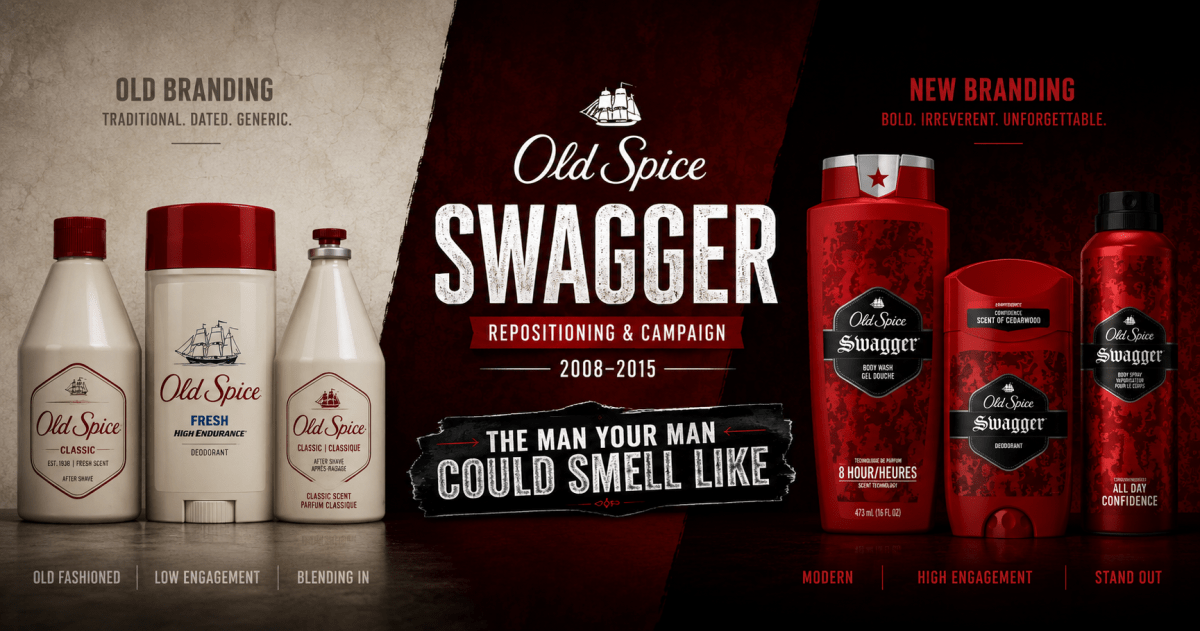
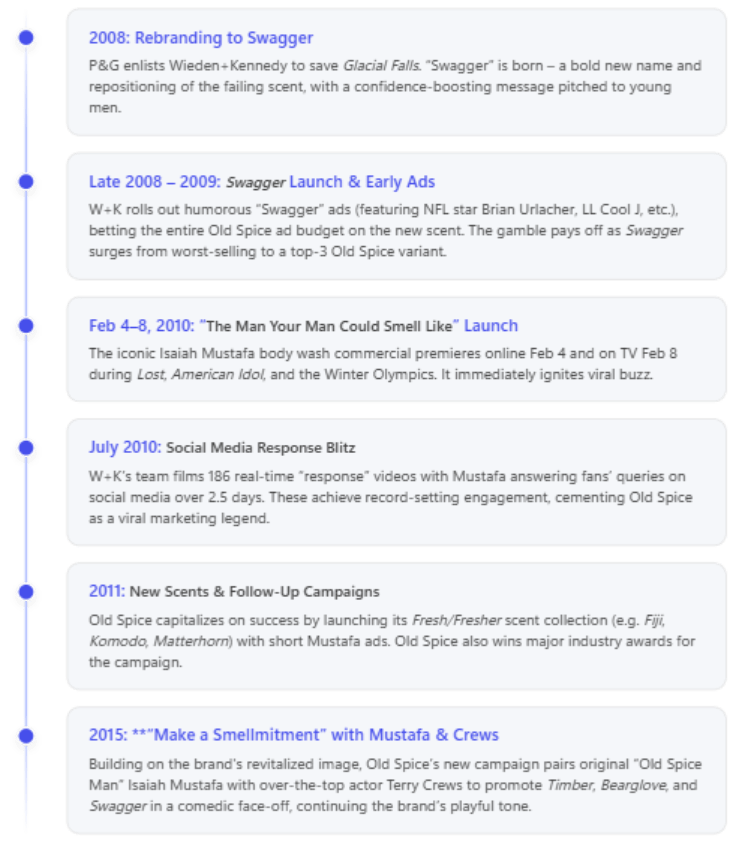
Rebranding Glacial Falls to Swagger (2008): By 2008, Old Spice’s Glacial Falls scent was the worst performer in Procter & Gamble’s (P&G) Old Spice portfolio and at risk of being discontinued. P&G’s brand team, led by James Moorhead (Brand Manager) and others, tasked Wieden+Kennedy (W+K) with saving the failing scent by doubling its sales. W+K’s Portland office, which had taken over the Old Spice account in 2006, devised a bold plan: reposition and rename Glacial Falls as “Swagger,” focusing on the emotional benefits (confidence or “swag”) rather than functional scent claims. This repositioning aimed to shed Old Spice’s dated “old man” image and appeal to a younger male demographic (teen to college age) by promising that using Swagger would give them confidence and “swagger” with the ladies. Early creative work from W+K included humorous “before-and-after” style ads featuring NFL star Brian Urlacher (Chicago Bears) and rapper LL Cool J, illustrating how even an awkward teenager could gain coolness by wearing Swagger deodorant.
Idea Genesis & Creative Team: The concept for the Swagger rebrand was a collaboration between P&G’s branding strategists and W+K’s creative team. W+K Portland’s creative directors Mark Fitzloff and Susan Hoffman oversaw the strategy, while copywriter Eric Kallman and art director Craig Allen (then a creative team at W+K) crafted Swagger’s irreverent tone and messaging. Jason Bagley and Eric Baldwin served as creative directors on subsequent executions. P&G provided critical consumer insight – notably that young men considered Old Spice an outdated “dad’s cologne” brand – and gave the agency latitude to take a riskier, comedic approach to rejuvenate its image. The “Swagger” identity and campaign were conceived at W+K, underpinned by P&G’s market research and internal championing by brand leaders like Moorhead.
Timeline of Key Milestones: The Swagger deodorant rebrand launched in late 2008, with the first Swagger TV and print ads appearing soon after (e.g. a Brian Urlacher “Before & After Swagger” commercial and print campaign in 2008). This initial phase was followed by a second, higher-profile wave in early 2010 – the “Smell Like a Man, Man” body wash campaign starring Isaiah Mustafa, which debuted online February 4, 2010 and aired on TV by February 8, 2010. In July 2010, W+K executed an unprecedented social media “Response” blitz with 186 personalized YouTube video replies from Mustafa to fans, which went viral. The brand continued to build on this momentum by introducing new scent collections: the “Fresh” (or Fresher) Collection in 2011, featuring exotic nature-inspired scents like Fiji and Komodo (each with its own 15-second Mustafa spots), and the “Wild” collection in subsequent years (e.g. Bearglove). By August 2015, W+K reunited Mustafa with actor Terry Crews in a humorous “Make a Smellmitment” campaign promoting multiple fragrances (Timber, Bearglove, Swagger) and contrasting their styles. This multi-year effort transformed Old Spice from a declining legacy brand into a pop-culture phenomenon.
2. Pre-Campaign Business Context (Pre-2010)
Market Position & Brand Challenges: In the late 2000s, Old Spice was a legacy P&G brand at a crossroads. The franchise was historically best known for aftershaves and colognes dating back to 1937, but by 2008 its core consumer base skewed older, and younger men saw Old Spice as an unfashionable “your father’s cologne” brand. While Old Spice was still the U.S. market leader in men’s deodorants with roughly 25% share in 2008, it was losing relevance in newer product categories like men’s body wash. Competitive pressures were intense: Unilever’s Axe (Lynx) brand – a relative newcomer – was surging among young men through risqué “Axe Effect” ads that promised irresistible sex appeal. By 2009, Axe held about a 7% share of the U.S. men’s body wash market, with Old Spice a close #2 at ~6%, highlighting the category’s fragmentation and Old Spice’s eroding lead. P&G executives were concerned that Old Spice’s growth had stalled; in fact, Old Spice’s market share in the men’s body wash segment had begun to decline by 2009, and P&G reportedly included Old Spice on a “sell or revitalize” shortlist for older brands in need of a turnaround.
Business Performance Pre-2008: Despite challenges with younger consumers, Old Spice remained a modestly sized but profitable brand for P&G’s beauty/grooming division. Fast Company reported that Old Spice’s total U.S. sales were around $225 million in 2008 (excluding some channels), which could rise to ~$270 million when adding Walmart sales. Nevertheless, P&G’s strategic aim was to dramatically accelerate growth and reinvigorate the brand. With bar soap sales declining and body wash sales booming industry-wide in the 2000s, Old Spice needed to defend and grow its share in the booming men’s body wash category or risk falling behind new entrants like Dove Men+Care, which Unilever planned to debut with a major Super Bowl 2010 launch. In short, by 2008–2009 Old Spice faced an aging brand image, intensifying competition (Axe, Dove Men+Care), and sluggish sales, setting the stage for a bold repositioning and creative reinvention.
3. Campaign Execution, Strategy & Tactics
Creative Strategy – Targeting Women to Reach Men: To reinvent Old Spice, the brand’s strategists and W+K creatives pivoted their approach. P&G’s consumer research yielded a crucial insight: women purchase 50–60% of men’s body washes and influence many men’s grooming choices. The Swagger deodorant rebrand (2008–09) had already tapped into young men’s desire for confidence and “cool”. Next, W+K built on that foundation for body wash: “The Man Your Man Could Smell Like” campaign (2010) was designed to spark a conversation between women and men about using Old Spice instead of “lady-scented” washes. In the now-famous 30-second ad, actor Isaiah Mustafa – a former NFL player with a suave persona – addresses “Hello, ladies” directly to women viewers, humorously contrasting their man with the idealized “Old Spice Man” (Mustafa) who smells like Old Spice. This creative tactic effectively targeted female shoppers (to buy the product for their men), while entertaining male viewers with over-the-top, hyper-masculine humor. The creative concept was developed by W+K’s team (Craig Allen & Eric Kallman) and directed by Tom Kuntz, emphasizing rapid-fire, tongue-in-cheek monologue with surprising visual transitions, all captured in a single continuous take. Mustafa’s charismatic, deadpan performance and the absurd scenarios (ending famously with “I’m on a horse”) struck a chord with both genders.
Media & Viral Tactics: The campaign’s media execution was as innovative as its creative. Rather than buy a prohibitively expensive Super Bowl ad slot, Old Spice chose to launch the ad online during Super Bowl weekend 2010 to capture “Super Bowl–level” buzz without the price tag. The commercial was seeded on YouTube and Facebook on Feb 4, 2010 – days before Super Bowl XLIV – accompanied by search ads on Super Bowl keywords to attract viewers who were searching for game-day commercials. This strategy paid off: by the time the spot first aired on television (during shows like American Idol, Lost, and the Winter Olympics on Feb 8) many viewers had already seen or heard of it online, amplifying its impact.
Old Spice’s media buy also deliberately targeted TV programming watched by couples (e.g. American Idol, Olympic Games broadcasts, movie theaters on Valentine’s Day weekend) in line with the campaign’s dual-gender strategy. Intensive PR efforts followed: Mustafa, now an overnight celebrity, appeared on high-profile talk shows (Oprah, Today, Ellen, etc.) to maximize earned media coverage.
A few months after launch, W+K executed the groundbreaking “Response” social media stunt. Over two days in July 2010, a nimble W+K team wrote and produced 186 personalized video responses featuring Mustafa in character, replying to individual fans, bloggers, and even celebrities by name (including tweets from Oprah, Alyssa Milano, and others). These were rapidly uploaded to YouTube and shared via Twitter & Facebook, creating a real-time interactive experience for the audience. This agile digital engagement, unprecedented in scale at the time, turned a one-way ad campaign into a two-way conversation and further amplified the brand’s visibility and goodwill.
Production & Budget: The “Man Your Man Could Smell Like” spot was produced by MJZ (Morton/Jankel/Zander) and directed by Tom Kuntz, known for his comedic, technically complex ads. Remarkably, the hero commercial was achieved mostly in-camera with minimal CGI, requiring three days of meticulous shooting and dozens of takes to get the continuous shot right. While the campaign’s exact budget has not been publicly disclosed, P&G significantly ramped up marketing spending in 2010, investing heavily behind Old Spice and other launches (the company’s overall ad spend hit a record $8.6 billion in FY2009–10). The decision not to purchase a Super Bowl ad saved millions, allowing Old Spice to redeploy budget to digital and PR efforts that yielded massive “buzz per dollar.” Moreover, in-store promotions like “Buy One, Get One Free” coupons for Old Spice body wash were integrated into the campaign to spur product trial (P&G has noted these contributed to sales, though exact figures remain confidential).
4. Post-Campaign Revenue & Market Impact
Immediate Sales Lift: The Old Spice campaign’s business results were explosive, far surpassing internal expectations. P&G had set a modest goal of +15% increase in body wash sales as a result of the campaign. Early results blew past that target almost immediately: Nielsen data showed Old Spice Red Zone body wash sales up +60% year-over-year by May 2010 (three months post-launch), and still accelerating. By July 2010 – roughly six months after the campaign’s launch – sales of Old Spice body wash had more than doubled (a +125% year-over-year increase), marking an all-time high in brand sales. In one peak four-week period following the social media response blitz, Old Spice body wash sales were reported to be +107% versus the prior year. This growth was especially impressive given that no product formula changes were made – Swagger was the exact same fragrance as Glacial Falls – only the name and marketing were changed. In essence, Old Spice dramatically grew sales and market share through brand positioning and advertising alone, demonstrating a powerful ROI for the marketing investment.
Market Share & Revenue Gains: The meteoric sales spike translated into major market share gains. Within months, Old Spice vaulted into the #1 spot in U.S. men’s body wash, overtaking Unilever’s Axe and other rivals. By mid-2010 Old Spice commanded the majority of online buzz (~75% share of voice) among top men’s body wash brands, indicating its dominance in consumer attention. In tracked retail channels, Old Spice body wash sales for the full 52-week period ending June 2010 were up ~16.7% (versus ~7% growth for the category), showing sustained improvement even factoring in the pre-campaign months. Some sources noted a slightly higher +27% sales increase over the first six months of 2010 (year-on-year) when isolating the campaign period – the slight variance illustrates how different measurements (full-year vs. campaign-period basis) yielded different growth figures. Despite these discrepancies, all sources agree that Old Spice’s growth vastly outpaced the category and achieved several times the initial sales goal. The brand was well on its way toward P&G’s vision of becoming a “billion-dollar brand” in annual sales. This surge in volume and market share, combined with the relatively low product development costs, meant the campaign delivered a handsome financial return on investment (ROI) for P&G. Exact profit figures are not public, but P&G cited Old Spice’s success as a bright spot in 2010 earnings calls, noting “improved market share for Old Spice body washes behind its popular marketing campaign.”
5. Broader Metrics of Success & Long-Term Effects
Beyond sales, the Old Spice Swagger/“Man Your Man Could Smell Like” initiative became a landmark in advertising by every measure – reach, engagement, and industry recognition. Consider the record-setting earned media metrics achieved:*
- Unprecedented Viral Reach: In the first 30 days, the main Old Spice ad and its follow-ups amassed tens of millions of views. By Day 1, the YouTube video had ~5.9 million views, surpassing the 24-hour view count of President Obama’s 2008 victory speech. By Day 2, Old Spice astonishingly held 8 of the top 11 most-popular videos on the entire internet (per Visible Measures). Within 3 days post-launch, total views exceeded 20 million, and after 1 week the campaign had garnered over 40 million views. As of mid-2010, The Man Your Man Could Smell Like became the #1 All-Time Most Viewed branded channel on YouTube, an unprecedented feat for a consumer packaged goods (CPG) brand.
- Social Media & Impressions: The campaign’s innovative engagement strategy led to phenomenal social media growth. In just one month, Old Spice’s Twitter followers jumped 2700%, Facebook fan interactions soared 800%, and traffic to OldSpice.com spiked 300%. The campaign triggered a tsunami of free publicity: in its first 6 months it generated 1.4–1.7 billion media impressions across TV, print, and online channels. (Some later estimates put the figure above 2 billion impressions, reflecting ongoing buzz and global reach.) Old Spice also dominated online conversations: in the three months post-launch it captured roughly 76% of all online buzz in the men’s body wash category, with over half of these conversations driven by women sharing or discussing the ads.
- Brand Perception Shift: The campaign had a profound impact on Old Spice’s image. Consumer surveys documented a rejuvenation of the brand’s personality – adjectives like “funny, modern, cool, and masculine” replaced the previous “old, outdated” perceptions. The charismatic “Old Spice Guy” persona became cultural shorthand for confident, playful masculinity, appealing to both men and women. The positive halo also lifted sales of other Old Spice products that weren’t directly advertised (a halo effect), as new customers explored the brand’s full lineup. Even P&G’s internal teams began heralding Old Spice Swagger’s turnaround as a model case study in brand rejuvenation via advertising.
- Critical Acclaim & Awards: The advertising industry heaped accolades on Old Spice and W+K. The Swagger rebranding effort earned a 2010 Silver Effie Award for marketing effectiveness. “The Man Your Man Could Smell Like” campaign itself won the 2010 Cannes Lions Film Grand Prix (the top prize at the world’s preeminent advertising festival), as well as the 2010 Emmy Award for Outstanding Commercial. It went on to win the 2011 Gold Effie Award (Beauty category) for excellence in driving measurable business results. In later years, Advertising Age ranked it among the top campaigns of the 21st century. The campaign’s cultural impact was evident in countless parodies (even a Sesame Street spoof by Grover) and references across media.
Sustained Impact and Evolution (2011–2015): Old Spice worked to sustain its newfound “cool factor” through continuous innovation in marketing and product development. In 2011, W+K produced follow-up TV spots starring Mustafa in similar surreal scenarios (“Questions,” “Scent Vacation”) and introduced new “Fresh” scents like Fiji and Komodo with their own short, humorous ads. By 2012, W+K enlisted actor Terry Crews for a “Smell Is Power” campaign on Old Spice body sprays (with the outrageous, high-energy style that complemented Mustafa’s suave approach). Finally, in 2015 the brand brought together Mustafa and Crews for the joint “Make a Smellmitment” campaign pushing Timber, Bearglove, and Swagger scents, highlighting two contrasting embodiments of masculinity (the smooth gentleman vs. the over-the-top macho man) in one ad series. These later campaigns did not quite match the viral frenzy of the 2010 breakthrough, but they helped cement Old Spice’s sustained leadership in men’s grooming and kept the brand’s image fresh into the mid-2010s.
Notably, critics and analysts have pointed out that some of Old Spice’s spectacular early sales gains were aided by promotions. The Effie case study mentions a nationwide BOGO coupon that accompanied the 2010 body wash launch – suggesting that part of the short-term volume surge was driven by trial incentives. However, even after promotional effects subsided, Old Spice retained its market share leadership, indicating genuine brand loyalty and long-term growth (testament to the campaign’s real impact, not mere short-term discounting).
6. Synthesis, Lessons Learned & Comparative Analysis
The Old Spice Swagger/“Man Your Man Could Smell Like” campaign is widely regarded as a textbook example of successful brand repositioning and viral marketing in CPG. Several key factors drove its remarkable success and hold valuable lessons for modern marketers:
- Bold Repositioning of a Legacy Brand: Old Spice demonstrated that even an “old” brand can become cool again through clever repositioning. Instead of abandoning its heritage, the campaign reframed what Old Spice stood for. By retaining a focus on “manliness” but updating it with humor and modern wit, the brand managed to overcome the stigma of being “my grandfather’s cologne”. The core insight – sell aspirational benefits (confidence, sex appeal) rather than product features – revitalized Old Spice without altering the product itself, proving that smart marketing can trump product changes. This success became an inspiration within P&G and beyond, showing other teams that advertising creativity and positioning can deliver huge sales lifts even for mature brands.
- Deep Consumer Insight & Targeting: The campaign’s strategy was built on understanding the category’s purchase dynamics. By recognizing that women were key purchasers, Old Spice did something bold: targeted women in a men’s product campaign, a first for the brand. This approach – speaking to women (“Hello, ladies”) while still amusing men – expanded Old Spice’s audience without alienating its male users, a delicate balance achieved through a playful tone. The lesson: shifting the focus to the actual purchase decision-maker can unlock growth for CPG brands (especially in categories where buyers and end-users differ).
- Risk-Taking and Creative Agency Partnership: Old Spice’s transformation highlights the importance of agency-client collaboration and willingness to take risks. P&G’s brand team trusted W+K’s offbeat creative approach and allocated their entire media budget to a single scent – a move considered risky internally. In fact, the iconic Mustafa ad nearly didn’t air at all until W+K co-founder Dan Wieden personally intervened when the client got cold feet during pre-launch. The payoff was enormous: the campaign’s runaway success validated this risk-taking and cemented trust between P&G and W+K. The lesson for marketers is that bold ideas, backed by consumer insight and championed by strong client leadership, can yield extraordinary results – but they require courage and partnership to see through.
- Integrated Media & Viral Mastery: Old Spice’s approach to media was revolutionary in 2010. The campaign seamlessly integrated traditional TV advertising with digital and social media, maximizing reach and engagement. Launching online around the Super Bowl (instead of paying for an in-game spot) and following up with tailored social media content allowed Old Spice to “out-Super Bowl” the Super Bowl, winning the buzz war against a much larger Dove Men+Care media buy. Moreover, the rapid-response video strategy in the Response campaign was a masterclass in real-time engagement marketing that set a template for future campaigns across industries. The key takeaway is that earned media and interactive content can dramatically amplify a brand message – but only if the creative is compelling enough to spark conversation and the brand is agile in execution.
- Lasting Brand and Industry Impact: The Old Spice campaign’s legacy is enduring. It lifted Old Spice to sustained market leadership in men’s body wash for years, and the brand has continued using humor-driven campaigns to launch new products (e.g., Wild and Fresher collections) and partnerships. Competitors like Unilever’s Axe – which once led the category – were forced to respond and evolve their own strategies. While Axe had pioneered provocative humor targeting young men in the 2000s, Old Spice’s approach was more inclusive and whimsical, appealing to both sexes and a broader age range. The result was a broader consumer base and a less polarizing brand image. Similarly, Dove Men+Care’s earnest, “real men” positioning launched in 2010 was overshadowed by Old Spice’s louder pop-culture splash, illustrating how an irreverent viral strategy can even outshine big-budget traditional launches.
In hindsight, “The Man Your Man Could Smell Like” has become an iconic benchmark for marketers. It demonstrated the power of aligning an insightful strategy (targeting the true purchase influencers) with breakthrough creative craft, and leveraging new digital platforms for viral engagement. The campaign’s ROI and awards speak for themselves, but its broader lesson is that a bold, insight-driven idea – executed across the right channels – can transform a brand’s trajectory.
Executive Summary & Key Takeaways: Old Spice’s Swagger/The Man Your Man Could Smell Like campaign (2008–2010) is a landmark case of turning around an aging brand through strategic repositioning and creative, viral advertising. Faced with a declining “old-fashioned” image and rising competition from Axe and Dove Men+Care, P&G partnered with Wieden+Kennedy to reinvent its worst-performing scent as “Swagger,” anchoring it in a promise of confidence and modern masculinity. This effort culminated in the 2010 “Hello, Ladies” body wash commercial starring Isaiah Mustafa, a spot that targeted women (the primary buyers of men’s grooming products) with humor and sex appeal. The campaign’s innovative media strategy – launching online around the Super Bowl to generate outsized buzz without a Super Bowl ad buy – and its interactive social media Response stunt propelled Old Spice into a viral sensation. Within months, Old Spice body wash sales doubled (+125% YoY by July 2010)**, making Old Spice the #1 men’s body wash brand and far exceeding the initial sales goal of +15%. The campaign garnered ~1.7 billion impressions in 6 months, won top industry honors (Cannes Grand Prix, Effie Gold, Emmy), and permanently revitalized Old Spice’s brand image and sales. Key lessons from this success include the value of sharp consumer insight*,* humorous creative that resonates across demographics*, and* agile multi-platform execution in driving both short-term sales and long-term brand equity.
Feb. 4, 2010
Avoid the multimillion-dollar in-game placement → redeploy toward digital, PR and engagement.

