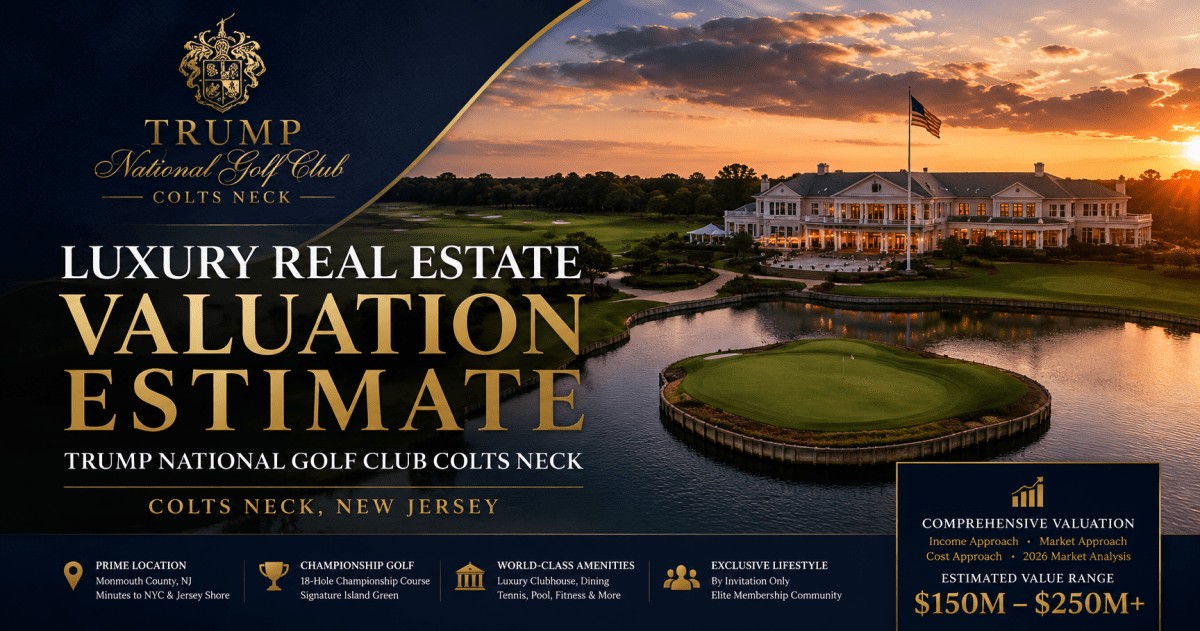
Executive synthesis and valuation range
Trump National Golf Club, Colts Neck is not best understood as only a golf course, and not even only as a private country club. It is more accurately a coastal-country luxury platform: a membership-driven hospitality business wrapped in manicured land, theatrically designed golf, a major-event capable clubhouse, and the social signaling power of the Trump brand in an affluent Monmouth County setting. The official club and Trump Organization sites market it as a private luxury club near New Jersey beaches and equestrian farms, while public descriptions place the estate at roughly 300 to 400 acres depending on how ancillary land is counted. [1]
Following the same broad triangulation logic used in the referenced Hacienda de San Antonio valuation analysis—income approach, thin-peer/market comparison, and cost or replacement logic, then a reconciliation through the lens of the likely buyer—I estimate a current 2026 fee-simple going-concern value range of approximately $72 million to $96 million, with a central tendency around $84 million. That range is not a single-point appraisal. It is a reasoned probability band built from public revenue disclosures, internal valuation data surfaced through New York litigation records, current private-club industry benchmarks, and the unusual scarcity value of a fully built luxury private club within commuting reach of New York and close to the Jersey Shore. [2]
The valuation is materially supported by three public anchors. First, Donald Trump’s June 2025 annual federal financial disclosure listed Trump National Golf Club, Colts Neck LLC as a golf-club asset in Colts Neck with a value of over $50 million and $16,072,118 in golf-related revenue. Second, a related disclosure database based on Trump’s candidate filings placed the club’s golf-related revenue at $16,391,735, showing a similar mid-$16 million top line. Third, New York attorney general exhibits tied to Trump’s 2021 net-worth support schedules showed Colts Neck with $47.5 million of fixed assets, a 15% branded-facility premium, and $2.69 million of EBITDA including capital leases, with a resulting indicated value of about $70.2 million in that internal worksheet. These are not independent MAI appraisals, but they are unusually useful public breadcrumbs for a normally opaque private-club asset. [3]
In plain English, this is the thesis: the club appears to be generating well above the average revenue of a typical Northeast private club, yet it remains a private-membership product whose economic value is only partly visible in annual EBITDA. Much of the real worth sits in the land control, the intangible draw of the finished lifestyle package, the event platform, the reciprocity network, and the costliness of recreating the asset from scratch in one of New Jersey’s wealthier enclaves. [4]
History and development
The history begins with reinvention. The site originally housed Colts Neck Airport, a small general-aviation airfield that ceased operations in 2002. It was then redeveloped into Shadow Isle Golf Club, which opened in April 2005 with a championship course designed by Jerry Pate, the 1976 U.S. Open champion. [5]
The club’s first chapter was glamorous but financially unstable. By 2008, Shadow Isle was financially distressed and headed through foreclosure. Top 100 Golf Courses reported that Trump moved to buy the property for $28 million, while contemporaneous reporting on the foreclosure showed the developers’ bank debt had risen to $41.6 million by March of that year. That gap between the construction-era capital stack and the distressed sale price is critical: it explains why Trump did not merely acquire a golf course, but effectively bought a half-formed luxury dream at a distressed basis. [6]
After the acquisition, the Trump Organization rebranded the property under the Trump National flag and brought in Tom Fazio II to lengthen and refine the course. The current club materials still emphasize the original Jerry Pate strategy and shot values, but they pair that with Fazio-directed lengthening, refinements, and the dramatic “19th hole” island green that now functions as both golf punctuation and event-stage iconography. [7]
The development story did not stop at golf. The official club pages describe a newly constructed 60,000-square-foot driving-range tee, a fully redesigned five-hole short course, new indoor golf simulators, newly enhanced racquet facilities, and a newly renovated ballroom. The club does not publicly date each capital phase, so the precise sequencing is incomplete, but the overall pattern is unmistakable: Trump’s strategy was to convert a distressed golf property into a luxury multi-amenity private hospitality product. [8]
That repositioning also shows up in competitive hosting. By 2017, the New Jersey PGA noted that the club had matured enough to host its first Section major, the Lincoln Charity Clambake, and highlighted that the course had already hosted earlier senior championships. In luxury-asset terms, tournament hosting is not just sport—it is proof of conditioning, operational credibility, and prestige circulation. [9]
Location and lifestyle advantage
If Mr. Luxury were narrating the drive in, the script would linger on the contradiction that makes Colts Neck so valuable: this is a place that feels pastoral, private, and horse-country calm, yet it remains connected to the gravitational pull of New York. Colts Neck Township lies about 28 air miles south of the southern tip of Manhattan; NJ Transit access from nearby Matawan can put riders in New York City in roughly 55 to 60 minutes and Newark in 35 to 40 minutes; and the township is tied together by Route 34, County Route 537, Highway 18, and proximity to the Garden State Parkway. [10]
That matters because privately clubbed luxury in 2026 is often about frictionless access to retreat. Trump’s own property page frames Colts Neck as being “near the beautiful beaches of New Jersey” and “amidst stately homes and equestrian farms,” and the club’s wedding materials describe it as a countryside destination near “the sparkling beaches of New Jersey.” The township’s recreation and open-space plans reinforce that image by describing Colts Neck as home to numerous private equestrian facilities and by explicitly prioritizing farmland and open-space preservation to maintain the town’s rural character. [11]
The demographics further explain why the location works for a premium private club. U.S. Census QuickFacts show a 2024 median household income of $199,573, per-capita income of $111,049, median owner-occupied home value of $917,200, and an owner-occupancy rate of 94.3% in Colts Neck. The township’s 2025 population estimate was just 9,989 residents across 30.72 square miles, which means the place is affluent and low-density rather than urban and volume-driven. [12]
In other words, the surrounding market is exactly what a high-end family club wants: substantial household wealth, large-lot living, a strong ownership base, and the cultural compatibility of equestrian estates, country roads, and shore access. Even the broader local imagination of Colts Neck leans trophy-asset. A 2024 feature on New Jersey’s priciest home for sale centered on a $27.9 million equestrian estate in Colts Neck, underscoring how the town is already legible to luxury buyers as a landscape of serious money and land-intensive living. [13]
There is also a more practical competitive point. Colts Neck’s own master-plan materials identify Trump National and Due Process as the township’s two private golf clubs, alongside one semi-private and one public course. That helps explain the club’s positioning: it is not competing in an overcrowded strip of interchangeable suburban clubs, but in a relatively thin local premium set where branding, amenities, and social theater can matter as much as the routing itself. [14]
Architecture and resort amenities
This is the cinematic heart of the asset. The official virtual course tour describes the championship layout as a par-72, 7,579-yard course with lakes, multiple tee sets, and the one-of-a-kind island-green “19th hole” situated behind the clubhouse. Golf Digest’s course profile lists the course at 7,552 yards, a small variance that likely reflects scorecard or tee-setup differences, but both sources agree on the central idea: this is a long, visual, water-laced private layout designed to look expensive on camera and feel exacting in person. [15]
Jerry Pate’s original design language was links-inspired, with strategic angles and compelling shot options, while Trump’s materials say Tom Fazio II’s later work transformed the course “from magnificent to spectacular.” That phrasing is marketing, of course, but the substance is real. The sixth, eighth, ninth, twelfth, and the island-green “19th” all place water conspicuously in the player’s field of vision, and the hole-by-hole descriptions repeatedly emphasize precision, wind exposure, and green contour. This is not a forested, hidden-hole course. It is a performance course, built to be seen. [16]
The club’s practice infrastructure is unusually strong for a family-oriented private club. Official materials cite a newly constructed 60,000-square-foot driving-range tee and an 18,000-square-foot USGA-approved putting green, along with the redesigned five-hole short course and indoor simulator access in the Learning Loft. The membership page makes clear that even non-full-golf categories can touch golf-adjacent product—short course, practice facilities, simulator, and limited 18-hole privileges—showing that the club monetizes golf not only as championship play, but also as a time-flexible, family-accessible amenity stack. [17]
Then there is the clubhouse, which the membership page describes as 75,000 square feet. The amenity list is plainly aimed at the country-club imagination of status: grand foyer, living room, member lounge, formal dining room, family dining room, ladies’ lounge, two-story locker rooms, pre-function cocktail area, executive conference room, ballroom with sweeping views of the island green, and a bridal suite. In YouTube terms, this is the reveal shot after the drone crosses the pond: the white clubhouse rising over a reflective water feature like a private coastal manor. [18]
Away from golf, the club behaves like a compact resort. The aquatics complex includes a 25-meter heated lap pool, children’s wading pool, hot tub, poolside service, lessons, and outdoor party capability. The racquet center includes four Har‑Tru clay tennis courts and four regulation pickleball courts, plus a pro shop and programming for adults and juniors. The fitness complex is available year-round and is marketed as TPI Golf Certified, linking wellness directly to golf-performance culture. [19]
For food, social life, and event revenue, the club is clearly more than a golfer’s locker-room-and-grill operation. The dining program features both formal and family dining, a year-round member social calendar, live entertainment, holiday events, tournaments, and member-guest gatherings. In other words, the operating thesis is not “18 holes and goodbye.” It is all-day dwell time. [20]
Weddings and events bring the luxury narrative to full theatrical bloom. The official event page emphasizes that the club hosts one event at a time, offers indoor and outdoor venues, and can stage ceremonies on the island green itself. The renovated ballroom features crystal chandeliers, floor-to-ceiling windows, and a private balcony overlooking the grounds; the promenade terrace looks toward Trump Pond and the 19th hole; and the formal dining room is positioned for more intimate fireside affairs. This is not background banquet business. It is a ceremonially choreographed luxury product. [21]
Ownership, management, and hospitality strategy
As of the June 2025 annual federal disclosure, Trump National Golf Club, Colts Neck LLC remained a Trump asset in Colts Neck, New Jersey, listed as a golf club with a value of over $50 million, and with ownership shown as 99% DJT Holdings LLC and 1% Trump National Golf Club, Colts Neck Member Corp. Public reporting around New Jersey liquor-license scrutiny also stated that Trump’s eldest sons have managed the Trump Organization since he returned to office, and the Trump Organization’s own leadership page presents Eric Trump and Donald Trump Jr. as “The Next Generation.” Eric Trump’s official biography says he leads strategic growth across hospitality and golf and plays a central role in acquisitions, branding, design, and hospitality operations. [22]
The most important business point is that Colts Neck is sold not as a stand-alone club, but as part of a portfolio ecosystem. The Colt Neck membership page promises reciprocal access to 18 Trump Golf properties, while The Trump Organization’s corporate site says Trump Golf spans 21 world-class championship properties globally. Reciprocity is one of the strongest competitive tools available to a branded private-club network because it transforms a local membership purchase into a travel and status platform. [23]
The membership architecture is also sophisticated. The club publicly markets Full Golf, Super Social, Social, Corporate, Young Professional & Junior, and Non-Resident memberships. That tells you exactly how management thinks: not in one-dimensional initiation-fee terms, but in segmented household capture. Full Golf monetizes the committed player; Super Social monetizes the family that wants lifestyle first and golf second; Corporate captures business entertainment; Young Professional and Junior create pipeline demand; Non-Resident extends the network logic beyond the immediate local catchment. [24]
Viewed through a Hotel Leaders Podcast lens, this is classic luxury-hospitality product design. The club bundles golf, short-course play, instruction, racquets, pool, fitness, simulators, dining, social programming, and events into a single gated experience. That bundling matters because Club Benchmarking’s 2025 research shows the “financial engine of a club is fueled by members,” that initiation fees act as a proxy for market position and member experience, and that clubs with stronger experiential propositions can support stronger demand even while subsidizing food and beverage. In short, country clubs win by making members feel the club is indispensable to their identity—not by treating every department like a stand-alone profit center. [25]
The events strategy is also telling. The official weddings page says the club hosts only one wedding at a time and offers sponsored programs that allow non-members to use the venue. Public marketplace data from The Knot says couples usually spend around $45,000, with ceremony pricing starting at $1,500, though actual totals vary with seasonality and guest count. It is reasonable to infer that even a modest luxury wedding count can produce a meaningful annual ancillary revenue stream, before adding golf outings, charity galas, banquet business, and member social functions. [26]
Operationally, that creates a deliberate tension. Club Benchmarking’s 2025 F&B white paper found that clubs are relying less on banquet revenue than in 2010 and that a higher banquet mix does not automatically correlate with stronger financial health at the median. That matters for Colts Neck because one-event-at-a-time luxury service is excellent for premium positioning, but management still has to protect member experience from being crowded out by outside events. The club’s current structure appears to acknowledge that risk by emphasizing exclusivity, controlled volume, and member-first atmosphere rather than banquet churn. [27]
Market position and valuation analysis
Public disclosures show that Colts Neck is a larger-than-average revenue producer in the private-club world. Trump’s June 2025 annual disclosure listed $16.07 million in golf-related revenue, while the candidate-report database showed $16.39 million. By comparison, Club Benchmarking’s 2024 private-club economic impact study put average revenue per Northeast private club at about $7.31 million. Even allowing for disclosure-method differences, Colts Neck appears to be producing more than twice the regional average club revenue, which is exactly what you would expect from a family-club platform that monetizes golf, dining, outings, events, and social amenities rather than relying on golf dues alone. [28]
The macro environment is supportive. Club Benchmarking reported that private clubs generated $32.6 billion in direct revenue in 2023, while its 2025 F&B white paper said 45% of clubs had membership wait lists. National Golf Foundation reporting further indicated that total golf participation reached a record 48.1 million in 2025, and that private-club rounds were running ahead of public-facility growth through much of 2025. That does not guarantee pricing power forever, but it does create a favorable backdrop for premium clubs that already have established infrastructure and affluent catchments. [29]
Following the spirit of the Hacienda framework, the cleanest way to value Colts Neck is not to pretend there is one perfect formula. It is to reconcile multiple imperfect lenses.
Historical financial context. The 2021 New York attorney general exhibit is the single richest public data point. It showed Colts Neck with $47.53 million in fixed assets, a 15% branded-facility premium of $7.13 million, and $2.69 million of EBITDA including capital leases, alongside a note stating that, based on Marcus & Millichap guidance, a “normal golf course with a consistently positive EBITDA” had recently traded at 9x to 10x EBITDA, with the Trump courses argued to deserve 10x. Again, this was client-supplied support data, not an independent appraisal, but it is extraordinarily useful for benchmarking how the owner’s side framed the asset economically. [30]
Income approach. A pure one-year EBITDA capitalization almost certainly undervalues the club because private clubs deliberately push value through dues, initiation fees, and member-funded capital rather than maximizing distributable cash flow. Even so, it creates an important floor. Using the public revenue band around $16.1 million to $16.4 million and the 2021 disclosed EBITDA of $2.69 million implies a rough mid-teens EBITDA margin as a cross-period check. If one assumes 2026 stabilized economic EBITDA in the $2.8 million to $3.5 million range and applies a high-quality private-club multiple near 9x to 10x, the income floor lands roughly in the high-$20 millions to mid-$30 millions. That is clearly too low for the fee-simple going-concern because it excludes much of the real-estate and membership-platform utility. A more realistic hybrid income case, which includes recurring initiation/capital income and event optionality as economic earnings, points more plausibly to about $55 million to $75 million. This is an inference, not a claim of actual current profitability. [31]
Market or comparable-sales approach. True disclosed sales of trophy private clubs in the New Jersey–New York corridor are scarce, so the best public comparables are imperfect. The most useful disclosed benchmarks are other Trump golf assets appearing in the same public records. In those records, Colts Neck’s own internal 2021 indicated value was about $70.2 million; Trump National Washington, D.C. appeared around $53.1 million; and Trump National Philadelphia around $43.7 million. When paired with the OGE revenues for those clubs, the implied value-to-revenue relationship brackets a wide but informative range. Applying that general range to Colts Neck’s current mid-$16 million revenue output supports a market view in roughly the $60 million to upper-$80 millions, with higher values justified by Colts Neck’s multi-amenity family-club positioning, shore-adjacent affluence, and event platform. [32]
Cost approach. The replacement burden here is enormous. The current official product includes a 75,000-square-foot clubhouse, championship course, redesigned short course, major practice complex, aquatics, tennis and pickleball, fitness, simulator space, ballroom/event venues, and extensive water and landscape infrastructure. Club Benchmarking notes that property, plant, and equipment represent 75% of the assets on an average club balance sheet, and the 2021 Trump worksheet already carried Colts Neck’s fixed assets at $47.5 million before adding a brand premium. Separately, the Financial Times reported that 86.81 acres at Colts Neck were receiving farmland treatment and that, at full value, those acres would have attracted about $171,000 of tax versus only $398, implying that even a subset of the land has meaningful baseline value. Public descriptions of the full club place it between about 300 and 400 acres. Taken together, the cost lens suggests the asset would be painfully expensive to replicate from raw land upward, which is why I view the cost approach as a strong support for a value above the simple EBITDA floor. A reasonable cost-style range is about $62 million to $82 million, again presented as an analytical estimate rather than a formal appraisal. [33]
Reconciliation. In the Hacienda spirit, the right buyer lens matters. The marginal buyer for Colts Neck is not likely to be a spreadsheet-only hotel investor asking whether member dining credits maximize margin. It is more likely to be a strategic luxury operator, a branded-club consolidator, or a prestige-oriented owner who understands that the club’s value sits in a hybrid of land, experience, scarcity, and cash flow. On that basis, I weight the income floor least, the market and cost approaches most, and I arrive at the earlier $72 million to $96 million range, centered around $84 million. That central case sits above the coarse “over $50 million” OGE band, above the 2008 $28 million distressed purchase, and modestly above the approximately $70.2 million 2021 internal value—an outcome that feels directionally sensible for an established 2026 trophy club in a still-favorable private-club market. [34]
Sensitivity. If private-club demand remains strong, revenue stays in the mid-to-high teens, and membership capital remains healthy, the upper end can push into the mid-$90 millions. If brand-related controversies, regulatory pressure, or a cyclical softening in private-club demand compress event volumes, initiation momentum, or valuation multiples, a lower band in the low-$70 millions becomes more appropriate. The most important sensitivity variables are not just rounds played or banquet count; they are member demand, capital-income velocity, and reputational liquidity. [35]
Future prospects, challenges, and limitations
The forward opportunity is clear. Golf participation remains historically strong, private-club usage has held up well, and clubs with broad family programming have structural advantages in retention and dues resilience. Colts Neck already has the right ingredients for that future: a full-family amenity base, brand reciprocity, high local incomes, strong event architecture, and enough land to preserve the feeling of exclusivity. The club’s official marketing does not advertise guestrooms or hotel accommodations, which means its next chapter is more likely to be deeper monetization of the existing private-club platform than a transition into a conventional resort hotel. That limits RevPAR-style upside, but it also protects the private-club mystique. [36]
There are, however, real operational and reputational challenges. Environmental scrutiny has followed the property before. ProPublica reported that the Colts Neck dispute with New Jersey regulators over water use was settled in 2016, but that the course had again exceeded monthly water limits in 2016 and remained under scrutiny afterward. In 2025, the Financial Times also reported that 86.81 acres were still being treated as farmland for hay and woodland management, producing substantial tax savings and inviting public criticism over whether the arrangement fits the spirit of New Jersey’s farmland-preservation law. [37]
Alcohol licensing is another live issue. The club paid a $400,000 penalty in a 2021 settlement after a patron who had been overserved caused a fatal crash, and reporting in 2025 said Colts Neck and Bedminster received temporary liquor-license extensions while New Jersey officials continued reviewing ownership and eligibility issues stemming from Donald Trump’s felony conviction. The latest reporting I found did not resolve the matter beyond those extensions and the continuing review, so this remains a live limitation on certainty rather than a resolved historical footnote. [38]
The biggest limitation in the research is the normal one for private clubs: true audited operating statements, membership counts, initiation pricing, and capital dues are not public. A second limitation is that public sources vary on acreage and sometimes on course yardage, which is common for golf properties but still worth noting. A third is that some of the richest valuation clues available—especially the 2021 internal worksheets—are client-supplied documents disclosed in litigation, not neutral appraisals. For that reason, every valuation number in this report should be treated as an analytical estimate, not as a substitute for an appraisal engagement with full financial access. [39]
Conclusion
Trump National Golf Club, Colts Neck succeeds because it sells a fantasy that is unusually coherent. The road in runs through preserved rural character and horse-country wealth. The arrival sequence opens onto reflective water, sculpted greens, and a clubhouse that looks like inherited privilege polished for the drone age. The golf is visual and exacting. The ballroom is staged for grand entrances. The social program is built for families who want their leisure to feel curated, not casual. And the business model—multi-tier membership, reciprocal network value, one-event-at-a-time luxury, year-round amenities—shows that this is not merely a course with a pond. It is a private hospitality engine wearing the costume of a country estate. [40]
From an investment and valuation standpoint, the club is strongest when seen as a hybrid trophy asset. The pure cash-flow lens understates it. The pure dirt-and-buildings lens misses the social capital. The right answer lies in the intersection. On the evidence available, a 2026 value in the low-$70 millions to mid-$90 millions, centered around about $84 million, is the most defensible conclusion. That estimate is broad because the data are incomplete, but the direction is clear: the Trump Organization turned a distressed 2008 acquisition into a materially larger, revenue-producing, experience-rich private club with significant location and replacement barriers. [41]
From Distressed Acquisition to Trophy Asset
Selected public value anchors and the report’s 2026 analytical estimate.
| 2008 | $28.0M | |
| Distressed Shadow Isle acquisition | ||
| 2021 | $70.2M | |
| Internal worksheet indicated value | ||
| 2025 | >$50M | |
| Federal financial disclosure reporting band | ||
| 2026 | $84.0M | |
| Central analytical estimate | ||
Revenue Scale vs. Northeast Private-Club Benchmark
Public disclosure compared with the reported average revenue per Northeast private club.
| Trump National Colts Neck | $16.07M | |
| Northeast Private Club Average | $7.31M |
The Physical Luxury Platform
|
🏛️
75,000
SQ. FT.
Clubhouse
|
⛳
7,579
YARDS
Championship layout
|
🏌️
60,000
SQ. FT.
Driving-range tee
|
●
18,000
SQ. FT.
Putting green
|
|
18
Championship holes
|
5
Short-course holes
|
4
Har-Tru tennis courts
|
4
Pickleball courts
|
25m
Heated lap pool
|
A Private Club Built as a Luxury Ecosystem
The club’s value proposition extends far beyond eighteen holes.
|
⛳
CHAMPIONSHIP GOLF
18-hole course · Island green · Short course · Practice complex
|
🏛️
CLUBHOUSE
Dining · Member lounges · Locker facilities · Ballroom
|
🥂
EVENTS
Weddings · Corporate events · Golf outings · Social programming
|
|
🏊
AQUATICS
Heated lap pool · Wading pool · Hot tub · Poolside service
|
🎾
RACQUETS
Har-Tru tennis · Pickleball · Lessons · Junior programming
|
🏋️
FITNESS + SIMULATION
Fitness facilities · Golf training · Indoor simulators
|
Luxury-Club Revenue Architecture
|
01 · MEMBERSHIP
Recurring Core
Dues, initiation capital and multiple membership categories.
|
02 · GOLF
Premium Activity
Championship play, instruction, outings, simulators and practice facilities.
|
03 · HOSPITALITY
Member Spend
Formal and casual dining, poolside service and social programming.
|
04 · EVENTS
Ancillary Upside
Weddings, private functions, corporate events and golf outings.
|
Three-Lens Valuation Framework
The estimate is reconciled rather than derived from a single mechanical formula.
| Income Approach | $55M–$75M |
| Market Approach | $60M–$89M |
| Cost Approach | $62M–$82M |
Illustrative Valuation Sensitivity Matrix
Scenario framework showing how shifts in membership economics and market valuation conditions could affect the asset thesis.
| Member / Revenue Environment | Compressed Multiples | Base Multiples | Premium Multiples |
|---|---|---|---|
| Soft Demand | $64M | $72M | $80M |
| Base Case | $74M | $84M | $94M |
| Strong Demand | $82M | $96M | $108M |
Illustrative scenarios only. Values outside the report’s core $72M–$96M range demonstrate directional sensitivity rather than additional formal valuation conclusions.
What Supports the Premium?
| Affluent Catchment | HIGH | |
| Replacement Cost | HIGH | |
| Amenity Breadth | HIGH | |
| Private-Club Demand | STRONG | |
| Brand / Network Reach | STRONG | |
| Event Monetization | GOOD |
Qualitative analytical scorecard; bar lengths illustrate relative strategic importance rather than measured statistical scores.
A hybrid trophy asset combining land, hospitality, membership economics and scarcity.
|
LAND
SCARCITY VALUE
|
CLUB
RECURRING ECONOMICS
|
BRAND
NETWORK + PRESTIGE
|
EXPERIENCE
LUXURY HOSPITALITY
|

[1] [11] https://www.trump.com/golf/trump-national-golf-club-colts-neck-new-jersey
[2] https://jaradponce.com/2026/02/20/valuation-analysis-of-hacienda-de-san-antonio/
[3] [22] [28] [31] [34] [39] https://extapps2.oge.gov/201/Presiden.nsf/PAS%2BIndex/4EC9A8E6DD078F2985258CA9002C9377/%24FILE/Trump%2C%20Donald%20J.%202025%20Annual%20278.pdf
[4] https://www.clubbenchmarking.com/hubfs/Club%20Resources%20Docs/Economic%20Impact%20Report%20FINAL%2011.19.2024.pdf
[5] Trump National Golf Club, Colts Neck – Wikipedia
[6] [41] https://www.top100golfcourses.com/news/trump-buys-colts-neck-golf-club-for-28-million
[7] [8] [16] [17] New Jersey Championship Golf | Trump National Golf Club | Colts Neck
[9] https://www.newjersey.pga.com/Trump-Colts-Neck-Hosts-First-Ma.news
https://www.newjersey.pga.com/Trump-Colts-Neck-Hosts-First-Ma.news
[10] [40] Natural Resources Inventory – Colts Neck Township
[12] U.S. Census Bureau QuickFacts: Colts Neck township, Monmouth County, New Jersey
[13] New Jersey’s priciest home is a $27.9M equestrian estate where world-class horses are bred, sold and raced
[14] coltsneck.org
https://coltsneck.org/wp-content/uploads/2022/05/Recreation-Element-1.pdf
[15] https://www.trumpcoltsneck.com/golf/course-tour
[18] [23] [24] [33] Colts Neck Membership Services | Trump National Golf Club | New Jersey
[19] Trump National Colts Neck | Pool & Aquatics Facility | Family Membership
[20] Trump National Colts Neck | Member Dining & Social Events | New Jersey
[21] [26] Coastal New Jersey Private Event & Wedding Venue | Trump Colts Neck
[25] [27] [35] https://www.colonialcc.com/Files/Library/2025FoodBeverageWhitepaperFINAL.pdf
https://www.colonialcc.com/Files/Library/2025FoodBeverageWhitepaperFINAL.pdf
[29] https://www.clubbenchmarking.com/news-blog/2024-club-economic-impact-report
[30] [32] https://ag.ny.gov/sites/default/files/2023-10/px-01501-1-sofc-supporting-data-6.2021-pbc-published.pdf
[36] https://www.ngf.org/about/ngf-news/
[37] https://www.propublica.org/article/trump-new-jersey-golf-courses-environmental-problems
[38] https://patch.com/new-jersey/marlboro-coltsneck/trump-s-colts-neck-golf-club-fined-400k-patron-s-dwi-crash

