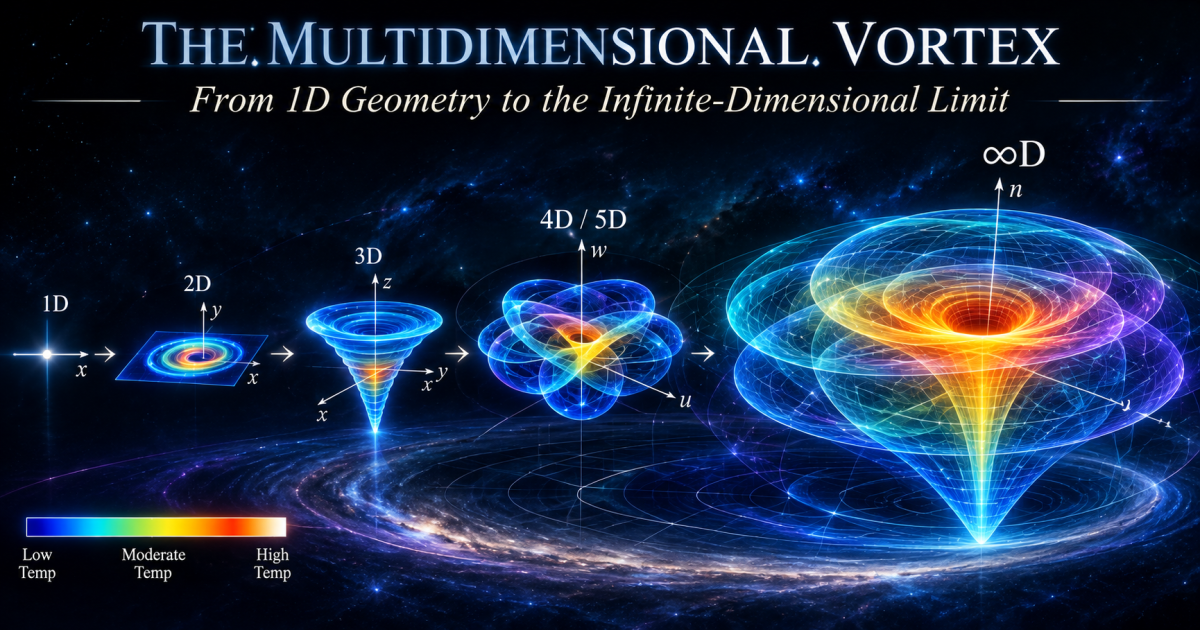
THE MULTIDIMENSIONAL VORTEX THEORY
A Progressive Mathematical and Physical Exploration of Vortex Geometry, Dimensional Expansion, Thermal Dynamics, and the Infinite-Dimensional Limit
1. Title Page
Author: Jarad Ponce
Type: Integrative theoretical research paper
Date: November 20, 2026
Epistemic labels: [EM] established mathematics;
[EP] experimentally established physics;
[ME] mathematically permissible extension;
[SP] speculative physical interpretation.
2. Abstract
A vortex should not be identified merely with a visible spiral. The most dimension-stable definition is a field possessing nonzero local antisymmetric rotation, nontrivial circulation, or topologically protected phase winding. In Euclidean n-space, the natural vorticity object is the 2-form
not a curl vector; the latter is a dimension-specific Hodge-dual representation in three dimensions. Geometric fluid mechanics already formulates Euler flow on an n-manifold using velocity 1-forms, vorticity 2-forms, Lie transport, and differential forms. [1]
This paper distinguishes: (a) Euclidean spatial models in ℝn; (b) Lorentzian relativistic fluids in spacetime; and (c) infinite-dimensional state spaces used to represent fields or PDE solutions. Four-dimensional Euclidean double rotations, relativistic vorticity tensors, Hilbert-space unitary rotations, and Navier–Stokes phase spaces are mathematically related through antisymmetric generators, but they are not physically interchangeable. The paper concludes with a clearly labeled original Generalized Multidimensional Vortex Framework (GMVF) and explicit conditions for existence, observation, and falsifiability.
3. Executive Summary
Core Result
Vorticity as a differential 2-form survives dimension change more faithfully than “curl as a vector.”
Minimum Dimension
A nontrivial continuous spatial rotation requires at least two dimensions; strict 1D has no nonzero skew generator.
Infinite-Dimensional Result
The strongest interpretation is usually a vortex-bearing PDE evolving on an infinite-dimensional phase space—not infinitely many physical spatial axes.
Black-Hole Result
The defensible connection is effective-metric and relativistic-fluid mathematics, not identity between vortices and black holes.
Central conclusion. No established literature located in this review supplies a single theory unifying Euclidean 1D → ∞D, relativistic spacetime, thermal transport, and functional-analytic vortex dynamics. The GMVF below is therefore an original synthesis, not established science.
4. Introduction and Research Motivation
Classical vortex theory developed through Euler, Cauchy, Helmholtz, Kelvin, and later viscous boundary-layer and turbulence theory. Geometric formulations identify mass as an n-form, flux as an (n−1)-form, velocity as a vector/1-form, and vorticity as dv♭. In barotropic ideal flow, the vorticity 2-form is Lie-transported; in three dimensions it can additionally be represented by a vector field and organized into lines, tubes, and filaments. [1]
Poincaré’s qualitative dynamics, Cartan’s exterior calculus, Noether’s symmetry–conservation correspondence, Hilbert-space analysis, von Neumann’s operator formalism, and Einstein’s Lorentzian geometry are relevant enabling structures—not evidence that those authors proposed a multidimensional vortex theory.
5. Definitions and Foundational Concepts
Let M be an n-dimensional Riemannian manifold with metric g, velocity v, and metric-dual 1-form α = v♭.
- Trajectory: Ẋ(t) = v(X(t),t).
- Circulation: ΓC = ∮C α.
- Vorticity: Ω = dα ∈ Ω2(M).
- Rotational velocity field: locally v(X) = AX, where AT = −A.
- Core/support: a set on which Ω, enstrophy, phase defect, or another rotation diagnostic is concentrated.
- Vortex surface: not universal. It may mean a level set, coherent-structure boundary, material surface, phase singularity, or vorticity-support manifold.
By Stokes’ theorem,
Thus circulation and vorticity remain meaningful without requiring a 3D curl vector.
6. Five-Step Progressive Exploratory Methodology
- 1D–2D foundations: coordinates, trajectories, circulation, singular point vortices.
- 3D physics: Navier–Stokes, vortex stretching, tubes, rings, helicity, dissipation.
- 4D–5D expansion: Euclidean SO(n) rotations and distinct Lorentzian spacetime formulations.
- nD–∞D: exterior calculus, topology, Hilbert operators, PDE phase spaces, GR and analogue gravity.
- Unified synthesis: heat, energy, invariants, projection, convergence, existence, and testability.
7. One-Dimensional and Two-Dimensional Vortices
Strict 1D
[EM] Since
strict ℝ admits no nontrivial continuous spatial rotation plane, closed loop around a core, or circulation integral. A scalar field may oscillate, reverse direction, or represent the projection of higher-dimensional rotation, but calling that a conventional 1D vortex would be [ME], not standard fluid mechanics.
2D
With radial distance
solid-body rotation can be written as
For an ideal point vortex,
Its domain is ℝ2 \ {0}; speed diverges as r−1, and vorticity is distributionally concentrated at the origin. MIT’s fluid notes explicitly identify the origin as singular and require it to lie outside the classical flow region. [2] A finite-core Rankine, Lamb–Oseen, superfluid, or experimentally resolved vortex requires additional constitutive physics.
8. Three-Dimensional Vortex Dynamics
For v : ℝ3 → ℝ3,
For incompressible Newtonian flow,
and the vorticity equation is
The stretching term (ω · ∇)v is a distinctively 3D mechanism. Vortex lines integrate the vorticity direction; tubes are regions whose boundary is tangent to that direction; filament models idealize thin concentrated tubes. [1]
Geometric Distinctions
- Flow field: v(x,t).
- Material structure: particles transported by the flow.
- Coherent structure: a diagnostic-dependent persistent region.
- Boundary/stream surface: physical or kinematic constraint.
- Visualization surface: an isosurface chosen by the observer.
Tornadoes, hurricanes, drain vortices, smoke rings, plasmas, superfluids, and accretion flows may all exhibit rotation, but differ in forcing, compressibility, stratification, electromagnetism, quantum circulation, and gravitation. Relativistic-fluid literature likewise spans heavy-ion collisions, neutron stars, jets, and cosmology without reducing them to one governing model. [3]
9. Four-Dimensional and Five-Dimensional Vortex Geometry
Euclidean 4D
Any real skew-symmetric A is orthogonally reducible to 2 × 2 blocks:
Thus
A generic 4D rotation consists of rotations in two orthogonal 2-planes. Distinct angles give a double rotation; equal angles an isoclinic rotation; one zero angle a simple rotation. [4]
Euclidean 5D
There can be two independent rotation planes and one unrotated direction. In general,
A 5D “vortex surface” must be specified:
- F(X) = c: generically a 4D hypersurface in ℝ5.
- Intersection F1 = c1, F2 = c2: generically 3D.
- Support of a simple vorticity 2-form: often organized relative to codimension-2 structures.
- Projected image: only an encoding, not the object itself.
A hypersphere Sn−1(R) is the boundary of the ball Bn(R), not the ball.
Spacetime—not Euclidean 4D
A relativistic fluid occupies Lorentzian spacetime (𝓜,gμν), typically signature (−+++), with normalized 4-velocity uμ. A standard kinematic vorticity tensor is
Canonical relativistic-fluid formulations also use the exterior derivative of momentum covectors as a vorticity 2-form; the relativistic Euler equation becomes an integrability condition involving that form. [3] Coordinate swirling is not sufficient: invariant rotation must be extracted through the metric, connection, projection, and congruence.
10. Generalized N-Dimensional Vortex Theory
Let X = (x1,…,xn), with generalized radial distance
| Familiar notion | nD status |
|---|---|
| Circulation | Direct: integral of a 1-form over a loop |
| Vorticity | Direct: 2-form dv♭ |
| Curl vector | Special to 3D representation |
| Angular momentum | Bivector/tensor Lij = xipj − xjpi |
| Vortex tube | Dimension- and codimension-dependent |
| Helicity | Standard in 3D; higher odd-dimensional form analogues are possible |
| Independent planes | ⌊n/2⌋ |
| Radial Laplacian | Δf = f″ + (n−1)f′/r |
A vortex is a field configuration with a nonzero antisymmetric rotation object and a geometrically or topologically identifiable support/core, together with circulation, flux, winding, or coherent transport sufficient to distinguish it from pure shear.
The second clause prevents every locally rotating linear map from automatically being treated as a physically coherent vortex.
11. Infinite-Dimensional Vortex Theory
Let
Hilbert-Space Rotation
[EM] A strongly continuous norm-preserving group U(t) has an infinitesimal generator with carefully specified dense domain. Stone’s theorem states that every strongly continuous unitary group has a unique self-adjoint T such that
and differentiability requires initial data in D(T). [6] In real notation, the corresponding generator is skew-adjoint.
Hence an abstract “Hilbert vortex field”
is rigorous when A is skew-adjoint, its domain is dense, and it generates a strongly continuous orthogonal group. For nonlinear Ẋ = F(X), local Lipschitz, monotonicity, compactness, semigroup, or PDE-specific estimates must supply existence and uniqueness.
PDE Phase-Space Interpretation
A fluid PDE evolves a function v(·,t) in a space such as L2, H1, or a divergence-free Sobolev space. This phase space is infinite-dimensional even when physical space is only two- or three-dimensional. This is the more physically defensible meaning of an infinite-dimensional vortex: an evolving vortex-bearing field with infinitely many modes or degrees of freedom.
Finite truncations PNH need not converge merely because N → ∞. One must specify convergence—strong, weak, operator, spectral, Galerkin, attractor, or statistical—and prove uniform bounds and compactness.
High-dimensional radial intuition also fails: sphere measure concentrates strongly, with neighborhoods of scale O(n−1/2) covering most normalized measure under standard hypotheses. [7]
12. Hyperspherical and Black-Hole Geometric Analogies
Visualization value: both contexts use radial coordinates, symmetry, rotating structures, accretion-like motion, singular limits, and projections.
Non-Equivalences
- Sn−1 ⊂ ℝn is a Euclidean boundary; an event horizon is a causal spacetime boundary from which an entered object cannot return. [8]
- A point-vortex singularity is generally a failure of an idealized field model; a GR singularity concerns geodesic incompleteness or divergent curvature diagnostics.
- Frame dragging is metric geometry, not ordinary fluid rotation. NASA describes it as the relativistic dragging of inertial frames around a spinning black hole, with possible accretion-disk precession signatures. [9]
Deeper defensible correspondence: linear perturbations of suitable fluids can propagate on an effective Lorentzian acoustic metric. The mapping is conditional on fluid model, equation of state, perturbation regime, and often potential-flow assumptions. [10] Laboratory analogue systems have produced effective horizons and rotating-vortex superradiance, but these model wave propagation—not the full nonlinear Einstein equations. [11]
13. Thermal Dynamics and Heat Distribution
Use the advection–diffusion energy equation
where Q is volumetric heating and Φ is viscous dissipation. For constant properties and no advection,
The n-dimensional free-space heat kernel is
with unit integral. [12] Dimension changes normalization and radial-volume weighting rn−1dr, but not the characteristic diffusion length √(αt).
A vortex core is not necessarily hot. Central heating may follow compression or dissipation; annular heating may follow high shear; inward/outward spirals arise from advection; cold cores occur under expansion, evaporation, radiation, or boundary cooling. Temperature requires its own equation and constitutive data.
14. Energy, Momentum, and Conservation Principles
In arbitrary dimension angular momentum is naturally an antisymmetric tensor/bivector, not a single axial vector. Noether-type conservation requires corresponding symmetry plus a suitable action and boundary conditions. Viscosity dissipates kinetic energy into internal energy; external forcing, open boundaries, compressibility, electromagnetic work, and curvature modify balance laws. Circulation conservation requires idealized hypotheses such as inviscid barotropic flow and conservative body forces.
15. Computational Models and Visualization
Every 4D+ image must be labeled projection, section, level set, or encoding.
- 1D: signed axis and trajectory.
- 2D: Cartesian/polar quivers, streamlines, circulation loops.
- 3D: top/side/cross-section; vortex ring, tube, funnel, helicoid.
- 4D: two rotation-plane panels plus stereographic or color-coded projection of S3.
- 5D: parameter slices of a 4D level hypersurface.
- nD: rotation-block matrix, invariant spectra, pairwise projections.
- ∞D: Galerkin coefficients, mode-energy spectra, attractor embeddings.
- Thermal: white → red → orange → yellow → green → cyan → blue, always with numeric legend.
- Black-hole comparison: paired causal diagram versus fluid-flow/acoustic-horizon encoding.
Convergence studies should vary grid, timestep, domain, truncation N, projection, and regularization independently.
16. Comparative Dimensional Analysis
| Space | Rotation | Natural vorticity | Typical core/support |
|---|---|---|---|
| 1D | None intrinsically | Zero 2-form | Projected/constrained analogue |
| 2D | One plane | Scalar or 2-form | Point/finite patch |
| 3D | One plane locally + axis | Vector or 2-form | Line/tube/ring |
| 4D | Up to two planes | 2-form | Model-dependent 2D/3D sets |
| 5D | Up to two planes + fixed direction | 2-form | Level set may be 4D |
| nD | ⌊n/2⌋ planes | 2-form | Codimension must be declared |
| ∞D | Operator-generated modes | Operator/field derivative | Spectral, modal, or PDE structure |
17. Mathematical Limitations and Physical Constraints
Mathematical existence does not imply physical realization. A valid model must specify:
- ambient space and signature;
- regularity and operator domains;
- governing equations and constitutive laws;
- finite energy and admissible singularities;
- boundary/initial data;
- causality for relativistic models;
- convergence of numerical truncations;
- measurable observables.
The experimentally demonstrated high-dimensional optical vortices reported in 2025 are an important synthetic/platform result, but do not establish macroscopic fluids living in extra ordinary spatial dimensions. [13]
18. Proposed Unified Theoretical Framework
Original Generalized Multidimensional Vortex Framework (GMVF)—Not Established Science
Define
- 𝒜: manifold, Euclidean space, Hilbert space, or PDE phase space.
- g: Riemannian, Lorentzian, or Hilbert inner product.
- Σ: core/support set with declared dimension/codimension.
- α: velocity/momentum/state 1-form or field.
- Ω = dα: projected relativistic tensor, or skew generator.
- T: temperature or thermodynamic state.
- ℰ: kinetic, thermal, potential, and field energy functional.
- 𝒢: Euler, Navier–Stokes, relativistic-fluid, heat, or abstract evolution equation.
- ℬ: boundary and initial conditions.
- ℐ: circulation, winding, flux, helicity-type, spectral, or Noether invariants.
- Π: observation/projection map.
- 𝔓: physical interpretation and test protocol.
Status: Ω = dα, SO(n), heat kernels, relativistic vorticity, and semigroup generators are [EM]; combining them in this tuple is [ME]; assigning extra spatial dimensions physical reality without evidence is [SP].
Limiting tests: In 2D, select α = vpv♭; in 3D recover curl, tubes, rings, and helicity; in finite n, retain the 2-form and skew blocks; in Hilbert space replace dα by the appropriate Fréchet derivative/antisymmetric operator and declare its domain.
19. Discussion and Implications: Answers to the 15 Central Questions
- Definition: antisymmetric rotation plus identifiable support/core and circulation, winding, or coherent transport.
- Minimum dimension: two for conventional spatial rotation.
- Symmetry: SO(n) replaces planar SO(2) and axial SO(3).
- Multiple planes: yes, at most ⌊n/2⌋.
- nD vortex surfaces: only after dimension/codimension and diagnostic are specified.
- Sphere/hypersphere: Sn−1 is the boundary of Bn.
- Hilbert vortices: rigorous through skew-adjoint generators or vortex-bearing PDE states.
- Radius: norm remains defined, but measure concentrates and naive visualization degrades.
- Temperature: scalar T(X,t) or a thermodynamic field on state/physical space.
- Diffusion: geometry enters through Δ, volume growth, boundaries, and kernel normalization.
- Prediction: only after equations, parameters, observables, and validation are supplied.
- Black holes: effective-metric correspondence exists; material identity does not.
- Invariants: circulation, flux, energy, winding, and helicity-type quantities under stated hypotheses.
- Finite-to-infinite novelty: unbounded generators, continuous spectra, weak convergence, attractors, and loss of local compactness.
- Testability: operational preparation, measurable projection, uncertainty bounds, competing null model, and reproducible falsification criterion.
20. Future Research Directions
Priority programs are: rigorous nD Euler/Navier–Stokes solutions with controlled vorticity support; topology of higher-codimension defects; relativistic multi-fluid vortex simulations; Galerkin convergence of vortex-bearing PDE attractors; thermal-vorticity coupling; and synthetic-dimensional optical or quantum experiments with explicitly reconstructed invariants.
21. Conclusion
The mathematically stable thread across dimensions is not the visible funnel but the antisymmetric geometry of rotation. Euclidean nD, Lorentzian spacetime, and infinite-dimensional phase space support rigorous vortex-related constructions, yet represent different ontological categories. The GMVF provides a disciplined common language while preserving those distinctions.
22. References
- Andersson, N., & Comer, G. L. (2007). Relativistic fluid dynamics. Living Reviews in Relativity, 10, 1. https://doi.org/10.12942/lrr-2007-1
- Bullerjahn, J. T., Fábián, B., & Hummer, G. (2023). Efficient generation of random rotation matrices in four dimensions. arXiv. https://doi.org/10.48550/arXiv.2302.06230
- Jacquet, M. J., Weinfurtner, S., & König, F. (2020). The next generation of analogue gravity experiments. Philosophical Transactions A, 378, 20190239. https://doi.org/10.1098/rsta.2019.0239
- Kim, D., et al. (2025). Dynamic realization of emergent high-dimensional optical vortices. Nature Communications. https://doi.org/10.1038/s41467-025-65087-2
- Unruh, W. G. (1981). Experimental black-hole evaporation? Physical Review Letters, 46, 1351–1353. https://doi.org/10.1103/PhysRevLett.46.1351
23. Mathematical Appendix
For radial f(r),
For ideal n-dimensional Euler flow,
These coordinate-free equations supply the principal finite-dimensional backbone of the theory. [1]
24. Glossary
- Bivector: oriented plane element representing rotation or angular momentum.
- Congruence: family of nonintersecting spacetime curves.
- Core: set where vorticity, winding, or rotational energy concentrates.
- Hypersurface: codimension-one submanifold.
- Lie transport: transport generated by a vector field’s flow.
- Phase space: space whose points represent complete system states.
- Skew-adjoint generator: operator producing norm-preserving evolution.
- Vorticity 2-form: coordinate-independent antisymmetric derivative of the velocity or momentum 1-form.

