1. Introduction and framing
“Stop and smell the roses” survives because it compresses a philosophy into a gesture: interrupt forward motion, attend to beauty, and let the body register that the world is still alive. The specific practice considered here—deliberately smelling a living or freshly cut flower immediately after waking—is narrower and scientifically more interesting. It asks whether the first sensory act of the day can shape affective tone, autonomic balance, and attention before the day’s cognitive load begins.
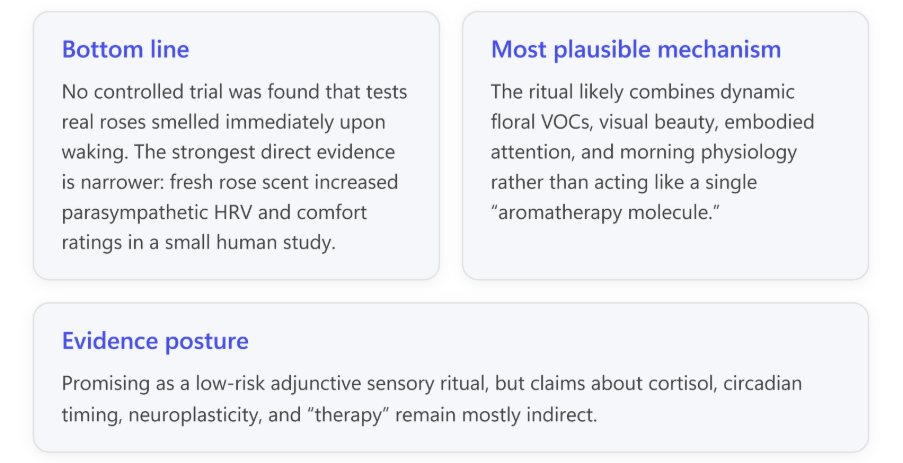
The evidence is not yet strong enough to call morning rose-smelling a validated therapy. But it is strong enough to justify serious inquiry. A fresh-rose study in 19 female university/graduate students found that olfactory stimulation by fresh rose flowers, compared with air, increased parasympathetic activity and feelings of comfort/naturalness; the chamber was controlled at 25°C, 50% relative humidity, and 230 lux. That is direct human evidence for fresh flowers, not essential oil. By contrast, much of the broader aromatherapy literature uses oils, hydrosols, or isolated odorants, which are chemically and phenomenologically different from a living bloom. [sage.cnpereading.com]
2. Evidence map: what is known, inferred, and missing
| Claim area | Evidence level | What the evidence supports | Key caveat |
| Fresh rose scent and relaxation | Small controlled human experiment | Fresh rose scent increased parasympathetic HRV and comfort/naturalness ratings [sage.cnpereading.com] | Young female sample; not morning-specific |
| Rose oil / rose aroma and stress markers | Human/animal aromatherapy evidence | Rose essential oil has been studied for stress-related cortisol/skin-barrier effects [pmc.ncbi.nlm.nih.gov] | Essential oil ≠ real flower |
| Olfactory-limbic pathways | Neuroanatomical review evidence | Odors reach piriform cortex and tertiary structures including amygdala, hippocampus, hypothalamus, orbitofrontal and insular cortices [pubmed.ncb…lm.nih.gov] | Mechanism does not prove therapeutic outcome |
| Circadian timing | Human chronobiology + plant scent biology | Human olfactory thresholds vary with circadian phase [pmc.ncbi.nlm.nih.gov]; plants rhythmically emit volatiles under clock/light/temperature regulation [ncbi.nlm.nih.gov], [mdpi.com] | No direct “upon waking + real rose” trial |
| Nature/garden benefits | Reviews/meta-analyses | Natural environments show some attention-restoration benefits, but results are heterogeneous [europepmc.org], [europepmc.org] | Not flower-smelling-specific |
| Historical/cultural resonance | Cultural/historical sources | Hanami, Persian rose-water culture, Islamic rose symbolism, Victorian floriography all show floral scent/beauty as renewal, devotion, love, or meaning-bearing medium [history.com], [worldhistory.org], [afkarjourn…dpress.com], [gardens.si.edu] | Symbolic evidence is not clinical evidence |
3. Historical, cultural, and cross-cultural contexts
Morning flowers are not a modern wellness invention; they sit at the intersection of agriculture, devotion, poetry, and domestic ritual. In Japan, hanami—flower viewing—has ancient spiritual and agricultural roots: cherry blossoms were read as seasonal signals and associated with Shinto understandings of divine presence in natural forms; over time, hanami became a national ritual of beauty, impermanence, poetry, and social gathering. This is not a rose-smelling-at-waking practice, but it is a well-documented model of flowers as seasonal affective reset. [history.com]
Persian and Islamic rose traditions bring scent more directly into the frame. Persian rose-and-nightingale (gul-u-bulbul) motifs treat the rose as beauty, perfection, and divine longing; the nightingale often represents the human spirit yearning toward the beloved or God. Islamic cultural sources likewise link rose fragrance, paradise, Prophet Muhammad, sacred spaces, rosewater, medicine, and food; rosewater has been used to perfume religious settings and as part of hospitality and ritual cleansing. In Qamsar/Kashan, Iran, qualitative accounts describe dawn harvests of Damask/Mohammadi roses, prayers before work, and fields “heady” with aroma as the sun rises. [worldhistory.org] [afkarjourn…dpress.com] [atlasobscura.com]
Victorian floriography adds a different kind of meaning: flowers became a coded medium for emotions constrained by etiquette. Smithsonian Gardens notes that Victorian flower meanings were learned through guidebooks, and that a rose could declare “devotion,” while flower meanings varied by color and culture. Indigenous ethnobotanical sources should be handled carefully: broad Indigenous plant traditions document ceremonial and spiritual uses of native plants, but I found no strong source for a generalized Indigenous “morning flower-smelling” practice; the USDA’s ethnobotany summary confirms that many native peoples use plants in ceremonial or spiritual rituals, without supporting a rose-specific dawn ritual. [gardens.si.edu] [onlinelibr….wiley.com]
4. Botanical and chemical reality of real flower scents
A real flower is not an essential-oil diffuser. Floral scent is a dynamic volatile plume shaped by plant genetics, tissue, developmental stage, circadian timing, temperature, light, humidity, pollination, and handling. A 2024 review notes that floral VOCs include terpenoids, phenylpropanoids/benzenoids, fatty-acid derivatives, amino-acid derivatives, and other sulfur/nitrogen compounds; more than 1,700 volatile compounds have been described across over 90 plant families. Petals are often the primary emitters, and headspace sampling from living or cut flowers can give a more realistic picture than distillation or solvent extraction. [pmc.ncbi.nlm.nih.gov]
For Rosa damascena, major rose-oil constituents commonly include monoterpene alcohols such as citronellol, geraniol, nerol, and linalool, while 2-phenylethanol is important but water-soluble and can be partly lost into distillation waters/rosewater. A review of Rosa damascena also reports geraniol, citronellol, nonadecane, nerol, phenylethyl alcohol, β-damascenone, β-damascone, and β-ionone among important constituents, with large variation by product type and extraction method. This matters: a freshly opened rose near a bedside is a whole-flower chemical ecology event, not a standardized dose. [mdpi.com] [ncbi.nlm.nih.gov]
Morning may matter botanically. Plant volatiles can be rhythmically emitted under circadian and light/dark regulation; plants often time scent to pollinator activity. Temperature changes also alter floral scent profiles: in four Osmanthus fragrans cultivars, temperature significantly influenced both compound number and release amount, with many compounds most numerous around 19°C and altered at higher/lower temperatures. In Qamsar, rose producers explicitly harvest in the morning because direct sunlight and heat allow fragrance to escape and lower quality. That supports the practical intuition that dawn flowers may smell different—but it does not yet prove a unique human therapeutic effect at dawn. [ncbi.nlm.nih.gov], [mdpi.com] [pmc.ncbi.nlm.nih.gov] [storiesand…bjects.com], [atlasobscura.com]
5. Physiological and neurochemical pathways
Olfaction has privileged access to emotion and memory systems. A review describes odor transduction through olfactory neurons and the olfactory bulb, then secondary and tertiary structures including piriform cortex, thalamus, hypothalamus, amygdala, hippocampus, orbitofrontal cortex, and insula; it also notes that odors can modulate mood, cognition, and behavior. This anatomy makes rose scent biologically plausible as a mood-setting stimulus, especially when combined with personal memory, visual beauty, and quiet attention. [pubmed.ncb…lm.nih.gov]
The best direct fresh-flower physiology evidence is the fresh rose HRV study: 19 young women inhaled fresh rose scent versus air; high-frequency HRV, interpreted as parasympathetic activity, increased, and participants rated the experience as more comfortable and natural. Essential-oil studies add indirect support: rose essential oil has been studied for stress-induced skin-barrier disruption and salivary cortisol effects. However, these studies do not establish that living roses upon waking modulate the HPA axis or cortisol awakening response. [sage.cnpereading.com] [pmc.ncbi.nlm.nih.gov]
The morning-specific hypothesis is intriguing but untested. Cortisol naturally rises after awakening—the cortisol awakening response is a well-studied marker of HPA-axis activation. Separately, human olfactory thresholds show circadian variation, indicating that smell sensitivity is not constant across biological time. Therefore, a morning flower ritual could plausibly intersect with both CAR and circadian olfaction, but that is currently an inference, not a demonstrated effect. [academic.oup.com] [pmc.ncbi.nlm.nih.gov]
The broader olfactory literature also points to memory and plasticity. In sleep research, rose odor has been used as a contextual cue during slow-wave sleep to enhance declarative memory consolidation. Overnight olfactory enrichment in older adults has been reported to improve verbal memory and alter brain connectivity markers, suggesting that repeated odor exposure can influence cognitive systems. These findings are relevant but indirect: they use odor delivery protocols, not waking contact with real flowers. [frontiersin.org] [us-prod.as…rosoft.com]
The diagram below summarizes the current mechanistic model and the evidence boundary: fresh-rose relaxation evidence exists; morning-specific synergy remains hypothetical.
Figure 1: A mechanistic map of the morning rose-smelling ritual: living-flower VOCs, visual/tactile context, olfactory-limbic-prefrontal pathways, autonomic balance, and circadian/CAR timing are shown as interacting—not yet fully proven—routes.
6. Psychological, affective, and cognitive outcomes
The strongest near-term psychological claim is modest: smelling fresh roses may promote relaxation and positive affect in some people. The fresh-rose study measured both HRV and subjective impressions, finding increased comfort and naturalness. This aligns with broader evidence that nature exposure can support attention restoration, though systematic reviews caution that results vary by attention measure, exposure type, study quality, and sample size. [sage.cnpereading.com] [europepmc.org], [europepmc.org]
The ritual may function as a micro-practice of mindfulness or savoring. Unlike passive aromatherapy, real flowers invite a whole-scene encounter: color, form, temperature, texture, temporality, and perishability. That makes the practice closer to nature-based contemplative attention than to simply inhaling a chemical stimulus. Horticultural therapy reviews generally support beneficial mental-health effects, but the interventions typically involve gardening, plant care, or structured programs rather than brief morning smelling of flowers. Compared with art therapy, the rose ritual is less active and creative; compared with horticultural therapy, it is less participatory; compared with meditation, it is more sensorially anchored. [frontiersin.org]
7. Practical phenomenology and embodied experience
The lived experience is simple but variable. It may occur beside a vase, on a windowsill, in a garden path, or at the edge of a rose bed after waking. The person approaches the flower, sees its color before smelling it, adjusts distance, inhales, and often pauses. Real flowers also make impermanence tactile: petals bruise, stems bend, and scent fades. Persian rosewater accounts describe harvesters rising before sunrise, praying, and entering aromatic fields while the air is still cool; Qamsar producers say flower season creates festivity, warmth, and joy, and that pure rose water should smell like the flower just picked. [atlasobscura.com] [storiesand…bjects.com]
Key variables include: flower species and cultivar; living versus cut status; freshness; room ventilation; pollen and fragrance sensitivity; individual olfactory acuity; and whether the act is hurried or deliberate. A ten-second sniff while checking messages is likely not the same intervention as a quiet one-minute sensory pause before screens, caffeine, and task-switching.
8. Benefits, limitations, risks, and individual differences
Potential benefits are plausible but should be stated conservatively: brief autonomic downshift, positive affect, attentional reset, sensory grounding, gratitude/savoring, and connection to seasonal nature. The strongest direct support is the fresh-rose HRV study, while nature and horticultural therapy literatures support broader contact-with-nature mechanisms rather than this exact practice. [sage.cnpereading.com], [europepmc.org], [frontiersin.org]
Limitations are substantial. Flower scent varies dramatically; the “dose” is hard to standardize; many studies use essential oils rather than real flowers; most samples are small; and there are few longitudinal protocols. Risks are usually mild but real: fragrance compounds such as citronellol, linalool, geraniol, neral, and eugenol are recognized potential fragrance allergens in rose-derived products. People with known fragrance sensitivity, migraine triggers, asthma symptoms around strong scents, contact dermatitis, or pollen allergies should treat the practice as optional and discontinue it if symptoms occur. People with anosmia or reduced olfaction may gain more from visual/tactile engagement than scent; olfactory disorders are associated with impaired quality of life in review literature. [mdpi.com] [pubmed.ncb…lm.nih.gov]
9. Research gaps and future study designs
The major gap is straightforward: I found no controlled study testing real roses, smelled immediately upon waking, at defined circadian times, with autonomic, cortisol, mood, cognition, and qualitative endpoints. The field is triangulating from fresh-flower HRV, essential-oil stress studies, olfactory neuroscience, circadian smell sensitivity, CAR research, and nature therapy.
Concrete designs:
| Study | Design | Measures | What it would test |
| Morning fresh-rose RCT | Within-subject crossover: fresh rose vs unscented flower vs air, first 15 minutes after waking | HRV, salivary cortisol at waking/+30/+45, mood, sleep quality | Whether real roses alter CAR-linked morning physiology |
| Time-of-day trial | Same flower exposure at waking, afternoon, evening | Olfactory intensity, HRV, affect, cortisol | Whether timing changes response |
| Real flower vs essential oil | Living rose, cut rose, rose essential oil, synthetic rose accord | GC-MS/headspace, HRV, affect, qualitative ratings | Whether multisensory realness matters |
| Ecological diary study | 30-day home protocol with photos and short voice notes | Mood, perceived stress, adherence, scent ratings | Feasibility and lived experience |
| Neuroimaging pilot | fMRI or fNIRS during real-flower visual+odor exposure vs odor-only | Amygdala/OFC/prefrontal activation | Multisensory integration mechanisms |
10. Synthesis and reflective conclusion
Smelling real roses first thing in the morning is not magic, and it is not yet a validated clinical treatment. But it is also not trivial. It brings together a biologically potent sensory channel, a dynamic living chemical source, a culturally saturated symbol, and a liminal moment in human physiology: waking. The current evidence supports a reasonable, low-cost adjunctive ritual for people who enjoy flowers and tolerate scent, especially as a mindfulness-like practice of attention and nature contact.
The most intellectually honest conclusion is therefore balanced: the ritual is plausible, gentle, and meaningful; its strongest direct evidence is small but favorable; its broader mechanisms are well-grounded; and its morning-specific therapeutic claims remain open. The mystery is not whether roses contain pleasant chemicals, but whether the act of greeting the day through a living flower—before screens, demands, and self-narratives rush in—can reliably shift the body toward receptivity.
Suggested further reading / source trail
- Fresh-flower psychophysiology: fresh rose HRV study [sage.cnpereading.com]
- Floral VOC chemistry and real-flower headspace methods [pmc.ncbi.nlm.nih.gov], [mdpi.com]
- Plant circadian scent emission [ncbi.nlm.nih.gov], [mdpi.com]
- Olfactory-emotional neuroanatomy [pubmed.ncb…lm.nih.gov]
- Chronobiology: human olfactory circadian variation and cortisol awakening response [pmc.ncbi.nlm.nih.gov], [academic.oup.com]
- Cultural contexts: hanami, Persian rose-and-nightingale art, Islamic rose symbolism, Victorian floriography [history.com], [worldhistory.org], [afkarjourn…dpress.com], [gardens.si.edu]
What the report can—and cannot—claim
The central distinction is between direct evidence, plausible inference, and open questions.
In a small controlled human experiment, fresh rose scent increased high-frequency heart-rate variability, interpreted as greater parasympathetic activity, and increased ratings of comfort and naturalness.
Olfactory pathways connect with the amygdala, hippocampus, hypothalamus, orbitofrontal cortex and insula, while smell sensitivity itself varies with biological time.
No controlled trial identified in the report directly tests real roses at waking with autonomic, cortisol, mood and cognitive outcomes together.
The report’s strongest direct human evidence
From established evidence to open hypothesis
| Claim area | Evidence level | What it supports | Key caveat |
|---|---|---|---|
| Fresh rose scent & relaxation | DIRECT HUMAN | Higher parasympathetic HRV and comfort/naturalness ratings. | Small sample; not morning-specific. |
| Rose aroma & stress markers | INDIRECT | Rose essential oil has been examined in stress-related physiological research. | Essential oil ≠ real flower. |
| Olfactory–limbic pathways | MECHANISTIC | Smell reaches networks involved in emotion, memory, autonomic regulation and evaluation. | Mechanistic plausibility does not establish therapeutic efficacy. |
| Circadian timing | PLAUSIBLE | Human smell sensitivity varies with circadian phase; floral emission also varies with biological and environmental timing. | No direct “upon waking + real rose” trial. |
| Nature / garden benefits | BROADER | Natural environments show some attention-restoration and well-being benefits. | Not specific to smelling flowers. |
| Historical / cultural meaning | CULTURAL | Flowers repeatedly function as symbols of renewal, devotion, beauty and meaning. | Symbolic evidence is not clinical evidence. |
How a living rose could influence the waking experience
This is an interacting pathway model—not proof of a single therapeutic mechanism.
A real flower is not an essential-oil diffuser
Living or Freshly Cut Flower
Essential Oil / Extract
Why the same rose may not smell the same tomorrow
Why “first thing in the morning” is scientifically interesting
The report identifies a plausible intersection between waking physiology, changing olfactory sensitivity and time-dependent plant scent emission—but the combined effect remains untested.
The sensory sequence of the ritual
What might the ritual support?
Flowers as renewal, beauty and meaning
Flower viewing developed into a cultural ritual involving beauty, impermanence, seasonal awareness, poetry and social gathering.
The rose-and-nightingale motif has conveyed beauty, perfection, longing and spiritual meaning.
Rose fragrance and rosewater have appeared in sacred spaces, hospitality, ritual cleansing, medicine and food.
Flowers became a coded emotional language, with meanings shaped by flower type, color, guidebooks and social convention.
Why certainty is limited
The ritual is optional, not universal
Five experiments that could answer the question
Fresh rose vs unscented flower vs air within the first 15 minutes after waking.
Compare the same flower exposure at waking, afternoon and evening.
Living rose, cut rose, essential oil and synthetic rose accord.
Thirty-day at-home protocol with photos and short voice notes.
Real-flower visual + odor exposure compared with odor alone.
Known → Inferred → Unknown
Plausible. Gentle. Meaningful.
Still scientifically open.
The morning rose ritual brings together a biologically potent sensory channel, a dynamic living chemical source, a culturally saturated symbol and the physiological threshold of waking.
The strongest direct evidence is modest but favorable. The broader biological mechanisms are credible. The distinctly morning-specific therapeutic claim remains a hypothesis for future research.
 Jarad Ponce