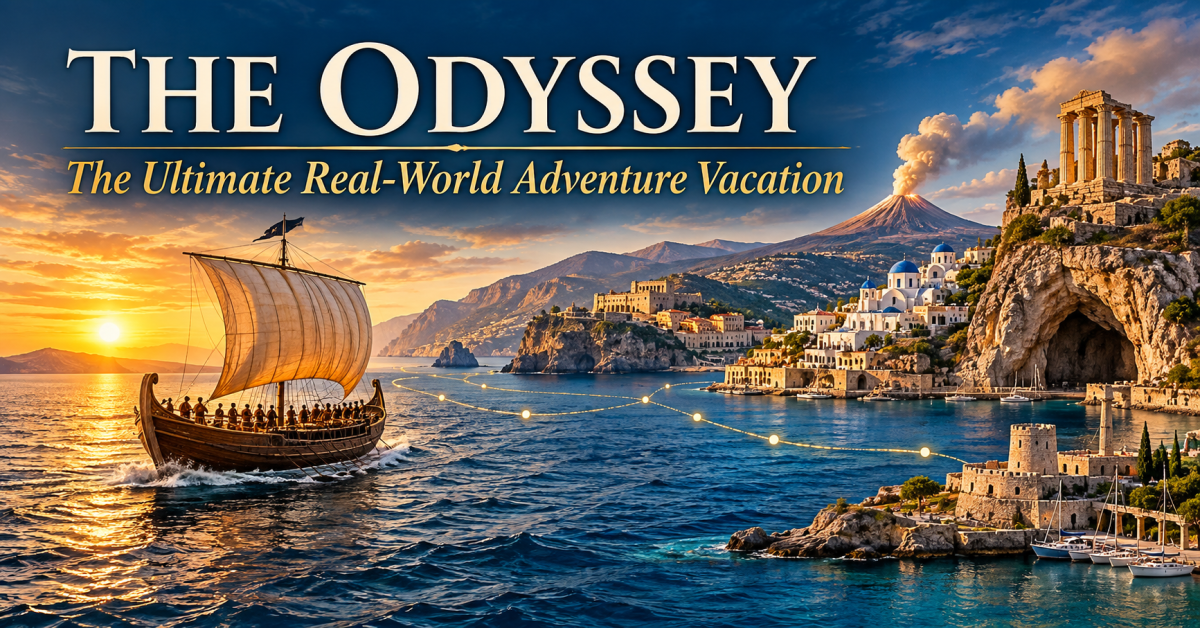
A real-world Mediterranean expedition inspired by Homer’s epic journey.
What if you could travel The Odyssey?
Start at Troy in modern Türkiye, cross the Aegean and central Mediterranean, descend to caves and volcanic islands, survive straits and temptations, and end in Ithaca.
This is not a sightseeing loop. It is a story-driven expedition: each stop asks what happened to Odysseus, what remains in the real world, and what the modern traveler can do there without confusing myth with proof.
Evidence key: HIGH = historically/geographically strong; TRADITIONAL = long-standing ancient or local association; PROBABLE = plausible scholarly/geographic reading; SPECULATIVE = one of several theories; MYTHIC/UNKNOWN = no reliable modern identification.
1. The Master Odyssey Itinerary
| Odyssey Stop | Modern Anchor | Country | Story Event | Confidence | Nights | Best Experience | Move Onward |
|---|---|---|---|---|---|---|---|
| Troy | Hisarlik/Troy, Çanakkale | Türkiye | Departure after Trojan War | HIGH | 2 | Troy ruins + Troy Museum | Drive/ferry via Dardanelles to Thrace |
| Cicones | Maroneia/Ismaros, Thrace | Greece | Raid, counterattack, first loss | TRADITIONAL | 1 | Maroneia ruins, vineyards, coast | Drive/fly via Thessaloniki/Athens to Tunisia or Malta |
| Lotus-Eaters | Djerba/Tunisian or Libyan coast | Tunisia/Libya | Pleasure that erases purpose | SPECULATIVE | 2 | Djerba beaches, markets, slow-island stay | Fly to Catania |
| Cyclopes | Etna + Aci Trezza, Sicily | Italy | Polyphemus, pride, escape | TRADITIONAL | 3 | Etna hike + Cyclops Coast boat | Ferry/hydrofoil to Aeolians |
| Aeolia | Aeolian Islands | Italy | Bag of winds, broken trust | TRADITIONAL | 3 | Lipari base, Stromboli night cruise | Ferry to Sicily, then Sardinia/Corsica or Rome |
| Laestrygonians | Bonifacio/Sardinia/Corsica theories | France/Italy | Cannibal giants destroy fleet | SPECULATIVE | 2 | Cliff harbors, dramatic coves | Fly/ferry to Rome/Naples |
| Circe | Monte Circeo, Lazio | Italy | Enchantment, transformation, counsel | TRADITIONAL | 2 | National park, caves, seaside dinner | Drive/train to Naples, fly/drive to Mani |
| Underworld | Cape Tainaron/Mani | Greece | Nekyia: counsel from the dead | TRADITIONAL | 2 | Cape walk, caves, austere villages | Drive to Athens, fly Naples or ferry Italy |
| Sirens | Li Galli/Sirenuse, Amalfi | Italy | Beauty controlled by discipline | TRADITIONAL | 2 | Private/small boat at sunset | Train/ferry to Calabria/Sicily |
| Scylla & Charybdis | Strait of Messina | Italy | Leadership under impossible choice | HIGH/TRADITIONAL | 2 | Ferry crossing, Scilla viewpoints | Continue Sicily/Malta |
| Helios | Trinacria/Sicily | Italy | Forbidden cattle, consequences | PROBABLE | 1 | Remote Sicilian coast reflection | Fly/ferry to Malta |
| Calypso | Gozo/Ogygia tradition | Malta | Paradise refused for home | TRADITIONAL | 3 | Gozo caves, swimming, boutique retreat | Fly Malta to Corfu |
| Phaeacians | Corfu/Scheria tradition | Greece | Rescue, hospitality, safe passage | TRADITIONAL | 3 | Old Town, beaches, palace gardens | Ferry to mainland, then Kefalonia/Ithaca |
| Ithaca | Modern Ithaca | Greece | Homecoming, identity restored | HIGH island / debated palace | 3 | Vathy, overlooks, swim, final toast | Depart Kefalonia/Athens |
2. The Journey Retold as a Vacation
You have escaped the Cyclops. But the Mediterranean has no intention of letting you go home.
The route treats The Odyssey as an emotional sequence—victory, temptation, pride, trust, transformation, descent, discipline, leadership, longing, rescue, and homecoming—while keeping the geography honest.
1. Troy — Çanakkale Province, Türkiye
What happened: Odysseus leaves the smoking afterglow of victory. The war is over; the real test begins.
Where are we today? The archaeological site of Troy at Hisarlik is the firmest starting gate: a real multilayered Bronze Age and later city, UNESCO-listed, with ruins and the Troy Museum near Çanakkale. It does not prove every Homeric detail, but it anchors the poem in a landscape of walls, gates, plains, and the Dardanelles.
The experience: Walk the ruins early, then visit the Troy Museum before a Çanakkale waterfront dinner. Base yourself in Çanakkale or a heritage-style hotel nearby.
Taste the journey: Grilled fish, meze, Turkish tea, and local olive oil.
The lesson: Victory is not wisdom.
2. Ismarus / Cicones — Thrace and Northern Greece
What happened: Fresh from war, Odysseus sacks the Cicones, lingers too long, and pays for it when survivors regroup.
Where are we today? Ancient Ismarus is commonly linked with the Thracian coast around Maroneia and Mount Ismaros, but the identification remains uncertain. Treat this as a landscape chapter: wind, vineyards, ruins, and the northern Aegean edge.
The experience: Explore Maroneia, coastal villages, and Thracian wine country by rental car from Alexandroupoli or Thessaloniki. Stay in a seaside guesthouse.
Taste the journey: Maroneia wines, seafood, and grilled meats.
The lesson: Appetite after victory can become carelessness.
3. Lotus-Eaters — Djerba, Tunisia, or the North African Shore
What happened: A narcotic sweetness makes men forget the journey. No monster attacks; the danger is wanting nothing.
Where are we today? Ancient and modern writers have proposed Djerba, Libya, and other North African/Mediterranean sites. None is verified. Djerba works best as a responsible modern analogue: an island of palms, whitewashed lanes, markets, beaches, and dangerous ease.
The experience: Spend two unhurried nights in a riad-style or beach hotel. Visit Houmt Souk, pottery workshops, and the coast before flying onward to Catania.
Taste the journey: Brik, couscous, harissa, and mint tea.
The lesson: Comfort can become captivity if it steals purpose.
4. Cyclopes — Etna and the Cyclops Coast, Sicily
What happened: Odysseus blinds Polyphemus, escapes under the rams, then ruins stealth with a boast.
Where are we today? Sicily is one of the most powerful traditional settings for the Cyclops. Etna supplies the one-eyed volcanic drama, while Aci Trezza and the Faraglioni are tied to Polyphemus traditions.
Cyclops Day: Begin with a dawn Etna hike with a licensed guide, break for pistachio pasta or arancini, take an afternoon boat beneath the Aci Trezza sea stacks, and finish with Nero d’Avola beside the water.
Stay: Catania, Taormina, or Aci Castello.
The lesson: Intelligence saves Odysseus; pride wounds him.
5. Aeolia — The Aeolian Islands
What happened: Aeolus almost gives Odysseus the way home; his crew opens the wind bag, and trust collapses.
Where are we today? The Aeolian Islands off Sicily are the traditional Island of the Winds and one of the trip’s great spectacles: Lipari as a base, Vulcano for fumaroles, Salina for wine and capers, and Stromboli for night fire.
The experience: Travel by ferry or hydrofoil from Milazzo. Stay in Lipari or Salina and book a Stromboli sunset/night cruise.
Taste the journey: Malvasia delle Lipari, capers, and swordfish.
The lesson: A leader must earn trust, but followers must deserve it.
6. Laestrygonians — Sardinia/Corsica Theories
What happened: A safe-looking harbor becomes a trap; the fleet is crushed by giants.
Where are we today? Competing theories place this episode in several dramatic harbors, including Sardinia, Corsica, or Sicily. Bonifacio’s limestone cliffs and narrow harbor capture the feeling without pretending certainty.
The experience: Make uncertainty part of the adventure. Choose Bonifacio or northern Sardinia for cliffs, boat caves, and fortified harbor views.
Taste the journey: Corsican or Sardinian cheeses, seafood, and Vermentino.
The lesson: Not every shelter is safe.
7. Circe — Monte Circeo, Lazio
What happened: Circe turns men into swine, then becomes host, lover, and guide. Odysseus stops surviving and starts learning.
Where are we today? The Circeo Peninsula has a long traditional association with Aeaea. Its mountain, national park, caves, dunes, and coastal towns make a sophisticated myth-and-nature chapter between Rome and Naples.
The experience: Hike Monte Circeo, tour coastal caves by boat, reserve a spa afternoon, then dine on seafood and Lazio white wine in San Felice Circeo.
The lesson: Transformation is not only punishment; it can be instruction.
8. Underworld — Cape Tainaron and the Mani, Greece
What happened: At the edge of the world, Odysseus calls the dead and learns the cost of homecoming.
Where are we today? Cape Tainaron, or Cape Matapan, is traditionally treated as an entrance to Hades and has sanctuary traditions tied to Poseidon. The Mani’s stone towers and austere coast make this the darkest chapter.
The experience: Base yourself in Areopoli, Limeni, or Gerolimenas. Drive to the cape, walk to the lighthouse, and visit caves and tower villages.
Taste the journey: Olives, lalagia, local honey, and grilled fish.
The lesson: Self-knowledge requires descent.
9. Sirens — Li Galli and the Amalfi Coast
What happened: Odysseus wants the song but not the shipwreck, so he turns desire into a controlled experiment.
Where are we today? The Sirenuse/Li Galli islands off the Amalfi and Sorrento coast are a famous traditional Sirens landscape. The coast supplies exactly the dangerous beauty the episode needs.
The experience: Book a small boat from Positano or Sorrento, swim in clear water, hear live music at sunset, and end with a cliffside dinner.
Stay: Praiano, Positano, or Sorrento.
The lesson: Discipline is not refusing beauty; it is refusing to be ruled by it.
10. Scylla & Charybdis — Strait of Messina
What happened: Odysseus chooses a survivable disaster: lose some men to Scylla rather than all to Charybdis.
Where are we today? The Strait of Messina is geographically compelling: a narrow, current-torn passage between Sicily and Calabria, with Scilla on the mainland side and Messina opposite. Charybdis is linked with whirlpool traditions in these waters.
The experience: Cross by ferry, then climb to Scilla viewpoints and photograph the water at golden hour.
Stay: Scilla, Reggio Calabria, or Messina.
Taste the journey: Swordfish rolls, bergamot, and granita.
The lesson: Leadership sometimes means choosing the lesser tragedy.
11. Island of Helios — Trinacria/Sicily
What happened: Starving men slaughter forbidden cattle; consequence finally overtakes the crew.
Where are we today? The poem names Thrinakia/Trinacria, often connected with Sicily, although the exact geography remains debated. Use a remote Sicilian coast day as a moral pause rather than a false pinpoint.
The experience: Add a quiet beach or rural Sicilian night after Messina: no big tour, just sea, bread, wine, and restraint.
The lesson: Hunger explains disobedience; it does not erase consequences.
12. Ogygia — Gozo, Malta
What happened: Calypso offers immortality and paradise. Odysseus still chooses a mortal home.
Where are we today? Gozo is one of the most popular modern Ogygia traditions, including Calypso Cave associations, although alternatives exist. It works beautifully as a luxury interlude.
Calypso Escape: Base yourself in Xagħra, Victoria, or a coastal boutique property; swim at Ramla Bay, explore sea caves by boat, sail at sunset, and book a spa treatment.
Taste the journey: Ġbejniet cheese, rabbit stew, and Maltese wine.
The lesson: The point is not escaping paradise; it is choosing what matters more.
13. Scheria — Corfu
What happened: Shipwrecked and exhausted, Odysseus is found by Nausicaa and restored by Phaeacian hospitality.
Where are we today? Corfu is the traditional Scheria: Venetian old town, palaces, beaches, olive groves, and a deep culture of welcome. It is the trip’s recovery phase.
The experience: Stay in Corfu Old Town or on the northeast coast. Visit the Old Fortress, Achilleion area, Paleokastritsa, and a village taverna.
Taste the journey: Sofrito, pastitsada, and kumquat liqueur.
The lesson: Hospitality can be civilization’s answer to suffering.
14. Ithaca — The Final Destination
What happened: The traveler arrives not at a resort but at a recognition: home must be reclaimed, not merely reached.
Where are we today? Modern Ithaca is securely the island called Ithaca, but the exact Homeric palace landscape remains debated. That tension is perfect: home is real, but memory is layered.
The final day: Watch sunrise over Vathy or a northern overlook, visit Odysseus-associated sites and villages, swim in a cove, eat fish and local wine, and raise a final toast at sunset.
The greatest destination is the person you become getting there.
3. The Ideal 34-Day Odyssey
The best version is 34 days: long enough to feel the epic, short enough to execute with modern flights and ferries. Start at Istanbul or Çanakkale; end via Kefalonia or Athens.
| Days | Base | Purpose |
|---|---|---|
| 1–3 | Istanbul / Çanakkale / Troy | Arrive, recover, Troy ruins and museum. |
| 4 | Thrace / Maroneia | Vineyard and northern Aegean coast chapter. |
| 5–6 | Djerba or Tunisian coast | Lotus-Eater pause. |
| 7–9 | Catania / Etna / Aci Trezza | Cyclops adventure. |
| 10–12 | Aeolian Islands | Lipari/Salina base and Stromboli night. |
| 13–14 | Bonifacio or Sardinia | Laestrygonian uncertainty chapter. |
| 15–16 | Circeo Peninsula | Nature, caves, food, and wellness. |
| 17–18 | Mani / Cape Tainaron | Underworld descent. |
| 19–20 | Amalfi / Sorrento | Sirens by boat. |
| 21–22 | Scilla / Messina | Strait crossing and Helios reflection. |
| 23–25 | Gozo / Malta | Calypso escape. |
| 26–28 | Corfu | Phaeacian recovery. |
| 29–34 | Ithaca | Slow homecoming and ferry/weather buffer. |
Best Season
Late May to mid-June or mid-September to early October offers the strongest balance: warm enough for swimming, better conditions for hiking and archaeological sites, fewer peak-summer crowds, and generally better value than July and August.
July and August deliver maximum beach energy but also maximum heat, crowds, and prices. Build ferry and weather buffer days into the island sections.
4. Budget the Odyssey
Indicative per-person planning ranges for a 34-day trip, excluding major shopping and assuming double occupancy where lodging is shared. Verify exact fares, hotel rates, opening hours, and ferry schedules before booking.
| Style | Estimated Total | What Drives Cost |
|---|---|---|
| Budget Adventure | $7,500–$11,500 | Guesthouses, slower ferries, simple meals, group tours, fewer private boats. |
| Comfortable / Premium | $14,000–$24,000 | Boutique hotels, strategic regional flights, guided archaeology/Etna, several boat days. |
| Luxury “King of Ithaca” | $35,000–$75,000+ | Top hotels/villas, private drivers, private boat charters, premium guides, spa, and fine dining. |
Typical Cost Buckets
- International airfare: $700–$1,800 from the United States
- Regional flights: $600–$1,800
- Lodging: $2,400–$25,000+
- Ferries, trains, and local transportation: $600–$2,000
- Rental cars, fuel, and parking: $1,000–$3,000
- Food: $1,200–$6,000+
- Tours, admissions, and boats: $900–$12,000+
- Insurance and contingencies: approximately 8–12%
Travel Strategy: Tips That Save the Trip
- Avoid backtracking: Think in arcs—Troy/Thrace, North Africa, Sicily/Aeolians, Italy, Greece, Malta, Corfu/Ithaca—not a perfect ancient line.
- Pack like a sailor-scholar: Breathable layers, water shoes, trail shoes, sun shirt, linen evening wear, small daypack, swimsuit, portable charger, and a soft-sided bag for ferries.
- Reserve early: Troy guide, Etna guide, Stromboli cruise, Amalfi boat, Gozo boat, and Ithaca lodging in peak months.
- Use cars selectively: Cars are useful in rural and coastal chapters but a nuisance in Amalfi, old towns, and some island centers.
- Expect walking: Archaeological sites, cliff paths, cave approaches, old towns, and hot stone streets reward early starts.
- Check border requirements: Türkiye, Tunisia, Malta, Italy, and Greece require cross-border planning. Verify passport and visa rules for your nationality before ticketing.
- Carry multiple payment methods: Euro zones dominate, while Türkiye and Tunisia use local currencies. Carry cards plus modest cash.
- Build weather buffers: Wind can alter ferries and small-boat days. Never schedule a long ferry and a nonrefundable international flight on the same day.
5. Odyssey Moments
- Troy at sunrise before the tour buses arrive.
- Etna under volcanic steam, followed by Aci Trezza by boat.
- Stromboli glowing after dark from the sea.
- Monte Circeo caves followed by a lantern-lit seafood dinner.
- Cape Tainaron on foot toward the lighthouse.
- Li Galli/Sirenuse at sunset from a boat with music.
- Crossing the Strait of Messina between the legendary hazards.
- A Gozo cave swim followed by a Calypso-themed sunset.
- Corfu Old Town at evening after a beach day.
- Arriving in Ithaca by sea and raising a final harbor toast.
6. Photography Guide
- Troy: Sunrise over stone and plain.
- Thrace: Vineyard and coast in late afternoon.
- Djerba: Blue doors and market textures in morning light.
- Sicily: Etna at dawn and Aci Trezza at sunset.
- Aeolian Islands: Stromboli after dark.
- Circeo: Cave-mouth silhouettes.
- Mani: Harsh stone landscapes rendered in black and white.
- Amalfi: Golden-hour cliffs.
- Messina: Ferry wake and Scilla harbor.
- Gozo: Cave water at midday.
- Corfu: Old Fortress during blue hour.
- Ithaca: Sunrise overlook, swimming cove, and sunset in Vathy.
7. Storyline Map
| Chronological Route | Evidence Status |
|---|---|
| TROY | HIGH |
| ↓ CICONES | TRADITIONAL |
| ↓ LOTUS-EATERS | SPECULATIVE |
| ↓ CYCLOPS | TRADITIONAL |
| ↓ AEOLUS | TRADITIONAL |
| ↓ LAESTRYGONIANS | SPECULATIVE |
| ↓ CIRCE | TRADITIONAL |
| ↓ UNDERWORLD | TRADITIONAL |
| ↓ SIRENS | TRADITIONAL |
| ↓ SCYLLA & CHARYBDIS | HIGH/TRADITIONAL |
| ↓ HELIOS | PROBABLE |
| ↓ CALYPSO | TRADITIONAL |
| ↓ PHAEACIANS | TRADITIONAL |
| ↓ ITHACA | HIGH island / debated palace |
Visual route principle: Use solid markers only for historically identifiable places such as Troy, the Strait of Messina, and modern Ithaca as an island; blue markers for traditional associations; amber markers for probable or plausible interpretations; purple markers for speculative zones; and red or gray for mythic or unknown locations.
The goal is wonder without false certainty.
You Have Arrived Home
At the end, Ithaca is not merely a dot in the Ionian Sea. It is home, family, identity, loyalty, memory, and the hard-earned right to belong again.
The traveler who follows this route has crossed borders, ferry wakes, ruins, cliff roads, caves, volcanic slopes, old harbors, and mythic weather.
The structure is the old one: leave home → become lost → encounter danger → learn → endure → choose what matters → return changed.
The final toast on Ithaca should be simple: not to the miles covered, but to the person who survived them.
Research Notes and Source Base
This report distinguishes literary tradition from geography. Recommended sources for booking and deeper verification include UNESCO World Heritage documentation for Troy; Turkish Ministry of Culture and Troy Museum information; Greek and Italian national and regional tourism authorities; official ferry and airline operators; Malta, Gozo, and Corfu tourism authorities; archaeological and museum resources; and modern Homeric geography scholarship.
Because ferry schedules, opening hours, ticket prices, and hotel rates change seasonally, verify operational details directly with providers before purchase.

