
1) Executive Summary
Gillette Venus succeeded because it was not merely a women’s version of Mach3. Gillette combined transferable blade technology with women-specific ergonomics, shower storage, beauty-category positioning, and a globally scalable emotional idea. Consumer research supported a common cross-market proposition: a razor designed around how, where, and across what body contours women shaved. Porter Novelli then framed Venus as a “beauty essential,” deliberately avoiding the perception that it was simply “Mach3 for women.”
The commercial evidence is strong:
- The 2001 program was publicly announced as a $150 million marketing campaign using television, print, radio, mobile marketing, and extensive in-store merchandising.
- A contemporaneous case source describes Venus as Gillette’s first simultaneous global introduction, covering 29 countries. This is credible secondary evidence but not independently confirmed in an accessible Gillette filing.
- Gillette reported more than $1 billion in Venus retail sales within three years, with the brand leading female shaving in North America and Europe.
- By 2008, Venus reportedly had more than 40 million users worldwide and was the world’s leading female-shaving brand.
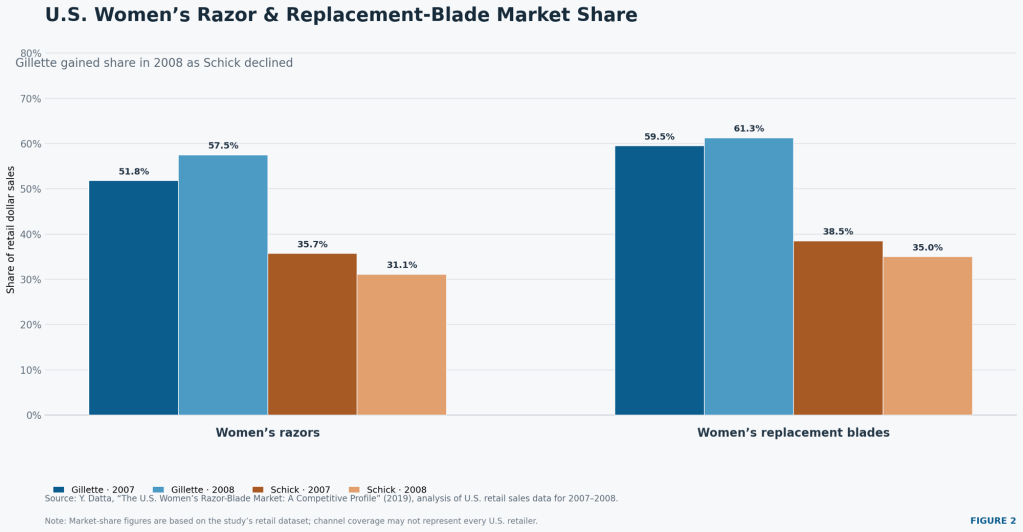
- In 2008, Gillette held approximately 58% of U.S. women’s-razor sales and 61% of women’s-blade sales, versus Schick at 31% and 35%.
- In the UK, P&G reported that Venus exceeded 50% share of a £68 million female-razor market in 2010.
Core Strategic Achievement
Venus transformed a functional shaving system into a premium women’s beauty franchise while retaining Gillette’s technological credibility.
Most Durable Asset
The combination of the Venus name, blue and turquoise design language, the “goddess” confidence idea, and recognizable music created unusually strong memory continuity.
Principal Limitation
The early platform equated confidence with smooth, conventionally attractive, largely idealized bodies. P&G explicitly acknowledged this representational narrowness when it reset the brand in 2018.
Critical conclusion. Venus is best understood as a successful category-premiumization and brand-separation strategy, not proof that emotional advertising alone created demand. Product innovation, distribution, trial, high advertising weight, recurring cartridges, and competitive response were all essential. The frequently repeated claim of approximately $300 million in Venus product-development investment remains unverified; it may reflect confusion with the widely reported $300 million Mach3 advertising budget.
2) Situation Analysis & Strategic Rationale
Category and Corporate Context
By late 2000, Gillette’s female-shaving business was reported at roughly $400 million, with management aspiring to reach $1 billion within three to four years. Female shaving was described by the launch public-relations team as Gillette’s fastest-growing shaving business, but the company was also facing earnings declines and heightened scrutiny.
Gillette already offered Sensor for Women from 1992 and SensorExcel for Women from 1996. Venus nevertheless warranted a separate identity because:
- Sensor architecture still carried a male-system heritage.
- Research indicated women shaved larger surfaces, used multiple grip positions, navigated knees and underarms, and often shaved in slippery shower conditions.
- A stand-alone name made it possible to enter the beauty frame of reference, rather than communicate only technical superiority.
- A separate franchise could support premium cartridges, new generations, distinct colors, and women-focused retail merchandising.
Porter Novelli’s research found broadly similar shaving habits across countries. Product-use testing produced a global proposition centered on how women shave and their shaving environment. Analytical inference: this reduced adaptation costs and made the simultaneous global-launch model less risky, although local media, retail, and cultural execution still required adaptation.
Product Design and Development
Original Venus used three blades derived from Mach3 technology, but added:
- A rounded, pivoting cartridge;
- Soft protective cushions;
- A contoured, nonslip ergonomic handle;
- Independently adjusting blades;
- Individually sealed ShowerSafe refills; and
- A shower-mounted storage compact.
These features created a defensible answer to allegations of superficial “pinkification”: the underlying blade platform was leveraged, but body geometry, grip, safety, and storage were redesigned.
Investment finding: accessible primary and high-quality contemporaneous sources confirm significant Gillette-wide research and development spending of $187 million in 2001, $185 million in 2002, and $202 million in 2003, but do not disclose Venus-specific development spending. Therefore, the claimed $300 million Venus R&D figure should not be used as fact.
Strategic Objectives
The evidence supports four objectives:
- Category expansion: move shaving from an unpleasant necessity toward a beauty ritual.
- Premiumization: accelerate trade-up to higher-performing, higher-priced systems.
- Global scale: use one brand, proposition, design system, and launch playbook.
- Competitive defense: build a women-specific franchise before Schick/Wilkinson Sword could appropriate the segment.
Gillette’s 2003 filing explicitly described growth as coming from consumer trade-up to premium systems and higher-priced disposables. Blades retailing above $1.50 grew 22% in the United States during 2003.
3) Brand & Creative Strategy
Positioning Architecture
“Reveal the Goddess in You” joined three layers:
- Functional: closer, safer, more controllable shaving around body contours.
- Emotional: confidence and the pleasure of revealing smooth skin.
- Symbolic: “Venus” connected the product to beauty, femininity, and the classical goddess.
The positioning deliberately contrasted with Gillette’s male-coded “The Best a Man Can Get.” Instead of presenting shaving as mechanical performance, Venus framed it as the first stage of a beauty transformation. A BBDO creative leader later credited the team with naming Venus, developing the tagline, and reframing shaving from a masculine chore into revealing beautiful skin.
Music and Visual Language
The launch film, created by BBDO New York, used groups of swimsuit-clad women in a beach setting, supported by a new rendition of “Venus,” known from Bananarama’s 1986 hit version. The beach functioned simultaneously as:
- A visible “test” of leg smoothness;
- An aspirational leisure environment;
- A setting compatible with the product’s ocean-blue design; and
- A repeatable global creative code.
The music was unusually valuable because the product name appeared naturally in an already familiar song. This created high mnemonic efficiency, but also risked making the advertising feel formulaic as cultural expectations changed.
Creative-Development Evidence
The strongest documented insight is behavioral rather than demographic: shaving was perceived as a chore, yet the desired outcome—smooth, visible skin—could be framed positively. Available sources do not provide formal segmentation studies, copy-testing scores, reach goals, or BBDO research instruments. Claims about detailed psychographic clusters should therefore be treated as unavailable.
4) Campaign Execution
Launch Scale and Sequencing
There are two contemporaneous spending figures:
- The Wall Street Journal reported $100 million when the product was unveiled in November 2000.
- Gillette’s March 2001 announcement described a $150 million marketing campaign.
The likely explanation is differing timing or scope, but no accessible source reconciles the figures. The $150 million figure is preferable for the full launch program because it was announced closer to execution and explicitly covered multiple channels.
Television was previewed during E!’s Academy Awards coverage on March 29, 2001. Regular U.S. advertising began April 2, and European advertising began April 9. Print followed in May.
Channel Plan
| Channel | Documented execution |
|---|---|
| Television | 30- and 15-second spots. Programs included Ally McBeal, Will & Grace, Providence, movies, and awards-related programming. |
| Vogue, InStyle, Cosmopolitan, People, and Shape. | |
| Radio | Included in the announced mix. Detailed schedules were not found. |
| Retail | Extensive in-store merchandising across food, drug, convenience, and mass-merchandise outlets. |
| Digital | GilletteVenus.com provided product, shaving, and tour information. |
| Experiential | “Venus in Motion” used two customized 53-foot trucks and four SUVs across 19 North American cities, beginning in Miami and Houston on April 21. |
| Sampling and PR | Razors were mailed to several hundred television anchors and radio personalities. The program also distributed broadcast footage and digital press materials. |
No credible evidence was found detailing outdoor weight, exact sample volumes, gross rating points, reach, frequency, trade allowances, or retailer-specific display compliance.
Guggenheim Unveiling
The pre-advertising public-relations centerpiece was a Guggenheim Museum unveiling that used the building’s curves to echo the product design. The event drew 75 journalists and more than 80 analysts. Within six weeks, Porter Novelli reported more than 1,100 placements and 293 million impressions. These are agency-reported public-relations outputs, not independently audited consumer reach.
5) Results & Business Impact
Early Commercial Performance
By 2003, Venus had generated more than $1 billion in cumulative retail sales, had become the leading women’s shaving system in North America and Europe, and represented about 5% of the global blades-and-razors dollar market. This effectively met the broad ambition of building a billion-dollar female-shaving franchise, although the original $1 billion aspiration appears to have referred to annual female-shaving business rather than cumulative Venus retail sales—an important distinction.
Gillette did not disclose Venus net revenue, operating profit, cartridge gross margin, or performance against an internal launch forecast. Consequently, incremental profit attributable to the campaign cannot be responsibly calculated. Retail sales are not equivalent to manufacturer revenue, and total Gillette segment margins cannot be assigned to Venus.
2008 U.S. Evidence
A study using A.C. Nielsen retail data estimated that in 2008:
- U.S. women’s razors generated $82.8 million in sales;
- Women’s replacement blades generated $192.1 million;
- Gillette held 57.5% of razor sales and 61.3% of blade sales;
- Schick held 31.1% and 35.0%, respectively; and
- Venus Embrace alone generated $23.1 million in razor sales, assisted by unusually heavy promotion.
The underlying dataset excludes Walmart, warehouse clubs, and dollar stores, so it is not a complete U.S. market total.
By 2010, Venus reportedly held more than 50% of the £68 million UK female-razor market. In 2011, P&G reported Venus disposable sales up 28% year over year in UK retailer communications, but this should not be attributed specifically to Jennifer Lopez because the evidence does not isolate ambassador effects.
6) Evolution & Brand Management
Product Generations
- Venus Divine: announced in 2003 and broadly launched in 2004, adding improved blade edges, multiple lubrication strips, and a more advanced handle.
- Venus Breeze: launched in 2007 with built-in shave-gel bars, responding directly to convenience competition.
- Venus Embrace: launched in 2008 with five independently adjusting blades and a moisture ribbon. P&G called it the largest Venus launch since 2001.
- SPA Breeze and Embrace: 2010 communications separated convenience and indulgence from expert-performance motivations while retaining goddess imagery and the recognizable music.
Competitive Response
Schick’s 2003 Intuition combined shaving and lathering in one product and was backed by a reported $120 million campaign, the largest launch in Schick’s history. Intuition represented a genuine reframing of the category around convenience, not merely an extra-blade response. Later Quattro for Women and Venus’s Breeze and Embrace sustained competition around blade counts, lubrication, comfort, and integrated preparation.
Celebrity and Platform Broadening
In 2011, Jennifer Lopez became Venus’s first global ambassador. The activation included television, print, public relations, digital, social, in-store communications, a new song recording, and the Venus Goddess Fund for Education. Strategically, Lopez personified a more multidimensional goddess—performer, professional, and parent—while preserving the core music and confidence assets. No credible source published brand-lift, sales, or return-on-investment results attributable to the partnership.
In 2015, #UseYourAnd encouraged women to reject one-dimensional labels, indicating movement away from purely appearance-led goddess imagery. In 2018, My Skin, My Way became an explicit overhaul: P&G acknowledged that prior campaigns had shown only one version of beautiful skin and committed to broader representation, no retouching, greater diversity behind the camera, social storytelling, influencers, and brand partnerships.
7) Critical Assessment
Strengths
- Product–message fit: the emotional promise was supported by meaningful ergonomics and performance.
- Distinct brand architecture: Venus avoided dependence on a male sub-brand.
- Global consistency: name, song, colors, product design, and goddess idea worked as a coherent memory system.
- Trial infrastructure: sampling, mobile activation, public relations, mass distribution, and merchandising converted awareness into use.
- Refreshability: Divine, Breeze, and Embrace attached new benefits to a stable masterbrand.
- Defensible premiumization: by 2008, Embrace operated in the super-premium price tier while Original Venus remained premium.
Weaknesses and Risks
- Early creative presented a narrow ideal: youthful, smooth, swimsuit-ready bodies in beach environments.
- “Reveal” could imply that confidence required hair removal and physical display.
- Repetition of the song, beach, legs, and goddess vocabulary risked creative wear-out.
- Technology shared with male platforms created continuing vulnerability to “pink tax” criticism, even though the body-interface design differed.
- Launch economics were exposed to very high fixed marketing costs and retailer-execution risk.
- Brand proliferation risked confusing differences among Divine, Breeze, Embrace, disposable, and specialty variants.
Alternative Strategies
Gillette could have launched Venus under the Gillette name with a more functional “designed for your body” proposition, reducing creative risk but sacrificing emotional differentiation. It could also have introduced broader body types and shaving-choice messaging earlier. The later My Skin, My Way direction suggests that choice, skin comfort, and personal agency offered a more inclusive evolution than abandoning the core benefit of confidence.
8) Legacy & Key Lessons
Venus’s most persuasive legacy evidence is continued category leadership. The contemporary product portfolio spans refillable and disposable razors, gels, electric devices, and specialized body and skin-care systems. Venus therefore outlived both the original executions and Gillette’s 2005 acquisition by P&G, which was valued at approximately $57 billion.
Transferable Lessons
- Lead with a real functional discontinuity. Emotional positioning is strongest when product design makes the promise credible.
- Separate a new audience from parent-brand baggage. Venus borrowed Gillette competence without inheriting masculine creative codes.
- Create multiple memory structures. Name, music, color, shape, and verbal platform reinforced one another.
- Use simultaneous global launches only when behavior is sufficiently universal. Global research supported a common core proposition, while launch manuals coordinated local public relations in 24 countries.
- Treat music as a renewable asset, not a permanent execution. Re-recordings refreshed recognition, but overuse reduced cultural flexibility.
- Refresh representation before equity becomes a constraint. Venus preserved confidence and skin care while replacing a narrow visual ideal.
- Do not confuse retail sales with profitability. The $1 billion milestone proves adoption and scale, not campaign return on investment.
- Platform longevity requires controlled evolution: stable masterbrand cues, rotating functional reasons to believe, and periodic reassessment of cultural meaning.
9) Appendix
Chronological Timeline
| Date | Milestone |
|---|---|
| 1992 | Sensor for Women introduced. |
| November 2000 | Venus unveiled; The Wall Street Journal reports a $100 million advertising plan. |
| 2001 | Launch campaign announced at $150 million; television, print, radio, experiential, retail, and public-relations activity activated. |
| 2001 | Reported simultaneous launch in 29 countries. |
| 2003 | Venus exceeds $1 billion in cumulative retail sales and leads North America and Europe. |
| 2004 | Venus Divine adds advanced lubrication and handle improvements. |
| 2007 | Venus Breeze introduces integrated shave-gel bars. |
| 2008 | Embrace launches with five blades; Venus reports more than 40 million users worldwide. |
| 2010 | UK Venus share exceeds 50%; largest brand advertising investment to date announced. |
| 2011 | Jennifer Lopez becomes the first global ambassador. |
| 2015 | #UseYourAnd broadens empowerment beyond appearance. |
| 2018 | My Skin, My Way formally overhauls representation and retouching policy. |
Key Metrics
| Metric | Reported result |
|---|---|
| Female-shaving business, 2000 | Approximately $400 million |
| Full 2001 campaign announcement | $150 million |
| Simultaneous markets | 29, secondary-source claim |
| Public-relations output after six weeks | More than 1,100 placements; 293 million impressions |
| Venus retail sales, first three years | More than $1 billion cumulative |
| Worldwide users, 2008 | More than 40 million |
| U.S. women’s razor and blade sales, 2008 | $82.8 million and $192.1 million |
| Gillette U.S. share, 2008 | 57.5% of razors; 61.3% of replacement blades |
| UK Venus share, 2010 | More than 50% |
Evidence Table
| Claim or metric | Period | Geography | Value or finding | Source | Quality | Status and notes |
|---|---|---|---|---|---|---|
| Product-development investment | Pre-2001 | Global | Approximately $300 million | No reliable source located | Unavailable | Unverified; possible Mach3 confusion |
| Launch spending | 2000 | Global | $100 million | The Wall Street Journal | High, contemporaneous | Reported; possibly a narrower or earlier scope |
| Launch spending | 2001 | Global | $150 million | Happi and Gillette announcement | High, contemporaneous trade source | Reported; preferred full-program figure |
| Global rollout | 2001 | 29 countries | Simultaneous | ICMR case | Medium | Reported by a secondary source; not confirmed through an accessible primary filing |
| Public-relations performance | First six weeks | Primarily United States | More than 1,100 placements; 293 million impressions | Porter Novelli case | Medium-high | Agency-reported |
| Early sales | First three years | Global | More than $1 billion in retail sales | Gillette annual report | High, primary | Reported cumulative retail sales |
| Worldwide users | 2008 | Global | More than 40 million | P&G release | High, primary | Reported |
| U.S. market share | 2008 | United States | 57.5% of razors; 61.3% of replacement blades | Datta analysis using Nielsen data | High for covered channels | Reported dataset with channel exclusions |
| UK market share | 2010 | United Kingdom | More than 50% | P&G via Talking Retail | Medium-high | Company-reported |
| Jennifer Lopez campaign impact | 2011 | Global | No isolated sales or return-on-investment result | Multiple sources | Unavailable | Execution verified; outcome unavailable |
| Incremental Venus profit | 2001–2011 | Global | Not disclosed | Annual reports reviewed | Unavailable | No defensible estimate |
Concise Creative-Example Descriptions
- 2001 Original: groups of women in a bright beach environment; blue aquatic styling, shaving demonstration, and a re-recorded “Venus” track.
- Divine: retained goddess confidence while shifting emphasis toward moisturization and premium skin care.
- Breeze and SPA Breeze: built scenarios around speed, indulgence, and integrated lather.
- Embrace: moved from the anonymous beach “army” toward the “everyday goddess,” combining multiple life settings with five-blade performance.
- Jennifer Lopez, 2011: stage, professional, domestic, and leisure identities connected celebrity glamour to multidimensional confidence.
- My Skin, My Way, 2018: diverse skin, scars, tattoos, body hair, and less-retouched imagery repositioned shaving as personal choice rather than conformity.
Source Register
Principal sources included Gillette’s 2002 and 2003 annual reports; Gillette and P&G product-launch announcements; Porter Novelli’s contemporaneous public-relations case; The Wall Street Journal launch and competitive-spend reports; Marketing Week; Talking Retail; Y. Datta’s Nielsen-based academic market study; the ICMR innovation case; and retrospective materials from a former BBDO creative lead.
Research Limitations
- The approximately $300 million product-development claim could not be verified and should not be cited as established fact.
- The 29-country simultaneous rollout is supported by a secondary case source but was not independently confirmed in an accessible Gillette filing.
- Retail sales do not equal Gillette or P&G net revenue.
- Venus-specific operating profit, contribution margin, or campaign return on investment was not publicly disclosed.
- Publicly reported market-share datasets differ in geography, retail-channel coverage, time period, and whether the measurement concerns razors, blades, or total female shaving.
- Brand-awareness, loyalty, and equity scores were frequently discussed qualitatively but were not available as a consistent public time series.

