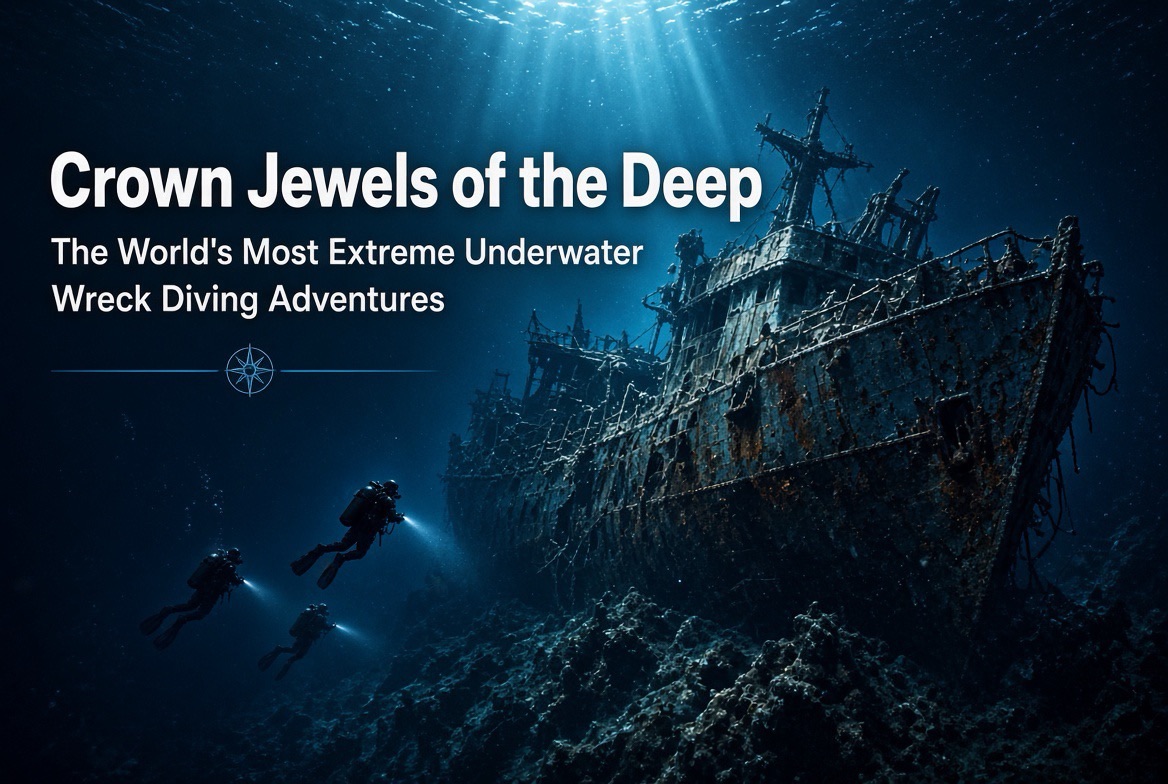
The Mountain Beneath the Atlantic
Imagine the moment your light beam hits steel.
Not a reef. Not a shadow. A wall—black, rusted, impossibly large—rising from cold North Atlantic darkness. Your computer reads 58 meters, then 65, then 70. Current worries the descent line like a live cable. Somewhere below, sprawled on her starboard side, lies the SS Andrea Doria: 212 meters (697 feet) of shattered Italian elegance, roughly 50 miles southeast of Nantucket, with her highest surviving structure near 58 meters and the sand at approximately 73–77 meters (240–253 feet). The bottom water can hover around 4–7°C (39–45°F), visibility may collapse without warning, and the current can turn a controlled ascent into a hand-over-hand fight for the anchor line.
In July 1956, the inbound Doria and outbound Stockholm misread one another’s radar movements in fog. The reinforced bow of the Swedish liner tore through seven of the Doria’s decks. Fifty-one people died, but an extraordinary overnight rescue saved most of the 1,706 passengers and crew before the mortally wounded liner rolled over and vanished the following morning. Within a day, Peter Gimbel was already diving toward her. A pilgrimage had begun.
The wreck offered trophies from another world: Italia Line plates, cups, silverware and fragments of a floating art gallery. Retrieving one became proof that you had survived the “Mount Everest of wreck diving.” It also produced “china fever”—the dangerous fixation on finding porcelain after judgment should already have ordered retreat. Accounts document numerous fatalities across the wreck’s diving history. The exact count varies with inclusion criteria, but the honest figure is roughly two dozen—and every number represents a person who failed to return.
The Doria helped force technical diving to evolve. After Captain Billy Deans lost a close friend there in 1985, he helped install oxygen-decompression capability aboard the charter boat Wahoo. In 1991, Bernie Chowdhury led the wreck’s first mixed-gas expedition from that vessel. Trimix weakened the grip of narcosis; rebreathers later stretched useful bottom time. Yet technology could not halt corrosion. The once-navigable interior has largely collapsed, the wreck is settling into the seabed, and what opens this season may be buried the next. Private expeditions still reach her, but the Doria is less a conventional destination than a moving, deteriorating test of judgment.
The North Atlantic and Celtic Deep: Liners, U-Boats and Black Water
Off Ireland’s Old Head of Kinsale, RMS Lusitania lies at about 92–95 meters (302–312 feet), barely 19 kilometers offshore yet exposed to tidal water, Atlantic weather and visibility that often contracts to six meters. A German torpedo from U-20 struck the liner on May 7, 1915; a second internal explosion followed, and the 240-meter ship sank in only 18 minutes with nearly 1,200 people. Today she rests approximately 30 degrees onto her starboard side, her superstructure largely gone and her once-grand hull folding inward under current, corrosion and earlier salvage damage.
Imagine descending through the thermocline while the wreck’s outline refuses to appear. Leigh Bishop described making the drop on open circuit using heliair 11/47, switching gases before reaching the deck at 93 meters. There, fishing nets drift across broken steel, navigation becomes difficult aft of the comparatively recognizable bow, and every photograph costs decompression. Modern CCR teams have documented boilers, elevator-cage fragments, marble fittings and ammunition while watching the structure change between expeditions.
Lusitania is legally protected: Ireland’s National Monuments Service requires a dive licence for recreational access, with additional consent necessary for detection, excavation or recovery work.
Farther west, 60 miles off New Jersey, the story becomes a detective thriller. In 1991, Captain Bill Nagle’s team found an unidentified German submarine in approximately 70 meters (230 feet). Naval records offered no explanation. Over six years, John Chatterton, Richie Kohler, John Yurga and Pat Rooney searched the wreck until artifacts conclusively identified it in 1997 as U-869. Three divers died during the investigation; the submarine’s 56-man crew remained aboard. It is still dived by specialized offshore teams, but its deepest lesson is not conquest. It is that a wreck can rewrite history while remaining, first and last, a grave.
The Mediterranean Giant: Britannic in the Aegean
At 269 meters (882 feet) long, HMHS Britannic does not simply emerge from the blue. She occupies it.
Built as the youngest Olympic-class sister of Titanic, requisitioned as a hospital ship, and sunk by a mine off Kea on November 21, 1916, Britannic went down in roughly 55 minutes. She now lies on her starboard side, with the upper port rail around 84–90 meters and the seabed commonly cited between 117 and 122 meters (384–400 feet). The bow is badly distorted, the mine-damaged area is hidden beneath the hull, and the ship stretches so far that even excellent Aegean visibility cannot make the entire liner understandable at once.
Jacques Cousteau’s team explored her in 1975–76, initially making a reconnaissance dive on air before using trimix and bell decompression. Kevin Gurr led the first modern technical expedition in 1997; Jarrod Jablonski’s GUE team followed in 1999. In 2003, Carl Spencer led the first expedition on which all bottom divers used CCRs. Spencer died during a subsequent filming expedition in 2009—a reminder that warm, clear water does not soften the consequences of 120 meters.
Until 2022, a Britannic invitation resembled a royal warrant: Greek permissions, the owner’s consent, shipped cylinders, compressors and expedition-scale support. The Kea Underwater Historic Site has since simplified access through authorized Greek centers, but not the dive itself. Current operations may require CCR hypoxic-trimix qualifications, substantial unit experience, DPV competence, checkout dives, guide supervision and strict no-penetration rules unless separately permitted.
A typical profile can mean 25–30 minutes on the wreck and three to three-and-a-half hours of decompression. Some expedition profiles use hypoxic trimix diluent such as 10/80, with total runtimes approaching four hours.
Picture the descent. Five minutes on a scooter. At perhaps 90 meters, a pale edge forms below. Then a rail. A companionway. A propeller taller than a room. You turn your head, but the hull continues beyond the reach of your lights. Your decompression obligation is climbing by the minute, yet the wreck seems barely begun. That tension—between scale and time—is what makes Britannic the Mediterranean’s giant.
Warm Water, Abyssal Numbers: The Red Sea
The Red Sea plays a trick on the senses. Sunlight glitters overhead. Water may feel tropical. Then the depth gauge says 145 meters.
The Cypriot freighter MV Jolanda—often spelled Yolanda—grounded at Ras Mohammed in 1980 carrying bathroom fixtures, aluminum, plastic sheeting and a BMW. Storms eventually dragged the ship from the reef into deep water, leaving toilets and bathtubs scattered through the recreational shallows while the hull disappeared down the slope.
Leigh Cunningham and Mark Andrews located the bow in 2005 between approximately 145 and 160 meters (476–525 feet). On December 9, they reached stern wreckage at 205 meters (673 feet), using open-circuit scuba for what they claimed as the world’s deepest wreck dive at the time.
Their deepest visit allowed only about six minutes on the wreck during a total runtime of roughly 205 minutes, using a 7/66 bottom mix and multiple travel and decompression gases. The accomplishment sounds absurd until you consider the visual: a cargo ship’s broken stern sitting where sunlight has surrendered, reached after following a debris trail down a near-vertical reef.
The warm water removes one enemy—cold—but depth adds gas density, oxygen-management, bailout and decompression problems of another order. This is expedition terrain, not an extension of the famous shallow Yolanda Reef drift dive.
At Big Brother Island, SS Numidia offers a more graduated descent. The 138-meter cargo ship struck the reef on July 20, 1901, later broke apart, and slid stern-first down the wall. Bow remnants begin near 10 meters; superstructure appears around 20; the deck runs toward 40 meters; and the propeller rests at about 80 meters (262 feet).
Strong currents can sweep the island, so the wreck becomes progressively more technical the farther you follow its tilted frame into blue water. It is accessible by Red Sea liveaboard—but the deep stern belongs only to divers prepared to stop the descent before beauty overrides the plan.
The Pacific Deep: Cargo Holds, Cruisers and Atomic Ghosts
In Chuuk Lagoon, San Francisco Maru sits upright with her deck around 50 meters and seabed near 63 meters (165–205 feet). She was struck by American aircraft during Operation Hailstone in February 1944 and sank stern-first with five crew lost. Tanks still perch on the forward deck. Cargo holds preserve mines, bombs, shells, trucks, fuel drums and an aircraft engine. The hull remains recognizable, but the superstructure has largely collapsed, converting penetration into a maze of unstable steel and wartime ordnance.
Chuuk’s warm water and moored wrecks can make the descent feel deceptively civilized. Then the holds swallow your light. CCR runtimes on the San Francisco Maru commonly reach 120–150 minutes, while open-circuit profiles may approach 100. Trained technical divers can book land-based or liveaboard expeditions, but the deeper wrecks demand trimix or normoxic-CCR training, conservative penetration and respect for sites where Japanese sailors died.
Across Ironbottom Sound, USS Atlanta waits in a different class of darkness. The antiaircraft cruiser was torpedoed and shelled during the Naval Battle of Guadalcanal on November 13, 1942, was mistakenly hit by USS San Francisco, and was later abandoned and scuttled. She lies between roughly 103 and 131 meters (338–430 feet), on her side in silt, with the bow now separated and much of the superstructure collapsing. Kevin Denlay and Terrence Tysall first dived the wreck in 1995.
In November 2025, a 12-diver CCR team completed 55 Atlanta dives over five days, with runtimes of 3.5–5 hours. Water at depth was a balmy 25°C (77°F); visibility extended as far as their torches. Yet access required years of credibility-building, a capable liveaboard, staged bailout gas, floating decompression systems and a weather window in waters where tide tables do not reliably predict current. This is as remote as technical wreck diving gets while still ending on a boat rather than in legend.
Then comes Bikini Atoll, the nuclear ghost fleet. Operation Crossroads placed 95 target ships around two 23-kiloton explosions in July 1946. The upright, 271-meter USS Saratoga rests with her flight deck around 27–30 meters and deeper interiors near 55 meters; the inverted Japanese battleship IJN Nagato lies around 52 meters; submarine USS Apogon sits upright near 50 meters.
Aircraft, torpedoes, medical spaces and even Saratoga’s dental office remain inside—but silt and long penetrations can erase visibility in seconds.
Bikini is accessible, but barely. Divers transit the U.S. military installation at Kwajalein with prior authorization, transfer to a technical liveaboard, then endure a 26–30-hour passage. The wrecks range from 21 to 57 meters, yet decompression dives occur far from rapid medical help. Warm water does not cancel remoteness. It merely lets you contemplate it more comfortably.
Freshwater Abyss: The Edmund Fitzgerald
Lake Superior offers no coral, no blue horizon below, no merciful warmth. At 160–162 meters (525–531 feet), SS Edmund Fitzgerald lies in two pieces: bow upright, stern inverted. She sank in a November 10, 1975 storm with all 29 crew, carrying more than 26,000 tons of iron ore. At the wreck, the water is approximately 2°C–4°C (36°F–39°F), and at 90 meters the world is already black.
On September 1, 1995, Terrence Tysall and Mike “Zee” Zlatopolsky made the only scuba dive to the wreck. They descended on trimix 9.6/62, reached the bow after about seven minutes, spent roughly six minutes there and required more than three hours to return.
Multiple regulators froze and free-flowed during the descent and decompression; support divers repeatedly delivered replacement cylinders. It was not a clean triumph. It was a demonstration of how a carefully engineered plan can survive cascading failures.
No repetition is presently lawful without provincial authorization. Ontario designated the Fitzgerald a protected marine archaeological site in 2006 and established a 500-meter exclusion radius. Access is controlled in recognition of both the wreck’s fragility and the families’ insistence that it be treated as a gravesite. The lake has preserved the ship. The law now preserves its silence.
The Evolution of the Possible
In the early 1990s, almost every extreme wreck dive was open circuit. Mixed gas was still “special mix”; rebreathers were experimental or handmade. A comparison of the ten deepest 1990s wreck dives places their average depth at approximately 122 meters, with about 16.7 minutes of bottom time and 192-minute runtimes.
In modern comparisons, the deepest dives average roughly 176 meters, rebreathers dominate many of the most ambitious expeditions, and average runtimes can exceed five hours.
Trimix and heliox reduced narcosis and oxygen exposure. CCR transformed gas endurance: exhaled gas is scrubbed of carbon dioxide, oxygen is replenished, and the breathing mix is continuously optimized—but new failure modes demand sensors, checklists, bailout and relentless training.
The Mathematics Behind the Gas
For example, ambient pressure at depth can be represented as:
Pambient ≈ (d / 10) + 1
where d is depth in meters and pressure is expressed in atmospheres absolute (ATA).
At 120 meters, for example:
Gas partial pressure can likewise be represented without relying on Word’s equation objects:
This HTML approach preserves subscripts, multiplication symbols and equation structure when the post is saved in Gutenberg, avoiding the formatting losses that often occur when equations are copied through Microsoft Word.
The Price of Admission
So, could you be next?
Perhaps. But not after a vacation certification and a burst of courage. A credible pathway runs through advanced nitrox and staged-decompression training, then trimix, substantial depth experience, CCR training and unit-specific experience, followed by advanced wreck and penetration work.
Cards are only the scaffolding. The real curriculum is years of calm repetitions: shutdowns, gas sharing, bailout ascents, lost-line drills, drysuit failures, scooter failures and team communication until the response arrives before panic.
Decompression sickness remains possible even on a correctly executed profile; narcosis can distort judgment; current can detach you from the ascent line; silt can turn a familiar room into zero visibility; cold can freeze regulators; monofilament can trap a cylinder valve; and a CCR can quietly provide an unbreathable mix without the drama of an empty tank.
The finest wreck divers are not those who penetrate deepest. They are those who know when the wreck has offered enough.
Above all, these are not amusement rides. Lusitania, Atlanta, U-869, San Francisco Maru, Edmund Fitzgerald and many others contain or commemorate the dead. Take photographs, measurements and memories—not trophies where law or ethics forbid them.
The ships are still down there. In black Atlantic water. Beneath warm Pacific blue. Under a Great Lake so cold that light itself seems to freeze. They are waiting—not for the boldest diver, but for the most prepared one.
And somewhere tonight, an armchair explorer will stare at the ceiling, picture a torch beam touching a century-old hull, and begin calculating how many years of training it might take to earn that view.

