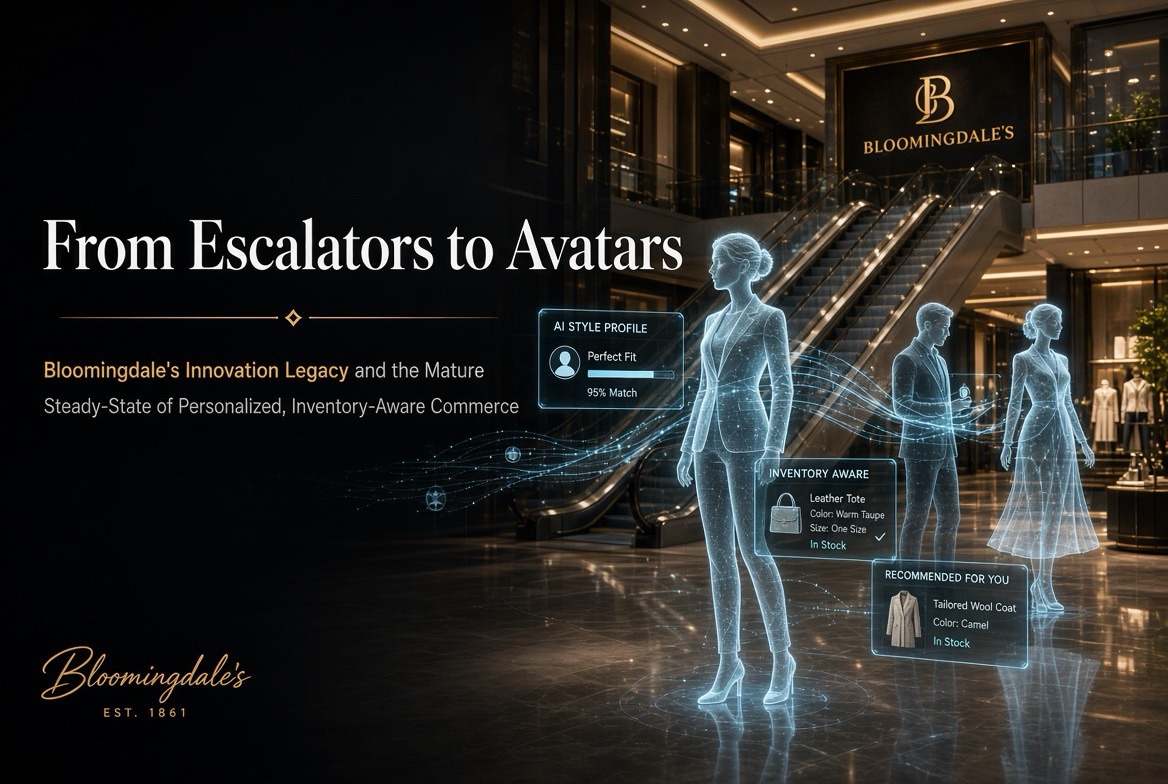
A Current-State vs. Full-Adoption Study of Persistent Customer Identity, Digital Twins, Real-Time Inventory Intelligence, Conversational AI, and Unified Commerce
Executive Perspective
Retail innovation is often analyzed as a sequence of technologies: the elevator, escalator, credit card, barcode, e-commerce site, mobile application, RFID tag, augmented-reality fitting tool, and artificial-intelligence assistant. That framing can obscure the more important pattern. The technologies that ultimately reshape retail are those that become sufficiently mature, interconnected, inexpensive, trusted, and operationally embedded that customers stop perceiving them as technologies at all.
This study therefore examines personalized, avatar-enabled, inventory-aware commerce not as an emerging experiment but as a mature steady-state operating model. The analysis assumes that the principal components—persistent customer profiles, photorealistic digital twins, item-level inventory intelligence, conversational and multimodal AI, visualization, unified commerce, and automated fulfillment orchestration—have achieved broad adoption and have been integrated into normal retail operations.
Bloomingdale’s provides the historical narrative anchor because its innovation legacy illustrates a recurring retail principle: successful innovation reduces friction while simultaneously increasing discovery, confidence, relevance, and theatricality. Elevators and escalators made large multistory stores navigable. Windows and Model Rooms made merchandise imaginable. International fairs transformed assortment into cultural experience. Designer boutiques reduced discovery complexity. RFID and omnichannel systems began connecting physical inventory with digital demand.
In a mature AI-commerce environment, the same underlying problem is solved at a new level. Instead of helping customers move efficiently through physical floors of merchandise, the retailer helps them move efficiently through an enormous decision space of products, sizes, combinations, prices, occasions, inventory locations, and fulfillment possibilities.
The central conclusion is that the mature state is not defined by an AI chatbot or a realistic avatar. It is defined by the integration of identity + fit + preference + inventory + visualization + decision intelligence + transaction + fulfillment into one continuous commerce system.
1. Bloomingdale’s Innovation Legacy as an Analytical Framework
Bloomingdale’s history can be interpreted as a long progression toward making increasingly complex assortments easier to discover, understand, visualize, and purchase. Its roots extend to the Bloomingdale family’s nineteenth-century apparel business, followed by the Great East Side Bazaar and the development of the large New York department-store format. As the store expanded, physical scale created a new problem: customers had to move efficiently through multiple floors and increasingly large assortments.
Mechanical vertical transportation helped solve that problem. Elevators and the early retail use of escalator technology did more than move people. They changed the economics and psychology of multistory retail. Upper floors became commercially viable, customer circulation increased, and movement itself became part of the shopping experience.
The same pattern appeared in visual merchandising. Dramatic windows, complete room presentations, Barbara D’Arcy’s Model Rooms, international merchandising events such as Casa Bella, designer boutiques, and the Big Brown Bag all combined practical retail functions with storytelling and identity.
The Model Room is particularly relevant to the future of digital commerce. Furniture displayed as isolated products requires customers to perform the difficult cognitive task of imagining how separate objects will work together. A fully designed room externalizes that mental work. It converts products into a coordinated outcome.
A mature digital styling system performs essentially the same function for apparel. Instead of asking a shopper to inspect a coat, trousers, shoes, shirt, and accessories separately and mentally assemble them, the system presents the coordinated result directly on a representation of the shopper.
Later developments in RFID, mobile commerce, pickup, delivery, smart fitting rooms, and omnichannel retail began solving another problem: the separation between what the customer could see digitally and what the retailer could actually locate and fulfill physically.
Viewed as a continuum, Bloomingdale’s innovation history repeatedly addresses four questions:
- How can the retailer understand what the customer wants?
- How can merchandise be presented so the customer can imagine the outcome?
- How can customers navigate a large assortment without excessive effort?
- How can inspiration be converted into possession with minimal friction?
The mature avatar-and-AI commerce model answers the same questions using digital identity, computational visualization, inventory intelligence, and conversational decision support.
2. The Current Retail Picture
Current retail already contains most of the technological components required for this future, but they generally exist as partially connected systems rather than as one coherent customer environment.
Customer identity is fragmented among loyalty databases, e-commerce accounts, mobile applications, payment systems, marketing platforms, customer-service records, and store interactions. A retailer may know what a customer purchased without reliably knowing whether the item fit well, why it was purchased, whether it was returned because of fit, or how it coordinates with the customer’s existing wardrobe.
Product discovery remains similarly fragmented. Search engines retrieve products. Recommendation engines predict likely clicks or purchases. Merchandising teams create seasonal stories. Influencers provide inspiration. Virtual try-on tools visualize selected products. Inventory systems determine availability. Fulfillment systems determine how an order can reach the customer.
The customer is frequently responsible for connecting these systems mentally.
A shopper may discover an outfit on social media, search for similar products, determine sizes independently, check whether individual items are available, imagine whether the pieces coordinate, place an order, and only after delivery discover whether the combination actually works.
The central weakness of the current model is therefore not an absence of technology. It is an absence of integrated decision intelligence.
3. Current State vs. Mature Steady State
| Dimension | Current Retail State | Mature Steady State |
|---|---|---|
| Customer identity | Fragmented across accounts, channels, loyalty systems, and transactions | Persistent, permissioned profile available across authorized touchpoints |
| Sizing and fit | Size charts, historical purchases, customer judgment, and trial-and-error | Continuously maintained body and fit model with category-specific confidence |
| Product discovery | Search, browsing, merchandising, advertising, and recommendations | Conversational, outcome-oriented decision support |
| Visualization | Product photography and limited virtual try-on | Personal digital twin as a standard evaluation environment |
| Inventory | Availability may be delayed, approximate, or channel-specific | Near-real-time item-level network visibility |
| Recommendations | Primarily behavioral or segment-based | Constraint-based optimization incorporating fit, taste, inventory, context, and fulfillment |
| Store role | Merchandise display and transaction location | Showroom, validation environment, service center, and fulfillment node |
| Associate role | Product locator, advisor, and transaction facilitator | Stylist, relationship manager, creative advisor, and exception specialist |
| Fulfillment | Often selected after product discovery | Evaluated during recommendation generation |
| Returns | Frequently used to resolve uncertainty after purchase | More uncertainty resolved before purchase |
4. The Mature Steady-State Commerce Architecture
In the mature state, shopping begins not with a search box but with a permissioned customer identity. The profile can contain verified or customer-provided measurements, category-specific sizing, preferred fits, colors, style preferences, purchase history, wardrobe information, budget tendencies, lifestyle context, and explicit data permissions.
The profile is not simply a marketing record. It becomes an input into a real-time decision system.
A digital twin provides the visual representation layer. The shopper may maintain a photorealistic avatar generated from photographs, measurements, scans, historical fit information, or combinations of these sources. As the system matures, the avatar becomes less of a novelty and more analogous to a saved shipping address: persistent infrastructure that the customer updates when necessary.
Inventory intelligence supplies the reality constraint. Recommendations are generated against merchandise that can actually be obtained within the customer’s acceptable fulfillment window. Item-level availability, size, color, store location, reservation status, distribution-center inventory, expected replenishment, and delivery options become part of the recommendation process.
Conversational AI becomes the orchestration layer connecting these systems.
A Conceptual Recommendation Equation
A mature recommendation engine can be represented conceptually as a constrained scoring problem. The following equation is analytical rather than a claim about any specific retailer’s proprietary algorithm:
Where:
- R(i,u,c) = recommendation score for item or outfit i, user u, and context c
- F = fit compatibility
- P = personal style compatibility
- T = trend and contextual relevance
- W = compatibility with the customer’s existing wardrobe
- M = merchandising or commercial relevance
- N = novelty or discovery value
- w = adjustable weights governing the relative importance of each factor
Crucially, the score operates only after hard constraints have been satisfied.
Where A represents availability, S acceptable sizing, C customer-defined constraints, and D fulfillment feasibility. If any mandatory condition equals zero, the item is excluded regardless of how attractive its recommendation score might otherwise be.
This distinction is fundamental. Current recommendation systems can recommend something desirable that is unavailable. A mature system must recommend something desirable and executable.
5. The Mature Customer Journey
Consider a shopper entering a flagship store or opening the retailer’s mobile interface. Authentication loads the customer’s authorized profile, digital twin, wardrobe context, and current preferences. The shopper asks:
“Show me the top three suggestions for the hottest fall season outfits for me.”
The request does not initiate a conventional keyword search. It initiates a constrained decision process.
The system evaluates seasonal trends, the shopper’s measurements and fit history, preferred silhouettes and colors, existing wardrobe, price sensitivity, current store inventory, network inventory, fulfillment timing, and the compatibility of individual pieces as complete outfits.
Three coordinated looks appear directly on the shopper’s digital twin. Each is presented as an outcome rather than a collection of unrelated product cards.
The shopper can rotate the avatar, compare looks side by side, change lighting conditions, add or remove accessories, and—where sufficiently accurate digital garment models exist—view the outfit in motion.
The conversation then becomes iterative.
“Make the second one more formal.”
The system preserves the accepted elements of the second outfit while modifying the components responsible for its level of formality.
“Swap the shoes for something in stock in my size.”
The AI does not merely retrieve visually similar shoes. It filters the candidate set by verified or probable size, current availability, outfit compatibility, price, and fulfillment feasibility.
“Keep the entire outfit under $900 and use the navy coat I already own.”
The system now treats the owned coat as a fixed component and re-optimizes the remaining outfit within the new budget constraint.
Here, U(O,u) represents the utility of complete outfit O for user u; B is the customer’s budget; and Fmin is the minimum acceptable fit-confidence threshold. The equation illustrates the conceptual shift from product retrieval to constrained solution optimization.
6. From Recommendation to Immediate Fulfillment
In the mature state, fulfillment is not a separate stage that begins after the customer decides what to buy. Fulfillment feasibility is incorporated into the recommendation itself.
Each completed look can therefore offer immediate actions such as:
- Send the complete outfit to a fitting room.
- Reserve all available pieces.
- Purchase for immediate pickup.
- Purchase and ship to the customer.
- Split fulfillment across store and distribution inventory.
- Request an associate or stylist review.
If an item becomes unavailable during the session, the system does not simply display an out-of-stock message. It re-optimizes the outfit and proposes the closest substitute that preserves the customer’s accepted aesthetic and functional constraints.
This is where inventory intelligence becomes customer experience. Inventory accuracy is no longer merely an operational metric hidden inside the supply chain. It directly determines whether the AI can be trusted.
7. The Transformation of the Physical Store
Full adoption does not imply the disappearance of stores. It changes their economic and experiential role.
The mature flagship increasingly operates as a combination of showroom, validation environment, service center, fulfillment node, cultural venue, and human styling studio. Customers no longer need every possible variation physically displayed in order to discover it. Digital visualization can expose the broader assortment while the store concentrates physical space on products, experiences, services, and environments where touch, fit, theater, and human interaction create the greatest value.
This development is consistent with Bloomingdale’s historical concept of retailing as theater. Technology handles complexity in the background so that the physical environment can concentrate on experience.
The historical escalator moved customers efficiently through physical merchandise. Mature AI moves customers efficiently through decision space.
The historical Model Room externalized the imagination required to combine furniture. The digital twin externalizes the imagination required to combine apparel.
RFID made physical inventory more visible to the retailer. Mature inventory-aware AI makes that inventory intelligible and actionable for the customer.
8. The Changing Role of the Associate
Automation also changes the economics of human service. Associates currently spend meaningful effort locating merchandise, checking sizes, retrieving alternatives, answering routine product questions, and facilitating transactions.
In the mature state, much of this informational work is automated. Human labor moves toward activities where human judgment has greater comparative value:
- Creative styling and aesthetic challenge
- Relationship development
- Emotional reassurance
- Special-event preparation
- Complex fit and alteration decisions
- Luxury service
- Exception handling
- Introducing customers to unfamiliar designers or styles
The AI therefore does not eliminate the stylist. It can increase the stylist’s leverage by transferring the customer’s approved context, rejected alternatives, fit information, inventory status, and current shortlist before the human interaction begins.
9. Mature-State Retail Economics
The business case for mature adoption rests on the interaction of conversion, basket size, returns, inventory productivity, and service efficiency rather than on any single metric.
Conversion
The mature system seeks to improve conversion by reducing uncertainty between inspiration and purchase. The important analytical question is not whether AI interaction correlates with conversion, but whether controlled comparisons demonstrate incremental conversion after accounting for customer intent and selection effects.
Basket Expansion
Traditional product recommendations frequently operate item by item. Mature styling systems optimize complete solutions. A customer seeking trousers can therefore be shown a coherent outfit rather than an arbitrary sequence of cross-sells. Basket expansion becomes a consequence of solution completeness rather than promotional pressure.
Return Economics
Digital twins cannot eliminate returns because comfort, fabric feel, personal reaction, and imperfect simulation remain relevant. Their economic value lies in resolving a larger portion of fit and appearance uncertainty before fulfillment occurs.
Inventory Productivity
This conceptual relationship captures an important mature-state effect. Recommendation systems can actively steer demand toward merchandise that is both relevant to the customer and operationally available. Personalization and inventory management therefore begin to converge.
10. Privacy, Consent, and Digital Identity
The mature state requires substantially stronger governance than conventional loyalty personalization because body measurements, photographs, purchase histories, wardrobe information, and lifestyle context can reveal sensitive information.
Consent therefore becomes part of the product architecture rather than a one-time legal acceptance screen. Customers should be able to determine which information can be used for which purposes, inspect active permissions, revoke access, delete stored representations, and use reduced-data or guest experiences.
The strongest mature model is not the retailer that collects the most information. It is the retailer that can produce the greatest customer value from the minimum information necessary for the authorized purpose.
11. Avatar Accuracy and Body-Image Considerations
A mature digital twin must represent the customer rather than silently modify the customer. Automatic beautification, slimming, reshaping, or other appearance manipulation would undermine both trust and fit accuracy if applied without explicit customer control.
The system should also distinguish visualization from certainty. A garment may have high confidence for color and length but lower confidence for drape, compression, movement, or tactile comfort. Mature interfaces should communicate these differences rather than presenting photorealism as proof of physical accuracy.
This creates an important principle:
Customer Trust = Accuracy + Transparency + Control + Reliability
12. Avoiding the Personalization Filter Bubble
Perfect personalization can become strategically counterproductive if it merely reproduces the customer’s past. Department stores historically created value partly through discovery: unfamiliar designers, unexpected combinations, international influences, and new aesthetic ideas.
A mature recommendation system should therefore optimize not only familiarity but controlled novelty.
If novelty approaches zero, personalization becomes repetitive. If relevance approaches zero, discovery becomes noise. If confidence approaches zero, experimentation becomes risky. The mature retailer balances all three.
13. Strategic Implications
In the current retail environment, competition is commonly framed around assortment, price, brand, location, convenience, marketing, and fulfillment speed. Those factors remain important in the mature state, but another competitive asset becomes increasingly significant: the quality of the retailer’s customer decision architecture.
The competitive question changes from:
“Who has the product?”
to:
“Who can most reliably determine which available combination is right for this customer, demonstrate why, visualize the outcome, and fulfill it immediately?”
This favors retailers capable of integrating customer trust, merchandising expertise, high-quality product data, inventory accuracy, digital assets, AI reasoning, physical stores, human service, and fulfillment infrastructure.
It also suggests that heritage department stores possess an underappreciated strategic advantage. Their historical expertise is not merely owning stores or carrying brands. At their best, department stores specialize in curating complexity. AI can industrialize that capability without eliminating its human and theatrical dimensions.
14. What Full Adoption Ultimately Means
Full adoption should not be defined as every customer using an avatar or every transaction involving AI. Mature technologies become infrastructure precisely because customers can use them selectively without disrupting the broader system.
The mature state exists when:
- customer identity can persist securely across authorized interactions;
- fit and preference information can inform decisions without being repeatedly re-entered;
- digital twins are sufficiently accurate to improve confidence;
- inventory availability is reliable enough to constrain recommendations;
- AI can reason across products rather than merely retrieve them;
- visualization and conversation operate as one interface;
- fulfillment feasibility is considered before recommendations are presented;
- human associates inherit useful context rather than starting over;
- customers retain meaningful control over their data and representation; and
- the entire system produces measurable improvements in customer and retailer outcomes.
Conclusion: From Moving People to Moving Decisions
Bloomingdale’s historical progression—from nineteenth-century fashion retailing to the department-store format, mechanical vertical circulation, theatrical windows, Model Rooms, international fairs, designer boutiques, iconic packaging, RFID, and omnichannel commerce—reveals a remarkably consistent innovation logic.
Each major innovation reduced some form of friction while increasing the customer’s ability to discover, imagine, navigate, or acquire merchandise.
The escalator optimized movement through physical space.
The Model Room optimized imagination.
The designer boutique optimized curation.
RFID optimized knowledge of physical inventory.
Omnichannel commerce began optimizing movement between digital demand and physical fulfillment.
The mature avatar-and-AI commerce environment combines these functions into a new operating model. Persistent identity tells the system who the customer has chosen to be within the shopping context. The digital twin provides a personal visualization surface. Inventory intelligence establishes what is actually possible. Conversational AI translates intent into constrained decisions. Unified commerce converts those decisions into physical outcomes.
The resulting transformation is larger than virtual try-on or conversational shopping. It changes the fundamental unit of retail interaction from the product search to the customer outcome.
= Customer Identity + Digital Twin + Live Inventory + Decision Intelligence + Visualization + Human Expertise + Fulfillment
In that steady state, success is not measured by whether a retailer possesses the most sophisticated avatar or the most conversational AI. Success occurs when a customer can express an objective, immediately see credible possibilities tailored to them, understand why those possibilities work, know that the merchandise can actually be obtained, refine the solution naturally, and move from inspiration to possession with substantially less uncertainty.
That outcome is not a departure from the department store’s historical purpose. It is a technologically mature expression of it. The nineteenth-century department store organized physical abundance. The mature twenty-first-century retailer must organize decision abundance.
Bloomingdale’s innovation legacy provides an appropriate historical metaphor for that transition. The escalator made an expanding physical store navigable. The next great retail infrastructure will make an expanding universe of choices navigable—personally, visually, conversationally, and in real time.

