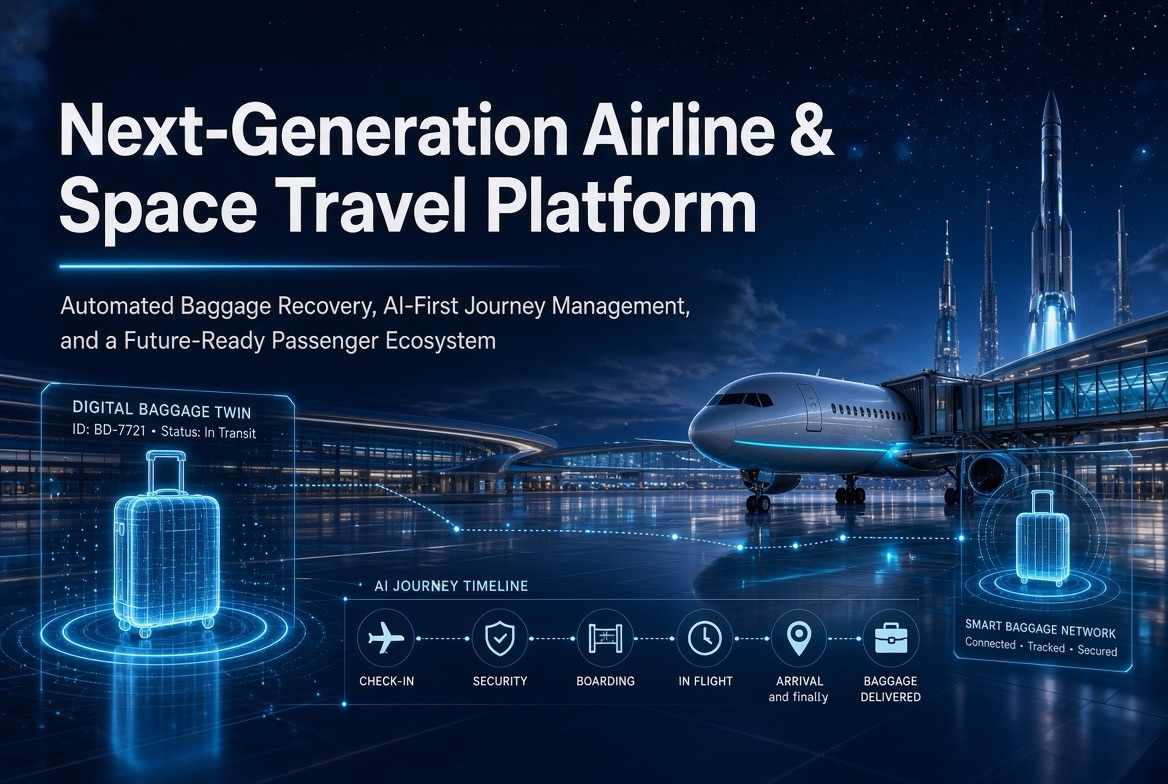
Automated Baggage Recovery, AI-First Journey Management, and a Future-Ready Passenger Ecosystem
Strategic product and operating-model research—not jurisdiction-specific legal advice.
This report evaluates the feasibility, differentiation, deployment pathways, partner requirements, economics, and future spaceport extensibility of a next-generation airline travel platform centered on automated baggage recovery, a governed bag digital twin, AI-first journey management, digital payments, and future transportation interoperability.
1. Executive Decision
Recommendation: Conditional Go
Launch an airline-sponsored, airport-partnered baggage-recovery pilot. Do not begin with a universal travel super-app or spaceflight booking platform.
Strongest MVP
A luggage hub combining verified bag events, automatic disruption detection, pre-filled digital reporting, address selection, courier orchestration, reimbursement intake, and human exception handling.
Primary Strategic Moat
Cross-party workflow orchestration and a governed bag digital twin—not another tracking map.
The platform is feasible now, but not as a fully independent consumer application. Its near-term success depends on direct access to airline, airport, handler, tracing, and delivery systems.
IATA Resolution 753 already establishes acceptance, loading, transfer, and arrival as minimum baggage-tracking points. WorldTracer already supports digital passenger reporting and case management. The opportunity is therefore to connect these components into one proactive, explainable workflow rather than recreate them.
The commercial problem remains material. SITA reported that approximately 24 million bags were mishandled in 2025, equal to approximately 4.9 bags per 1,000 passengers, with an estimated industry cost of approximately $6.3 billion and an average cost of approximately $260 per mishandled bag. Transfers represented a substantial portion of mishandling cases.
These figures should be treated as global industry benchmarks rather than airline-specific audited expenses. A pilot business case should replace them with actual airline and airport operating data wherever possible.
Recommended ownership model: a hybrid B2B2C structure. The airline should sponsor the passenger experience and remain accountable for carriage and customer redress. A neutral platform can provide event normalization, workflow orchestration, digital-twin services, courier integration, and analytics. Airports and ground handlers supply operational events.
2. Current-State Baggage Ecosystem
End-to-End Lifecycle
- Acceptance: The airline or agent accepts the bag, issues the baggage identifier, and associates it with the traveler and flight.
- Screening and sortation: Airport systems screen and route the bag using barcode, RFID, OCR, or manual processes.
- Make-up and loading: A Baggage Reconciliation System confirms authorized loading and may associate individual bags with a cart or unit-load device.
- Transfer: Custody and operational responsibility may pass among airlines, handlers, terminals, or airports.
- Arrival: The bag is unloaded and routed to reclaim, special delivery, customs, or an exception process.
- Disruption recovery: A delayed or misrouted bag may be traced, reflown, cleared, couriered, reimbursed, and eventually closed.
Failure Modes and Stakeholder Pain
| Failure Mode | Passenger Effect | Operational Effect | Platform Response |
|---|---|---|---|
| Missed or stale scan | Uncertainty and potentially misleading status | Weak exception detection | Show event source, timestamp, age, and confidence |
| Missed connection | Passenger arrives before bag | Reflight, delivery, and customer contacts | Predict risk and create recovery workflow |
| Interline handoff gap | Conflicting airline answers | Unclear custody and responsibility | Shared event model and custody ledger |
| Tag damage or detachment | Bag becomes difficult to identify | Manual matching effort | Bag image, descriptive attributes, and tracker link |
| Wrong reclaim or transfer routing | Bag appears to be at airport but not where expected | Retrieval delay | Cross-check arrival, transfer, and baggage-system events |
| Courier fragmentation | Repeated calls and uncertain delivery | Manual case-by-case follow-up | Digital dispatch, ETA, and proof of delivery |
| Damage or pilferage | Evidence burden | Valuation, fraud, and liability review | Time-bound photo capture and claim workflow |
| Customs or security hold | Unexplained delay | Release cannot necessarily be automated | Plain-language status and specialist escalation |
A core design principle is that tracking and reconciliation are not the same thing. A load event may indicate that a bag was processed toward an aircraft without proving final physical loading. The passenger interface should therefore distinguish verified events from inferred states.
3. Technology and Standards Assessment
| Technology | Best Role | Principal Limitation | Recommendation |
|---|---|---|---|
| Barcode / LPN | Universal identity and baseline interoperability | Line-of-sight and damaged tags | Maintain as required fallback |
| Passive RFID | High-volume automatic reads | Reader and tag infrastructure | Use at high-throughput hubs |
| OCR / Computer Vision | Recover unreadable tags and appearance matching | Lighting, camera coverage, and model governance | Add as secondary evidence |
| BLE Consumer Trackers | Passenger-supplied recovery signal | Crowdsourced, intermittent, and consent-dependent | Accept as an independent signal |
| GPS / Cellular | Specialized high-value tracking | Battery, communications, and carriage constraints | Optional premium or special-item use |
| Electronic Bag Tags | Off-airport tagging and reusable identity | Airline eligibility and integration | Partner rather than build hardware |
| WorldTracer | Multilateral tracing and digital case management | Experience and integration vary by airline | Integrate rather than replace initially |
| BIX / Modern Messaging | Structured cross-party interoperability | Migration from legacy messages | Adopt canonical events with adapters |
Consumer tracking should be represented as “passenger-authorized tracker location”, not as operational truth. The passenger interface should distinguish among:
- Last verified operational scan
- Passenger-authorized tracker location
- Sensor-derived location
- System-inferred location
- Predicted next movement or ETA
- Unknown or stale status
Every displayed status should include a source, timestamp, and confidence level.
4. Competitive Landscape and Differentiation
| Provider / Example | Demonstrated Capability | Remaining Gap |
|---|---|---|
| Delta | Booking, flight management, notifications, and bag tracking | Does not establish a neutral multi-carrier recovery layer |
| United | App bag tracking, online delayed reporting, consumer-tracker sharing, and delivery setup | Primarily operates within United’s own service ecosystem |
| Lufthansa | Digital baggage status, carousel alerts, electronic bag tags, and online delayed reporting | Availability and touchpoints vary by airport |
| SITA WorldTracer | Passenger reporting, tracing, case updates, and delivery integration | Often functions as a module rather than a unified journey object |
| BAGTAG Ecosystem | Off-airport electronic tagging | Does not itself solve disruption orchestration |
| Amadeus | BRS, DCS integration, messaging, travel inventory, and AI ecosystem | Implementation remains organization-specific |
The proposed product is therefore not differentiated merely by digital reporting or baggage status.
The stronger differentiation is a cross-organizational bag digital twin combined with automated fulfillment: one governed object unifying operational scans, tracker observations, custody, predicted recovery, passenger-selected destination, courier delivery, expenses, liability decisions, communications, and closure.
5. Future-State Passenger Experience
Normal Journey
The luggage menu should be visible directly from the active trip screen. Each bag card should display:
- Bag photograph
- Bag-tag identifier or suffix
- Planned route
- Latest verified event
- Last update time
- Current confidence level
- Next expected milestone
- Estimated arrival or delivery time when supportable
Terms such as “loaded,” “delivered to carousel,” and “courier delivered” should be used only when supported by the relevant operational event. An inference should instead be labeled “expected,” “predicted,” or “likely.”
Passenger Arrives Before the Bag
- The system detects no qualifying arrival event or identifies a missed-connection signal.
- The passenger receives a notification such as: “Your bag is delayed; you do not need to wait at the baggage desk.”
- Trip and bag data automatically pre-populate the report.
- The passenger verifies the bag image and may attach an authorized tracker location.
- The app offers the passenger’s profile address, current hotel, itinerary lodging, map pin, or manual address.
- The workflow checks customs, security, delivery eligibility, and airline policy.
- The bag is reflown and assigned to a courier.
- The passenger sees the recovery flight, delivery window, courier state, and proof of delivery.
- Eligible expenses and fee refunds are processed or reviewed.
- The case closes only after delivery confirmation and unresolved financial actions are completed.
6. Automated Disruption State Machine
| Event | Detection Signals | Automation Boundary |
|---|---|---|
| Delayed | Missing arrival event, passenger arrival, failed connection | Auto-create draft; passenger confirms address |
| Misrouted | Event at unexpected station | Auto-alert operations; avoid exposing sensitive airside detail |
| Lost | Unresolved case beyond governing policy or treaty threshold | Human valuation and liability approval |
| Damaged | Passenger photos and report timestamp | AI may classify; human adjudicates |
| Pilfered | Inventory discrepancy or passenger claim | Fraud and security review |
| Unaccompanied | Passenger and bag itinerary divergence | Apply security and reflight controls |
| Customs Hold | Government or handler release state | Inform passenger; no autonomous override |
7. Technical and Data Architecture
The architecture should preserve airline and operational systems as authoritative sources while creating a consent-governed orchestration layer between those systems and the passenger experience.
Bag Digital Twin
BagTwin
├── bagId / 10-digit LPN
├── passengerOrderLink
├── image + descriptive attributes
├── plannedJourney[]
├── observedEvents[]
│   ├── eventType
│   ├── source
│   ├── time
│   ├── station
│   ├── custodyParty
│   └── confidence
├── latestVerifiedEvent
├── trackerObservations[] (consent-scoped)
├── inferredState
│   ├── reason
│   └── modelVersion
├── connectionRisk
├── ETA
├── uncertainty
├── security/customsState
├── disruptionCase
├── recoveryJourney
├── deliveryAddressToken
├── courierState
├── proofOfDelivery
├── expenses/refunds/compensation
├── consentHistory
└── immutableAudit
Systems of Record
- Airline order / PSS: commercial itinerary
- DCS: check-in and operational passenger state
- BRS / BHS: baggage-handling events
- WorldTracer or airline case platform: tracing and disruption case
- Payment processor: financial transactions
- Courier: delivery state and proof of delivery
- Identity provider: authentication and authorization
- Government systems: customs, admissibility, and regulatory decisions
The bag digital twin should function as an orchestration projection, not as a replacement for every underlying source system.
8. AI Travel Assistant, Payments, and Loyalty
The AI assistant should convert voice or chat requests into structured constraints such as dates, budget, traveler identities, accessibility requirements, narrative order, preferred pace, loyalty preferences, and payment rules.
It should then query authoritative inventory and policy services rather than treating generated language as inventory.
“Book a summer vacation that visits the real-world locations associated with an Odyssey-style journey in narrative order, while staying within my budget and available calendar dates.”
The AI may recommend and draft automatically. Reservations and purchases should require explicit authorization rules and a final passenger review displaying supplier, itinerary, restrictions, total price, currency, cancellation terms, and payment source.
AI Action-Control Model
| Action | AI Authority |
|---|---|
| Research destinations | Automatic |
| Generate itinerary options | Automatic |
| Compare live offers | Automatic |
| Recommend a booking | Automatic |
| Hold inventory | Only under explicit passenger rules |
| Purchase travel | Explicit passenger authorization required |
| Change or cancel high-value travel | Explicit authorization required |
| Override customs, security, or safety decisions | Never |
9. Legal, Privacy, and Regulatory Matrix
| Regime | Product Implication |
|---|---|
| U.S. Domestic | Airlines must compensate qualifying lost, delayed, or damaged-baggage losses subject to applicable rules and liability limits. |
| Montreal Convention | International baggage liability is subject to the applicable SDR ceiling; the ceiling is not an automatic award. |
| EU / UK | Apply Montreal-based baggage liability plus regional consumer, accessibility, privacy, and complaint rules. |
| Canada | Apply applicable Air Passenger Protection Regulations and accessible passenger-rights requirements. |
| GDPR / UK GDPR | Define controller and processor roles, purpose, lawful basis, retention, rights, transfers, security, and automated-decision transparency. |
| Payments | Apply PCI DSS, processor and wallet requirements, regional authentication, refund, and chargeback rules. |
| Biometrics / Location | Use separate, revocable consent and minimal disclosure. |
| Spaceflight | Dedicated informed-consent, safety, medical, training, and participant-readiness workflows are required. |
10. Business Case
The business case should be built from airline-specific operating data rather than relying exclusively on global industry averages.
Core Business-Case Variables
| Variable | Definition |
|---|---|
| P | Annual checked passengers |
| r | Local mishandling rate per passenger |
| e | Percentage of incidents eligible for digital resolution |
| d | Digital completion rate |
| S | Savings per digitally resolved incident |
| R | Incremental annual platform or ancillary revenue |
| F | Annual fixed platform cost |
| V | Variable cost per digitally resolved case |
Equation 1 — Annual Mishandled-Baggage Incidents
Where I is the estimated number of annual mishandled-baggage incidents.
Equation 2 — Digitally Eligible Cases
Where E represents incidents that can reasonably be handled through the digital workflow.
Equation 3 — Completed Digital Cases
Combining the first three equations:
Equation 4 — Savings per Digitally Resolved Incident
The savings components can include:
- Cdesk = avoided baggage-desk labor cost
- Ccontact = avoided contact-center cost
- Ctracing = reduced tracing labor
- Crecovery = reduced recovery or reflight cost
- Ccourier-admin = reduced courier-administration cost
- Cleakage = prevented compensation or fraud leakage
Equation 5 — Gross Annual Savings
Substituting the digital-case equation:
Equation 6 — Net Annual Benefit
A more explicit formulation is:
Equation 7 — Break-Even Digital Cases
In conventional mathematical notation:
Equation 8 — Payback Period
Equation 9 — Net Present Value
Where:
- I0 = initial investment
- CFt = net cash flow in period t
- k = required discount rate
- n = number of periods
Equation 10 — Internal Rate of Return
The internal rate of return is the discount rate IRR that satisfies:
NPV and IRR should not be treated as credible until the pilot airline supplies station-level incident counts, fully loaded labor rates, handling time, contacts per case, delivery costs, compensation, tracing and reflight costs, current app adoption, integration costs, and applicable capital assumptions.
11. Build, Buy, Partner, and Governance
| Capability | Recommended Decision |
|---|---|
| Passenger luggage UX | Build |
| Bag digital twin and event normalization | Build — Core IP |
| Workflow, rules, and analytics | Build / Configure |
| WorldTracer tracing | Partner / Integrate |
| BRS / BHS / DCS / PSS / Order systems | Integrate |
| RFID readers and digital tags | Partner |
| Consumer tracker networks | Partner with revocable consent |
| Courier network | Partner through multi-carrier orchestration |
| Payment acquiring and wallets | Partner |
| Identity and passkeys | Standards-based integration |
| AI foundation models | Multi-model partner; retain orchestration and audit |
| Spaceflight safety, medical, and consent | Future specialist module |
12. Roadmap and Pilot
| Horizon | Scope | Gate |
|---|---|---|
| 0–3 Months | Data-access validation, legal mapping, service blueprint, baseline costs | Four-event coverage and partner agreements |
| 3–9 Months | Luggage hub, verified status, digital report, address selection | Accuracy, completion, and accessibility |
| 9–18 Months | Automated recovery, courier, reimbursements, predictive alerts | Cost and resolution improvement |
| 18–24 Months | AI planning, live offers, wallet checkout, calendar synchronization | Booking accuracy and authorized-payment success |
| 24–36 Months | Multi-airline and multi-airport deployment plus interline events | Cross-party SLAs and unit economics |
| Later | Spaceport identity, readiness, consent, custody, scrub, and recovery events | Licensed-operator demand and regulatory maturity |
Recommended Pilot
Begin with one airline, one hub, two to four domestic spoke stations, the airline’s principal ground handler, its existing tracing platform, and one courier integrator.
The pilot should include normal, delayed, damaged, multiple-bag, mobility-aid, and low-connectivity journeys while excluding autonomous international customs decisions and fully autonomous AI purchasing.
KPI Tree
- Coverage: acceptance, load, transfer, and arrival-event completeness; status freshness.
- Accuracy: displayed-status accuracy, prediction precision and recall, and false alerts.
- Passenger: task completion, abandonment, accessibility success, trust, and complaints.
- Operations: notification, case creation, recovery, dispatch, delivery, reimbursement, and closure time.
- Economics: cost per case, contacts per case, desk deflection, courier cost, and leakage.
- Reliability: availability, latency, failed events, duplicate cases, and security incidents.
- AI: grounded-offer accuracy, price-change handling, unauthorized-action rate, and escalation.
- Equity: smartphone versus assisted-channel completion and comparable outcomes.
13. Principal Risks
| Risk | Severity | Mitigation |
|---|---|---|
| Poor or missing partner events | High | Confidence labels, stale-state UX, and contractual data SLAs |
| Incorrect automated disruption | High | Threshold validation, reversible workflow, and human review |
| Location or identity misuse | High | Consent isolation, minimization, expiry, and audit |
| Legacy integration failure | High | Event adapters, replay, offline queue, and manual fallback |
| Overpromising “real time” | High | Source, timestamp, and confidence vocabulary |
| Regulatory inconsistency | High | Journey-level rules engine and qualified local counsel |
| AI purchases wrong itinerary | High | Live inventory, final confirmation, and transaction limits |
| Vendor concentration | Medium | Portable event model and multi-provider contracting |
| Scope creep | High | Phased baselines and stop/scale gates |
| Premature spaceport investment | Medium | Design adapters now; implement domain modules later |
14. Final Decision Answers
- Is the platform feasible now?
Yes—conditionally, using airline and partner integrations. - Which portions are technically available but operationally fragmented?
Tracking events, app status, consumer-tracker sharing, tracing, delivery, wallets, digital identity, and AI planning. - What is the strongest differentiated MVP?
A bag digital twin combined with end-to-end delayed-baggage recovery. - Which promises must be qualified?
Use “latest verified event” or “passenger-authorized tracker location” rather than promising universal real-time location. - Who should own and operate the platform?
The airline should retain the passenger relationship while a neutral orchestration platform manages cross-party workflows and airports and handlers provide operational data. - Which partners are unavoidable?
Airlines, airports, ground handlers, tracing providers, couriers, payment providers, identity providers, and consumer-tracker ecosystems. - What are the principal gating factors?
Event rights, interline exchange, data quality, source-of-truth governance, contracts, privacy, customs, and liability rules. - What is the best pilot?
One carrier and one hub with controlled spoke stations and existing tracing and baggage-system access. - What should trigger scale?
Improved case completion, resolution time, contact volume, unit cost, passenger trust, and event coverage without material legal, safety, or security failures. - Is spaceport compatibility valuable?
Yes as an architectural extension, but it is premature as a major operational investment. - What is the recommended go-to-market model?
White-label SaaS plus integration and transaction or workflow fees. Passenger-data monetization should not be a core business model. - What should be built over 12, 24, and 36 months?
First the baggage hub and digital recovery workflow; then AI retailing, payments, and servicing; then interline and multi-airport scale.
Final Recommendation
Proceed to a tightly governed pilot.
The concept’s strategic value is not that every supporting technology is new. Its value is that the platform can make the baggage-disruption journey continuous, proactive, explainable, and fulfillable from the passenger’s existing travel application.
The strongest near-term product is therefore not simply a better baggage tracker. It is an automated baggage recovery operating layer connecting the passenger, airline, airport, ground handler, tracing system, courier, payment system, and customer-service organization.
Spaceport compatibility should influence the platform’s data models, identity architecture, event model, and adapter boundaries from the beginning. However, material investment in spaceflight-specific functionality should remain gated until the aviation product demonstrates measurable operational and financial value.

