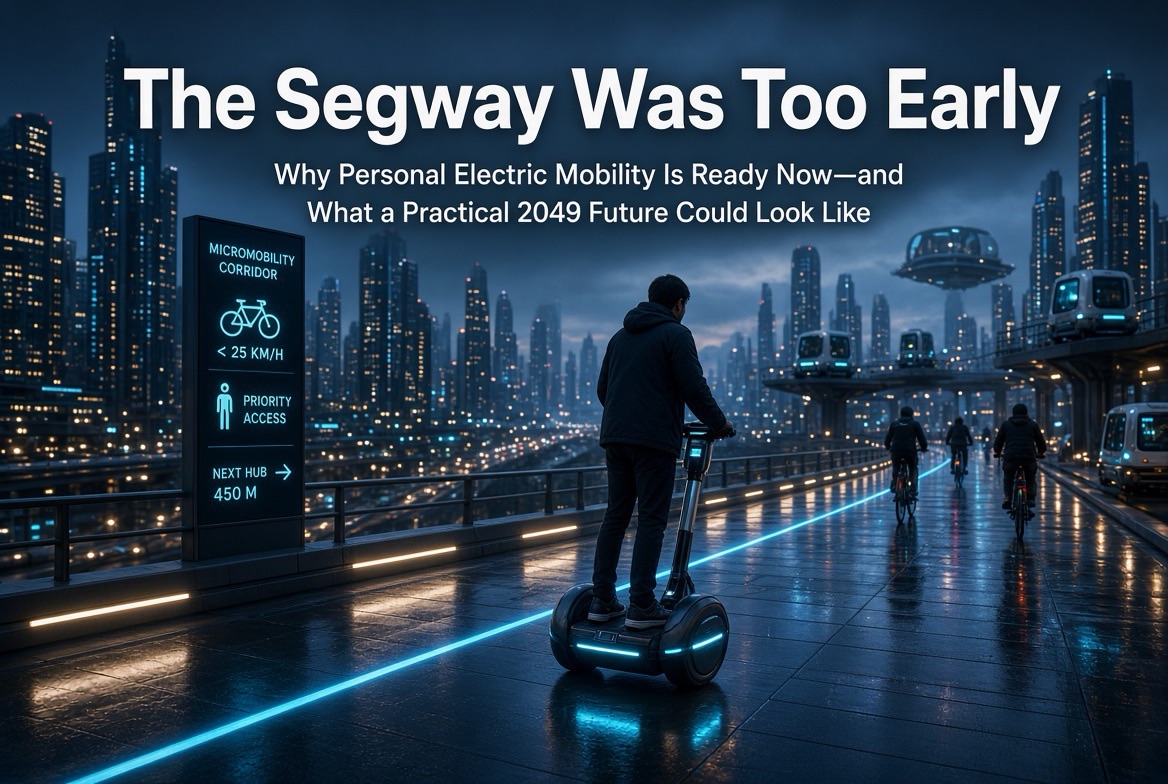
Abstract — The original Segway Personal Transporter demonstrated successful self-balancing engineering but failed as a mass-market mobility system; two decades of battery progress, micromobility adoption, infrastructure investment, digital integration, and regulatory learning now make a refined Segway-class platform commercially plausible, though success would depend more on product-market fit and street design than on technology alone.
Introduction
The Segway’s history is a case study in the difference between inventing a compelling machine and introducing a viable transportation system. Before its December 2001 unveiling, a leaked proposal described a secret invention—variously known as “IT” and “Ginger”—that Steve Jobs reportedly considered as significant as the personal computer and Jeff Bezos called revolutionary. The resulting media frenzy created expectations closer to antigravity than to a short-distance electric vehicle; even the televised reveal produced an immediate “That’s it?” reaction. Yet people who actually rode the machine frequently described an intuitive, almost magical sensation, suggesting that the engineering achievement was real even if the social narrative surrounding it was unsustainable.
The commercial product exposed the mismatch. A 2002 Segway weighed approximately 83 pounds, cost $4,950, traveled approximately 8–12 miles, and reached 12.5 mph. Those specifications were impressive for an early battery-powered, dynamically stabilized vehicle, but they were difficult to reconcile with stairs, apartment storage, public transit, casual ownership, or the price of competing bicycles and used cars.
The central argument of this report is therefore qualified rather than nostalgic: the Segway was technologically successful as a demonstration of dynamic stabilization, but it was not yet a market-ready mobility system. Timing was decisive because batteries, infrastructure, digital services, regulation, and consumer behavior were immature—but overengineering, excessive cost, awkward portability, and weak market research were genuine product shortcomings, not merely bad luck.
Why the Segway Was Too Early
Dean Kamen’s team adapted self-balancing technology originally developed for the iBOT mobility device. Gyroscopes, sensors, processors, redundant batteries, and dual motors continuously moved the wheels beneath the rider’s center of gravity, allowing acceleration and braking through body movement. Contemporary accounts describe thousands of measurements and calculations occurring each second and substantial redundancy intended to prevent a single-point failure. This made the Segway unusually durable and technically sophisticated, but also heavy, expensive, difficult to service, and dependent on early-generation rechargeable batteries.
Battery limitations were particularly consequential because dynamic balancing requires continuous power, not merely propulsion. In 2003, approximately 6,000 Segways were recalled for a software upgrade after low-battery conditions could leave insufficient power to maintain balance during abrupt acceleration or obstacle encounters; three related falls had been reported. This was not evidence that the basic control concept was unsound, but it showed that power management and rider safety were inseparable.
Modern battery economics illustrate how different the underlying environment has become. The U.S. Department of Energy estimates that large-scale lithium-ion vehicle-pack cost declined from $1,415 per usable kilowatt-hour in 2008 to $139 per usable kilowatt-hour in 2023, measured in constant 2023 dollars.
Battery-cost decline:
((1415 − 139) / 1415) × 100 ≈ 90.2%
In other words, estimated large-scale battery-pack cost fell by roughly 90%. The calculation above is included both as MathML and as plain text so that the mathematical relationship remains readable even if a WordPress theme or plugin does not render MathML.
Market readiness was equally weak. Kamen’s secrecy prevented normal consumer research, and the product emerged with an institutional design, a premium price, and no clearly prioritized user segment. It was too expensive for routine walking replacement, too slow and exposed to replace a car, and heavier and less portable than a bicycle. The initial hype worsened the problem: an effective but bounded transportation device was judged against claims that it would reorganize cities. Popular depictions subsequently associated it with tourists, security personnel, and comic awkwardness, converting unfamiliarity into stigma.
The regulatory strategy also revealed the absence of an established operating environment. Segway did not fit existing definitions of pedestrian, bicycle, wheelchair, or motor vehicle. In early 2002, state legislatures created “electric personal assistive mobility device” rules permitting sidewalk use, often with locally varying speed limits, helmet provisions, and other qualifications. Pedestrian advocates objected that an approximately 80-pound machine traveling near bicycle speeds did not belong in walking space, while road classification could expose riders to faster traffic.
This produced a structural problem that remains relevant: a vehicle may be technically safe in isolation yet systemically unsafe when placed in infrastructure designed for a different speed and mass.
The surrounding ecosystem supplied few compensating advantages. The launch preceded app-based shared micromobility, ubiquitous navigation, digital payment, ride-hailing, real-time vehicle diagnostics, and the fleet-management systems that now make small vehicles discoverable and maintainable. Shared micromobility did not emerge as a significant commercial category until 2017; the original Segway therefore asked individuals to purchase, store, charge, secure, maintain, and socially justify an expensive unfamiliar machine themselves.
Car-oriented urban design, limited protected cycling networks, inexpensive parking, and weaker climate-policy pressure further reduced the value of replacing short automobile trips.
Commercially, the product settled into durable niches—police, security, tours, campuses, and industrial facilities—rather than mass personal transport. Kamen sold the company in 2009; it later passed to Summit Strategic Investments and was acquired by Ninebot in 2015. Approximately 140,000 original-format Segways were sold over two decades, and the Segway PT represented less than 1.5% of company revenue before production ended in July 2020.
That trajectory supports a nuanced verdict: the Segway did not fail because balancing technology was fraudulent. It failed because a high-cost, heavy and ambiguous vehicle entered a world without the complementary infrastructure, digital layer, social familiarity, or scalable use cases required to turn novelty into routine mobility.
The Current Rise of Electric Personalized Transportation
The market the Segway anticipated now exists, although it is fragmented across many form factors:
- Electric kick scooters, privately owned or shared, emphasize low cost, narrow width, and foldability.
- E-bikes extend cycling range and accessibility; cargo models serve families and delivery work, while folding variants integrate with transit and small homes.
- Self-balancing devices include hoverboards, electric unicycles, one-wheel boards, and compact knee-controlled platforms.
- Electric skateboards and longboards prioritize portability and recreational or enthusiast commuting.
- Segway-style transporters survive in lighter forms. The Ninebot S2, for example, offers app controls, a 335 Wh battery, an advertised 21.7-mile typical range, 11.2 mph speed, water-resistance measures, and UL-certified battery and electrical systems.
- Seated scooters, adaptive cycles, tricycles, and lightweight multi-wheel vehicles expand micromobility toward older riders, mobility-limited users, passengers, and urban freight.
This diversity matters because there is no universal “last-mile” vehicle. Kick scooters excel at short, spontaneous trips; e-bikes offer efficiency over longer distances; cargo bikes trade compactness for payload; and self-balancing devices maximize maneuverability and a small footprint but demand training. SAE’s micromobility taxonomy now formally differentiates powered bicycles, standing and seated scooters, self-balancing boards, non-self-balancing boards, and powered skates—evidence that a once-ambiguous product space has become a recognized transportation category.
Adoption is no longer speculative. North American riders made at least 237 million shared-micromobility trips in 2025, approximately 5% more than in 2024, across approximately 350,000 vehicles and at least 403 cities. The average trip was approximately 1.5 miles, and 70% of surveyed riders reported using shared micromobility to connect with transit.
Earlier NACTO data recorded 157 million U.S. and Canadian trips in 2023, including 81 million station-based bikeshare trips and 69 million dockless-scooter trips. European industry data separately recorded 5.1 million e-bikes sold in the EU27 and United Kingdom in 2023.
The enabling conditions are cumulative. Better lithium-ion batteries reduce weight and cost; efficient motors and power electronics improve range; smartphones provide identity, payment, navigation, remote locking, diagnostics, and fleet access; and sharing systems allow users to purchase trips rather than vehicles. Congestion, parking scarcity, urban delivery demand, transit gaps, and environmental policy make short car journeys more expensive socially and individually.
Europe’s Urban Mobility Framework explicitly links urban transport to safety, inclusion, affordability, resilience, and emissions reduction, while a global 2026 study found shared micromobility available in urban areas across 52 countries and increasingly diversified into cargo bikes and e-mopeds.
The boom nevertheless carries real costs. CPSC estimated 360,800 U.S. emergency-department visits associated with e-scooters, hoverboards, and e-bikes between 2017 and 2022, while warning that exposure and fatality reporting remain incomplete. Battery fires, motor-vehicle collisions, uneven surfaces, and rider-control failures require certified systems, better street design, lower operating speeds, and improved data.
Affordability is also uneven: NACTO reported an average 2023 dockless e-bike or scooter trip price of roughly $6, undermining claims that every shared system is automatically equitable public transportation. Sidewalk clutter, recycling obligations, winter performance, vandalism, and operator bankruptcies remain material constraints.
Future Adoption Estimates and the Case for Bringing the Segway Back
External forecasts support growth but should not be mistaken for certainty. McKinsey estimates that the combined private and shared micromobility value pool could reach approximately $340 billion by 2030, led by Europe and China, while warning that many operators still struggle with high manufacturing and operating costs.
For planning purposes, a reasonable author scenario envelope—not a measured forecast is that small electric devices could perform roughly 8–15% of all trips in dense urban areas by 2035 and 15–30% by 2049. Moderate-density cities might reach approximately 5–10% and 10–18%, respectively, while lower-density areas could remain near 2–5% and 4–10%, concentrated around campuses, town centers, trails, and transit nodes.
Conceptual adoption relationship:
A = f(D, I, C, R, T)
Where A = micromobility adoption, D = urban density, I = infrastructure quality, C = relative cost, R = regulatory environment, and T = technology maturity. This is a conceptual relationship rather than an estimated econometric model.
These ranges assume protected routes, secure parking, moderate regulation, and continued improvement in purchase and subscription economics; without them, adoption would remain substantially lower.
A modern Segway-class product could occupy a defensible space between the kick scooter and cargo e-bike. The strongest proposition would not be a literal recreation of the 83-pound original, but a stable, weather-tolerant platform with larger wheels, standing and optional seated modes, meaningful payload capacity, modular batteries, secure parking, and graceful failure behavior.
Existing products already demonstrate app-based speed control and battery management, while current e-bike ABS uses inclination sensing and software-controlled brake pressure to improve stability. Research prototypes have combined cameras, depth sensing, inertial measurements, and deep learning to identify potholes, cracks, branches, and other scooter hazards in real time, indicating a credible path toward rider warnings and limited automatic intervention.
The commercial strategy should begin narrowly. High-value initial segments include campuses, airports, large industrial sites, mobility assistance, resort districts, security patrols, and first/last-mile subscribers who value stability and carrying capacity more than minimum weight. Ownership could serve enthusiasts and commuters; subscriptions could bundle maintenance, theft protection, and battery replacement; fleets could integrate with transit accounts; and business customers could lease vehicles by utilization or service level.
The original mistake was defining the market as “everyone who walks.” A revival should instead identify trip types for which superior balance, payload, durability, and low-speed maneuverability justify a price above that of a basic scooter.
Regulatory learning now offers an advantage. Munich has used geofenced parking and no-parking zones, operator data, and designated corrals to improve scooter parking, although GPS accuracy, privacy, and differing national powers remain constraints. A modern platform could therefore ship with speed classes, programmable access rules, auditable maintenance logs, and standardized transit interfaces.
The strategic judgment is conditionally positive: bringing back the category is sound if it is lighter, cheaper, safer, infrastructure-compatible, and targeted. Reintroducing the original product architecture with only a larger battery would repeat the error.
Speculative 2049 Scenario: A Blade Runner-Inspired Personal Mobility Landscape
The likely 2049 city is not a swarm of unregulated devices on sidewalks. It is a layered network: pedestrians retain protected space; small electric vehicles use connected low-speed corridors; autonomous shuttles and cars operate in separate lanes; and rail remains the backbone for high-capacity travel.
Mobility hubs combine transit entrances, docks, repair kiosks, battery exchange, secure storage, cargo transfer, and accessible seated vehicles. Geofenced rules adjust speed near schools, stations, events, and pedestrian districts, extending practices already tested in Munich and other cities.
The visual experience may evoke a restrained version of Blade Runner 2049: dense vertical development, illuminated wayfinding, and continuous streams of compact machines. Yet the practical reality would be quieter and more regulated—workers on cargo e-bikes, commuters on self-balancing standing or seated platforms, riders on e-unicycles, and families using compact multi-wheel cycles.
Phones may become optional as identity and payment migrate to wearables or vehicle credentials, while public-transit fares and micromobility access operate as one service.
A practical 2049 mobility hierarchy: walking for the shortest trips; personal electric mobility for short and medium urban trips; high-capacity transit for major corridors; and autonomous road vehicles where flexibility, accessibility, freight capacity, or distance justify their greater spatial footprint.
More speculative developments include inductive charging embedded in high-use corridors, elevated micromobility bypasses at congested intersections, and vehicles that actively stabilize riders or negotiate right-of-way with autonomous cars. These are technically imaginable but less certain than protected lanes, geofencing, certified batteries, digital parking, and transit integration.
Materials and energy systems would become as important as vehicle design: standardized cells, repairable frames, producer take-back, battery traceability, and renewable electricity would be necessary to prevent mass adoption from simply shifting environmental impacts upstream.
Inequality would not disappear. Premium autonomous or self-balancing devices could coexist with underfunded public transit; low-income districts might receive fewer protected lanes and charging points; digital identification could exclude unbanked users; and location controls could become surveillance infrastructure.
The desirable 2049 future therefore depends on public standards, accessible cash or pass options, transparent data governance, universal-design vehicles, and investment beyond wealthy downtowns—not merely on better machines.
Conclusion
The Segway’s failure was not proof that personal electric mobility was unnecessary. It was evidence that transportation innovations succeed only when technology, price, infrastructure, regulation, culture, and complementary services mature together. The original device solved dynamic balancing impressively but arrived as an expensive, heavy product without the digital ecosystem, protected routes, market segmentation, or social legitimacy needed for scale.
Those conditions have shifted. Hundreds of millions of shared trips, millions of annual e-bike sales, declining battery costs, formal vehicle taxonomies, app integration, safety electronics, and geofenced regulation have normalized small electric travel.
A refined Segway-class platform therefore deserves renewed experimentation—but as one specialized component in a diverse mobility portfolio, not as a universal substitute for walking or cars. Its greatest societal value would be to make short urban travel safer, more accessible, and less space-intensive while complementing transit.
The lesson is not simply that the Segway was too early; it is that the future it anticipated requires an entire mobility system, not just a remarkable balancing machine.
References
The research base for this analysis includes contemporary reporting on the Segway launch and commercial history; U.S. Consumer Product Safety Commission records; U.S. Department of Energy battery-cost data; NACTO and NABSA shared-micromobility reports; European Commission urban-mobility policy materials; SAE micromobility taxonomy standards; academic research on micromobility safety and obstacle detection; and current manufacturer technical documentation.

